Young, Not Restless

Stacia Roberge is 28. She lives in Berlin, put her money where her mouth is and opened a business. That’s gumption.

Ms. Roberge owns Rumorz Boutique, a women’s clothing store on Main Street. She opened May 17, 2008; the country has been in recession since December, 2007. Ms. Roberge said the store has had challenges, but they are still open. Just today I saw someone carting their things out of a space on Main Street, “STORE CLOSING” written on the windows. Berlin’s Main Street is a hardscrabble place, with empty storefronts and burned out buildings. What would convince her to do such a thing?
Berlin. There is no better explanation for what holds people here. Its residents have a loyalty to the area that doesn’t die. Ms. Roberge, who went to UNH and lived in Virginia for a while, is one who came home. She retained the loyalty, and she came back.
And why shouldn’t she come back? Ms. Roberge points to all the things Berlin has, and it seems everyone should want to live here. It’s beautiful, it’s inexpensive, it is a great community. It is a historic community on a beautiful river. Why would anyone want to leave?
But those things aren’t what Berlin is known for. It’s known for its stink, its grime, its outdated thinking and its fires. What a way to view a city.
Berlin does not stink. There is no odor here. I haven’t been working here near long enough to remember when it did, but Ms. Roberge has. She grew up here, and she remembers the mill. It forged her work ethic, but it didn’t melt her spirit. The rest of the state thinks of stinky Berlin, she said, but that’s flat wrong. Berlin is an affordable place to live with a view of New Hampshire’s Presidential range. It is a place with houses normal people can afford. It is a city with one of the most beautiful downtowns anywhere, except for the empty storefronts and burned buildings. It is a place with potential.
Ms. Roberge used to be one of the staffers for the Main Street Project, but now she’s engulfed in her business. While there she thought of a marketing plan for the city: send out scent-free car fresheners labeled “Berlin, New Hampshire,” with a link to a website describing the city. She said people thought she was crazy. I thought she was a genius.

Every night I drive home from work I drive over the Notch. I drive to Glen, where I can’t afford a house and where there are more Massachusetts plates than New Hampshire (in both Summer and Winter). In Glen and further south I talk to people about Berlin and they look at me like I drive to a third world country every day. They tell me about how bad it stinks and how bad the fires are up there. They tell me about how backwards the people are and about how bad the drug problem is. In some ways it’s like me telling the residents of Berlin about Berlin (which I do every week). They don’t know. They know nothing. I’m in Berlin every week, talking to people, photographing people, getting to know the city, its residents, its business owners, its police officers and its firefighters. It is so much more than it appears to be, and it isn’t the things people think it is.
I admit I have compared Berlin to Dresden, Germany, after the firebombing. It is hard to drive through the city and see so many burned buildings. When I first started there was a string of fires over the weekends, and I would get depressed as I drove in up on Monday mornings. But the burned buildings are the misrepresenting headlines, not the facts of the story. They are a momentary tremor in a peaceful city working to find its place in the 21st century. Unfortunately the city doesn’t do enough to combat those headlines. They don’t do enough to project the real story.
A number of times in city council meetings I’ve heard councilors complain that Concord doesn’t pay any attention to this part of the state. But this part of the state has to shake Concord and elsewhere out of this foggy misrepresentation. Berlin can’t wait for people to change their minds — it has to make them change their minds. It has to get the message downstate: “Berlin – beautiful, historic, affordable, odorless.”
Why? Why does Berlin have to do this? Because Rumorz won’t survive. Because Teabird’s Cafe won’t survive. Gill’s Flowers won’t survive. Morin’s Shoe Store won’t survive. Because nowhere and nothing will survive if the city doesn’t show the state and the region it has something to offer.

The opportunity is in the fact that Ms. Roberge is right. Berlin has something to offer. It doesn’t stink. It is inexpensive. It has lots of property waiting for homeowners. It is beautiful. But Ms. Roberge doesn’t need to know that. I don’t need to know that. Chances are you don’t need to know it either. The world needs to know it, and Berlin needs the world to know it now.
Berlin 2.0 is just an ad campaign away.
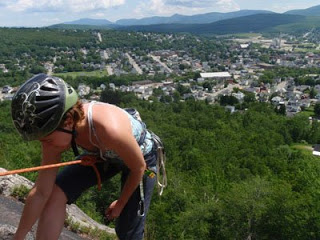
On the Rock

If people in Berlin are looking for economic opportunities they should look to the west. Mount Forist, if it were an hour south, would be covered with rock climbing routes. Instead it has less than 10. Ed Webster’s guidebook to climbing in the White Mountains describes Mount Forist as covered in ash from the mill, leaving climbers’ hands black at the end of a route. But Paul Cormier, local new route developer, said any soot had long since washed off. What is left is clean, moderate slabs of granite.
North Conway has a long history of climbing on Cathedral and Whitehorse, the two granite cliffs just outside of town. People make a living as guides and working in outdoor shops. Embracing the outdoors has been good for Conway; it could be good for Berlin too.
The thing Conway lacks is beginner terrain. There are easy climbs, but because they were climbed early in climbing’s history they are not well protected. Climbs can be made safe or dangerous, but early climbers often felt it was necessary to prove how bold they were, putting little protection into easier climbs. This created easy climbs that require experienced climbers to ascend them.
Berlin is different. So few established routes means there is room for more. And the ethic has changed since 30 years ago. It is no longer frowned upon to make easy climbs safe. New route developers could put in the well protected moderate routes that appeal to the majority of rock climbers. North Conway lacks that terrain; Berlin has that opportunity.
Climbing isn’t big business, but every weekend dozens to hundreds of people flock to climbing areas in other parts of the state. They eat at restaurants, shop at stores and stay in hotels. They bring dollars to municipalities near climbing areas. Why not Berlin?

My wife and I had a great day on Mount Forist today. We didn’t see anyone else, we got a great view of the city, and the climbing was wonderful. She wants to go back to put in more routes. Anything we develop will be protected with moderate leaders in mind. This is the sort of energy the city should embrace, something it should harness, as part of the assortment of new economic drivers that will carry the city into the twenty-first century.

The Forefront

In some ways Berlin is leading the nation. I work for a newspaper that doesn’t exist in Berlin. Or anywhere for that matter. I am a backpack reporter, journalist 2.0.

The Berlin Reporter building is being turned into a restaurant by some hardworking people willing to take a chance investing in real estate in a city hopefully on the backside of a depression. I never worked in that building. Neither did my predecessor. I work from my car, from my cell phone, and from poached internet around the region.
When the city manager called me the other day he asked where I was. He assumed my 207 telephone number meant I was calling from Maine. And why shouldn’t he – no other local newspaper has an out of state number. But I don’t have an office, so my cell phone becomes my office.
Some days, when I’m trying to drum up stories, this arrangement is challenge. I often track back and forth from the community college campus to meetings and interviews because the college is the best place I can find to work that has Internet. No one minds if I hang out all day, making appointments and phone calls and writing stories.
I got a job in Berlin because the population of the city does not rely on the Internet sufficiently to close the newspapers. The Reporter and the daily paper both succeed while newspapers nationwide are folding. They aren’t really threatened by the Internet. Try to find a car on Craigslist in Berlin. They are there, but without the critical mass that makes Craigslist viable in other cities. Try for a Google News search to find out what’s going on in Berlin. There are stories, usually about the prison, but not the sort of coverage people expect and get in other places.
Berlin is disconnected. The distance between Berlin and Gorham is probably greater than the distance between Gorham and Concord. It is hard to imagine if you don’t spend a lot of time in the area, but if you ask the city council they know it. People forget about the city and have a hard time understanding its idiosyncrasies.

The people of Berlin are among the hardest workers I’ve ever met. They cling to their blue collar roots, which at times is a hindrance, but it is a city with a work ethic. Years of the promise of mill jobs trained people if they worked hard they would be successful. As industry has evaporated, however, this maxim no longer holds true. Industriousness is no longer enough, and the infrastructure isn’t there for other avenues to success.
Part of that missing infrastructure is high speed Internet. Berlin has the only public library I’ve been to in recent years without wireless Internet. There is also no Internet cafe in town. People don’t have the same connectivity as they do elsewhere, and that is a threat to their economy.
I used to live in Portland, Maine, where I met my wife and went to college. In the time I lived there I went from hating computers and connectivity to working and living through Apple products. Almost every building in the city has wireless Internet. It is easy to be a freelancer or employed at an online business. When my wife and I moved to the Conway area it was a shock how much different it was. Most of our friends are college educated, and most of them own computers. But many of them went to town to the library or the local cafe to do their web surfing. Sasha and I have uber-high speed wireless at our house and would be hard pressed to continue our professional lives without it. It was a transition to get used to people who worked in a different paradigm.
Then I got a job in Berlin. If the initial Conway shock was a tremor, Berlin was an the earthquake. There is no Internet cafe, no wireless at the library. The NHWorks office and the community college offer connectivity, but the community is not set up for the twenty-first century worker. The desire to draw those people to the community is there, but not the infrastructure.
A friend asked if Berlin could be an artists community in the same way Deer Isle is in Maine. I think it could be — it is beautiful, with inexpensive property for sale that could be easily renovated into studio space. These people don’t need much except inspiratirational surroundings and a quiet place to work. Berlin has a wealth of both. But they do need a way to get products to market; this is where Berlin is lacking.
Councilor Lafleur raised this point at the last city council meeting. He said the state needs to pave a highway to the city to increase its economic viability.
I disagree. That is twentieth century thinking, based on twentieth century technology. Relying on the internal combustion and cheap gasoline is not the way to ensure long-term economic success. Like building a biomass facility in the center of town, this is a solution for the last hundred years, and a mistake for the next hundred.
Instead the city should look to the Internet as its method of connection. There is no need to pave a highway to the downtown. In fact it would ruin many of the valuable assets the city has. Instead, the city should preserve its heritage, its buildings and its aesthetic. The twenty-first century highway is the information super-highway. This is where the city should put its energy and its lobbying efforts.
How do I know this will work? The Berlin Reporter already proved it does. I am an employee for a paper no longer in the community. I work twenty-first century style, commuting more miles over the Internet than I do in my car. The challenge is that Berlin is so poorly set up for this type of work. It is does not have the infrastructure to handle more workers like me. It needs to implement Internet 3.0 now to step into this century.

As it is, I am a backpack journalist working for print media. The only thing about this solution is it might put me out of a job.

Who will fix it?

Who’s responsibility is it to fix problems?
Throughout the journalism world, people are complaining about the demise of the status quo, looking to blame everything from corporate greed to Twitter.
Around Berlin people complain about the problems with the area.
Where is the SWOT analysis for both? Strengths, weaknesses, opportunities, threats. Everything is not gloom and doom in journalism, nor in Berlin. Let me point out some of the strengths:

Journalism

  • required for democracy
  • technology makes communication easier
  • technology is cheaper than ever
  • produces a valuable product
  • requires little more than a skilled practitioner to produce
  • has people who care about it immensely

Berlin

  • has hard working, resilient citizens
  • has a DOWNTOWN instead of urban sprawl
  • is located in a beautiful region with rivers, mountains
  • is actively thinking about the future
  • has low cost of living, low cost of property
  • has people who care about it immensely

At the city council meeting tonight councilors mentioned convincing people from Portland to travel to Berlin. The decor of Berlin could easily appeal to the Falmouth/South Portland crowd, if the riverside buildings were turned into upscale art galleries and restaurants and the detritus was removed. Is that were the city wants to go? Does it have the assets to move in that direction? That remains to be seen. Some people have said the city’s blue collar traditions might prove too much to overcome.
But pointing to problems doesn’t find solutions; pointing out possible solutions finds solutions. Who cares who is to blame, whether the problem is a lack of classified ads or a lack of jobs? The solution required is to find a solution.

Rain, More Rain…

I’m working on a piece about the effects of the miserable weather on the Gorham economy. People at every business I’ve stopped at have reported the rain has dampened more than just their spirits. One hotel said they are normally booked on weekends through the entire summer. Instead they still have vacancies. Coupled with the weak economy this makes for an extremely difficult economic situation for much of the area.
Berlin is talking about building a tourism based economy. But the one positive about the current state of Berlin’s economy is that it is so disconnected from much of the rest of the state and the country that it doesn’t feel the same economic pain as elsewhere. Many Berliners have told me the most recent recession hasn’t felt particularly difficult because Berlin has been down for so long. In fact some Berliners have expressed optimism, saying the city is moving upwards, in contrast to the rest of the nation.
The eight miles between Berlin and Gorham often seem like more than eight miles. As the rain pours down on Coös county, for the first time in a while Berlin is on the winning end of that arrangement.