
 Water. In Fryeburg, Maine, it’s a big deal: 603,000 gallons a day, a multinational company, a legal battle, a state Supreme Court ruling. Water is a very big deal.
I remember when the Fryeburg Water Co. agreement with Nestle/Poland Spring first made headlines. It was the first time I’d seen liberals act like scared conservatives.
As a reporter you get used to hearing Republican fears — who is going to take their guns, their jobs, their money. It’s part of the modern conservative message: We have something to lose. We need to protect it.
Among liberals, however, the same fear-based rhetoric doesn’t sell. Issues like abortion and gay rights are pitched without resorting to demagoguery. Government, for Democrats, isn’t something to cower from; it’s something that can be controlled.
Republicans, meanwhile, want to starve the beast, kill it if they can.
But I remember that first meeting after the Nestle deal, the activist stances, the sharp words of trepidation that spilled out. I remember the petition campaigns, the heated elections of the Fryeburg Water District, neighbors shouting at neighbors, outside entities called in for logistical and activist support. Replace the word “government” with “corporation” and suddenly liberals become as fearful as conservatives.
But fear provokes knee-jerk reactions, and knee-jerk overreactions, regardless of party. Republicans fear for their guns to the point that they stymie common-sense gun regulations aimed at reducing school shootings and other tragedies. It’s foolish, but it’s impossible to reason with fear.
The same irrationality has been on display locally. But this time it’s a different crowd, a liberal crowd, raising the alarm: Corporations are evil! Our water is not for sale!
But corporations, just like governments, are not evil. These are not autonomous entities, Frankensteinian monsters wielding supreme power. They are run by people. They are governed by laws. They can be tamed.
But not through fear. The fear response Fryeburg Water activists employed was akin to blindfolded swings at a pinata — a lot of fury, but little meaningful contact. Water activists threw everything they had at the Nestle deal, took it to the highest court in Maine, but it is moving forward nonetheless. The fearful blows failed to land.
And why should they? The deal is legal, fitting neatly within the framework set up by the state of Maine. There was an administrative review, then a legal review. Beyond vocal objections, there was nothing to derail the project.
But here’s the thing: the Fryeburg Water activists had a point, and it was a good one. There are tremendous questions about resource extraction. It’s conversation not limited to water: When a resource buried beneath the earth is turned into a salable commodity, who should benefit? Whether water, oil or ore, what is owned by the individual, what is owned collectively, and what is free for the taking? Who owns what? What is the citizenry entitled to when extraction occurs? Should anyone be able to bottle a resource, cart away all they can and pocket the income? Or is something owed for this action?
This is not a new question, but it was also not the one Fryeburg Water activists were asking. Like gun activists thwarting the latest background check legislation, they were shouting in an all-or-nothing fight to stop the deal. They were not calmly looking to put in reasonable safeguards. And in all the shouting, they yelled themselves hoarse.
They had a point; they just failed to aim where it matters.
And where does it matter? In the Legislature, not the courts.
Water is a precious resource. It is a Maine resource, a Mainer’s resource, one currently open to extraction. To change that will require changing the law, which requires working within the bogeyman entity liberals are comfortable with: government.
Activists need to put down the picket signs and trade them for cell phones. They need to push lawmakers to create of a resource fund built on extraction revenues, something similar to Alaska’s Permanent Fund, which is funded through oil sales.
A small tax on water extraction — a half-cent per gallon, or even a quarter-cent — accrues quickly at 603,000 gallons a day. And it would serve as a bulwark against the risk that large scale extraction might someday deplete Fryeburg’s aquifer.
That is the middle road, threading the needle between government and corporations. And it works: In Alaska every resident gets a check, a payout every year, funded by the extraction industry. In 2015, that check was for $2,072 for every resident. The payout is a dividend — the fund itself has grown to more than $53 billion since it launched in 1977.
That money came from oil, not water, and required a change in the state constitution. But extraction is extraction, and bottled water sells at prices similar to gasoline.
Maine doesn’t have oil. Maine has water. It’s a resource, understandably, in which Mainers have a tremendous stake. Currently, the legal and legislative recognition of that stake is minimal, and nothing in the past few years has been done to change that. Activists opposed to Nestle went to battle with empty hands. Instead of looking to arm themselves, they wandered into the fields to get slaughtered. The Maine Supreme Court decision dispatched the last of their hopes.
But Mainers have power. It sits in the tremendous value of bottled water. Residents sit on a commodity, a valuable one. Shouting in the face of its being packaged into profits isn’t going to change things, but taxes do change things. It would be the middle way, accepting that businesses have a right to do business rather than an all out victory against an “evil” corporation. But it would create real value for Mainers rather than just noise.
And should the battle rise again, it would give activists an actual weapon. “The power to tax,” after all, “involves the power to destroy,” U.S. Supreme Court Chief Justice John Marshall said nearly 200 years ago.
This column was featured in the Conway Daily Sun newspaper.
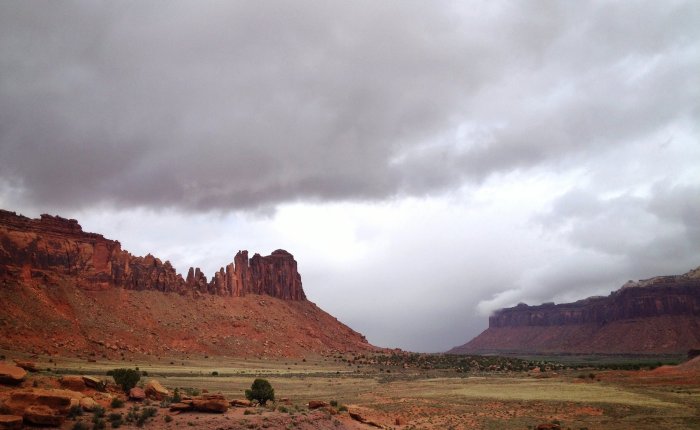
 I stood by the side of U.S. 191 waving my arms. Another car slid past. Then another. And another.
 From there I drove on to Wilmington, North Carolina, for a weekend of freediving, descending like a SCUBA diver but without a tank, holding my breath as the light faded through the meters of oceanwater. Stealth-camping in my Element, eating meals out of Wholefoods, it felt like any climbing weekend, except that the worst advice you can give is “BREATHE!”
 “This route is five stars,” my friend told me again and again. He was right. Beautiful sandstone, and to ourselves. We put up a new 5.12 with a fun bouldery crux near the ground and bolt after bolt of devious climbing above, 16 bolts of perfection. The Southeast is still full of hidden gems.
 That’s how I landed on the side of the U.S. 191 waving in vain at passing cars.
 ErikEisele.com