Pins, Stein Pulls and Scottish Conditions

Ryan Stefiuk high on SKYWALKER.

Yesterday, a month and two days after I got out for my first day of ice climbing this season, I went out for a second day. This time instead of heading over to Cannon for my yearly stab at getting the first seasonal ascent of the Black Dike, I was after an actual first ascent.

Just to the right of Pinnacle Gully in Huntington Ravine is a massive buttress of rock. It separates Pinnacle from Central Gully, and it is therefore known as the Central Buttress. It has a handful of rock lines up it, including two that are doable in winter — Mechanic’s Route and Cloudwalker. Last year, however, I saw another line I was psyched to try, and yesterday I lured two of my favorite climbing partners, Ryan Stefiuk and Michael Wejchert, out to try it.

The line basically starts right at the base of Pinnacle Gully, but instead of heading up the gully you march straight up the steepest line Central Buttress offers. Much of it is slabby and poorly protected, and often there is just a veneer of ice and snow. It is a mixed route similar to those rime-ice covered rock routes they are famous for climbing in Scotland — desperate and possibly dangerous but more fun than it is risky.

The first pitch has a section that is vertical with a little roof in the middle. It has a three-inch crack in the back, and when you’re on it everything feels overhung. I’d been up to look at it last year around this time twice, and I’d been shut down both times. This time, I determined, was going to be different.
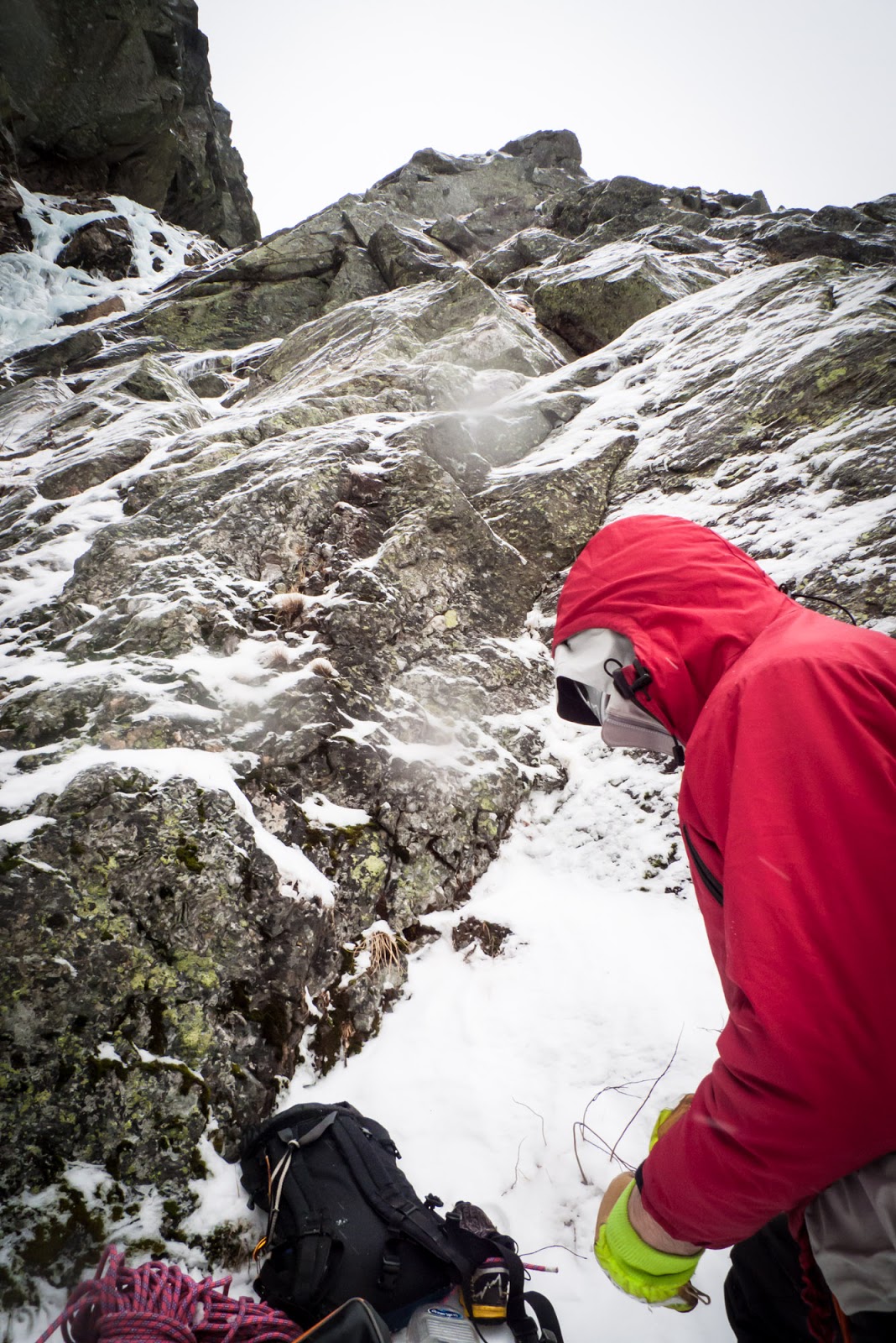
Michael Wejchert at the base of
SKYWALKER preparing to launch.

Michael, Ryan and I got to the base amid stiff winds, rain, sleet and snow — again, ideal Scottish conditions. It was a Saturday, but there was no one on Pinnacle Gully. We smiled at each other, joked, and then started to get dressed for a trip to the moon.

A friend of mine described winter climbing that way: a trip to outer space. He’s a guide, and he heard another guide describe guides as astronauts. “You’re going to the moon out there,” the guide said. Yesterday I couldn’t agree more.

I launched up the first section of iced slab with no pro, but the ice was thick enough I didn’t care. I got one screw about 20 feet before the crack, and then I found myself staring up at it.

I placed a hex in the bottom and started jamming with a gloved hand. Pretty soon I was 10 feet up, my hands buried in the crack searching for feet. I kept finding gear, and even though the climbing was desperate I couldn’t think of an excuse to stop. A stein pull led to a turf shot, which led to a sideways hook which led to a flake. I got a cam and then pounded in a small pin; I jacked my feet up and kept going.

It just all seemed to work. I knew the hooks would appear, and they did. I knew the gear would hold if I had to trust it, and it did. I launched into outer space, and I found I could breathe.

At the top of pitch one.

Ryan and Michael followed, making their way up to the first belay. By now there was a party starting up Pinnacle, but no one was following us. Michael took the next pitch, launching off onto snow-covered slab without a piece of protection in sight.

The snow and ice, however, just seemed to be working in our favor. The turf sticks all held, and every once in a while a shallow crack showed up. Michael only got partially-driven pitons, but they were enough to keep him going. He picked his way up the slab, into a groove, onto a shelf, around the ridge and into some ice, eventually landing at a good belay stance.
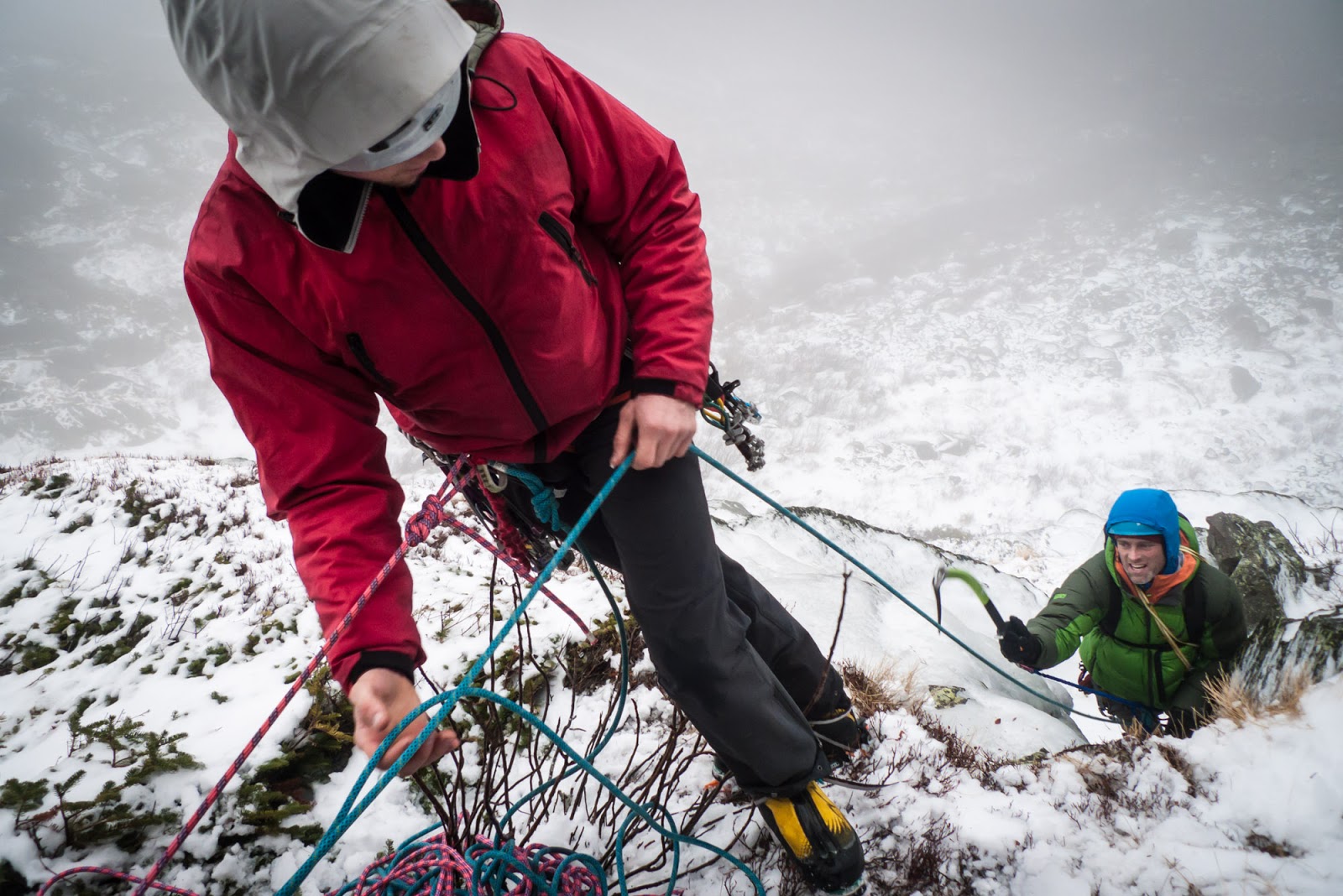
The top of pitch two.

Ryan was then up for the final pitch, which attacked a gendarme that looked like it might put up a fight. He pounded in a crappy pin right off the belay and then just started paddling uphill, never slowing down. The terrain kept opening up for him, swallowing his picks and his gear, allowing him to meander up what had minutes before looked unsurmountable.
Michael and I quickly followed. The temperatures were now warm enough that we could hear ice falling. Every one of our turf shots and ice sticks held true, however, and we scampered up in Ryan’s tracks.

We found two old pins on the upper pitches, so we don’t believe we climbed an entirely new route, but the initial pitch, which we were guessing was M6 or M6+, didn’t have any scratches. We are pretty certain that is new terrain.

Either way, however, it was new to us, and it was good enough we think it should have a name. We dubbed it SKYWALKER because of its proximity to Cloudwalker.

And because every moon mission needs an appropriate name. And astronauts.
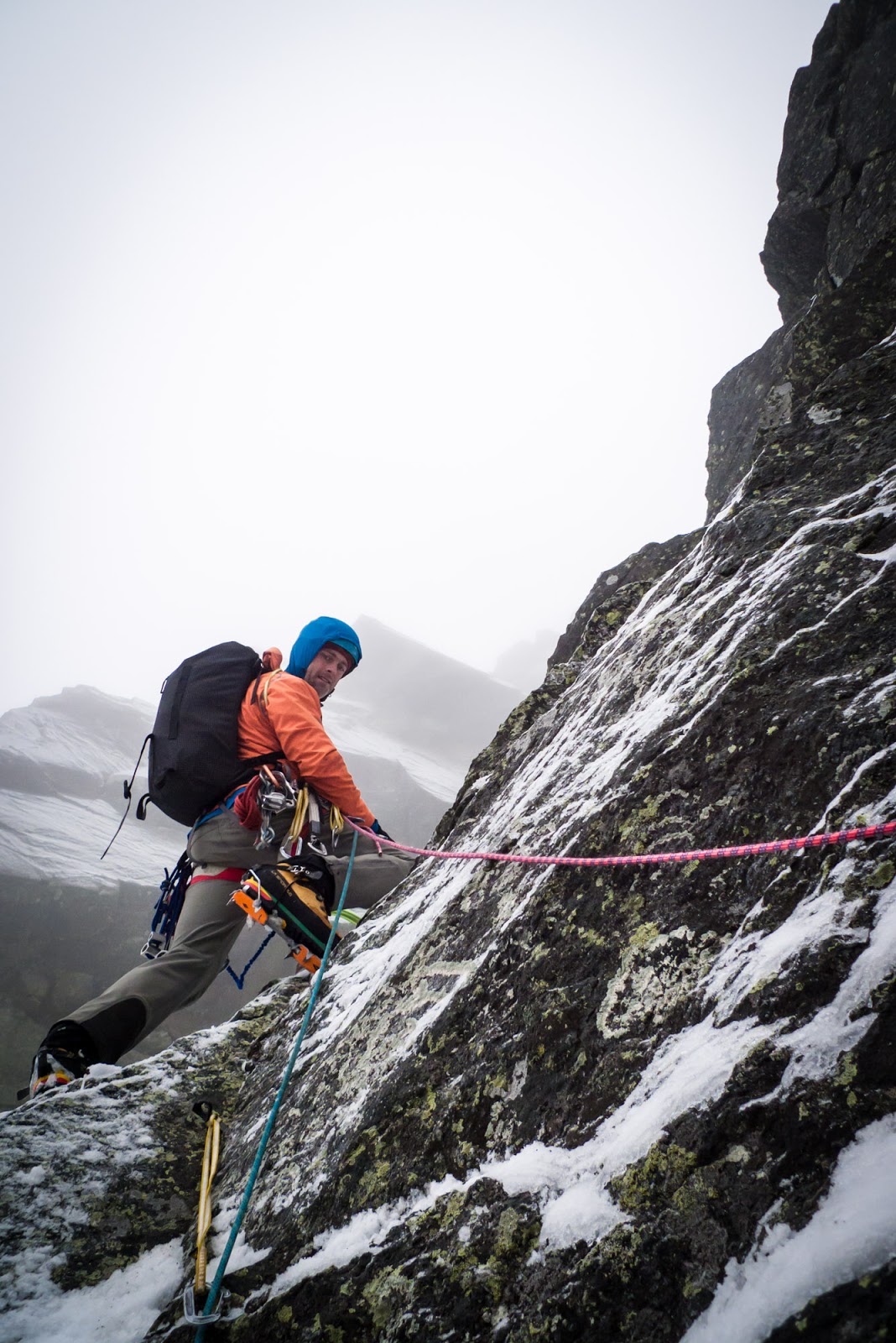
Ryan on pitch three.

Truth in Politics

It isn’t often that small papers have the time or the resources to really catch national politicians in lies, half-truths or misrepresentations. Last week, however, several things landed in my lap that were just too obvious to ignore. I was able to pull them together into a story that I hope gets across the problems with today’s political system. Either way, it was fun to take both parties to task for their indiscretions. It’s not every day a small paper gets to do it.

More Globe

I got a PDF copy of the Globe piece that ran last weekend. The photos looked good, the story looked good, and best of all I had a great time doing it. Looking forward to pitching a few more pieces their way.

Best of all, according to the Audit Bureau of Circulations, more than 365,000 people see the Sunday globe. That’s not a bad readership.

Diving In

Sometimes you get started on stories so big you just can’t get them rolling.

I started on one of those yesterday. I have been hearing for more than a year that some moderate Republicans are concerned the actions of more ideological members of their party could affect them come November. Then yesterday I got an email invitation to a movie that calls into question President Obama’s paternity. The email came because I am on the mailing list of the Mount Washington Valley Republicans. I got to wondering what local Republicans in positions of authority thought of this type of production, if it represented them and their party, so I started making calls.

From there things got interesting quick. The Republicans I talked to said they would rather argue policy than paternity, and they did not plan to see the film. They defended, however, people’s right to see the film.

That wasn’t really my question, but that seemed to get lost in the mix. I was more interested if any of them thought it was worth objecting to a film alleging the president is lying about who his father is. My question got a luke-warm reception.

I basically wanted to know if local Republicans consider their “big tent” approach to the party to include people making outlandish claims, such as those made by “birthers.” A Republican state house rep from Jackson championed that issue this year, and I wondered if it a.) concerned more mainstream Republicans or b.) provoked any rebuke from the party. The Republicans I talked to did not indicate they saw any real issue with it.

The thing that got me thinking about this episode from the 2008 campaign:

In this clip Sen. John McCain shows real character, standing up against inaccurate portrayals of then Sen. Obama despite possible political consequences. I wondered if any local Republicans showed similar character, whether in the face of the “birther” advocates or when it’s a discussion of the president’s paternity.

The responses I got indicated local politicians were not willing to stick their necks out particularly far to contest this rhetoric. The people I spoke to preferred policy discussions, but they weren’t about to push back on this sort of thing.

That made me wonder where they would draw the line. Was there any issue that deserved repudiation? I decided to press a little further, to ask about whether the Republican “big tent” was big enough to embrace racism. Everyone I asked that of told me no.

That begged the question, however, of how a local Republican in a leadership position was able to retain that leadership position after his use of racial epithets became public. (The Sun covered it, but the online archive of the story was eliminated when we changed computer systems.) One person told me they did not have an answer. Another told me the use of racial slurs in private did not rise to the level where the person should be rebuked. Another asked me if I thought the man was a racist just because he used the N-word. I was asked if that person be censored, to which I responded no, but shouldn’t at least some local Republicans have suggested such comments weren’t befitting someone in a leadership position? Again, my comments didn’t get much traction.

By the end of all this my head hurt. I was caught in a circular argument I couldn’t get straight. Local Republicans said they didn’t think racism fit in their “big tent,” but when examples of inappropriate use of racial slurs by a party official hit the newspaper no one made a sound. I shouldn’t connect the actions of one person to the whole of the Republican Party, I was told. But I have a hard time understanding why not one local Republican exhibited the character of Sen. McCain, not one Republican thought it was worth it to stand up and say, “I disagree with the president on policy, but there is no need to stoop to the language of racism to make our point.”

I had hoped to go see the movie about Obama’s paternity so I could tie this all into a story, but deadlines caught up with me this afternoon. My morning spent discussing ideological issues forced me to race the clock at deadline, so I didn’t make it. I didn’t realize I was getting into this morass when I made the first phone call. Now that I’m partway in I feel an obligation to keep working my way through it. Sometimes you dive in at the shallow end of the pool. Sometimes you don’t know how far down the deep end goes.

Update: I found this Economist article, which in some ways connects. I thought it was interesting considering the topic.

138 Votes

Sometimes it’s clear your work makes a difference.

This week it wasn’t my work, it was the work of my colleague Daymond Steer, that likely unseated the incumbent sheriff. Last night was the primary. The sheriff, who had served two terms, was facing a challenge from a man who had run for the office and lost several times before. This time, however, the newspaper took the time to dig into several stories that my have cost the sheriff his office.

First was a story about a lieutenant who quit after an incident where the sheriff didn’t detain someone U.S. Marshalls wanted to arrest. There are questions about what exactly happened and how it all played out, but the stories didn’t look very good for the sheriff. Then there was a story about how a plaintiff in a civil case was asking a judge to find the sheriff in contempt of court. Again, it didn’t look good for the sheriff. Then there were the opinions of the various police chiefs in the area — not one supported the incumbent. Working with him was described as “a nightmare.” All of this made it into the paper, much of it on the front page, in the weeks leading up to the election.

And then the sheriff lost the primary by 138 votes. That is with thousands of people voting. We worked hard to get accurate stories out to the public before voting day, and it looks like that coverage may have affected people’s choices at the polls. We didn’t uncover any blatant corruption, but clearly people had questions about the sheriff’s behavior. It was clear in the numbers that readers in our coverage area were less inclined to support him (although that may not be a causal relationship — his challenger is a local). I have to image those stories made a difference, and when the margin is 138 votes it doesn’t take much.

New Tests Every Day

Yesterday I covered a shooting, today I served as the complaint department. There is no such thing as a dull day at a newspaper.

A man called the managing editor today outraged about what a columnist said about him, demanding an apology from the paper. The man insulted the editor, and the editor essentially told him goodbye.

The man was a source for one of my stories this week, a story about water in Fryeburg, which, because of Nestle and the bottled water industry, is always a contentious subject. The man called me later in the afternoon repeating his demand that the paper apologize to him.

It’s interesting to be in this new position, because usually I save my aggressive demeanor for politicians in the midst of their political dance. As the news editor, however, there seem to be more and more situations where being resolute is crucial. A paper needs to have a spine, and that often falls on the editors (although our publisher has no problem ruffling feathers).

I told the man I appreciate where he was coming from, but if he had a complaint he could send a letter. The paper would not be issuing any apology. If he had a problem with the columnist’s piece her email was at the bottom of the column. Columns, I said, include opinions, and they are often driven by the news of the day. He was an elected official (to the water district, granted, but in Fryeburg water is a hot topic), and therefore it was not unreasonable for a columnist to be critical. Also, I said, it would behoove him to treat the managing editor with more respect. He did not write the article.

We have had some great reporting lately on several contentious issues, from the Bartlett School District to the Carroll County Sheriff’s Office to Fryeburg and water. Several of these have caused blowback, but it is the best kind. It is the kind where we are challenging public officials, holding them accountable for their statements and verifying that what they say is accurate. Sometimes that takes someone willing to look someone in the face and say, “I hear you, but what we wrote was fair. If you’d like to be interviewed for a followup story that would be reasonable.” That’s what I’m doing a lot of these days. What I’ve taken to telling people is, look, the truth doesn’t come out in one day. We find something out, and that leads to something else, which leads to something else. In the end what we are striving to do is get the facts out there, and sometimes that takes two stories. Or five. Or 15.