From the Backseat: Catfish 101

ssI got the weirdest note the other day. It was one of those Facebook message requests that comes from someone you aren’t friends with. Her name was Elizabeth.

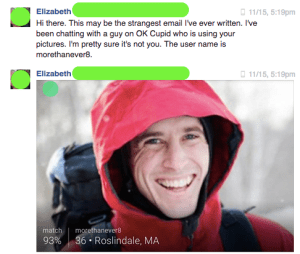
“Hi there,” Elizabeth said. “This may be the strangest email I’ve ever written. I’ve been chatting with a guy on OKCupid who is using your pictures. I’m pretty sure it’s not you. The username is morethanever8.”

Next was a screenshot: a photo of me from a few years ago, taken in New Hampshire by my friend Brian when we were ice climbing. I’m wearing a red jacket, the hood is up, I’m smiling and looking right at the camera. It’s one of my favorite pictures.

But apparently, it isn’t me — across the bottom, text read “morethanever8.” My OKCupid alter ego is apparently 36 and lives in Roslindale, Mass. And his match percentage with Elizabeth was a solid 93 percent.

“If this is the guy I’ve been chatting with, why don’t you add up?” Elizabeth wrote.

I stared at my computer screen. Identity theft is not usually how I begin my mornings. I clicked refresh to see if perhaps I had misinterpreted the situation. But no, my picture was being used to lure unsuspecting women. Unbeknownst to me I was part of a catfishing expedition.

But Elizabeth was smart. She’d done some Googling. As a climber and writer, I’m pretty easy to find online. And after some reading and a spot of quick mental math, she went on Facebook. She found me and sent me a note. Catfished she wouldn’t be.

But she and morethanever8 had chatted it up a bit, and he’d given her his phone number. She included it in the note. Well played, Liz.

So I called.

It was my journalism background that made me do it. I had his number, and a good reporter does not shy away from the hard questions. As the phone rang, I felt the familiar tension in my chest of an impending argument, a feeling that marks the lead up to any contentious interview. It’s trepidation mixed with excitement, fight-or-flight by phone. Stories like these are always an adrenaline rush, and this one even more so. This time it was personal.

But morethanever8 didn’t pick up. After a handful of rings, he sent me to voicemail. His alter-ego, and yet he denied me. Who would date such a jerk? I left a message:

“Hi. I’m Erik. This is kind of awkward, but I got a note saying you’re using my picture on your online dating profile. Um, could you not? I mean, I’d kind of appreciate it if you took it down, thanks. If you want to talk about this, you have my number. Bye.”

As so often happens in online dating, I’m still waiting for him to respond. But a few hours later Elizabeth messaged to say morethanever8 had removed my photos. It was only in writing this column that I noticed her note said “pictures,” not just the singular “picture.” Eww.

I’ve told this story a handful of times now, and each telling gets a laugh. But it also raises questions. Several people have suggested Elizabeth is some sort of online dating ninja, that she couldn’t have found me based on just the pictures and maybe concocted the whole story as a ploy to get my phone number. Maybe the number I dialed was hers, people suggest.

But I don’t buy that. As a reporter I regularly find people on scant evidence. I believe Elizabeth to be my Hillary Clinton, not my Donald Trump; my pantsuited white knight rather than my con artist.

But morethanever8 I’m still confused by. Who is he? What was he thinking? Did he expect to pull off being me once it grew time for an in-person meeting? Or was this some other type of scam, one where the prize was something other than carnal? Did he know what he was doing? Would this ploy allow him to evade a meeting and thus detection?

I clearly don’t understand these things. Like some long-retired phone company employee who borrows an iPhone to make a quick call, despite my inside role I still have no idea how catfishing works. I know only that I got nothing out of it but this column.

I do, however, still have morethanever8’s phone number. Maybe I’ll try giving him another call today.


This column appeared in the Portland Phoenix.

Control

Someday I’ll write an honest story. An honest sentence. An honest word. Someday.

Sometimes driving I close my eyes. Speeding along the highway I pinch them shut and see how high I can count: one Mississippi… two Mississippi… three Mississippi… Sometimes I get to five. I’m always aiming for 10, but my fear invariably overwhelms me and my eyes snap open before I reach it. Maybe my car is a little out of its lane, but usually no. Usually I would have been safe for a few seconds more. Usually I would have lived.

I close my eyes and try again.

Reckless. Stupid. Crazy. I know. But I need it. I need it to remind myself. Because I want something different. I want control. I want to see the world, to know what’s coming, to understand it and be able to maneuver around the dangerous parts. I want to know everything speeding at me, to avoid the crash, to never be surprised, overwhelmed, heartbroken. I want my open eyes to be enough to live a life without hurt.

But it’s not. Open or closed eyes, I am going die. As fast as I may drive, it drives faster. It is coming for me, and that truth is one I’m scared of. I do my best not to be, but how do you hold out a hurricane? It is coming, and what it means I don’t know. I only know it comes bent on consumption.

So sometimes I close my eyes. Not to forget or to hide, but to make ready. Does it seem crazy, my closing? It is foolish and reckless with no possible gain. I know. I can agree with that. But it also may be my first honest word.

I love life. That is my honest sentence. I love the look and feel and sway of it, the way it kisses me awake in the mornings and slams me down some evenings. I love how the day brightens for me, how words like “precipice” roll off my tongue. There is so much amazingness, and its beauty overwhelms me.

But life is not within my control. It spins around me, a cyclone I somehow exist within. I am both part of it and at the same time separate, an inhabitant of it more than its owner. Life will never be mine to keep.

And neither is yours. Neither is anyone’s. With our eyes open we may become convinced otherwise, we may think we can wrestle some version of control, but that is the real crazy. We can’t steer. We can’t. Crazy thinking is we are in control. We can only watch the hurricane, our eyes our front porch.

I am crazy, and I am not crazy. I am only saying out loud what life whispers every day. Life is the crazy one. I am not its outlier. I am in its heart. As are all of us. This madness is all of us. You think yourself safe? Life will kill us all. Do your best to control what you will, but eventually you will see too. We will all see. We have no control.

It is terrifying, overwhelming, and freeing. There is an openness in closing our eyes and letting go of control. It carries a freedom: The freedom to be, the freedom to live, the freedom to love openly, the freedom to exist with our whole hearts. I close my eyes to embrace that vision. I close my eyes to remind myself, to see beauty, to let go of any demands and instead catch a glimpse of what surrounds me. Flying along through the madness I can see how little I need for my heart to feel joy. Suddenly perfection is everywhere, in you and in me. It needs no push, no refinement, no outside markers. It fills the room, spills into the hallway. It is overwhelming. It becomes the hurricane.

That is what I want. I do not want to control. I want to accept. I want to live. I want to walk alongside. I want to love, and to be loved, without conformity or comfort. I want to live in the wind.

I love you, and in loving you I want to control you. My eyes are open, and I want to see you, to know you, to know you will accept me and never be mad at me and never leave me. Most importantly that. I want to be loved like you want to be loved and I want to be free from hurt like you want to be free from hurt. I want. I want. I want.

But at night on the road I close my eyes. And I remember.

I do not want to control you. I only want to see you, to bear witness to who you are, to feel the pulse of your heart and the rise of your breath. To learn about you without the push or pull of my own interest. I want you to love me and only me and never anything else, but more importantly I want to not care about any of that. I want to watch you unfold, to forget your past and the future and see who you are, to be let into the guesthouse of your heart, to stand at the foot of your spinning life, to lie next to you in the whirlwind of time. No steering. No control.

For that version of love I need to be reckless. I need to fly down dark alleys and make it to 10, to 100, to 1,000. I need to let the winds come full force as I stand naked in the rain, feel the waves and blown sand rake my body. I need to let life overwhelm me and drown in its blackness. I need to let it all come, even hurt and death, and lie in peace. Let the silence slide over me. I need to lose. I need to forget. I need to fall.

And it is so hard for me. It scares me so much. I want control. I want to never hurt, never be alone, never feel anguish or loss again.

So I close my eyes. I do it to let go of fear. I do it to recover myself, to reignite my spirit, to remind me that hurt and loneliness and anguish are just more sand, more waves. If I love you out of fear I love no part of you, not even the idea of you. I love the idea that someone might see me, accept me, nothing more. You are an apparition, a placeholder. That is the place where the crazy lives.

So I close my eyes. I let go, and in letting go I learn to love fully. I learn to seek and explore without fear, to question what makes your heart shine rather than question your motives for shining. There is a recklessness to it, a foolishness. Discovering your heart and yet ignoring the urge to stay safe, rejecting the urge to control, is its own version of night-driving. It is another risk, one without gain. It is crazy, lost, bleeding. We all want to be loved. And we want that love to be steadfast, enduring.

Maybe letting go is the key. Maybe rejecting control allows two people to grow in time: If I accept you then I can watch you shift and change without it threatening me. If you can watch me shift and change too without it threatening you maybe we have a chance.

I cannot control these shifts; not in you, not even within myself. And with time yours may diverge from mine. I want to celebrate them as I celebrate you, because in truth they are you. Your growth is you. Your movement and momentary expression in the world is you. That spinning movement of self is the miracle we call life. Your body is just a vehicle, one you both live in and never own. I do not wish to own it, or you, only to honor.

But that is not our pattern. We so want others to “be themselves,” like they are some fixed thing. But they are not. You are not. You are more complex than that. How much have you changed in the last year? The last five? What are you if not those shifts?

To love you I must let you go. I must cede control. I must strive to see the person you are, not who you were or who I would like you to be. I must find your heart, your never settled, perfect, dancing heart. And if you are you you cannot be who I want you to be. Unless I only want you to be you, who you are. I cannot want to change that, even if loving you as you are means together we veer into oncoming traffic. So I forfeit control. I close my eyes. I let go of the wheel.

And perhaps I find a perfect story.

CDS Column: Conway Daily Firestarter

Do you know of Friendsgiving? It comes once a year, and it’s a holiday that serves as refuge from family holiday drama. It’s traditional observance is a day or two after Thanksgiving, and it looks a lot like Thanksgiving only calmer.

Mine came on Friday this year. I went to the house of close friends and gorged myself on turkey pot pie, turkey soup, cooked carrots, brussel sprouts and a host of other leftovers that littered the kitchen. Some of us finished a Halloween puzzle while others watched Roger Moore race across the TV, jumping speedboats and judo chopping as James Bond. The kids ran around wild-eyed, and after dinner a handful of us pulled out musical instruments for a jam session. It was what the holidays are supposed to be, with more relaxed laughter than Thanksgiving, among chosen-family not just blood relatives.

About halfway through dinner the host’s sister flashed me a smile. “I hated your column the other day,” she said as she spooned soup into a bowl. “You totally missed the point. It was bad enough that I got mad at you, and I haven’t read any of your stuff since.”

I laughed. “At least you read it,” I said. “Which one was it?”

“I don’t remember,” she replied. “But I hated it. I stopped reading after that. At this point it’s been a little while.”

We eventually sorted out the offending piece was one I wrote prior to the election. It was about locker room talk and how male culture looks at sex. I’d missed an opportunity to talk about power dynamics and the nature of sexual assault, she said. I’d totally blown it. She was calm and articulate as she explained, and all her points were valid.

“I can see that,” I said, nodding as she talked. “Yeah.”

That is one of my favorite parts about writing for a small town paper — walking into International Mountain Equipment or Front Side Grind or the North Conway post office or any of my other usual stops and having people pull me aside.

“I read your piece in the paper the other day,” is how the conversation usually starts, and from that launch point it can go anywhere. Some people love it: “Best thing you’ve written!” they’ll say. Others hate it: “Why did you even write about that?” Some point out points I didn’t have space for. Others point out points I’d never thought of. All of it is lively discussion, usually with a handshake to start and a laugh or two over the course of conversation regardless of its beginning.

There is something about writing for a small newspaper in a small town that keeps you honest. There is no avoiding your neighbors, and your neighbors are your readers. If I write something a reader doesn’t like that reader may very well see me in Hannaford, or Cranmore, or out to dinner. There is no anonymity.

I remember being a kid and going to the grocery store with my dad. We lived in a small town on the Maine coast, and he always used shopping visits as a time to catch up with people. I would stand there bored as he blabbed on, me nagging and pulling at his hand.

Now when I walk through the grocery store I’m twice the offender my dad was: I slowly make my way between handshakes and cart conversations, maybe chatting with friends but more likely getting “feedback” on some piece I’ve written.

And I love it. It’s the point of the writing, the stories, of having something to say. I have reporter friends who have realized they have to avoid the grocery store all together if they ever want to make it home for dinner.

At the outset of any conversation I am almost always driving blind. A reader has something to say, but I don’t know what piece of writing they’re talking about. After a while they all blend together, and sometimes I forget what I just wrote, much less what ran two months ago. But usually my interlocutor can navigate me to the point I was making. Other times I just do my best to carry my side of the conversation despite being totally lost. Tricky business, but oh well.

Other times the notes arrive as emails rather than in person. The feeling is still the same: “You read it? Thank you, thank you, thank you!” I’m not sure why I’m always surprised, but I am. I’m also grateful.

One occasional commenter is another Sun columnist, and no matter what his emails say I take it as the highest compliment. He could have read and then stuffed the Sun in his wood stove. So many of us do. But he didn’t. He thought it worth a word.

Again, honored.

THAT is part of what makes writing worthwhile. Writers write for readers as much as we write for ourselves. I write columns about politics, economics and social issues because I want our community (and our state, and our country) to be its best. They are not meant to chide or lambaste, but to elevate. Maybe my ideas aren’t always complete, and maybe sometimes my thinking is downright wrongheaded (as my Friendsgiving friend gently explained), but they are intended to be sparks, little flashes that light conversations. And hopefully those conversations continue at work, at the grocery store, around the holiday table. They get people talking about issues, sharing diverging viewpoints, debating, discussing. It becomes a conversation between neighbors, community members, people who don’t see eye-to-eye but otherwise believe the person they’re talking to is reasonable, smart, engaged.

People call us the Conway Daily Firestarter. They say it for all the wood stoves we fill. Yes, that may be true. But those aren’t our only sparks.

And again, as always, thank you for reading.


This column ran in today’s Conway Daily Sun.

Love and Thanks

messages-image1395101098I read a short story the other day, and in it the author did all the things I admire. Her writing was playful, light, a drift of thrushes flitting about a thicket. I was deeply taken with her.

My writing, by contrast, is more goose-like: heavy, waddling from here to there. Sometimes it flies, but it only takes flight through powerful strokes. And once airborne it soars; the light dance is not for me.

I wish it were. There is a pixie-ness in erratic movement, a detachment from worry and the future. My writing is too serious, too focused on getting a point across. Responsibility for understanding sits with me, the writer, rather than on you, the reader, and therefore every sentence is planned, deliberate.

But for a book on love that technique will never work. There words can’t fall like stones too heavy to lift again. I’d be lighting a tea candle with a flamethrower. Love deserves better treatment than that. It deserves starlings and pigeons, packs that move in unison though they have nowhere to go. That’s love. Or a version.

I know a girl who holds her heart like a grasshopper tucked in cupped hands and covered. She wants it to leap, but everywhere are frogs waiting so she keeps her hands closed.

Another woman’s beauty is her curse. She’s not sure if it’s her that men love or her container. They profess everything but whenever she speaks they go blank. Her words become an echo. Her physical beauty is only a reflection, that a woman so stunning will accept them is to say they are enough. It is the acceptance they care about. She is lost to them.

I married the same thing once, only it was smart that mattered rather than pretty. She was pretty, mind you, but it was the quick-talking brain I fell in love with. That is to say, if she was that smart and loved me then maybe I was that smart too. I couldn’t tell—I’d never been very good at looking at myself. But with her as my rearview I stared quite contentedly. It didn’t last long.

What is love? Is it a joke? A tease? Because it never seems to go as we’d like. I have an answer, one that leans on trademark and is likely deeply unsatisfying for many. But it was shown to me, so I must tell.

Love is the Force, the Matrix. It is everywhere. It binds the world together. It flows into people and pets and chairs. It moves inanimate objects and pulls apart windmills. It’s a fingerprint from god, and it’s on you.

I wish I could explain it more precisely, but there it is. Love is a hummingbird, not a goose. The goose we can predict. It takes to the sky in great heart-shaped flocks and soars south to north with seasonal efficiency. But love isn’t like that. Love is Canada, where the geese land, and the rain that slows their way. It is the hunter looking to fell them. It is the marshes where they take refuge. It is the bullet and the reed. It is all those things. But we keep looking for the goose alone.

If I love you I don’t care who you are. I look at you and I know. I look at you and see brilliance. I see you for who you are and love that thing. I love it unceasingly, without reciprocation. Love is in the viewing, the standing next to, the breathing in. It is in your scent, the brush of your eyelash, the movement of your throat as you swallow. I love madly because I must love. It has nothing to do with being loved back. Those two are not connected.

Love honors, but it does not keep. How hard to remember! But I do not honor your walk by demanding it parallel mine. I honor your walk by watching you take it, by being blown away by each stumbling step, by admiring your courage those times your heart calls you to walk alone and you heed it, cast me to dust. That tearing sound? It is me. Your walk may leave me bloody, but it amazes me just the same. Love cannot kill me because it is me. It never leaves. It flows in and out of things. Sometimes it flows into you and out of me. A river in springtime, sometimes swelled with snowmelt and rain, a river in fall, sometimes lean and rocky. All versions of love are as equal.

So where does my love live? Where can it reside if not in you, with you? Nowhere. Everywhere. In me. Because you are fleeting, and if I love you I want you to be. I want your transformation to end, for the you that is to be you always. But you are the hummingbird. Your dance I cannot understand. Your shimmer changes with every twitch. I can only watch. I can only follow you with my eyes, my hands, my body. You might linger for a time, but I can not pour myself into you. Such acts are temporary.

So where does my love live? It lives in me. It is me. It is my body and being. It is my every heartbeat and breath. That is where my love lives. I boil with it, and it overflows me. I see you and recognize another such creation, perfect and wild. But I cannot give you anything. I can only hold that love myself, let the wonder of you live in my eyes. I know that love boils in you too, that the grasshopper you carry is a feint, a distracting jellybean. Your love is not for you to give away; it radiates like a second sun. It gives no greater light for my proximity. Find a place to entrust your heart inside of you and let it power the shining. Your heart is everything—the goose and the hunter.

And what of the fear that they are here because of the container? I suffer that fear myself, but only when I am in search of a container too, when my motives are shallow too. My covered eyes allow the world to fool me. Because what is a container? If you love, you offer the world you. That is the gift. Your container is destined to die. I may love the look of you, but look with an eye for beauty and everyone is beautiful. Smart, funny, pretty, kind, everyone has pieces. The other day I drew a woman who had the most stunning lips. I wanted to kiss them, but that’s not what she was there for. All the beauty of the world sat right there beneath her nose: full, red, alive. The rest of her form, what does it matter? Where are your lips?

I can’t fully explain. Either you get this or you don’t. But if you don’t, please come back to me. Reread, looking for pigeons rather than eagles. Majesty cures for a while, but humility allows a glimpse of the world around us. I am not wise, I can barely explain. But the river in springtime flood can carry us away without explanation. Love is like that. Don’t worry about the words themselves. Trust the feeling. Wade in. Worry about nothing. Worry about not drowning. That would be scary.

From the Backseat: Hipster Hunting

Hipster hunting doesn’t mean what you think it means.

I’ve been doing it for about a year. And no, the quarry doesn’t wear flannel or a beard (although if it did, Portland would be rich game grounds). Hipster hunting is hunting as a return to the past, as a return to authenticity, an homage to killing. It’s hunting to personally experience what goes into every meal containing meat.

Because, let’s face it, killing is something we’ve forgotten how to do.

Not as a society — as a people we’re quite adept at killing chickens, cows, pigs, the planet, whatever — but as individuals we’re bad at it. It’s one of many things we’ve outsourced. When was the last time you wrung a bird’s neck? Or smashed a fish over the head with a wooden baton? Sounds brutal, right? A bit barbaric? But here’s the thing: Chicken is GOOD. Fish is GOOD. Who would want to live without fish tacos? Almost every time I order a meal out, I get chicken, fish, lamb, a burger, something made of flesh. So really each time I go out I’m killing a chicken, a sheep, a cow. I mean sure, I’m not the one chopping off its head — that work goes to someone else — but my hunger is the architect of death. I’m basically the chicken Gestapo.

Last night I ordered a burger with bacon on top — not just cow, but a pig on a cow. I killed them, both in one meal. Devastation.

Earlier in the day I grabbed a pair of Otto’s pizza slices, one with bacon, the other turkey. Two more beasts — BAM! — gone.

Some days my fork is set to full auto.

Now I want to be clear: I have no problem with meat. We’re built to eat it, and animals taste awesome. I want cows and chickens and pigs to live happy lives, but I don’t think it’s wrong to eat them.

But we have grown pretty far removed from our food. Some people plant gardens as a reminder of where their carrots come from, but I’ve never been good at half-measures: I signed up to take my proper place in the killing fields—I took a hunter safety course.

But like most half-baked hipster ideas, it’s just not that easy. I’ve been stumbling around the woods for weeks draped in blaze orange and dragging a 12-gauge, but I have yet to experience the primal mix of elation and guilt I imagine accompanies killing.

Hunting is HARD. It may seem like an unfair game — sweet woodland creatures up against a man with a loaded gun — but when the person hunting has no idea what he’s doing the woodland creatures do just fine. I’ve been out a dozen times, and I haven’t shot a thing. I haven’t even swung my gun to my shoulder. The only thing I’ve shot is a paper plate, and if it were moving I’d bet money I’d miss.

I’ve seen game in the woods, but they are a lot faster than I am, a lot stealthier and probably a lot smarter. My best look is their backsides before they disappear into the underbrush.

On a recent trip I got so lost I had to use a compass to find my way back to my car. I followed a course east to the river and then hopped boulders upstream until I came to a bridge. I was tired, thirsty and overheated by the time I got back to my car, and over my two-plus-hour adventure I saw one bird. I didn’t get more than a snap look at him. Trying to follow him I nearly fell in a river. If it weren’t for Hannaford’s rotisserie oven I’d be poultry-starved.

So hipster hunting is thus far not a resounding success. All my meat still comes ordered off a menu. I’ve found new respect for those who can actually go out and harvest something for the table, but my personal ethical escapade has been fruitless.

Killing. It’s grisly business to be sure, but so far my tally is zero. Maybe I’ll have better luck next week.

CDS Column: Lost Hiker

I don’t hike much anymore.

I used to. I used to hike all the time. Through high school it’s all I wanted to do. When I graduated I wasn’t ready for college, so instead I went hiking — first on a cross-country road trip to hike Colorado, the Grand Canyon and Jackson Hole, then on the Appalachian Trail. At 18, I walked from Georgia to Maine. It took four months and transformed me from relative backcountry novice to old hand. Night after night, firing up a tiny backpacking stove, filtering water, sleeping among the pines, hiking became my first full-time job.

From there I moved to mountains, to rock climbing, ice climbing, mountaineering and skiing, added tools to get me to the top, techniques to push adventures to new heights. “Hiking” became something I did to get to the fun part: the snow, the rock, the vertical parts where the rope came out. I hiked on 14ers in Colorado (the state’s highest peaks), volcanos in Washington and the knife-like ridges of the Tetons, to rock faces in the Shawangunks in New York and Yosemite Valley in California, but keep in mind none of it was hiking.

And over time it moved even further aside. It got renamed “the approach” as I traveled to South America, Europe and Africa for mountains, rock and ice climbs. “Hiking” meant carrying a rope, harness, helmet and all the climbing gear for the adventure ahead, and thus weighted it became more work than fun. The sport once again found itself on my periphery.

But recently I’ve found myself back in the woods. I find myself there with no summit in sight, tramping between trees and ducking under spruce bows, the trail unbeaten and unmarked. I’m out there wandering, splashing through creeks and past logs downed by beavers. It feels like a return, a recovery of my hiking spirit.

But it’s not. It’s from before my high school days, before hiking boots and Gore-Tex and double-walled tents. It’s from my very first explorations of the woods, back in late elementary and middle school when I would pull on duck boots, grab the dog and vanish into the trees out past the cemetery at the end of the street. There were trails, but they were serpentine and poorly marked. The spruce and pine hung close, and though it was only a few hundred acres hemmed in by road on one side and ocean on the other, it was enough to get lost in. There were rotting logs and moss-covered rocks to climb over, and a canopy so thick sunlight struggled to reach the forest floor. It was just woods, more rugged than any hiking trail. My Australian shepherd Cody and I would walk for hours, wandering deer-paths looking for stray antlers and animal signs, imagining ourselves intrepid explorers, Native Americans maybe.

But that’s where hiking began for me, those first forays into woods as pretend hunters and explorers. The nylon windshirts, LED headlamps and ultralight stoves came later, the slick well-marketed modern trappings that now adorn that early call.

My earliest role models weren’t looking to stand on top of things. “Because it’s there” is a modern concept. They were looking to survive, to find enough to eat or the safest/quickest route. “Adventure” was an accident borne of necessity. Hiking wasn’t the approach to those explorers, it was the pre-industrial equivalent to a trip to the grocery store. It wasn’t sport, it was just part of life.

What brought me back to my roots? To the root of my roots? My new hiking partner—not an Australian shepherd, but a 30-year-old Sears and Roebuck 12-gauge.

That’s right, hunting is my new hiking. With my dad’s old shotgun I wander, no vertical objective calling from the horizon. I find myself stumbling through undergrowth, pushing aside tree branches, mucking across marshes and otherwise tramping, the original forest call. I’m not ticking off another peakbagging summit or trying to break my speed record up Washington; I’m just walking, wandering the woods, looking for antlers and animal sign.

And with the walking the wonder returned. The things I used to love about hiking — noticing the feathers scattered among the tree roots marking some kill, walking an old logging road in the cold morning air that eventually peters into nothing, tripping on the rusted hulk of an old peavey left by some long forgotten logger — now lives in blaze orange. It’s exploration with a walking stick of wood and steel.

And just like those early walks with Cody, when I go hunting I have no idea what I’m doing. I get lost. I get wet. I find myself tired and hungry and running low on water. I overdress or underdress, wear the wrong socks or wrong hat. It’s all those things I used to struggle through while hiking, but when there are summits involved I’ve long since learned my lessons. Not in hunting though. In hunting I’m still the utter beginner, more akin to that elementary school kid than ever.

As a result the animals of the forest are safe. I see game, but everything in the woods moves so much faster than me. I have yet to get my gun to my shoulder much less get a shot off before my quarry disappears. It’ll be a long time before I kill anything. When I see something I wind up chasing, but the animals know the hiding spots better than I do. So I search, walk in circles sometimes for hours.

It’s the most hiking I’ve done in years.


This column appeared in today’s Conway Daily Sun.

CDS: Heroin “Ground Zero”

CONWAY — By this point, we are used to hearing about an opiate crisis has reached pandemic proportions. More people dying from overdoses each year than car crashes. A cheaper, stronger heroin that is often mixed with powerful synthetics like fentanyl and destroying lives across the social spectrum.

And while it’s in every corner of the country, according to U.S. Drug Enforcement Administration Deputy Administrator Jack Riley, who spoke to WMUR last month, “the Northeast, in particular New Hampshire, is ground zero,” he said.

As if on cue, two days later, the New Hampshire branch of the U.S. Department of Justice announced indicting more than two dozen individuals, mostly from Massachusetts and Manchester, on heroin-trafficking charges.

Locally, news stories about heroin show up with regularity: a Conway man out on bail for one heroin complaint arrested a week later on a second; a Bartlett couple arrested with more than 5 grams of heroin and $4,000 cash; a selectman’s adult son charged with conspiracy to sell heroin; a pair arrested at the public library allegedly using heroin; a homeless man arrested for heroin possession with intent to distribute; a man arrested twice in two months on heroin-related charges. Police are doing what they can to combat addiction and trafficking, but the uptick continues.

But heroin is more than just a headline or a quick story. It is the everyday experience of many in the Mount Washington Valley, from police officers to doctors, EMTs to midwives.

“The question is how we deal with this problem,” Conway Police Lt. Chris Mattei said after a bust in March of 2015. “When we hinder the accessibility of one drug, addicts have proven that they will find another source to feed their addiction. The way to attack the drug issues long-term within a community is to help the addicts who utilize these illicit drugs.”

He is not the only local police official pushing for more prevention.

“We know we cannot arrest our way out of this,” Bartlett Police Chief Janet Hadley Champlin said last month. “As long as there is demand for drugs, there will be suppliers. For all of those in our community who are addicted to drugs, now is the time to get help.”

But there are few options for recovery. The state’s own report on New Hampshire’s substance use disorder treatment service capacity lists Carroll County as one of four regions without any residential programs, and according to addicted.org there is not a single long-term recovery program northeast of Lebanon and Tilton.

New Hampshire, meanwhile, ranks third in the nation for prescription rates of long-acting/extended-release opioids, according to a Federal Reserve Bank of Boston report released in September. Neighboring Coös County ranks as one of seven counties in New England with an overdose mortality rate of more than 20 per 100,000 deaths. And Carroll County is not far behind: one of the 20 New England counties with overdose mortality rate above 16 per 100,000.

Dr. Matt Dunn works nights in Memorial Hospital’s emergency department. He grew up in the valley, graduated from Kennett High in 1991, but he did his medical training in Albany, N.Y. He worked in a 400-bed hospital in Glen Falls, N.Y., before returning here almost three years ago. Dunn sees patients with opiate-related complaints “multiple times a week,” he said. “I see much more frequent issues with heroin here than I ever did in New York.”

The heroin-related complaints Dunn deals with fall into three categories: overdoses where the patient “is just about to die,” injection-related infections and people coming in asking for help.

These days, it is EMS personnel who do the heavy lifting in overdose cases. New protocols have enabled almost anyone to administer naloxone (Narcan), an opiate antidote, and “often by the time overdose patients get to me they’re awake and talking,” Dunn said. Many, he said, “get up and leave.”

Ambulance personnel see something else.

“The heroin snore,” Rick Murnik, director of the Bartlett/Jackson Ambulance Service, said referring the depressed breathing of overdose patients. “Once you see it, you’ll never forget what it looks like.”

An overdose leaves the patient taking only four or five breaths a minute — too few to keep them alive.

“Our first heroin overdose was five or six years ago,” Murnik said. “We didn’t know what it was.”

Now the service, which responds to only about 500 calls a year, sees several a month.

Conway Fire Chief Steve Solomon described what his EMTs see all too often: a patient reported to be unconscious, pale, breathing at less than half the normal rate, maybe lodged between the bed and a wall or sprawled in the bathroom.

“We’ll find well-meaning people have tried to revive them by pouring water on them,” he said. But water doesn’t work.

What does work is Narcan, which in Conway is usually given via IV and nasally in Bartlett.

“Within a minute or two, that person will wake up,” Solomon said, and sometimes they’ll be grateful that the EMTs that just saved their life. But some will be angry, upset that someone interrupted their high.

“We’re using Narcan to bring these people back from death,” Solomon said, and ambulance staff may end up getting yelled at.

In Conway, there may be no overdoses for a while, Solomon said, and then the next day there’s one at noontime, another in the evening, two more at night. His guess is overdoses surge when a new batch of drugs comes to town. “It’s not so much there are more people doing drugs,” he said. “It’s that the drugs have changed. The dose they give themselves to get high is now a lethal dose.”

One girl in her 20s “we’ve brought back from the dead three times,” Solomon said. “Most of our narcotic overdose patients we’ve seen before.”

But, says Shannon Monnat, an assistant professor at Pennsylvania State University and a fellow with the University of New Hampshire Carsey School of Public Policy, “we’re not going to Narcan our way out of this.” What her research has uncovered is that addiction takes root in rural communities and small cities left stagnant by structural economic change.

In the face of sustained economic hardship and uncertainty, “drugs and alcohol are a way to cope.”

“The problem is not a new problem,” she said. “The problem has been building for three decades.”

Access to Narcan and improved mental health services are “important first steps,” but “we need to get to the underlying cause. People without a college education need opportunities for a livable wage,” she said. “People need to feel their role in this country is important.”

In the valley, organizations are still figuring out how to serve a population with growing addictions.

Memorial Hospital, for instance, launched a prenatal program in March after more than a year of watching the number of heroin-addicted mothers-to-be skyrocket.

“We were seeing more and more moms coming in who were addicted,” said Dr. Marni Madnick, an OB/GYN at Memorial. “We felt we had to do something.”

Ten percent of pregnancies at Memorial involve opioid — primarily heroin — dependence. In 2014, that meant roughly 24 women.

Infants born to addicted moms require more treatment than traditional moms, which can mean days in an acute care setting.

But concentrated support upfront can reduce the services addicted babies need. So Memorial’s midwives, OB/GYNs and birthing center staff drew up plans for the New Life prenatal program, combining pre- and postnatal care, community support services and access to social workers with drug treatment and substance abuse counseling.

“It’s a lot more work,” Madnick said. These moms often face additional challenges even beyond addiction, like transportation problems, financial limitations and domestic violence issues. But if the team can meet these challenges, they can make a real difference.

Since the center opened, it has helped four women give birth. Each received the prescription drug Subutex to treat the mom’s opiate cravings and the fetus’ addiction.

“Our goal is to keep these moms with us for one year postpartum,” Madnick said.

Ten more moms are set to deliver at New Life over the next nine months.

Dr. Dunn, meanwhile, focuses his prevention efforts on high school students. Research shows the majority of heroin users report first experimenting with opiates between age 17 and 25, so he has been holding forums at Kennett High to talk about the risks.

“Once this decision is made, it often becomes a lifelong issue,” Dunn said. Therefore, it is vitally important to reach people before they take their first dose.

“I’ve seen straight-A honor students die,” he said.

“This can be anyone, from any walk of life,” he said. “It’s a tragedy everywhere. But this is where we live.”


This story ran in the Conway Daily Sun.
From the Backseat: Fear, the Biggest Liar

I will not be afraid.

Fear is a mask without holes to see through. It pulls at us, weighs us down. It is a yoke, a liar. I will not be afraid.

I will, however, say thank you to the women in my life: my sister Liz, my mom Nell, my nieces Charlie, Kennedy and Mackenzie. My sister-in-law. My step-mother. My cousin Lisa. My friends Helga, Lindsay, Terry, Nicole, Ana, and others too many to list and too strong to hold down. You are breathtaking. Powerful. Worthy. Equal. Unique. Amazing. I can only imagine your thoughts, the frustrations spinning inside. There is nothing I can say or do, but I hear you, grieve with you. Not for a missed political opportunity, but for the national sidestep around your inherent equality, our collective rejection of your internal capacity. For the continued elevation of your bodies as objects. For the grinding lack of respect you endure.

And to my friends of color — Jahad, Cynthia, Sinclair, Ish, Katie, Miguel, Helga, Lisa — my Muslim friends — Wasim, Farah, Selma — I can only imagine this moment for you, the feelings of exclusion, of otherness. You are the blood and bones of America. Your Haitian heritage, Salvadoran past and Saudi roots add texture to our fabric, your Friday prayers as sacred as Sunday. Worth does not live in color, sex or religion. It just is. Do not dim your light for anything, for anyone — doing so robs both you and the world.

Where to go from here? Part of me wants to drop the anger, to push for healing and national unity. But another part realizes this is a false choice, that the repudiation of Clinton and Obama grew out of racism and misogyny. Anger at the extreme right, meanwhile, is a rejection of these most American characteristics.

So how do we extract hate and exclusions from America? How do we instead spread ideals like tolerance, inclusivity and religious liberty? By yelling at opponents? No. We have to try something else.

Hurt people hurt people, a friend told me. Hurt people lash out. They react. They do damage. America today is full of hurt people. Will we, the tolerant, now become hurt too? Will this rejection grow to anger?

No. I will not be afraid. Fear is what got us here. I am sad, disheartened, but I will not move forward in anger. America has had enough of that.

Instead, I will look for the bright spots. Like Pious Ali, who was elected to Portland’s City Council. The first African-born Muslim to hold the office, he is a resounding voice for America’s integrated future. I heard Ali speak in September on young immigrants and people of color in America. His message was clear: We are stronger together. The gaps that divide us are narrow. The success of our newest citizens mark success for us all. Ali is not a man of fear. His eyes are open. He sees the American challenge with clarity, and instead of cowering in its shadow he smiles at it. He brings an unfettered heart to the fight. We must do the same.

The forces of inclusivity are strong, woven deep within the American experiment. We, the tolerant, are not alone. Fear and exclusionary violence will erupt from time to time, but those blows cannot overcome America’s inevitable grind towards equality. Over the long arc we are moving forward, and that movement continues, however awkwardly.

But our fight will always be hamstrung. We are cursed with the knowledge our opponents are as human as we are, as worthy and valuable as ourselves. We cannot demonize; even those who see us as abhorrent are our brothers.

How do we rise from such handicap? Like Ali: With clear eyes. By refusing to cower and rejecting the shadows. By realizing our commonalities will always be stronger than our rifts are deep. By engaging even our adversaries with curiosity and compassion. By refusing to be afraid. Fear is a liar. Put down that mask.


This column appeared in the Portland Phoenix.

Wednesday After

13403970_1509050489121031_6107610005133950721_oI caught the most amazing wave today.

My arms and shoulders were still tired from handstand class, but the waves were peeling long. My friend Mike sent me a note that he was going to Higgins Beach, and in the aftermath I decided to join. I entered the water in full neoprene—hood, gloves and booties even—and hopped my way out as far as I could against the surge. At the last break of whitewater I started paddling. A few waves crested over me, crashed and pushed me under, but after a few surf sessions in recent weeks I’ve developed enough fitness that I got out.

But barely. These were big waves, and by the time I pulled beyond them my shoulders were spent, my arms slapping the water. I sat up, let the ocean roll beneath me. I’d done the hard part, made it past the breakers, and now was recovery. I sat for 7 or 8 minutes, bobbing.

Then I started chasing waves. They were big and loose, I kept missing their pull. They came with enough force, but I was far out and they lacked shape. I kept sitting up and looking for something to carry me.

Then it came. I’m not nearly the surfer as I am a climber, but this wave wanted to teach me. I felt it buck underneath me, steep and rowdy. I paddled to match, pulled with everything left in the marrow of my shoulders. And it took me. Suddenly I was sliding down its face. I hopped up, shooting forward in the gathering maelstrom, turned and grabbed the wave’s shoulder, its crest roaring and tumbling white at my back. I felt it catching up, saw churning in my periphery, but I augured deep, carved into her flesh as the wave rolled forward. I was on the brink, just a step ahead of the tumbling, in the pocket, my board carving a dividing line between blue face and crashing white. I’d landed here before, but never on anything nearly so big—it was taller than me, snarling like a wolf at my feet. But my fingers were in its mane, and I held fast.

I don’t know how long it lasted—like those infrequent moments where I hold a handstand it felt like forever, but it was seconds, 20 or 25 maybe, or maybe only 10. I rode the flashing teeth, danced in their spray, felt the board rock and toss, dragged my fingers against the ocean’s lips. She seemed to rise to meet me, to push me with an angry kiss. I shot forward, ahead of the white and onto a less turbulent elbow. I bounced down these final tendrils to the foam of the beach, where I jumped, leaving the beast to the rodeo clowns.

It was incredible, perfect. It still feels like someone else’s memory.

CDS: Political Standing and Climate Science

CONWAY — The divide over climate change has long split along party lines, but a new report by University of New Hampshire researchers highlights just how politicized climate science has become.

“We found that most Americans are unclear about where the North and South Pole are located,” said Larry Hamilton, professor of sociology at UNH, “but they have definite ideas about whether the climate there is changing. And those ideas, along with basic knowledge, correlate with how they plan to vote in November.”

Hamilton was lead researcher on the first ever polar, environment and science survey, a joint project between the UNH Carsey School of Public Policy and Columbia University. Researchers asked Americans their views on science and climate change, their sources of information, their thoughts on the current problems and possible solutions. They also tested basic geographic knowledge related to polar regions. The survey was conducted in August, and the results came out in October.

Public views on almost everything related to climate change — acceptance of basic scientific observations, trusted sources of information, the seriousness of current problems, the need for a policy response — differ greatly depending on political orientation, the survey found.

“Trump supporters are much less likely to accept or know the scientific observations that carbon dioxide has increased and arctic sea ice declined,” Hamilton said in the report. “Logically, we could separate the scientific observation that climate change is occurring from the political question of what should be done. In public opinion, however, the science and political issues prove not very distinct.”

Ninety-nine percent of Clinton voters believe climate change is happening now, and 86 percent believe it is largely caused by humans. This, Hamilton said, is the statement most scientists support.

A majority of Trump supporters, however — 55 percent — believe climate change is occurring through natural forces. Only 33 percent believe humans are the primary cause. Another 7 percent do not believe climate change is occurring.

A similar divide occurred when respondents were asked whom they trust for information on climate change. Supporters of both Clinton and Trump listed scientists as their most trusted source, but the two sides showed differing levels of trust: 85 percent of Clinton supporters said they trust scientists for information on climate change, compared with 61 percent of Trump supporters.

For Trump supporters, Fox News was the second-most trusted source for information — 49 percent — followed by friends at 38 percent and religious leaders at 34 percent.

Only 10 percent of Clinton supporters, meanwhile, trust Fox, and 26 percent trust religious leaders. Clinton supporters trust websites, friends and political leaders most after scientists, at 44 percent, 42 percent and 42 percent. Only 18 percent of Trump supporters trust political leaders, and 22 percent trust websites.

That separation continued into policy questions, where Clinton supporters repeatedly give high priority to policy moves aimed to reduce the impacts of climate change such as renewable energy investments, lifestyle changes and a carbon tax.

But Clinton supporters are not alone here. “Trump supporters also place high priority on action to reduce climate risks,” Hamilton said, though not as high as Clinton supporters: “39 percent prioritize renewable energy investments and 27 percent consumer or lifestyle changes.”

Researchers also found a relatively poor understanding of the forces at work in global warming, paired respondents’ belief they were well-informed. Respondents had more confidence in their understanding of issues like sea level rise and melting glaciers than the data bore out.

“Objective tests suggest,” Hamilton said, “that such confidence often derives from political convictions rather than knowledge of science or the physical world.”

The survey found most respondents had limited knowledge of polar regions. “Less than 40 percent correctly place the North Pole on ice a few feet or yards thick, floating over a deep ocean,” Hamilton said.

“Similar proportions think the pole is on ice more than a mile thick, over land, while others imagine a rocky, mountainous landscape. Answers regarding the South Pole are not much better; less than half correctly place it on thick ice over land.”

Similarly, fewer than 20 percent of respondents recognized the United States as an arctic nation, with more than 3 million square miles of territory and thousands of inhabitants within the Arctic Circle.

Over the past seven years, UNH researchers have seen public acceptance of climate change “drifting upwards,” Hamilton said, and the scientifically supported view that humans are the main cause has climbed from roughly 50 percent seven years ago to 63 percent in recent surveys. “Thus, despite sharp political divisions, there is broad and rising public recognition of climate-change problems and of the need to shift our energy use in response.”


This story appeared in the Conway Daily Sun.