Parking Pressure

Jim Rafferty from NH Charitable Gaming gave a presentation to residents Tuesday night about the casino his company would like to build in the Berlin downtown if legislation currently before the NH House passes. They would start with 250 slot machines and 10 table games in the Albert Theater and hopefully grow into a 40,000 square foot $50 million facility with a 300 room hotel and convention center at the Rite Aid building across the street. The city would get 3 percent of revenues, or an estimated $300,000 the first year. That doesn’t include the property tax and other taxes the city would collect.
Casinos, of course, have lots of opponents. Gambling is often considered a vice, and proposed casinos in nearby states have resulted in bitter battles.
The opposition in Berlin Tuesday rallied around only one issue, however: parking.
The city would lose valuable parking spaces if there was a gaming facility in the downtown area, opponents said, and businesses on Main Street would suffer.
Councilor Lucie Remillard asked if Mr. Rafferty would consider other locations outside the downtown. Others suggested the east side or the old Converse factory aside. Mr. Rafferty said the Albert Theater was the most viable location and he hoped to make the location work.

Many of the opponents were business owners with shops on Main Street. These shops would benefit from increased traffic through the downtown, and they would benefit from visitors to Berlin, no matter the draw. People made it clear they don’t want the casino in the downtown, but they didn’t really address why. Parking as a reason is ridiculous.

What if viable businesses moved into all of the empty buildings in downtown Berlin? What would the city do for parking then? Would business owners say having all those businesses in the downtown is a detriment because of the parking challenges it creates? What other industry would move into Berlin and spend the money to level a building to create 187 parking spaces? The phase one of the casino plan would level the Rite Aid building to build a parking area — no other business would.

Traffic could be a concern; Main Street wasn’t built to handle large numbers of cars. But if too many cars in Berlin would be a significant improvement over the current problem of too few. Both Mayor David Bertrand and city manager Pat MacQueen pointed out there are ways to deal with parking issues, and that a parking problem with adequate revenue isn’t really a problem. Mr. Rafferty said if they casino is so successful there is no place to park he’ll build the city several garages.

This debate goes back to the earlier discussion about creativity. What makes people see only roadblocks instead of opportunities? What made Lorraine Leclerc see opportunity in a burned out school building while others see roadblocks when an entrepreneur approaches the city with a business idea?
Casinos have negative characteristics. In many places opponents to gambling gain enough traction that municipalities see battles between pro- and anti-gaming factions. Such a debate is important, particularly in Berlin, which has to decide what path it wants to take forward into the twenty-first century. But parking as a roadblock to economic development? What sort of draw to the downtown can there be without creating congestion? How can the city reestablish the downtown as an economic, social and cultural center without people? What depressed city shoots down a business idea because it’ll attract too many people to the area?
Where is the ingenuitive spirit to attack this challenge? Where is the dynamic community ready to move quickly to clear a path for business? What is the yoke around this city’s neck that makes everything appear overwrought and dangerous?

A luke-warm reception to gambling is understandable. But not for such a thin reason as parking.

A prison, a biomass plant, another prison…

… and a casino.
Will Berlin change its motto from The city that trees built to Not in your backyard? How about here? It is discouraging to think the only businesses the city can pursue are the industries everyone else wants to get rid of.
Yesterday I got sidetracked while talking to one of the firefighters about the most recent fire. We wound up discussing the economic challenges the city has, making for one more conversation to add to my list. The fireman said he looks around and sees many opportunities no one takes advantage of. He mentioned rescuing someone off Mt. Forist, the big cliff on the west side of town.
“That could be the next Cathedral Ledge,” he said.
Being a climber, I don’t agree; I think it could be better than Cathedral. Or at least it has the potential to be more of an everyman cliff than Cathedral, because it is waiting to be developed. Easier routes could go up without being scary or dangerous. This could be one part of the multi-step approach to drawing people to Berlin.
He mentioned ice climbing, and boating, and ATVs, but Berlin doesn’t have a single hotel and the restaurant selection is pathetic. What does it take to move toward adventure tourism? I don’t hear anyone even discussing it.

The creativity of people trying to solve the problems in Berlin is lacking. Norm Charest, Tri-County CAPs economic development director, said people in the area are caught in a mindset that keeps them from seeing opportunities. His biggest critic, Lorraine Leclerc, is on the same page — it was Project Rescue’s creativity and drive that got things going at the former Notre Dame school.
But these two are doing battle publicly instead of joining forces to solve the city’s problems. Maybe it is the curse of society to have more challenges created by living together than are solved, but it seems Mrs. Leclerc’s creativity is exactly what Mr. Charest championed. Mr. Charest had other development ideas, like an indoor adventure center near the ATV park to provide poor weather and after dark entertainment. Who is going to come up with more ideas like this and move them forward?

The city council seems to be waiting for someone to arrive with this type of creative thinking. They are hoping to find something better than Laidlaw to fill the center of town, some sort of economic advancement that doesn’t spew smoke. They don’t need one employer to bring back the 2,000 jobs the mill used to provide, but they need something. The council has been approached now for a fourth time with an outside idea: build a casino. Casinos may have positive economic effects, as do biomass facilities and prisons, but they aren’t the MOST desirable business to build a community around.
So where are the inside ideas? Where is the creative thinking coming from inside Berlin? The Gill Building was renovated in hopes that by cleaning up the downtown the economy will improve, but that misses the step of having something to build a beautiful downtown around. Who is going to come up with that?

Mr. Charest said he thinks the citizens are so beaten down they don’t know how to get out of this rut. Mrs. Leclerc proved they can. Who in Berlin is going to take the ball from these two and run with it?

Fire Five

Empty houses burning — at this point they just make me sad. The house with the sign on it has been sitting vacant for years, according to one of the firefighters who put it out Saturday morning. Three surrounding buildings will need repairs, including the one in the picture, which was on fire when crews arrived. And this three unit house, listed for less than $50,000, is now basically worthless.

It goes back to the issue of what to do with these vacant houses. They are a drag in so many ways, and worst of all when they catch fire and damage other people’s property. Hopefully the $4.3 million will make some headway in dealing with this problem. If not, there are still a lot of empty buildings sitting around waiting to catch fire.

Money for Nothing

The Neighborhood Stabilization Act is making its way to Berlin. The city is going to receive $4.3 million to rehab homes, demolish old buildings and reinvigorate the housing stock. The money was awarded Thursday, and Berlin received the highest percentage of its funding request of any city in the state.
City housing coordinator Andre Caron and I had talked about the money a week and a half ago, but at that time he wasn’t sure how much the city would get. $1 million for demolition will go a long way to pay for buildings in the 155B process. Mr. Caron said the city still has to learn the specifics of how the money can be allocated, but it should make a big difference in the city.
It begs the question — is it time to by real estate in Berlin? With the federal prison a year and a half from completion and money coming in to revitalize the neighborhood this could be the upswing moment.
Part of the $4.3 million will subsidize owner occupancy house purchases. The city will give you $20,000 (for example) to buy a home in Berlin if you are going to live in it. In a city where housing prices are in the basement such an incentive makes the prospect of home ownership seem more than a wise investment — a $35,000 house with at $20,000 injection of federal money is a done deal. If you can handle the winters.

Interesting Converstations

In the past 24 hours I had four conversations about Berlin’s economy. The conversations were with Paul D., Conway town engineer, Norman Charest, Tri-County CAP economic development director, the staff and sponsors of the StoryCorps mobile booth, and Norm Small, a Berlin business owner.

First, though, I have to mention my piece on dilapidated buildings came out today. It is on the cover of the Reporter. Pick up a copy and check it out, it explains many of the challenges the city is facing. I am interested to see what feedback I get from residents.

So the conversations. Everyone wonders what will come to Berlin to turn it around. Will it be the prison? Will it be a biomass plant? Will it be tourism? Will it be anything? I’m not sure any of those provide a good answer. As Paul D. pointed out, Berlin is too far from any transportation hub for any viable industry. Mr. Charest echoed that, saying it’s a depressed city which has grown accustomed to depression. What could possibly go right for Berlin?
Norm Small said his daughter, who is 29, is never coming back. The hope that the next generation will revitalize the area is lost, he said, because there isn’t anything there for young people. I’m not so sure about that, but I can see his point. Berlin has strong community spirit, and if the city can capitalize on that it can turn it into an economic asset.
I don’t know if the younger generations have that community spirit, however. I have seen it at city council and other public meetings with people over 35, but I don’t have examples of it with younger citizens. In fact, I can’t say that I see much for young engaged residents. I have not had a lot of experiences with people over 18 and under 35 in Berlin. They may be there, but up until now they have largely been below my radar. The same isn’t true for Gorham, which has a thriving population of 20- and 30-somethings.
So maybe Mr. Small is right, and Berlin’s youth will not provide the economic boost the city needs. Who then? The prison?
The new federal prison, I just found out, will not hire anyone over 37. And they have very stringent guidelines for hiring and a rigorous application process. As far as I can tell, Berlin doesn’t have the demographics to fill the more than 200 positions the prison will offer. Maybe there are, but, as I said, I haven’t seen them. Plus, with the depressed nature of the area, some of the guidelines will be hard for people to meet (read my upcoming story on the prison in next week’s paper for more on this).
Laidlaw?
I am extremely skeptical about this. At the last two city council meetings there have been people saying the majority of Berlin residents are in favor of the Laidlaw biomass plant moving to Berlin, but I haven’t met them yet. Everyone I talk to is against the plant moving to its proposed site, at the stack in the middle of town. There are vocal proponents, but every person I talk to in quiet side conversations is opposed. Mr. Small said the city council chose the newest member, Ryan Landry, partly because he opposed Laidlaw. It is pretty clear the council opposes it, but as far as I can tell they are representing their constituents well on the issue.
So what else? Mr. Charest thinks Berlin needs to finish grieving for the mill and move on. But to what?

I’ve heard several ideas over the day, and I think they are all worth considering:

  • Brewery — My lovely wife suggested that one. Lots of warehouse space and easily trucked product. And fits with the town’s blue collar image of itself. Perfect.
  • ATV Park — As Mr. Charest said, “It fits.” Again, matches the town’s image and would provide a good reason for the existing infrastructure.
  • University — It’s a long way to Plymouth. WMCC is headed that way and is gaining a reputation for its nursing program. This one would be a huge success, but it’s long term.
  • Indoor Recreation Center — Paintball, bumper cars and laser tag would compliment an ATV park well. That one I think is great.
  • Biodiesil Plant — I have to admit I was impressed by Forrest Letarte. His model could be replicated anywhere. Why not in Berlin?

I know there have to be more. Industry won’t cut it, so it’s time to think of other options. I’d love to hear any other ideas for a depressed city with lots of infrastructure. Maybe the city can turn these ideas into profitable businesses. Maybe that way they can turn it all around.

The Next Journalism?

I happened upon this article about where journalism is headed. I can’t say I’m on board 100 percent, and since it didn’t really explain what these entrepreneurs were doing it’s hard to judge. I’m not psyched about having to think about the success of the business while considering what to cover, and, as I understand it, online ad space is too cheap to sustain much, but it is good to see people thinking about how to revamp journalism and taking a proactive approach.

John Deere anyone…

Berlin’s city parks are unmowed. Its gardens are full of weeds. The past may be bleak, but the way forward isn’t much brighter.
The city cut its budget by $13 million this year. (Correction — the city didn’t receive $13 million in grant money this year, which made cuts look bigger than they actually were. The council tried to cut each department by 7.5 percent, resulting in about a $3 million reduction.) Every department got hit. At the public hearing last Thursday several people spoke up for the parks and recreation department, saying it couldn’t sustain with the proposed cuts — $30,000 less than last year. The kids, people said, will be the ones who lose out.

And they made another point: What do people want the city to look like? What image does the city want to project? Should parks match foreclosed houses, with overgrown lawns and weeds? Should the city round out its image of burned out remains, boarded up relics and abandoned industrial sites with its city parks’ lawns?

It’s hard to make cuts. The city asked for reductions across the board for fiscal year 2010, which starts on July 1. Every department had its supporters and detractors, and the city was stuck making tough decisions. The councilors and the mayor defended their cuts one at a time at the public hearing, citing their reluctance to increase taxs. But several residents looked at the resulting budget and announced they would prefer a tax increase to what they saw.
The city’s tax base is eroded by years of decline. With more than 100 empty homes and few taxable employers the city has no one but homeowners to turn to if it wishes to increase revenue. But when councilor McCue called the city depressed he got sharp words from the audience.
Councilor Goudreau said he didn’t care if people don’t like the word, Berlin is depressed. It’s understandable the word draws criticism, but to call Berlin something else would be euphemism. The question is whether the city is closer to 1934 or 1940. Or even 1944. With buildings around town that look like they were in the firebombing of Dresden, it’s hard to understand just which direction the city is moving.
City manager Pat MacQueen said he didn’t used to get complaints about the burned out buildings around town; people were so accustomed to these eyesores they didn’t even take notice. But now, with an interest in renewal, people are letting him know they care.
Still, progress is lateral. According to Dave Morin, owner of Morin’s Shoe Store on Main Street, when one building gets redone two more burn. It seems to him sometimes the city is sliding sideways, not moving forward.
And now there isn’t enough money to cut the grass. Perhaps the city is continuing on its decline. Perhaps its 1934.

Or maybe the city is making hard choices to so it can forward. The councilors don’t want to discourage growth, either in business or homeowners, so they are unwilling to raise taxes. And they don’t want to spend money that isn’t their, so they have to cut programs. They plan on spending $11 million on capital improvements over the next five years to rebuild the infrastructure that has sat untended for so long. Like the National Recovery and Reinvestment Act today, or the CCC and the WPA 70 years ago, the city is investing in its future. The short term pain may wind up trumping the long term value.

A house in Berlin cost $30,000. That’s either a steal in a city coming back into its own or a waste of time not worth the money; it depends on where in the depression Berlin really is. Either way, there is one thing the citizens and the city both would like you to do: cut the grass.

One more…

I’ve been working on stories and pictures and news projects every day for the last week, and tomorrow I get up at 6 a.m. to go to the Berlin Police Department to cover the police log. I wonder if journalists anywhere consider it just a job.

I love this, but anyone who knows me knows I often have a hard time balancing the things I love. I have burned out of a number of jobs, from working as an EMT to ski patrol to climbing (not really a job). My wife and I have both been going all out lately, and we’ve felt the effects.

She works with nonprofits, another field it is easy to burn out on. She has been thinking, “what is the next step,” while I’ve been diving headlong into mine. I’m working every day at least a few hours and she’s bored with the lack of diversity in her work. It seems sometimes it is all or nothing.

Tomorrow is one more day at the office, but I think in order to maintain an adequate level of enthusiasm for such a demanding job it’s important to take some days off. Saturday I drove to Gorham at 7 p.m. to shoot a few photos and get a story about high school students sleeping in boxes. Maybe that was the one I should have passed on to create the right amount of separation between my life and my work. Although on a week shortened by a holiday that might be easier said than done.

Passion for work and passion for life: two things I’ve never been great at balancing. What do other people do to keep themselves afloat? Both my wife and I could use some suggestions.

Our Town

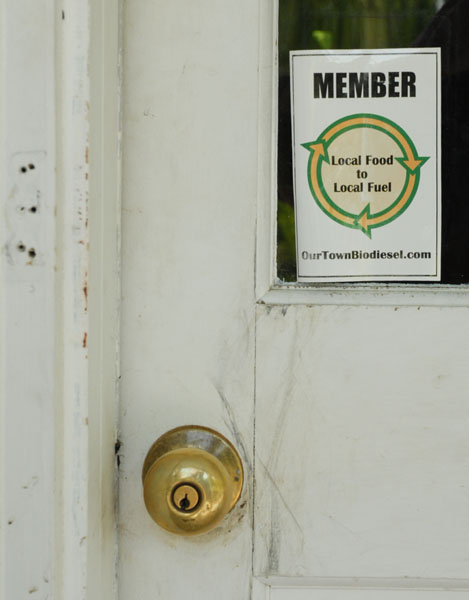
This morning I interviewed the CEO of a Tamworth company, Our Town Biodiesel, for a piece I’m working on a piece for NHPR News. Our Town was started by a 25 year old in his dad’s garage. It turns waste vegetable oil from restaurants into biodiesel and sells it as home heating oil.

It makes me wonder what it takes to succeed. Forrest Letarte graduated from Plymouth State two years ago and works in Boston. He comes home every weekend to run the business. He runs it out of his dad’s garage with his dad Hank’s help. Hank fired up a tractor powered by biodiesel — it smells like barbecue chips and runs 70 percent cleaner than regular diesel.

Forrest and Hank sold 4,500 gallons last year and expect to double that this year. At $3 a gallon it’s a good weekend job; if the price goes up further it could become lucrative.

New Hampshire has such incredible diversity, between the southern, central and northern parts of the state, but I’m still waiting to happen upon this type of entrepreneurial venture in Berlin, but I’ve got hope. There is room for creative thinking up there. Between the low cost of property and the diesel powered industries (i.e. logging) being mostly off-road (you don’t have to pay IRS gas tax for offroad operation like a skidder) someone could be reasonably successful running a similar business. I don’t see anyone getting rich, but in a region looking for this type of investment and the low costs of launching such an operation, it seems it could make someone a living wage.

In Tamworth, Forrest comes home every weekend to make his business thrive while also making an environmental difference. Where are the entrepreneurs returning to Berlin to make a difference, ecologically or economically?

Long Day

The police arrested someone for arson and possession of stolen property, there was a fire started by a small child, the city held a public hearing about the 2010 budget, there was an open house for a program house built by high school students in the vocational program, and there was an event for the local after school program.

And that’s just Berlin. I am also supposed to cover Gorham, Dummer, Milan and other area towns. I stopped by the police department to ask about the 18 year old man arrested for arson and wound up talking with the detectives there for a while. We started talking about some of the larger problems Berlin is facing, and I started to wonder how the city manages with only two papers.
Only two? Does that sound strange? It is strange, because a daily paper and a weekly paper are more than many towns and cities have. But I am only writing eight to twelve stories a week, including the police log and covering city events. Today there were five events I found worth covering. That was today. I don’t have the time to cover everything, so luckily the daily paper covers some of those responsibilities. But still, there is enough happening, enough going on around Berlin, much less the surrounding communities, to warrant two daily papers and two weekly papers. Maybe the old model of the morning and evening paper would work well here, plus a weekly paper to dissect larger topics.
I feel like a throwback here, like someone who belongs in Chinatown or On the Waterfront. This seems absurd today, that a city of 10,300 should have three newspapers, but now, working in that exact environment, that’s what I feel would get the job done.
And what should it be worth to people? At tonight’s city council meeting there were references to stories in both papers, statements made by councilors and residents making it clear they were reading the papers. They pay 50 cents a week for the Berlin Reporter and nothing for the daily paper. Is that what it’s worth? Would people pay $26 a year to know what is happening in their community? I would think so. I know people who pay $3 a day for coffee. It doesn’t seem so far fetched to pay as much $3 a day for news. I know the Internet is taking over, I know people see papers as passe, but the idea, the concept of print journalism, is timeless.

I was talking to a detective about the man who was arrested last night, and I asked if I could talk to him in jail. He looked at me and said, “You really like to dig, huh?”
Who else out there is digging? I don’t know that I like to do it, but it is what I am in Berlin to do. And I would hate to live in a world where no one did it. I intend to talk to everyone I can, not just take someone else’s word for any fact. I hope a model can be developed to do my job in a twenty-first century medium, and I am thankful the Reporter is still willing to do it in print. I hope the citizens of Berlin are thankful as well. I hope I earn their 50 cents.