On the way to work today I listened to a Morning Edition interview with Alexandra Berzon from the Las Vegas Sun. Mrs. Berzon won the Pulitzer prize for public service for her reporting on construction deaths in Vegas. It was an interesting interview, worth listening to, and it fits well with my last post — what’s a community to do without print?
The Latest Fire
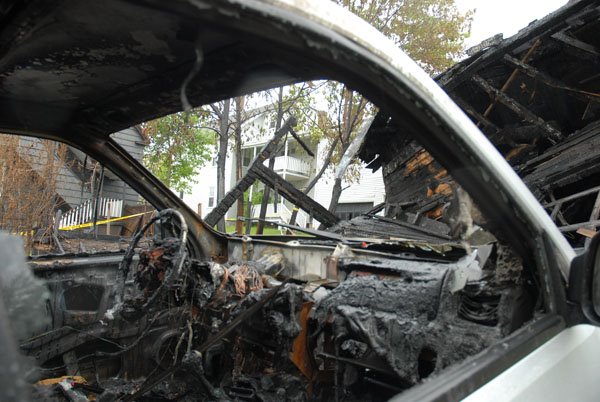
One more weekend, one more fire. Today I made it over to the garage that burned Saturday night. The garage was behind an empty house, and it caught the neighboring house where someone was sleeping on fire. The woman got out unharmed, but the house needs repairs. Firefighters were able to save it, and Karen Bradley, the owner, was amazed at how effectively they fought the fire. The garage, however, didn’t fair so well, and several cars were also badly damaged or destroyed.
Now the big question: how does it all get fixed? Mrs. Bradley has insurance, but the remains of the garage are leaning on her house, and she doesn’t know who owns it. She is a lifelong Berlin resident, and this city isn’t big enough for anonymity. The owner most likely lives out of state or out of the area, which is the central challenge for Berlin. As I wrote in my last post, it is often worth it for landowners to walk away from burned out properties instead of fix them up. But where does this leave the landowners who want to rebuild? Usually it doesn’t matter, because if a house burns down it only affects itself, or even if it catches other houses on fire it doesn’t stick around for the cleanup. But Mrs. Bradley needs the garage moved before she can go to work. If this property owner is like many in the area, this may prove a challenge.
Berlin has a host of challenges, between fires, absentee landlords and property owners, job losses and a declining population. My job, as I see it, is to sort them all out for the citizens of Berlin. It is amazing to watch this large group of people, all with the same general goal but with a million competing specific self-interests, wrestle to work together.
The fire department can’t tear down houses because they’re private property. The property owner can’t rebuild because she needs the abutting owner to raze his property. The landowner might not want to put money into a property essentially devoid of value, and for the city to tear it down it’s a year long process and takes $25,000 to complete.
Last week, at the meeting about the fires that almost no one showed up to, people were complaining about a property on Gilbert Street. I stopped there today as part of a story I’m working on. At first I couldn’t tell which property they were talking about — there were too many abandoned properties on Gilbert Street. But then I looked around, and the one they were upset about became obvious. But what is the city to do? It is private property, and they can’t just tear it down. And what is a landowner to do? In this incendiary environment every vacant house looks like a target. No one wants to be the next Mrs. Bradley.
How do you sort out competing interests all headed in the same direction? How can the city preserve the rights of out of state landowners and the safety of residents? They have to stay within the law, they can’t just bulldoze all the empty properties in the city, of which there are more than 100. The city and its residents are caught in a battle fighting themselves for the same goal.
I’m working on a piece about this for next week’s paper, but it is hard to put all these issues into one story. The fires, the long distance landlords, the city’s efforts and the residents’ fears all coalesce into something too big for a thousand words. But it’s hard to imagine who will tell it in cities and towns across America if print journalism fails.
Pick up the Berlin Reporter and there is a week’s worth of conversations and interviews, events and insights from the residents of Berlin and Gorham. I find it hard to understand how this city, or any city for that matter, can function without a paper. Too much goes on every hour, every day and every week in any town or city for people to just pick it up. People can filter the world through the Internet, or television, or radio news, but that doesn’t filter the local. And the local doesn’t matter, perhaps, until you wake up at 2 a.m. to your dog barking and your house burning. Then, all the sudden, what the reporters in your town are doing matters.
Fire Number Four
The fourth fire in two weeks happened over the weekend. It started in the garage of an abandoned house and damaged the house next door. I don’t know if the fire marshal has declared the fire incendiary or not yet, but either way it still touches on an issue that is central to Berlin: what to do about burned buildings.
I talked to Berlin Fire Chief Randall Trull, as well as city manager Pat MacQueen and housing coordinator Andre Caron about it today. Berlin is in a unique situation — if a building burns, the leftover property is often worth less than the total of cleanup costs. This results in landlords walking away from their properties. Chief Trull, Mr. MacQueen and Mr. Caron all pointed to RSA 155B as the best means to move forward in this situation. The law allows the city to do something about these abandoned properties, even though the city doesn’t own them. In addition, sometimes the law can even incentivize landlords to clean up properties they otherwise would have walked away from. It isn’t perfect, Mr. MacQueen said, but recent changes to the law are making it possible for the city to move forward with destroyed properties at less cost to taxpayers.
Berlin used to have 22,000 residents. Now there are 10,300. That means there is a wealth of infrastructure for a dearth of population. The empty houses are only one symptom; the closing schools are another. In a city where there are ample vacant properties for arsonists to burn there are also schools closing for lack of students. The Bartlett school will close in about two weeks, and not just for the summer. The new superintendent will be in charge of only four schools, where the current superintendent is in charge of six.
At the same time there are signs of improvement. The Gill Building, on Main Street, former home of Gill’s Flowers, is now available for rent. David Morin, one of the investors who bought and renovated the building, showed me around the four beautiful apartments and downstairs office space. It is the type of place any young professional would love to rent — well built, quiet, efficient and inexpensive. StoryCorps has jumped on the opportunity to rent the apartments for the first month. Now Morin and his partners are looking for a few people in search of quality office and living accommodations in the downtown. It is a promising move forward in a city Mr. Morin said is often making lateral movements.
Check out next week’s Berlin Reporter for an in depth look at these stories.
The Stack
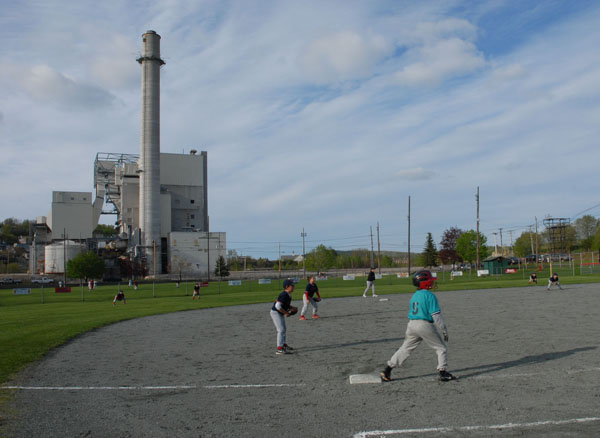
Kids in Berlin play baseball in the fields next to the old smoke stack and boiler from the mill. The mill is gone, and this massive structure is all that’s left. The kids grow up in the shadow of Berlin’s success, hearing stories about it and seeing traces of its past without ever knowing it. Laidlaw, an alternative energy company, is trying to build a biomass power station in the site of the old mill, using the smoke stack. The city council is against the idea. Mayor David Bertrand said a massive industrial facility in the center of town is the city’s past, not its future. But the biomass plant would bring 40 jobs to the area; 40 jobs the area needs. Clean Power, another company working to build a biomass facility, does not raise the same objections Laidlaw does within the council. As the newest city councilor Ryan Landry said, if Laidlaw wanted to build the plant on Jericho Road on the outskirts of town there would be no problem. But they aren’t. They own the land in the center of town with the boiler, and that is where they want to build. The city has decided to retain Downs, Rachlin and Martin, a law firm out of Vermont for around $295 an hour in preparation of the legal battle. They expect to spend $100,000 in the fight. The city councilors are torn between 40 jobs now with a 19th century downtown or an empty downtown now in hopes of a cleaner future. Right now, they are betting on the future.
For more information on Berlin, NH, check out the Berlin Reporter.
I have a job!
I’ve been trying to find work as a newspaper reporter for years. YEARS! Honestly, as I watched newspapers nationwide crumble, I thought it was a pipe dream. I was looking into going to grad school for economics, because the possibility seemed too remote.
Part of that is my fault. I love the outdoors, so I chose to move back to rural New Hampshire after college. If I was completely consumed by a drive for a job in print I would have moved to NYC, or Boston, or at least an urban center. But in order to rock climb and ice climb and ski I moved to Glen, NH, right next to the greatest climbing town in the world. (Check this out for proof.)
And I tried to find work in journalism. Northern NH is not the place to job search, I soon found out, and I had a lot more trouble than I’d hoped. I was able to piece things together, working as an ice climbing guide and doing freelance graphic design work, but the only journalism work I could get was the occasional freelance piece for NHPR. It was not nearly enough to eek out a living, much less to satisfy my professional ambitions. I needed more.
Not a lot more, but forward progress. I love journalism. I always thought I wanted to work for a daily paper, but now I know better. I want to tell stories, to get human experience across, whether it is on a page, through photographs, video or sound. I took a job at a radio station through college because I wanted to learn how to tell stories like they do on This American Life. That is what I want to do, because journalism is the greatest tool for positive change available in a free society. I cannot, as one man, make abortion legal or illegal through political means. I cannot make gay marriage legal or illegal. I cannot stop violence in Sri Lanka, Somalia, the Sudan or South-central L.A. through any application of political, military, or economic force, as one man.
But I can by writing. I can by photographing. I can by recording, and editing, and broadcasting, and showing.
The first piece I did for New Hampshire Public Radio was about methadone. In Conway, NH, a group tried to open a methadone clinic, but they couldn’t muster support within the community. Eventually the plan disintegrated. People were divided on whether they liked the idea or not, sometime rather vehemently. It was a decisive issue that made people angry on both sides.
I didn’t feel like rehashing one side’s argument, then the other. And the news director at NHPR didn’t feel like airing that story. But he did like the story I wanted to tell: people drive from Conway to Somersworth, home of the nearest methadone clinic, 62 miles way, every day to get their treatment. Agree with the clinic or not, their story, their experience, should be told. They are part of the argument, part of the town, and their story needs to be told too.
It is a universal fact: no story isn’t worth telling. No one’s life isn’t worth showing. A corporate executive, a president, a thief or a child, all of their stories are valid. Some people tell their stories with pictures. Some tell it with art. Some tell it with Twitter. And some tell it in Print.
I work for the Berlin Reporter. That’s Berlin, NH, not Berlin, Germany, and it is pronounce BER-lin, with the emphasis on the first syllable. They changed the pronunciation during WWII to disassociate themselves with the Third Reich. It is “the city that trees built,” according to its motto. It was a mill town. The city is proud of its heritage, but it is still trying to figure out how it fits into the present. I am the only reporter for the paper. It comes out once a week, made up mostly of the stories I write and the photos I take.
It is a wonderful thing, the paper, because it is for a city that does not get its news from the Internet. It is for a city where everyone has a home telephone, and not everyone has a computer. The paper costs 50 cents and people are willing to pay for it. It is a city with only its big toe in the 21st century; the rest is unsure how to dive in.
Berlin has empty mills, houses and storefronts, but people with a passion for the city that makes them do strange things. At the last city council meeting the council had to fill a vacant seat until the next election. Five people showed up to interview for the seat, and a sixth, a high school student, wasn’t able to make the meeting. Not one of the applicants had served in a political position before, but each one said this was their city, and they wanted to lever it forward, to regain its past glory. One of them, a homemaker with two kids, said honestly she didn’t know many specifics about the most recent issues the town was dealing with, but she loved Berlin and wanted to help it prosper again.
Prosper again. Berlin prospered once. Earlier in the 20th century, Berlin had 22,000 residents. Now it has 10,300. Berlin was the third largest city in NH, a city quite literally built by trees. The paper mills, and pulp mills, and industrial production that fueled the city’s growth have withered, and only their hulking remnants remain. Berlin was left behind by the American Century, and it has a long way to catch up. It is a city not clear where it is going or how to get there, but passionate people help it along.
I can’t help but notice the parallels between Berlin, NH and the profession I’ve chosen. I don’t see the light at the end of the tunnel for Berlin or print, but I am amazed by their noble histories. I can’t imagine a world where the people who love either would allow them fail. It seems both ludicrous and painfully obvious that the city of Berlin and the institution of print journalism are past their prime.
I work in city that is a relic from America’s industrial age, chronicling its slow decay. And I do it in a medium doomed to follow suit. I hope print journalism has people as dedicated to it as the residents of Berlin are to their city. And I hope to be here watching as they are both reborn. I hope I am not the Last Print Journalist.
 ErikEisele.com