Obvious Questions

I got the press release about Laidlaw sponsoring Berlin Youth Hockey, and I read the story in today’s daily paper. It’s good to see Laidlaw making some investment in the community; that is the sort of corporate citizen the city should hope for.
The story, however, didn’t go deep enough. Max Makaitis held up the daily at tonight’s community EFSEC committee meeting in response to questions about how Laidlaw will give back, effectively quelling any criticism of the answer they gave the committee on the subject. I don’t think the story soundly defeats all arguments.
I can’t fault anyone at the daily on that account, however, seeing as I put several unsuccessful calls into Laidlaw representatives. They no doubt had the same luck I did getting additional comments, and with deadline fast approaching that story was all they could get in there. The benefit of a daily is it gets the news out FAST; the benefit of a weekly is it gets a little deeper. And that’s what I’ll be doing in a story for next week.

The obvious questions:

  1. Was this a response to quell criticism voiced at the community EFSEC meeting two weeks ago?
  2. Was the timing planned to coincide with the committee meeting?
  3. What sort of commitment is Laidlaw making to Berlin Youth Hockey? Does this last one year, or will it be recurring?
  4. What other sorts of commitments of this type will the company make?
  5. How much does the company expect to give away in these types of arrangements?

It seems only appropriate to use the opportunity Laidlaw created to ask some of the questions members of the committee and the community want answered.
Really, it comes down to the fact that Berlin is lucky to have two papers. Many communities don’t have the resources to give these issues a second look. Their dailies, like Berlin’s, have another story to churn out. Anything more than a cursory look is a luxury.
So don’t sweat it if the daily didn’t ask the questions you wanted. And convince more of your friends to buy the weekly.
GET YOUR BERLIN REPORTER, ONLY 50 CENTS!
We don’t have newspaper boys around Berlin, figured I’d do my part.

Oh, and the other question I will ask: When will Laidlaw be applying for EFSEC evaluation? I figure I keep going to the meetings, I’d like to know when the subject I’m writing about is actually going to happen.

Blue Collar Prophets

It is my first day home after a four-night holiday weekend. My wife and I mini-vacationed on the coast of Maine, visiting family along the way. The drive back to northern New Hampshire was eerie after a summer of traffic. The roads were quiet and the sidewalks were empty; my first thought was how nice it is to have our town back. Shops are still open though, and businesses will have to shift into survival mode for the next few months. It’ll be a long fall before the skiers arrive.

Where I grew up on the coast of Maine there was only one season — summer. Midcoast towns are bleak in January, with boards covering windows and vacant parking lots. Tourism is a tough industry to build an economy on, with its seasonal nature and unpredictability.

What does the current economic upheaval mean for those businesses, and by extension, those towns? They are still guessing at what the environment will be. A city like Berlin may be well positioned to become an outdoor recreation destination, but for the first time in half a century the way Americans recreate is threatened.
What happens if disposable incomes dry up enough to impact the number of skiers and riders coming north this winter? What if it costs too much to cart three snowmobiles 100 miles north for a weekend ride? What will become of the North Country? What will happen to the cities that rely on that income?
Last year I did a story on NHPR News about ski areas. I was interested in how the economic crisis was affecting their business. The basic attitude was snow conditions trump economic conditions. If the weather cooperates, ski areas do fine. In addition, the New York Times reported people accustomed to vacationing at Western resorts like Vail or Jackson Hole were staying closer to home, resulting in greater numbers of skiers in “drive markets.” The result was a busy year for Attitash and Wildcat. The poor economy, it seemed, didn’t affect them.
But mulitply that scenario out over several years. The economy does not rebound; it plods slowly forward, another jobless recovery. Credit markets stay tight, and Americans no longer spend fast and loose. What does that mean for those towns that rely on that income?
In North Conway, which has a long history as a recreation destination, such a transformation would be devastating. A huge portion of the jobs there are in retail and hospitality, almost entirely supported by outside dollars. There isn’t the population to support the outlet stores, hotels and restaurants in the town, and if the tourists stopped coming they would quickly fold.

How different is that from the mill that supported Berlin for a century? What type of cataclysmic event would it take to devestate North Conway’s infrastructure in a similar way? Could a loss of American supremacy in global markets and the corresponding loss of the American consumer’s purchasing power do it? What happens in North Conway if China overtakes the U.S. as the world’s economic driver? Where will that leave places like the coast of Maine?

How will out of work people go on vacation? Who will pay those communities’ bills when there is no gridlock of Massachusetts license plates?

Berlin has a blue collar mindset, people say. Some complain about it: it holds the city back from joining in the new economy. But part of that blue collar history is a yearning to make something. Berlin is a city with a history of exporting a product, something this country does too little of today. The idea that computers or ATVs or anything else will replace manufacturing in Berlin is no more realistic there than it is for the rest of the country.
A city that relies on tourism in a country that over-borrowed and is now trying to make good on its debts it is bound to see tough times. Only so much paper can be shuffled, websites can be built and meals can be served before the fact that no one makes anything becomes clear. There has to be some sort of production for the country to survive, and it is that blue collar mindset that reminds us of that.

It can’t be furniture or shoes — they are made cheaper elsewhere, as former Ethan Allen and Bass shoe workers around the North Country can attest. But providing tourists with “good times” only works with a robust economy, in a robust future. Without something solid to base the national economy on those jobs are no more secure than a paper mill.
Berlin has an aversion to letting go of its industrial past. That sentiment is a good one, not just for the future of Berlin, but also for the future of the country. It is a sentiment key to reestablishing a foundation on which tourist towns can survive. If the city of Berlin is the last outpost resisting a service-only economy, where food is cooked and hands are shook but nothing is created, it should be celebrated. The industrial base has to be there.

Like all things, the blue collar mindset is part good and part bad. It may be a hindrance to developing in the city into its early 21st century iteration, but it is also a pertinent reminder of the failing of that iteration. It is a reminder of the rotting underpinnings of the current U.S. economy. This isn’t a problem Berlin can solve, but it is a perspective residents shouldn’t forget. It is a perspective that will hopefully keep them from once again constructing an economy around what could prove to be a bankrupt model.
The idea of a tourist destination may be attractive, but the “smell of money” the city lost was an economic foundation the country needed, and needs to figure out how to replace. The grumblings of a few who reject the new chosen path may have some value after all.
Define Community

I got to have a long conversation with councilor Tim Cayer yesterday about what it is that makes Berlin a remarkable place. I, like him, was astounded to find a pocket of small town America so perfectly preserved; a city with a feeling lost a half century ago in most places. The allure of a “dying mill town” may seem hard for some people to grasp, but I can’t get enough of it. It has something most of America has lost.
It’s hard to define “quality of life.” Does that mean outdoor recreation opportunities? Sure. Does it mean clean air, water, trees and mountains? Yep. Does it mean beautiful views and panoramic vistas? I guess. But none of those are the real root of what quality of life really means.
I lived in Portland, Maine, for three years while going to school at University of Southern Maine, and there wasn’t a single business person there who knew my name. Why? Because in a city, even one so small as Portland, you are but a face in the crowd. I’ve worked in North Conway, N.H., for six and a half years, as a climbing guide and at International Mountain Equipment, one of the stores on Main Street. I might be able to go into the local coffee shop and find a couple people who know my name, but even there the flood of people anesthetize people to individuals.
Not in Berlin. I’ve only been working in the city for four months, and already I know people, and people know me. When I go to Rumorz Boutique or Morin Shoe Store, or even just walk down Main Street, people wave and say hello. Not because I’m the reporter for the local paper, but because that is what community is around here. At Tex Mex, where I eat most Mondays, I watch Greg Dobbin and Kelly Leclerc greet their customers, usually by name.
This is a place where people still have time to say hello and listen to what you have to say. They aren’t so busy as to push you aside for the next best thing. That slower pace is something lost in many places; some people are looking for cities where it has been preserved.
I have heard this from a number of people who left Berlin and came back. Community isn’t a commodity to be valued lightly. The connection between people in Berlin is strong, built in the years when the city was isolated from the rest of the state. As urbanization has crept up the U.S. Route 16 and I-93 corridors, it has largely left Berlin alone.
What it is worth? That depends.

I worked on a small town ambulance for a while. On day we were sitting at the station when the tone went off.
“Their is a 10-55 in front of Tim Woods’ house,” the dispatcher shouted, sounding red faced and out of breath.
The paramedic on looked at me, his expression blank.
“Any idea where that is?” he asked.
He was from out of town.

Does anyone know where the Bass factory building is in Berlin? Or the Converse factory? Wait, those are the same building?
Excuse me, I’m from out of town.

That sense of history, that sense of place, is missing in many cities. Portsmouth and Portland have lost much of their blue collar heritage. People forget that Commercial Street in Portland’s Old Port was called Commercial Street because of all the shipping that occurred there, not because of all the shops. Berlin residents haven’t forgotten those parts of their heritage. The community still has that which has been lost so many other places.

To the paramedic sitting next to me that day, the description of where the accident was proved the town we was a backwater. To others, though, it reminds them of a nostalgic time most communities have lost. That is worth something. The city has something there that residents can’t let fade. It may be hard to see what a depressed city offers, when most of the time is spent trying to combat the depression, but it offers something special.

Quality of life — what an elusive phrase. Like the supreme court said in reference to pornography: I know it when I see it. I see it in Berlin.

Mission: Accepted

The city has the opportunity to apply for a grant for $14 million to fix every city street. Every road would be repaired and brought from its present condition to very good or excellent condition. The understanding, however, according to city manager Pat MacQueen, is that if the city accepts the grant it will spend $600,000 a year to maintain those roads. The city currently spends between $120,000 and $300,000 a year, according to public works director Mike Perreault. City councilors did not balk at the idea; in fact they were enthusiastic about the chance to improve the city’s infrastructre.
At the same time, housing coordinator Andre Caron has several buildings slated to come down in the next several months. October will be a busy month, he said. The two burned out buildings on Main Street will be among those razed.
Sylvia Poulin and the Main Street program worked in partnership with BIDPA over the weekend to beautify the Rite Aid block, planting trees, mulching, adding benches and more. Their efforts are noticeable as you pass on the street.

People have had criticisms: Why did it take until now to get those buildings demolished? Why did city beautification wait until the fall? Why has the city let its infrastructure fall into such disrepair in the first place? These are valid critiques, but they miss the big picture. Berlin is improving. The city has people dedicated to finding their own path forward, not relying on the benevolent will of an industrial polluter to balance their budget. True, they haven’t had that option in a decade, but the “mill mentality” kept the city plodding downward at the same lethargic pace. These efforts, though but a drop in the bucket, represent the turning tide of Berlin’s approach. Residents needs something to rally around, something big to draw them out of their shells to embrace their municipality. These aren’t it, but what they are is something residents can be proud of. Instead of cursing the city for its backward leadership and petty infighting, these are examples of forward thinking actions and decisions. As I said, I feel like I’m here at a time of tremendous positive change in the city, and yesterday I stumbled on a number of examples of it. What are some others?

Crossroads

The next year or two will the years to watch in Berlin. The prison will finish construction, Clean Power will start building, Laidlaw will apply for EFSEC review, Fraser will reach an agreement with someone to supply cheap energy, Jericho Mountain State Park will have hold its first ATV festival and the blue line will finally run through town. I can’t imagine a better time to be reporting there.

I’ve recently had both pro- and anti-Laidlaw people mad at me for the way I approached their subject. My wife was accosted yesterday by a man who heard her last name and didn’t like an article I’d written. Someone else told me they were looking to expand their business in the area and really appreciated my reporting on other successes around the city. I feel like I’m pissing enough people off that residents must be reading the paper. They care enough to comment; that makes me feel successful.

No one I know wants Berlin to fail. People fight vehemently for their vision of the city, but they all have the same goal. Like Democrats and Republicans in Washington, D.C., factions in Berlin are battling each other, thinking the other side is wrong and evil, but both with a passion for their city, all because they want to see the city thrive.
It’s important to allow diverging opinions and contradicting viewpoints to be heard, otherwise there isn’t honest debate. But in many ways opinions are moot, because we are single actors, in many ways just bystanders. I interview people each week opening and running businesses in Berlin who don’t have time to attend city council meetings, chamber of commerce meetings or school board meetings. They are fighting to bring more life and success to the city in other ways; ways that include the words open for business. They are the wave that will push the city into the future.
I look at Berlin and I am hopeful. Regardless of what I or others think are the big issues of the day, there are people who don’t care about what is said in the paper or on the Internet. They are loyal to the city, and they will fight for it to the end.

I’ve been thinking about this moment in Berlin’s history, which, as Mr. Charest has said, is when the city must reach maturity. The story of Berlin is a smaller version of the story of the United States: once a manufacturing superpower, it hasn’t built anything in years. Honestly, I have to believe Berlin can remake itself, because both it and our country will have to to survive.
I want to tell that story, and not just on LPJ or in the Berlin Reporter. I’ve been thinking about doing a documentary on the city, telling the story of the entrepreneurial seekers who see more in Berin than just its past. This crossroads is truly exciting, and it could be a parable for the nation. The “big issues” as but a backdrop for the passion residents have maintained through countless setbacks. The irrepressible spirit of the city amazes me, and I think it is a story worth telling. The next year, I hope, will paint a clear portrait of what a community can do for itself, defining its future and without neglecting its past.

May you live in interesting times — an apt description for the residents of Berlin. It is also true around the country. Berlin can be the anecdote for the nation. I want to be there to see it, and to tell it.

Strained Responses

Marketing, people, I’m talking about marketing!
I know there are people who are passionate about Laidlaw, one way or the other. I agree it is a big issue, and both Berlin papers have done a miserable job reporting on it. I intend to change that. I want to find out more about the company, about its history, about North American Dismantling, and about every aspect of biomass as it affects the citizens of Berlin.
BUT IT IS ONLY ONE ISSUE!
Will bringing Laidlaw to the area solve all Berlin’s problems? No. Will keeping Laidlaw from opening in the area solve all Berlin’s problems? No.
Stop trying to make the story of Berlin the story of Laidlaw. It isn’t; it is only one part. I intend to use this blog to discuss all the issues I see as pertenant. Anyone who would like to join in the discussion is welcome.
Nancy Clark, owner of the Glen Group, a marketing company in North Conway hired to market the North Country, said she doesn’t see the boiler as that big an issue, whether it’s making electricity or rusting away. There are bigger issues to deal with than this. Even if North American Dismantling conspired with Laidlaw to sell them the boiler so PSNH can buy a biomass plant in five years that isn’t the biggest issue in Berlin. It isn’t the thing that will cause the city to fail or allow it to succeed.
Norm Charest said Berlin doesn’t have anything to market. He said the blight has to go before it is worth it. I completely disagree. I think Mr. Charest is afflicted with the same disease everyone else that has stared at the boiler too long suffers from: blindness. Or call it a lack of vision. There are business people moving here. They see opportunity. Burned out buildings will keep some people away — people looking for a sure thing. But that doesn’t mean they will keep everyone away.
People in search of a guaranteed investment will not come to Berlin. The city can’t offer a 10 percent rate of return. But people like Curt Burke are willing to invest millions of dollars in the area. Is he crazy? Or does he see something?
Coupled with Tim Cayer, Katie Paine, and Tom Bendah, that makes a spark. As Berlin knows, it only takes a spark to start a fire.
People are moving to the area. I have been profiling businesses for more than a month of people from here and from away who want to live in Berlin. It can draw. Why does even Mr. Charest refuse to see that?
I worry when the economic development director has lost faith in the city. But in this case I don’t worry for Berlin. The city does not have its plans in order to attract people. It is not doing a good job at marketing. But people are coming. The efforts of the state, which have failed Berlin for years, appear to be one of the few efforts citizens can count on. And yet people come.
Dick Huot, manager of Northern Forest Heritage Park, got a Maine television program to profile St. Kieran Community Center for the Arts, Northern Forest Heritage Park, Gorham Moose Tours and Jericho Mountain State Park. Where are other efforts like this? If the opinion is the area is too blighted and burned out to market, than this would be folly. Guess what? It isn’t folly. It is exactly what the city should be doing, the economic development director should be doing, and every private business in the area should be doing. The chamber of commerce, of which Mr. Huot is a member, should be working as hard as possible to get these images of the city out there.
Take a look at this video. Is it really so hard to imagine these pictures can’t bring people to the area? Is there really so much blight this sort of effort is futile?
I don’t think so, and so I don’t want to see a valid discussion about marketing turned into a debate about biomass.
Want to talk about Laidlaw? Fine, but don’t try to drown out other pertinent discussions with your personal obsession, at least not on this blog. I, as the local newspaper reporter, am working to improve every aspect of Berlin and the surrounding towns. That means I will be covering dozens of issues, and one issue cannot take all the oxygen out of the room, extinguishing all other conversation. So please, open up a little, and care about more in Berlin than just one issue. It does not all come back to Laidlaw. It used to all come back to the mill. Those days are over; help me determine what comes next.

And one more thing: instead of asking, “What is the state going to do to market the area?” when I say, “You can read about it in next week’s Berlin Reporter,” pick up a copy of the paper. Don’t ask me to tell you what I’m reporting on for free. You can buy 40 hours worth of my work for 50 cents — that’s cheap enough.

More on Marketing: Relying on the State

New Hampshire Department of Resources and Economic Development has hired a North Conway company, the Glen Group, to do marketing for the North Country. Part of the plan is to throw an event at Jericho Mountain State Park. Mayor David Bertrand said previous councils relied on the state to market Berlin, and the results didn’t do much for Berlin. Is this one more example of the same?
Chris Gamache from New Hampshire Trails said if a campground wasn’t completed by the time of the event next July they would route people down the railroad bed to Moose Brook State Park in Gorham. Councilor Ryan Landry spoke up and said the council would rather keep the people in Berlin. But Berlin’s hopes aren’t the issue at the top of the state’s list. Councilor Landry said he wanted to keep people in the city; is DRED and NH Trails working to further those goals, or to promote the state park for the state park’s sake?
The city needs to continue working on its own to change people’s minds. Mayor Bertrand was correct: the city in the past relied too heavily on the state. They don’t want to do that again this time.
I’ll be talking with the Glen Group, Chris Gamache and DRED to find out more about this proposition; look for it in next week’s Berlin Reporter. Hopefully the city will not rely on these organizations’ efforts alone. The city recognized the 21/21 initiative as something they should embrace to move forward, but when it came to marketing the talk got fuzzy. Who in the city is going to make sure that doesn’t once again fall to the wayside? If everything changes and the city is renewed, but no one comes because no one knows every business will fail before people’s perception of the city changes. The marketing has to start now, so people will come so the businesses can survive and grow.

Tonight’s Meeting

On the agenda for tonight at Berlin City Council: Economic Development/Promoting Berlin Discussion.
Councilors will be discussing what the city can do to better promote itself. I hope that is a discussion that continues throughout the city. It isn’t something that should just be happening at city hall; the ramifications continue down Main Street, out Route 110, and throughout Coös County.
Hopefully that discussion will spark more of them, and marketing can become the thing residents rally around.

I was discussing marketing today with someone, trying to get some background on Laidlaw, and they pointed out that, from a marketing perspective, an abandoned stack in the middle of town is probably worse than a biomass facility. Who will come up with the money to tear down that stack if it isn’t used? I’m meeting with Mayor David Bertrand in half an hour to ask that question. Laidlaw has become an issue that divides this city, when it needs more than ever to be united. I’d like to find some answers to those questions, to poke holes in all sides of the debate. I can’t see the city spending money to demolish the stack, so how will it ever get better? A tweeter told me Dover declared their stack historic and stuck cell phone antennas on it. Honestly, its the only idea I’ve heard, so right now it sounds like a good one.
I’m coming into this debate, as I said last night, like the last one to a busted up party. But I still think there is a discussion worth having that does not see eye to eye with either side.
Is Laidlaw good? In the sense that it would provide jobs and do something with that stack, yes. Is the company bad, as some insist? I don’t know. I will be looking into that in the near future.
But what about Berlin? What does it do? A couple weeks ago Councilor Ryan Landry said if Laidlaw doesn’t build there someone else will. Likely true. Will it turn off tourists? Councilor Tim Cayer is working to bring ATVers here with a hunk of junk on the mill site. Are they turning away because of the stack? The ones I spoke to at Jericho didn’t care, but of course they are the ones that came. It is hard to determine what the real ramifications of the city’s decisions will be.

I guess that’s my question: If not a biomass facility, then what? Forget Laidlaw. Who will take down that relic? Who is going to pay for it? What is the better alternative?

The city is getting serious about its image, it seems. What will that image be? Councilor David Poulin had the great idea to get the stacks off the city seal. Who is proposing getting the stacks out of the city? How are they going to do it? Who is going to pay for it? Isn’t Clean Power building stacks instead of erasing them? What is this fascination with the old mill site and where has it gotten the city? It’s like an ex-wife the city can’t get over, can’t seem to escape the memories of.

I intend to find some answers, but I’m interested in your response. Laidlaw is just a symptom. I’ll find out about it, but that still doesn’t deal with the pink elephant in the room. Or is it a gray boiler? Whatever.

In Medias Res

So I haven’t posted in the last several days because I spent most the week chasing down stories more complicated than I understand. I spent so much time at conversations with people that didn’t result in stories that I wound up scraping for stories by the end of the week. Whenever I write a story I usually only put 25 percent of what I’ve learned into the paper. The rest is background and information to make sure I can explain it effectively. With what I’m looking at now, that isn’t the case. It is so vast and complex I’m treading water trying to comprehend it all.
Laidlaw and Clean Power — two companies the city has been fighting over since long before I arrived. What does each one represent? How many jobs would each bring, and what kind of jobs would they be? Can the forest sustain both? What sort of neighbors will they make? These are big issue to some people, and so they have to be to me too. The Reporter is the residents’ paper first and my paper second; if an issue is important to them it is important to me. It’s just up to me to explain it.
But this issue is different than explaining the city’s marketing problem, or its blue collar mindset. It’s different than recounting a city council meeting, or explaining the RSA 155B process, or profiling a restaurant. It’s about power purchase agreements, and PUC rules, and least cost options. It’s about Ellicottville, NY, and Portsmouth, and Concord, and Berlin. It’s about power, and it’s about power.
I don’t care about debates; I care about facts. Will a biomass plant look like hell in the center of town? Sure, if your priority is scenery and a tourism economy, but not if your priority is industrial jobs. I’m not looking for scenery, and I’m not looking to cover fluff. That discussion belongs in an article about marketing, not in one about power. The real questions I’ve got involve substance.
I find myself in the middle of a debate I don’t know the history of, expected to get to the root of it to explain to the people who were around for it. This is a blog, and not the place where I actually report; that’s in the paper, where more people actually care what I write and it affects people’s lives. People in Berlin seem to have already made up their minds about this issue, and I’m not sure they’ve done so on evidence. More often it seems they decided on gut feelings. I’m going to find evidence to prove whether those gut feelings are right or whether they’re crap. Love Laidlaw? I want to show you it’s evil. Hate Laidlaw? I want to prove their perfect. My goal is to test every hypothesis from every side, to tap it and poke it until the actual facts fall to the floor screaming, “Here I am! Here I am! Just leave me alone!”
Berlin’s economic future it tenuous, but the sun is rising after years of black. The residents deserve to know how their actions (or inaction) will affect them. I’ve heard that my stories have brought new customers to businesses struggling to survive. They have breathed life into things formerly dormant. The city of Berlin needs something to believe in, I hear. I can’t deliver something to believe in, but they’ll be able to believe the Berlin Reporter.
I’m not sure if this is a threat, or who it goes out to. To a reporter, truth is thicker than water. If you live in Berlin I wouldn’t expect to stop hearing about this issue anytime soon. And expect to hear from some voices you haven’t heard before. This is why I chose this profession. Now I get to see what I can do.

Even Google Is Against It

I love Google. I use Gmail, Google Maps, Google Docs, Google Calendar, Blogger, all sorts of Google applications. But then, every once in a while I find a reason to hate Google.
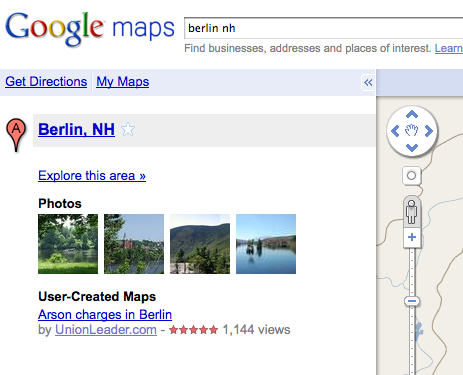
Google has a company policy to never be evil, so hopefully they don’t turn into a 21st century Microsoft. I can appreciate that. But then how come when I type Berlin NH into Google Maps, the tag that comes up under Explore this area is a couple photos and Arson charges in Berlin? This is the type of thing that makes me consider Google evil. Come on Google! I’m saying the city needs a marketing campaign, but it’s damn hard to argue with Google, a search engine so ubiquitous its become a verb. This is not the type of coverage the city needs.
I know, it isn’t really Google’s fault, because the map was made by the Union Leader. But wouldn’t it be so much nicer to have a map made by the recreation department, or the city marketer, showing the city’s parks and recreation spots? How about its swimming holes? Or its historic buildings? Its churches? They wouldn’t erase the word arson from showing up on the side of the Google search, but they would at least put the word in context. Berlin isn’t all burned out buildings, but look to Google and that’s what it appears. Who wants to do something about that? Thus far, the answer is no one. That makes it hard to point the blame at Google.