New Turn for Town?

Biomass energy has a number of questions associated with it, probably more so than answers. White Mountain’s Community College hosted a forum Thursday night to try to tackle some of those questions, with panelists from UNH, Clean Power, BEDCO and other places. The resulting discussion far from answered all questions, but it might resolve the issue for Berlin.
Here is the argument laid out at the meeting. And keep in mind, this isn’t just industry people — the panel included people interested in sustainable environmental practices and forestry. Not every view was represented, but this wasn’t a biomass press conference.
Biomass can mean many things. Burning wood for heat is biomass; so is burning wood for electricity. These two are not created equal: thermal production is 75 to 80 percent efficient, while electricity production is 20 to 25 percent efficient. That means if you have four pieces of wood, you waste one making heat, or you waste three making electricity. Seems clear which you’d choose, right?
Sort of. Northern NH has a need for heat. Home heating oil costs Americans roughly $3 billion a year. That’s $3 billion that is sent overseas instead of pumped into the local economy. By using a biomass plant to generate heat communities can support their local loggers, reduce dependence on foreign oil, reduce carbon output (wood burns cleaner), be more efficient and save money.
What it takes is a community cooperative, where pipes are laid like like for sewer or water to everyone’s house, that taps into the thermal generation capacity of a large scale biomass plant.
But heat isn’t all people need — they need electricity also. By coupling these two together it is possible to achieve something close to 50 percent efficiency. That is the idea with Clean Power.
What they would do is make electricity their primary focus, but thermal production would be a part of their operation. The executive director of the Biomass Energy Resource Center said making the thermal output the primary focus results in the best efficiency, but Clean Power is looking for profit, not just efficiency. By coupling the two they will get reasonable efficiency, two logs out of four, and good profits.
They’ll have excess heat though, and Berlin can harness that. What’s more, it’s hard to store electricity. Batteries don’t do a great job of it — that’s why electric cars can’t go nearly as far as gas powered cars. But it is easy to store hot water, and through it thermal energy. A couple silo sized thermoses would create heat reserves for the entire city. There are also ways to create refrigeration with heat pumps (beyond me but sounded cool) for food storage and using the water for snow removal by laying radiant floor heating in parking lots and melting the snow as it falls. The possibilities are being explored in Europe, according to the Northeast District Energy Corporation, and they are working to bring them here.

What would it do to the forests? And to the loggers? Those questions are hard to answer. The paper industry is down and demand for building materials is close to zero, so right not wood looks like a cheap resource. Another market would be great for the loggers. But those markets could turn around and it’s hard to predict what that would mean. The biomass facility would burn the tops and limbs of trees, and those trees not valuable for production. They might also plant fast-growing trees on unused farmland to increase the volume of material without affecting the market for pulpwood or the wood destined to become for lumber. However the loggers would need to figure out ways to defray some initial cost of investment for things like chippers to turn the waste wood into usable material. A couple ideas were floated around, like creating co-operatives or having a chipper at the biomass plant to encourage smaller scale loggers to get involved.
The forests are hard to judge, but Clean Power reduced the size of their plant because they didn’t want to overbuild as compared to the capacity of the land. They only want to get wood from within 30 miles of the plant because trucking costs and emissions would be prohibitive from further away. How much wood is there in that range? No one can answer that exactly, and it would be hard to tell without the plant in operation what the overall impact would be. Speakers stressed sustainable harvest practices and how important they are to the continued success of the plant; it doesn’t do any good to have a biomass plant and no wood left around to fuel it.

I could continue. It was one of the most informative two and a half hours I’ve ever been to, and by the end my head hurt. Maybe I can touch on the wood markets at a later time. But biomass answers made it seem like the questions are worth asking. Can the city handle two plants? Again still a question. Can it integrate the community heating program and invest in the appropriate infrastructure to get the full value from the facility? Again, it isn’t clear. But it would change Berlin from a city in the darkness to the forefront of the green energy movement in a matter of years if it happened. All while remaining “the city that trees built.”

No Casino

It doesn’t look like Jim Rafferty’s dreams of a casino on Main Street is going to happen. The legislature rejected gambling as the way to balance the budget less than 12 hours before I interviewed the Berlin police chief to get his views on the subject. He said he didn’t think the discussion was over; it is likely people will continue to push for a casino locally. Mr. Rafferty said he spent $10,000 on the architectural drawing he brought to the city council and the casino meeting. That sort of investment dies hard. The vote does end one chapter in the debate, however, and at least pushes any facility back from the “best case scenario” time frame of Fall 2010.

So it still leaves the question open — what is Berlin going to do?

Quiet Weekend

It is strange when a weekend with more than a dozen arrests is considered “quiet,” but a weekend without a fire is a blessing around here. At 8 a.m. every Monday I go to the police station to get the police log, and it is an activity I’ve started to dread.
Living in Glen I miss most of what happens in Berlin on the weekend unless it’s a scheduled event I’m planning to cover. So usually the police log is my first encounter with the weekend’s destruction. I meet Craig Lyons from the daily paper just inside the station, and he usually already has the weekend report for me. This weekend it was a prowler getting arrested after a foot chase. Last week it was a three story building burned. I have to say I prefer the former.

I’ve been working for the Reporter for something around seven weeks. I can’t claim to be anything close to a local, living in Glen, growing up in Maine and being born in Virginia, but the people I interact with in the city are warm, inviting and interested. I walk into stores looking for someone to talk to and often end up getting the opinion of almost everyone in the place. It has the feel of a city time forgot, and not only in a bad way. Part of my idea behind this blog is that Berlin is looking to find its way into the twenty-first century, but then there are those aspects of the city’s character where I’m sure residents don’t want to “progress.”

And progress might be Berlin’s biggest problem.
Ryan Landry, the newest city councilor (and Last Print Journalist reader, thanks Ryan) made a comment about how people from out of town were wrecking Berlin’s way of life. He made the comment when he was being interviewed by the city council for the seat he wound up filling. He said people were moving to Berlin to take advantage of the cheap rent and they were changing the character of the city.
Since then, as I’ve gone around the city having my repeated economic discussions, I’ve posed that thought to other people to see if they agree. I received an array of responses.
First, there are certainly people who agree with Mr. Landry. Several business owners on Main Street said they have had people come in and say they just moved to Berlin from Lowell, Mass., or Manchester, or Lewiston, Maine. They told the business owners their landlords raised the rent and said if they wanted to keep the rent the same they had to move to the landlord’s property in Berlin. In one part of the equation, this view is correct — people are moving here from out of state. Many of these people are on disability, according to the business owners, and they are looking to stretch their limited financial resources as far as they can go.
And who can blame them? A dollar in Berlin goes further than in almost any other city in the Northeast. Berlin is certainly seeing a migration of low income individuals, but are those people to blame?
One business owner said no, it is the landlords who are at fault. They buy properties for cheap, do the least amount of work possible to make them habitable, and then start jacking up rents to the south to speed up the migration. These out of town land owners are the ones destroying the character of the city.
But really, really, is it because of these out-of-towners that Berlin is suffering?
The police said no, it isn’t the out-of-towners that are doing all this bad stuff. They put the ratio at 50/50; 50 percent out-of-towners, 50 percent locals. They were talking about petty crime, theft, drugs and arson. This is interesting, because it is a report from the front lines about who in the lower socio-economic levels is hurting Berlin. Is it those from here, or those from away? Turns out, it’s a bit of both.
Today, however, I heard an incredibly insightful critique of higher level socio-economic sabotage in Berlin I’ve heard yet. It could be argued there is a 50/50 split between who is to blame for Berlin’s eroding character at this level too. I’m not sure this is the case, but I think it is an intriguing argument.
It goes like this:
These out of town landlords who buy these apartment buildings, what is their investment in the community? Not much. They buy an building, do a minimum of work to it and rent it out for as much as they can get. People know it is going on and blame them for the effects.
But who locally is benefiting from the sale of these properties? Who benefits from every property that sells? Who is desperate to move every apartment house they can?
The real estate agencies. The Realtors. And how many of them live in Berlin? How many commissions have the Berlin Realtors made by selling properties to out of state landlords? How much money has passed through their hands as Berlin has foundered?
Do the Realtors know when they are selling to a slumlord? Doubtful. But as the problem has grown and owners have bought more and more Berlin buildings it has become clear who the slumlords are. Could the Realtors really not know when they are selling their city’s character?
The real estate agencies seem to be oblivious, however, and continue to sell Berlin’s future for short money.

Kind of an interesting thought, it isn’t it?
So next time it isn’t a quiet weekend, think why it isn’t. Next time a building burns, or a car is broken into, or a fight breaks out, think about the 50/50 chance it is someone from Berlin. And if it’s not, maybe 50 percent of the blame for that person living here belongs in Berlin anyway. Maybe more. Interesting thought.

Parking Pressure

Jim Rafferty from NH Charitable Gaming gave a presentation to residents Tuesday night about the casino his company would like to build in the Berlin downtown if legislation currently before the NH House passes. They would start with 250 slot machines and 10 table games in the Albert Theater and hopefully grow into a 40,000 square foot $50 million facility with a 300 room hotel and convention center at the Rite Aid building across the street. The city would get 3 percent of revenues, or an estimated $300,000 the first year. That doesn’t include the property tax and other taxes the city would collect.
Casinos, of course, have lots of opponents. Gambling is often considered a vice, and proposed casinos in nearby states have resulted in bitter battles.
The opposition in Berlin Tuesday rallied around only one issue, however: parking.
The city would lose valuable parking spaces if there was a gaming facility in the downtown area, opponents said, and businesses on Main Street would suffer.
Councilor Lucie Remillard asked if Mr. Rafferty would consider other locations outside the downtown. Others suggested the east side or the old Converse factory aside. Mr. Rafferty said the Albert Theater was the most viable location and he hoped to make the location work.

Many of the opponents were business owners with shops on Main Street. These shops would benefit from increased traffic through the downtown, and they would benefit from visitors to Berlin, no matter the draw. People made it clear they don’t want the casino in the downtown, but they didn’t really address why. Parking as a reason is ridiculous.

What if viable businesses moved into all of the empty buildings in downtown Berlin? What would the city do for parking then? Would business owners say having all those businesses in the downtown is a detriment because of the parking challenges it creates? What other industry would move into Berlin and spend the money to level a building to create 187 parking spaces? The phase one of the casino plan would level the Rite Aid building to build a parking area — no other business would.

Traffic could be a concern; Main Street wasn’t built to handle large numbers of cars. But if too many cars in Berlin would be a significant improvement over the current problem of too few. Both Mayor David Bertrand and city manager Pat MacQueen pointed out there are ways to deal with parking issues, and that a parking problem with adequate revenue isn’t really a problem. Mr. Rafferty said if they casino is so successful there is no place to park he’ll build the city several garages.

This debate goes back to the earlier discussion about creativity. What makes people see only roadblocks instead of opportunities? What made Lorraine Leclerc see opportunity in a burned out school building while others see roadblocks when an entrepreneur approaches the city with a business idea?
Casinos have negative characteristics. In many places opponents to gambling gain enough traction that municipalities see battles between pro- and anti-gaming factions. Such a debate is important, particularly in Berlin, which has to decide what path it wants to take forward into the twenty-first century. But parking as a roadblock to economic development? What sort of draw to the downtown can there be without creating congestion? How can the city reestablish the downtown as an economic, social and cultural center without people? What depressed city shoots down a business idea because it’ll attract too many people to the area?
Where is the ingenuitive spirit to attack this challenge? Where is the dynamic community ready to move quickly to clear a path for business? What is the yoke around this city’s neck that makes everything appear overwrought and dangerous?

A luke-warm reception to gambling is understandable. But not for such a thin reason as parking.

A prison, a biomass plant, another prison…

… and a casino.
Will Berlin change its motto from The city that trees built to Not in your backyard? How about here? It is discouraging to think the only businesses the city can pursue are the industries everyone else wants to get rid of.
Yesterday I got sidetracked while talking to one of the firefighters about the most recent fire. We wound up discussing the economic challenges the city has, making for one more conversation to add to my list. The fireman said he looks around and sees many opportunities no one takes advantage of. He mentioned rescuing someone off Mt. Forist, the big cliff on the west side of town.
“That could be the next Cathedral Ledge,” he said.
Being a climber, I don’t agree; I think it could be better than Cathedral. Or at least it has the potential to be more of an everyman cliff than Cathedral, because it is waiting to be developed. Easier routes could go up without being scary or dangerous. This could be one part of the multi-step approach to drawing people to Berlin.
He mentioned ice climbing, and boating, and ATVs, but Berlin doesn’t have a single hotel and the restaurant selection is pathetic. What does it take to move toward adventure tourism? I don’t hear anyone even discussing it.

The creativity of people trying to solve the problems in Berlin is lacking. Norm Charest, Tri-County CAPs economic development director, said people in the area are caught in a mindset that keeps them from seeing opportunities. His biggest critic, Lorraine Leclerc, is on the same page — it was Project Rescue’s creativity and drive that got things going at the former Notre Dame school.
But these two are doing battle publicly instead of joining forces to solve the city’s problems. Maybe it is the curse of society to have more challenges created by living together than are solved, but it seems Mrs. Leclerc’s creativity is exactly what Mr. Charest championed. Mr. Charest had other development ideas, like an indoor adventure center near the ATV park to provide poor weather and after dark entertainment. Who is going to come up with more ideas like this and move them forward?

The city council seems to be waiting for someone to arrive with this type of creative thinking. They are hoping to find something better than Laidlaw to fill the center of town, some sort of economic advancement that doesn’t spew smoke. They don’t need one employer to bring back the 2,000 jobs the mill used to provide, but they need something. The council has been approached now for a fourth time with an outside idea: build a casino. Casinos may have positive economic effects, as do biomass facilities and prisons, but they aren’t the MOST desirable business to build a community around.
So where are the inside ideas? Where is the creative thinking coming from inside Berlin? The Gill Building was renovated in hopes that by cleaning up the downtown the economy will improve, but that misses the step of having something to build a beautiful downtown around. Who is going to come up with that?

Mr. Charest said he thinks the citizens are so beaten down they don’t know how to get out of this rut. Mrs. Leclerc proved they can. Who in Berlin is going to take the ball from these two and run with it?

Fire Five

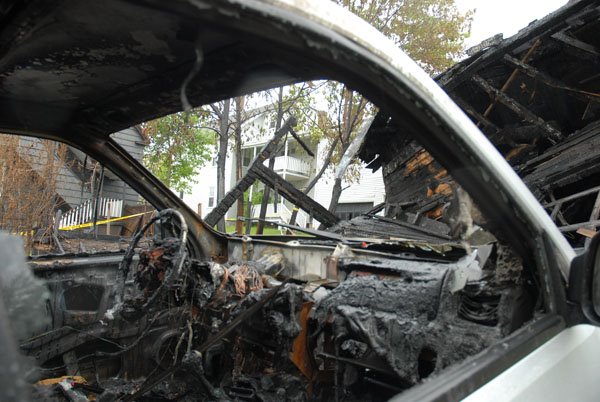
Empty houses burning — at this point they just make me sad. The house with the sign on it has been sitting vacant for years, according to one of the firefighters who put it out Saturday morning. Three surrounding buildings will need repairs, including the one in the picture, which was on fire when crews arrived. And this three unit house, listed for less than $50,000, is now basically worthless.

It goes back to the issue of what to do with these vacant houses. They are a drag in so many ways, and worst of all when they catch fire and damage other people’s property. Hopefully the $4.3 million will make some headway in dealing with this problem. If not, there are still a lot of empty buildings sitting around waiting to catch fire.

Interesting Converstations

In the past 24 hours I had four conversations about Berlin’s economy. The conversations were with Paul D., Conway town engineer, Norman Charest, Tri-County CAP economic development director, the staff and sponsors of the StoryCorps mobile booth, and Norm Small, a Berlin business owner.

First, though, I have to mention my piece on dilapidated buildings came out today. It is on the cover of the Reporter. Pick up a copy and check it out, it explains many of the challenges the city is facing. I am interested to see what feedback I get from residents.

So the conversations. Everyone wonders what will come to Berlin to turn it around. Will it be the prison? Will it be a biomass plant? Will it be tourism? Will it be anything? I’m not sure any of those provide a good answer. As Paul D. pointed out, Berlin is too far from any transportation hub for any viable industry. Mr. Charest echoed that, saying it’s a depressed city which has grown accustomed to depression. What could possibly go right for Berlin?
Norm Small said his daughter, who is 29, is never coming back. The hope that the next generation will revitalize the area is lost, he said, because there isn’t anything there for young people. I’m not so sure about that, but I can see his point. Berlin has strong community spirit, and if the city can capitalize on that it can turn it into an economic asset.
I don’t know if the younger generations have that community spirit, however. I have seen it at city council and other public meetings with people over 35, but I don’t have examples of it with younger citizens. In fact, I can’t say that I see much for young engaged residents. I have not had a lot of experiences with people over 18 and under 35 in Berlin. They may be there, but up until now they have largely been below my radar. The same isn’t true for Gorham, which has a thriving population of 20- and 30-somethings.
So maybe Mr. Small is right, and Berlin’s youth will not provide the economic boost the city needs. Who then? The prison?
The new federal prison, I just found out, will not hire anyone over 37. And they have very stringent guidelines for hiring and a rigorous application process. As far as I can tell, Berlin doesn’t have the demographics to fill the more than 200 positions the prison will offer. Maybe there are, but, as I said, I haven’t seen them. Plus, with the depressed nature of the area, some of the guidelines will be hard for people to meet (read my upcoming story on the prison in next week’s paper for more on this).
Laidlaw?
I am extremely skeptical about this. At the last two city council meetings there have been people saying the majority of Berlin residents are in favor of the Laidlaw biomass plant moving to Berlin, but I haven’t met them yet. Everyone I talk to is against the plant moving to its proposed site, at the stack in the middle of town. There are vocal proponents, but every person I talk to in quiet side conversations is opposed. Mr. Small said the city council chose the newest member, Ryan Landry, partly because he opposed Laidlaw. It is pretty clear the council opposes it, but as far as I can tell they are representing their constituents well on the issue.
So what else? Mr. Charest thinks Berlin needs to finish grieving for the mill and move on. But to what?

I’ve heard several ideas over the day, and I think they are all worth considering:

  • Brewery — My lovely wife suggested that one. Lots of warehouse space and easily trucked product. And fits with the town’s blue collar image of itself. Perfect.
  • ATV Park — As Mr. Charest said, “It fits.” Again, matches the town’s image and would provide a good reason for the existing infrastructure.
  • University — It’s a long way to Plymouth. WMCC is headed that way and is gaining a reputation for its nursing program. This one would be a huge success, but it’s long term.
  • Indoor Recreation Center — Paintball, bumper cars and laser tag would compliment an ATV park well. That one I think is great.
  • Biodiesil Plant — I have to admit I was impressed by Forrest Letarte. His model could be replicated anywhere. Why not in Berlin?

I know there have to be more. Industry won’t cut it, so it’s time to think of other options. I’d love to hear any other ideas for a depressed city with lots of infrastructure. Maybe the city can turn these ideas into profitable businesses. Maybe that way they can turn it all around.

John Deere anyone…

Berlin’s city parks are unmowed. Its gardens are full of weeds. The past may be bleak, but the way forward isn’t much brighter.
The city cut its budget by $13 million this year. (Correction — the city didn’t receive $13 million in grant money this year, which made cuts look bigger than they actually were. The council tried to cut each department by 7.5 percent, resulting in about a $3 million reduction.) Every department got hit. At the public hearing last Thursday several people spoke up for the parks and recreation department, saying it couldn’t sustain with the proposed cuts — $30,000 less than last year. The kids, people said, will be the ones who lose out.

And they made another point: What do people want the city to look like? What image does the city want to project? Should parks match foreclosed houses, with overgrown lawns and weeds? Should the city round out its image of burned out remains, boarded up relics and abandoned industrial sites with its city parks’ lawns?

It’s hard to make cuts. The city asked for reductions across the board for fiscal year 2010, which starts on July 1. Every department had its supporters and detractors, and the city was stuck making tough decisions. The councilors and the mayor defended their cuts one at a time at the public hearing, citing their reluctance to increase taxs. But several residents looked at the resulting budget and announced they would prefer a tax increase to what they saw.
The city’s tax base is eroded by years of decline. With more than 100 empty homes and few taxable employers the city has no one but homeowners to turn to if it wishes to increase revenue. But when councilor McCue called the city depressed he got sharp words from the audience.
Councilor Goudreau said he didn’t care if people don’t like the word, Berlin is depressed. It’s understandable the word draws criticism, but to call Berlin something else would be euphemism. The question is whether the city is closer to 1934 or 1940. Or even 1944. With buildings around town that look like they were in the firebombing of Dresden, it’s hard to understand just which direction the city is moving.
City manager Pat MacQueen said he didn’t used to get complaints about the burned out buildings around town; people were so accustomed to these eyesores they didn’t even take notice. But now, with an interest in renewal, people are letting him know they care.
Still, progress is lateral. According to Dave Morin, owner of Morin’s Shoe Store on Main Street, when one building gets redone two more burn. It seems to him sometimes the city is sliding sideways, not moving forward.
And now there isn’t enough money to cut the grass. Perhaps the city is continuing on its decline. Perhaps its 1934.

Or maybe the city is making hard choices to so it can forward. The councilors don’t want to discourage growth, either in business or homeowners, so they are unwilling to raise taxes. And they don’t want to spend money that isn’t their, so they have to cut programs. They plan on spending $11 million on capital improvements over the next five years to rebuild the infrastructure that has sat untended for so long. Like the National Recovery and Reinvestment Act today, or the CCC and the WPA 70 years ago, the city is investing in its future. The short term pain may wind up trumping the long term value.

A house in Berlin cost $30,000. That’s either a steal in a city coming back into its own or a waste of time not worth the money; it depends on where in the depression Berlin really is. Either way, there is one thing the citizens and the city both would like you to do: cut the grass.

The Latest Fire


One more weekend, one more fire. Today I made it over to the garage that burned Saturday night. The garage was behind an empty house, and it caught the neighboring house where someone was sleeping on fire. The woman got out unharmed, but the house needs repairs. Firefighters were able to save it, and Karen Bradley, the owner, was amazed at how effectively they fought the fire. The garage, however, didn’t fair so well, and several cars were also badly damaged or destroyed.

Now the big question: how does it all get fixed? Mrs. Bradley has insurance, but the remains of the garage are leaning on her house, and she doesn’t know who owns it. She is a lifelong Berlin resident, and this city isn’t big enough for anonymity. The owner most likely lives out of state or out of the area, which is the central challenge for Berlin. As I wrote in my last post, it is often worth it for landowners to walk away from burned out properties instead of fix them up. But where does this leave the landowners who want to rebuild? Usually it doesn’t matter, because if a house burns down it only affects itself, or even if it catches other houses on fire it doesn’t stick around for the cleanup. But Mrs. Bradley needs the garage moved before she can go to work. If this property owner is like many in the area, this may prove a challenge.

Berlin has a host of challenges, between fires, absentee landlords and property owners, job losses and a declining population. My job, as I see it, is to sort them all out for the citizens of Berlin. It is amazing to watch this large group of people, all with the same general goal but with a million competing specific self-interests, wrestle to work together.
The fire department can’t tear down houses because they’re private property. The property owner can’t rebuild because she needs the abutting owner to raze his property. The landowner might not want to put money into a property essentially devoid of value, and for the city to tear it down it’s a year long process and takes $25,000 to complete.

Last week, at the meeting about the fires that almost no one showed up to, people were complaining about a property on Gilbert Street. I stopped there today as part of a story I’m working on. At first I couldn’t tell which property they were talking about — there were too many abandoned properties on Gilbert Street. But then I looked around, and the one they were upset about became obvious. But what is the city to do? It is private property, and they can’t just tear it down. And what is a landowner to do? In this incendiary environment every vacant house looks like a target. No one wants to be the next Mrs. Bradley.

How do you sort out competing interests all headed in the same direction? How can the city preserve the rights of out of state landowners and the safety of residents? They have to stay within the law, they can’t just bulldoze all the empty properties in the city, of which there are more than 100. The city and its residents are caught in a battle fighting themselves for the same goal.

I’m working on a piece about this for next week’s paper, but it is hard to put all these issues into one story. The fires, the long distance landlords, the city’s efforts and the residents’ fears all coalesce into something too big for a thousand words. But it’s hard to imagine who will tell it in cities and towns across America if print journalism fails.
Pick up the Berlin Reporter and there is a week’s worth of conversations and interviews, events and insights from the residents of Berlin and Gorham. I find it hard to understand how this city, or any city for that matter, can function without a paper. Too much goes on every hour, every day and every week in any town or city for people to just pick it up. People can filter the world through the Internet, or television, or radio news, but that doesn’t filter the local. And the local doesn’t matter, perhaps, until you wake up at 2 a.m. to your dog barking and your house burning. Then, all the sudden, what the reporters in your town are doing matters.

Fire Number Four

The fourth fire in two weeks happened over the weekend. It started in the garage of an abandoned house and damaged the house next door. I don’t know if the fire marshal has declared the fire incendiary or not yet, but either way it still touches on an issue that is central to Berlin: what to do about burned buildings.

I talked to Berlin Fire Chief Randall Trull, as well as city manager Pat MacQueen and housing coordinator Andre Caron about it today. Berlin is in a unique situation — if a building burns, the leftover property is often worth less than the total of cleanup costs. This results in landlords walking away from their properties. Chief Trull, Mr. MacQueen and Mr. Caron all pointed to RSA 155B as the best means to move forward in this situation. The law allows the city to do something about these abandoned properties, even though the city doesn’t own them. In addition, sometimes the law can even incentivize landlords to clean up properties they otherwise would have walked away from. It isn’t perfect, Mr. MacQueen said, but recent changes to the law are making it possible for the city to move forward with destroyed properties at less cost to taxpayers.

Berlin used to have 22,000 residents. Now there are 10,300. That means there is a wealth of infrastructure for a dearth of population. The empty houses are only one symptom; the closing schools are another. In a city where there are ample vacant properties for arsonists to burn there are also schools closing for lack of students. The Bartlett school will close in about two weeks, and not just for the summer. The new superintendent will be in charge of only four schools, where the current superintendent is in charge of six.

At the same time there are signs of improvement. The Gill Building, on Main Street, former home of Gill’s Flowers, is now available for rent. David Morin, one of the investors who bought and renovated the building, showed me around the four beautiful apartments and downstairs office space. It is the type of place any young professional would love to rent — well built, quiet, efficient and inexpensive. StoryCorps has jumped on the opportunity to rent the apartments for the first month. Now Morin and his partners are looking for a few people in search of quality office and living accommodations in the downtown. It is a promising move forward in a city Mr. Morin said is often making lateral movements.

Check out next week’s Berlin Reporter for an in depth look at these stories.