Young, Not Restless

Stacia Roberge is 28. She lives in Berlin, put her money where her mouth is and opened a business. That’s gumption.

Ms. Roberge owns Rumorz Boutique, a women’s clothing store on Main Street. She opened May 17, 2008; the country has been in recession since December, 2007. Ms. Roberge said the store has had challenges, but they are still open. Just today I saw someone carting their things out of a space on Main Street, “STORE CLOSING” written on the windows. Berlin’s Main Street is a hardscrabble place, with empty storefronts and burned out buildings. What would convince her to do such a thing?
Berlin. There is no better explanation for what holds people here. Its residents have a loyalty to the area that doesn’t die. Ms. Roberge, who went to UNH and lived in Virginia for a while, is one who came home. She retained the loyalty, and she came back.
And why shouldn’t she come back? Ms. Roberge points to all the things Berlin has, and it seems everyone should want to live here. It’s beautiful, it’s inexpensive, it is a great community. It is a historic community on a beautiful river. Why would anyone want to leave?
But those things aren’t what Berlin is known for. It’s known for its stink, its grime, its outdated thinking and its fires. What a way to view a city.
Berlin does not stink. There is no odor here. I haven’t been working here near long enough to remember when it did, but Ms. Roberge has. She grew up here, and she remembers the mill. It forged her work ethic, but it didn’t melt her spirit. The rest of the state thinks of stinky Berlin, she said, but that’s flat wrong. Berlin is an affordable place to live with a view of New Hampshire’s Presidential range. It is a place with houses normal people can afford. It is a city with one of the most beautiful downtowns anywhere, except for the empty storefronts and burned buildings. It is a place with potential.
Ms. Roberge used to be one of the staffers for the Main Street Project, but now she’s engulfed in her business. While there she thought of a marketing plan for the city: send out scent-free car fresheners labeled “Berlin, New Hampshire,” with a link to a website describing the city. She said people thought she was crazy. I thought she was a genius.

Every night I drive home from work I drive over the Notch. I drive to Glen, where I can’t afford a house and where there are more Massachusetts plates than New Hampshire (in both Summer and Winter). In Glen and further south I talk to people about Berlin and they look at me like I drive to a third world country every day. They tell me about how bad it stinks and how bad the fires are up there. They tell me about how backwards the people are and about how bad the drug problem is. In some ways it’s like me telling the residents of Berlin about Berlin (which I do every week). They don’t know. They know nothing. I’m in Berlin every week, talking to people, photographing people, getting to know the city, its residents, its business owners, its police officers and its firefighters. It is so much more than it appears to be, and it isn’t the things people think it is.
I admit I have compared Berlin to Dresden, Germany, after the firebombing. It is hard to drive through the city and see so many burned buildings. When I first started there was a string of fires over the weekends, and I would get depressed as I drove in up on Monday mornings. But the burned buildings are the misrepresenting headlines, not the facts of the story. They are a momentary tremor in a peaceful city working to find its place in the 21st century. Unfortunately the city doesn’t do enough to combat those headlines. They don’t do enough to project the real story.
A number of times in city council meetings I’ve heard councilors complain that Concord doesn’t pay any attention to this part of the state. But this part of the state has to shake Concord and elsewhere out of this foggy misrepresentation. Berlin can’t wait for people to change their minds — it has to make them change their minds. It has to get the message downstate: “Berlin – beautiful, historic, affordable, odorless.”
Why? Why does Berlin have to do this? Because Rumorz won’t survive. Because Teabird’s Cafe won’t survive. Gill’s Flowers won’t survive. Morin’s Shoe Store won’t survive. Because nowhere and nothing will survive if the city doesn’t show the state and the region it has something to offer.

The opportunity is in the fact that Ms. Roberge is right. Berlin has something to offer. It doesn’t stink. It is inexpensive. It has lots of property waiting for homeowners. It is beautiful. But Ms. Roberge doesn’t need to know that. I don’t need to know that. Chances are you don’t need to know it either. The world needs to know it, and Berlin needs the world to know it now.
Berlin 2.0 is just an ad campaign away.
On the Rock

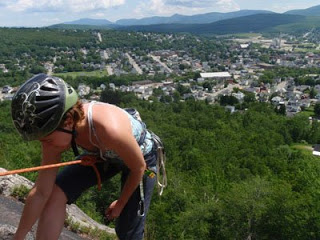
If people in Berlin are looking for economic opportunities they should look to the west. Mount Forist, if it were an hour south, would be covered with rock climbing routes. Instead it has less than 10. Ed Webster’s guidebook to climbing in the White Mountains describes Mount Forist as covered in ash from the mill, leaving climbers’ hands black at the end of a route. But Paul Cormier, local new route developer, said any soot had long since washed off. What is left is clean, moderate slabs of granite.
North Conway has a long history of climbing on Cathedral and Whitehorse, the two granite cliffs just outside of town. People make a living as guides and working in outdoor shops. Embracing the outdoors has been good for Conway; it could be good for Berlin too.
The thing Conway lacks is beginner terrain. There are easy climbs, but because they were climbed early in climbing’s history they are not well protected. Climbs can be made safe or dangerous, but early climbers often felt it was necessary to prove how bold they were, putting little protection into easier climbs. This created easy climbs that require experienced climbers to ascend them.
Berlin is different. So few established routes means there is room for more. And the ethic has changed since 30 years ago. It is no longer frowned upon to make easy climbs safe. New route developers could put in the well protected moderate routes that appeal to the majority of rock climbers. North Conway lacks that terrain; Berlin has that opportunity.
Climbing isn’t big business, but every weekend dozens to hundreds of people flock to climbing areas in other parts of the state. They eat at restaurants, shop at stores and stay in hotels. They bring dollars to municipalities near climbing areas. Why not Berlin?

My wife and I had a great day on Mount Forist today. We didn’t see anyone else, we got a great view of the city, and the climbing was wonderful. She wants to go back to put in more routes. Anything we develop will be protected with moderate leaders in mind. This is the sort of energy the city should embrace, something it should harness, as part of the assortment of new economic drivers that will carry the city into the twenty-first century.

The Forefront

In some ways Berlin is leading the nation. I work for a newspaper that doesn’t exist in Berlin. Or anywhere for that matter. I am a backpack reporter, journalist 2.0.

The Berlin Reporter building is being turned into a restaurant by some hardworking people willing to take a chance investing in real estate in a city hopefully on the backside of a depression. I never worked in that building. Neither did my predecessor. I work from my car, from my cell phone, and from poached internet around the region.
When the city manager called me the other day he asked where I was. He assumed my 207 telephone number meant I was calling from Maine. And why shouldn’t he – no other local newspaper has an out of state number. But I don’t have an office, so my cell phone becomes my office.
Some days, when I’m trying to drum up stories, this arrangement is challenge. I often track back and forth from the community college campus to meetings and interviews because the college is the best place I can find to work that has Internet. No one minds if I hang out all day, making appointments and phone calls and writing stories.
I got a job in Berlin because the population of the city does not rely on the Internet sufficiently to close the newspapers. The Reporter and the daily paper both succeed while newspapers nationwide are folding. They aren’t really threatened by the Internet. Try to find a car on Craigslist in Berlin. They are there, but without the critical mass that makes Craigslist viable in other cities. Try for a Google News search to find out what’s going on in Berlin. There are stories, usually about the prison, but not the sort of coverage people expect and get in other places.
Berlin is disconnected. The distance between Berlin and Gorham is probably greater than the distance between Gorham and Concord. It is hard to imagine if you don’t spend a lot of time in the area, but if you ask the city council they know it. People forget about the city and have a hard time understanding its idiosyncrasies.

The people of Berlin are among the hardest workers I’ve ever met. They cling to their blue collar roots, which at times is a hindrance, but it is a city with a work ethic. Years of the promise of mill jobs trained people if they worked hard they would be successful. As industry has evaporated, however, this maxim no longer holds true. Industriousness is no longer enough, and the infrastructure isn’t there for other avenues to success.
Part of that missing infrastructure is high speed Internet. Berlin has the only public library I’ve been to in recent years without wireless Internet. There is also no Internet cafe in town. People don’t have the same connectivity as they do elsewhere, and that is a threat to their economy.
I used to live in Portland, Maine, where I met my wife and went to college. In the time I lived there I went from hating computers and connectivity to working and living through Apple products. Almost every building in the city has wireless Internet. It is easy to be a freelancer or employed at an online business. When my wife and I moved to the Conway area it was a shock how much different it was. Most of our friends are college educated, and most of them own computers. But many of them went to town to the library or the local cafe to do their web surfing. Sasha and I have uber-high speed wireless at our house and would be hard pressed to continue our professional lives without it. It was a transition to get used to people who worked in a different paradigm.
Then I got a job in Berlin. If the initial Conway shock was a tremor, Berlin was an the earthquake. There is no Internet cafe, no wireless at the library. The NHWorks office and the community college offer connectivity, but the community is not set up for the twenty-first century worker. The desire to draw those people to the community is there, but not the infrastructure.
A friend asked if Berlin could be an artists community in the same way Deer Isle is in Maine. I think it could be — it is beautiful, with inexpensive property for sale that could be easily renovated into studio space. These people don’t need much except inspiratirational surroundings and a quiet place to work. Berlin has a wealth of both. But they do need a way to get products to market; this is where Berlin is lacking.
Councilor Lafleur raised this point at the last city council meeting. He said the state needs to pave a highway to the city to increase its economic viability.
I disagree. That is twentieth century thinking, based on twentieth century technology. Relying on the internal combustion and cheap gasoline is not the way to ensure long-term economic success. Like building a biomass facility in the center of town, this is a solution for the last hundred years, and a mistake for the next hundred.
Instead the city should look to the Internet as its method of connection. There is no need to pave a highway to the downtown. In fact it would ruin many of the valuable assets the city has. Instead, the city should preserve its heritage, its buildings and its aesthetic. The twenty-first century highway is the information super-highway. This is where the city should put its energy and its lobbying efforts.
How do I know this will work? The Berlin Reporter already proved it does. I am an employee for a paper no longer in the community. I work twenty-first century style, commuting more miles over the Internet than I do in my car. The challenge is that Berlin is so poorly set up for this type of work. It is does not have the infrastructure to handle more workers like me. It needs to implement Internet 3.0 now to step into this century.

As it is, I am a backpack journalist working for print media. The only thing about this solution is it might put me out of a job.

Rain, More Rain…

I’m working on a piece about the effects of the miserable weather on the Gorham economy. People at every business I’ve stopped at have reported the rain has dampened more than just their spirits. One hotel said they are normally booked on weekends through the entire summer. Instead they still have vacancies. Coupled with the weak economy this makes for an extremely difficult economic situation for much of the area.
Berlin is talking about building a tourism based economy. But the one positive about the current state of Berlin’s economy is that it is so disconnected from much of the rest of the state and the country that it doesn’t feel the same economic pain as elsewhere. Many Berliners have told me the most recent recession hasn’t felt particularly difficult because Berlin has been down for so long. In fact some Berliners have expressed optimism, saying the city is moving upwards, in contrast to the rest of the nation.
The eight miles between Berlin and Gorham often seem like more than eight miles. As the rain pours down on Coös county, for the first time in a while Berlin is on the winning end of that arrangement.

New Turn for Town?

Biomass energy has a number of questions associated with it, probably more so than answers. White Mountain’s Community College hosted a forum Thursday night to try to tackle some of those questions, with panelists from UNH, Clean Power, BEDCO and other places. The resulting discussion far from answered all questions, but it might resolve the issue for Berlin.
Here is the argument laid out at the meeting. And keep in mind, this isn’t just industry people — the panel included people interested in sustainable environmental practices and forestry. Not every view was represented, but this wasn’t a biomass press conference.
Biomass can mean many things. Burning wood for heat is biomass; so is burning wood for electricity. These two are not created equal: thermal production is 75 to 80 percent efficient, while electricity production is 20 to 25 percent efficient. That means if you have four pieces of wood, you waste one making heat, or you waste three making electricity. Seems clear which you’d choose, right?
Sort of. Northern NH has a need for heat. Home heating oil costs Americans roughly $3 billion a year. That’s $3 billion that is sent overseas instead of pumped into the local economy. By using a biomass plant to generate heat communities can support their local loggers, reduce dependence on foreign oil, reduce carbon output (wood burns cleaner), be more efficient and save money.
What it takes is a community cooperative, where pipes are laid like like for sewer or water to everyone’s house, that taps into the thermal generation capacity of a large scale biomass plant.
But heat isn’t all people need — they need electricity also. By coupling these two together it is possible to achieve something close to 50 percent efficiency. That is the idea with Clean Power.
What they would do is make electricity their primary focus, but thermal production would be a part of their operation. The executive director of the Biomass Energy Resource Center said making the thermal output the primary focus results in the best efficiency, but Clean Power is looking for profit, not just efficiency. By coupling the two they will get reasonable efficiency, two logs out of four, and good profits.
They’ll have excess heat though, and Berlin can harness that. What’s more, it’s hard to store electricity. Batteries don’t do a great job of it — that’s why electric cars can’t go nearly as far as gas powered cars. But it is easy to store hot water, and through it thermal energy. A couple silo sized thermoses would create heat reserves for the entire city. There are also ways to create refrigeration with heat pumps (beyond me but sounded cool) for food storage and using the water for snow removal by laying radiant floor heating in parking lots and melting the snow as it falls. The possibilities are being explored in Europe, according to the Northeast District Energy Corporation, and they are working to bring them here.

What would it do to the forests? And to the loggers? Those questions are hard to answer. The paper industry is down and demand for building materials is close to zero, so right not wood looks like a cheap resource. Another market would be great for the loggers. But those markets could turn around and it’s hard to predict what that would mean. The biomass facility would burn the tops and limbs of trees, and those trees not valuable for production. They might also plant fast-growing trees on unused farmland to increase the volume of material without affecting the market for pulpwood or the wood destined to become for lumber. However the loggers would need to figure out ways to defray some initial cost of investment for things like chippers to turn the waste wood into usable material. A couple ideas were floated around, like creating co-operatives or having a chipper at the biomass plant to encourage smaller scale loggers to get involved.
The forests are hard to judge, but Clean Power reduced the size of their plant because they didn’t want to overbuild as compared to the capacity of the land. They only want to get wood from within 30 miles of the plant because trucking costs and emissions would be prohibitive from further away. How much wood is there in that range? No one can answer that exactly, and it would be hard to tell without the plant in operation what the overall impact would be. Speakers stressed sustainable harvest practices and how important they are to the continued success of the plant; it doesn’t do any good to have a biomass plant and no wood left around to fuel it.

I could continue. It was one of the most informative two and a half hours I’ve ever been to, and by the end my head hurt. Maybe I can touch on the wood markets at a later time. But biomass answers made it seem like the questions are worth asking. Can the city handle two plants? Again still a question. Can it integrate the community heating program and invest in the appropriate infrastructure to get the full value from the facility? Again, it isn’t clear. But it would change Berlin from a city in the darkness to the forefront of the green energy movement in a matter of years if it happened. All while remaining “the city that trees built.”

No Casino

It doesn’t look like Jim Rafferty’s dreams of a casino on Main Street is going to happen. The legislature rejected gambling as the way to balance the budget less than 12 hours before I interviewed the Berlin police chief to get his views on the subject. He said he didn’t think the discussion was over; it is likely people will continue to push for a casino locally. Mr. Rafferty said he spent $10,000 on the architectural drawing he brought to the city council and the casino meeting. That sort of investment dies hard. The vote does end one chapter in the debate, however, and at least pushes any facility back from the “best case scenario” time frame of Fall 2010.

So it still leaves the question open — what is Berlin going to do?

A prison, a biomass plant, another prison…

… and a casino.
Will Berlin change its motto from The city that trees built to Not in your backyard? How about here? It is discouraging to think the only businesses the city can pursue are the industries everyone else wants to get rid of.
Yesterday I got sidetracked while talking to one of the firefighters about the most recent fire. We wound up discussing the economic challenges the city has, making for one more conversation to add to my list. The fireman said he looks around and sees many opportunities no one takes advantage of. He mentioned rescuing someone off Mt. Forist, the big cliff on the west side of town.
“That could be the next Cathedral Ledge,” he said.
Being a climber, I don’t agree; I think it could be better than Cathedral. Or at least it has the potential to be more of an everyman cliff than Cathedral, because it is waiting to be developed. Easier routes could go up without being scary or dangerous. This could be one part of the multi-step approach to drawing people to Berlin.
He mentioned ice climbing, and boating, and ATVs, but Berlin doesn’t have a single hotel and the restaurant selection is pathetic. What does it take to move toward adventure tourism? I don’t hear anyone even discussing it.

The creativity of people trying to solve the problems in Berlin is lacking. Norm Charest, Tri-County CAPs economic development director, said people in the area are caught in a mindset that keeps them from seeing opportunities. His biggest critic, Lorraine Leclerc, is on the same page — it was Project Rescue’s creativity and drive that got things going at the former Notre Dame school.
But these two are doing battle publicly instead of joining forces to solve the city’s problems. Maybe it is the curse of society to have more challenges created by living together than are solved, but it seems Mrs. Leclerc’s creativity is exactly what Mr. Charest championed. Mr. Charest had other development ideas, like an indoor adventure center near the ATV park to provide poor weather and after dark entertainment. Who is going to come up with more ideas like this and move them forward?

The city council seems to be waiting for someone to arrive with this type of creative thinking. They are hoping to find something better than Laidlaw to fill the center of town, some sort of economic advancement that doesn’t spew smoke. They don’t need one employer to bring back the 2,000 jobs the mill used to provide, but they need something. The council has been approached now for a fourth time with an outside idea: build a casino. Casinos may have positive economic effects, as do biomass facilities and prisons, but they aren’t the MOST desirable business to build a community around.
So where are the inside ideas? Where is the creative thinking coming from inside Berlin? The Gill Building was renovated in hopes that by cleaning up the downtown the economy will improve, but that misses the step of having something to build a beautiful downtown around. Who is going to come up with that?

Mr. Charest said he thinks the citizens are so beaten down they don’t know how to get out of this rut. Mrs. Leclerc proved they can. Who in Berlin is going to take the ball from these two and run with it?