Local, Local, Local

On the ride to Berlin this morning I was listening to NHPR, and I heard an story on the success of local newspapers. It gave me hope that the Berlin Reporter, and even the local daily, can survive and thrive. I have received a fair bit of positive feedback (and a little negative as well) about the Reporter’s coverage of the area. Like Berlin, the paper has to provide a quality product to attract people. In our case it’s advertisers, the basis of the newspaper business model. The stories I’ve been covering hopefully are the kind of local coverage people are looking for, the kind the NPR story was talking about communities celebrating. Is the Reporter thriving financially? I have no idea. There is supposed to be a firewall between the editorial side of the paper and the advertising side of the paper; at the Reporter, it’s more of an ocean than a firewall. Because I basically work out on my own, with direction from my editor, I hear less than nothing from that side of the business. But I feel like the coverage has been well received and maybe a breath of fresh air in the city.
As far as I can tell, people are reading the paper. Some don’t like it, but more hopefully do. I trust all those who are reading it are buying it (come on, it’s only 50 cents!) and/or advertising in it. The local paper is invaluable to the development of a community, and its was good to hear they are at community papers are surviving. I feel I’m doing good work for Berlin, and I’d hate to see that work disappear.
So go down to the corner store and buy a Berlin Reporter. If you live out of town get a subscription. If you like this blog buy a paper, because if the Reporter were to close I’d have a lot less to write about. (I’d probably make it up to Berlin a lot less to, which would be a shame.) The paper fills a different niche than the daily, and both are valuable to the community. The NY Times wrote about how some major cities may soon lose all their daily papers. Berlin is lucky to have the strong newspapers it does.
Maybe there is a future for both the Reporter and Berlin in the 21st century. I hope so.

Disclaimer: I have probably screwed up a bunch as the Reporter’s reporter, misquoting and misrepresenting people in all sorts of ways. I said valuable, not infallible.

Dropping the Shade — Part II

Sometimes I don’t like being right: yesterday’s attack on Twitter was to silence a Blogger from Georgia who opposed Russian influence in the region.

http://bits.blogs.nytimes.com/2009/08/07/attack-on-twitter-came-in-two-waves/?hp

As print disappears as a viable medium, what are the weaknesses of the alternative? It’s awful hard to burn every book; is it easier to burn down a website? I hope people don’t throw away all their printing presses.

Dropping the Shade

Twitter went down for a few hours earlier today. Even now I can’t post anything, although my feed is still going. It makes you wonder: what would we have learned about Iran had there been a cyber-attack at the same time? I don’t think Twitter will replace journalism, but it certainly aids in the practice of it. What happens when regimes learn to wield technology on par with demonstrators? Or will they always be just a bit behind?
In February, 1982, Syrian soldiers murdered between 10,000 and 40,000 Sunnis after an uprising in the city of Hama, without the dominate media of the time illuminating the massacre. Thomas Friedman, in Beruit to Jerusalem, said the president’s brother boasted he’d killed 38,000. Imagine that — 38,000 people dead, with no world wide coverage. That’s more than half the Americans that died in the Vietnam War, killed in a day.
It’s nice to think that couldn’t happen now. It’s nice to think interconnectivity makes it impossible for people to hide such abuses. But imagine if another cyber-attack were to occur just before China decided to rid itself of Uighurs. Or Mexico decided to rid itself of Zapatistas. Or Egypt decided to rid itself of the Muslim Brotherhood. Or Russia decided to rid itself of Chechens. The Iranian example proved the power of social media, much in the same way Tienanmen Square proved the power of traditional media. But what happens in the vacuum? Who is watching then? What happens if a country learns how to drop the shade?

Other Projects

So I’ve got a few other projects on my plate for the next couple weeks, which will probably end up on here. The first one I start tomorrow and ought to be pretty interesting. The second one I’m still in the process of figuring out. But I thought I’d give a little preview:

  • Food For Thought — Steve Dupuis is a stone mason who lives in Evan’s Notch on the border of Maine and New Hampshire. This past Spring, as he geared up to start a $50,000 job, the client called up and canceled. The job that was supposed to last Mr. Dupuis the summer didn’t last a day. Not one to get pinned down by circumstances, Mr. Dupuis cleared some land, expanded his garden, bought some chickens and some pigs and started raising his own food. He was looking for high yield on small money as an alternative method to feed his family. He said he’s not some back to the Earth hippy; this is just what he had to do. And, he said, it’s been a wonderful experience.

I’m trying to pitch it to NHPR for their Working It Out series, but because Steve actually lives on the Maine side of the border I’m not sure they’ll go for it. I might try MPBN, or for This American Life, but that’s aiming high. I’m going to mix the audio, and I’m also going to shoot a bunch of photos to create a multimedia presentation. I’m hoping it comes out well; I meet with Steve tomorrow morning for the first interview.

  • Beyond Brown Paper — The photograph archives of the Brown Paper Company are at Plymouth State University. I want to partner with them to interview people from around Berlin about the mill and life in the city before it closed. I want to take the photos and lay them over the audio, again creating a multimedia project that will tell the history of the city.

I’m not really pitching that to anyone; I just think it could be a pretty amazing compilation. I’ve talked with dozens of Berliners about the city’s past. That is a record that shouldn’t be lost forever. StoryCorps captured some of this history, but there is so much more waiting up there.
Those are my latest ideas for side projects. I’d love to hear any ideas people have for interesting stories and interviews in Northern New Hampshire, and I promise to post them here when (if?) I finish them.

Our Town

My story on Our Town Biodiesel aired this evening on NHPR News. It profiles Forrest Letarte, the 25 year old founder and CEO of Our Town, which takes waste vegetable oil and turns it into home heating oil fuel. It’ll be on tomorrow morning as well, and you can listen to it on NHPR’s website. Check it out.

It isn’t a video at all — it isn’t possible to upload MP3s to Blogger, so I set it to photos. I only had two from this project, so they repeat. Listen anyway.

Repeat Repeat Performance

I was talking about Twitter with someone and they pointed out something wonderful: while there might be trending topics, it’s possible to read about whatever interests you through a simple search. There may be a saturating conversation that day, but it doesn’t extinguish everything else. Twitter is not a zero-sum game.
Radio, however, is.
I love radio. Some of my first reporting was for WMPG, the community radio station in Portland, Maine, and today I freelance for NHPR News. I listen to the NPR all the time, and I love it — most days.
The last few weeks have proved one of the biggest problems in media, perhaps the reason journalism is failing. I’ve heard more about Michael Jackson, the moon landing, Walter Cronkite and Henry Louis Gates Jr. than I ever heard about the Uighurs, that is until the Uighers hit Guantanamo.
On three different shows on NPR today I heard about Professor Gates. I agree it’s news, but has even NPR been so sucked into the 24 hour news cycle they have to beat stories to death? Is it really necessary to have multiple hours about the moon landing, fresh news 40 years ago?
It isn’t that I’m not interested in these stories, but I’m not interested to the exclusion of other news. What else is going on out there? Nothing? Or just nothing the media thinks we’ll care about?
A diversity of news, opinions and stories are what I turn to news sources for, but unfortunately the product is homogeneous, the same news hour after hour day after day.
And it isn’t limited to radio. Particularly television, but also news papers and website are prone to the same problems. They all cover the same thing, and not necessarily from differing perspectives.
It is easiest to understand in television and radio, where airtime is limited, but then some of the best shows out there disprove the myth that these mediums are bound to such a model. PBS’ Frontline and Frontline World, and PRI’s The World prove the over-saturation model isn’t the only one out there. They cover unique stories, featuring people, places and events not tackled by most outlets. If these programs are doing it, why can’t others?
The last few days I’ve heard about Cambodian fish, learned about Afghan MPs and seen the Somali stock exchange. These stories that connect to the world, and they need to be told. Niche sectors of public broadcasting are the only ones bringing it to us.
The most obvious argument why these programs are so much better: they aren’t built around the profit motive. The journalism world is falling apart, sure, but if coverage of Michael Jackson is all we’re getting I’m not sure its a horrible loss. When the New York Times covers Cronkite’s death almost a week afterward it’s easy to understand why people are leaving.
Newspapers have lots of real estate for stories, so they have to have a wide range. Many, like the Times, usually deliver breadth and depth, but the web offers even more real estate. Television isn’t totally lost, but many times it seems close. Radio has grown into it’s lower tier status, and therefore has learned better how to capture listeners attention. The World and This American Life bring stories, powerful and quirky, exactly what I expect from reporters. It doesn’t have to be with the same stories everyone else is doing — in fact it shouldn’t be.
Twitter lets me chose what I want to learn about, even if the main subject is the same as the headlines. But what if I don’t know what the stories are? What if I don’t know where to look? The headlines and the trending topics both let me down. I expect journalism and the media to fill that void. Maybe until it does I won’t be disappointed its crumbling.

Up, Then Down

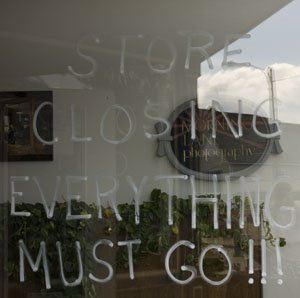
Unfortunately, about the time it seems Berlin is scoring a hit, it gets hit instead. Main Street is the heart of the downtown, and residents have been working hard to improve it. The last thing it needs is one more empty building. But Morning Lane Photography, owned and operated by Paul Charest, is shutting its doors. Mr. Charest said one of the hardest things to do was to write “Going out of business” on the windows. He said he apologized to the surrounding business owners before he wrote it. He is trying to sell the building too.
Mr. Charest said he thinks photography isn’t going to be viable in the long term. Too many changes with digital, now everyone is a photographer.
As I stood talking to him I felt the weight of my Nikon D200 on my shoulder. It, and the newer versions of it, are exactly what he was talking about. It is smarter than me when it comes to taking pictures and makes most of them come out well.
Of course it and I are not immune to the forces he talked about. My D200 three years old and already is obsolete. And I am writing for a newspaper, another medium that might soon fall by the wayside. I understand his frustration and his exasperation. I live it just as he does.
And just as Berlin does. This is exactly what this blog is about: Change. Berlin in changing. What will the city do about it? Journalism is changing. What will reporters, the public and society do about it? And photography is changing. What will Paul Charest do about it?
Paul is doing something about it. He admitted that it was hard to close a business after 21 years, a business he’d put countless hours into, but he’s training to become an X-Ray tech. He is moving forward, looking to what he can do to keep himself afloat. He said he’s excited to be able to spend time with his family, to take advantage of not being a photographer.

Has Berlin taken advantage of not being a mill town? Has journalism taken advantage of not being confined to print? Berlin and journalism: to entities rooted in trees. What will it take to move beyond them?
For Berlin at least, salvation lies in technology. City councilors are always complaining about not having a highway to Berlin. Why? So Berlin can wind up like Gorham on U.S. Route 16 just south of the city line, a corridor of low-rise big box stores with low wage jobs? If Wal-Mart and Tractor Supply Co. are the best of Berlin’s future the city is aiming too low. There are better opportunities out there for the city and its residents.
New highways are made of fiber optic cable, not pavement. If credit card companies can reroute telephone calls to Bangalore on cable laid across the Pacific, it shouldn’t be hard to run cable to Berlin. More and more people in Berlin are using the Internet. More and more people are creating careers for themselves while living in beautiful rural settings like Northern New Hampshire. The city has to facilitate that process and work to get city wide wireless, not pave over its historic buildings.
What else does the city need to do? The same thing Mr. Charest did — get an education. The job landscape isn’t changing in Berlin, it has changed. For a city with a blue collar mindset, there aren’t many blue collar jobs left. Even positions at the prison are easier to get if you have a college degree. Residents have a wonderful resource in the White Mountain Community Center; it would behoove them to use it.
Everyone could use more education, but Berlin is used to the work harder model, not the work smarter model. Residents have to get over that and learn all the things they don’t know. It is possible to do some jobs from anywhere, but it means knowing how to do those jobs. Berlin residents need to get an education in 21st century careers, because the ones that sustained them in the 20th century are gone forever. They are living in change, and they must decide if it will be a good change or a bad one.

Back Twitter

I was on Twitter last night just looking around when two bombs exploded in the capital of Indonesia. I noticed a post from an Indonesian that included some photos, so I started following the story and retweeting posts I found.
It was strange to be talking to people who live in Jakarta, witnessed this and were scared. They answered my questions, explaining what time it was there and translating earlier messages to English. They were getting information out to a world hungry for news. They helped me understand what was going on, and I tried to pass that knowledge on.
But there were also people posing ideas as to who could have set off these bombs. They were tossing back ideas, in some ways pulling the usual suspects out of a hat. Maybe some of them were informed opinions, maybe they weren’t. On my Twitter application, Journotwit, there is a box called “Chatter.” That describes much of what is on Twitter. It highlights both its uses and its limitations.

There is no editor on Twitter. As Jeff Goldblum might have remarked, and to paraphrase Mark Twain, “Reports of my death are greatly exaggerated.” That is much of what Twitter is — exaggerated reports. I had a brief instant where I thought the wire services like AP and Reuters were doomed by Twitter, but the moment someone started throwing out that Al Qaeda might be to blame I new that wasn’t a worry.
Today I noticed a Twitterer who reported breaking news. I looked through all the Tweets and wondered how anyone could have access to so many stories. Then I realized there were no links to other news outlets to elaborate on the reports. Suddenly I was thinking how easy it would be to make up each and every one of those headlines. I’m not sure if this Twitterer was, but I had no way of determining one way or another.
I work as a reporter. One of my jobs is to be skeptical. If someone tells me something, one of the best questions I can ask is, “How do you know that?” On Twitter, when news is breaking, it is hard to ask, “How do you know that?” I was able to do it at the beginning, before #Jakarta started trending, with hundreds of new posts every minute, but soon it was information overload. Soon I had too many questions to ask too many people. It was mayham, and no one was there to create order.
At that point I started looking for links to real stories, links to stories printed by reputable news agencies. The AP and Reuters were quick to get information out, and I am much more confident in what they print than I am what some random person in Germany, Georgia or Gorham writes about Jakarta. It was exhilarating to be there for the beginning, but too quickly it degrades into madness.

How was it good? I was talking to Indonesians. I heard from a woman who was there, a young mother. It grounded the story more than any video of smoking buildings could. I talked to someone affected by the bombs. I was scared for her. I had empathy for Indonesians. That is what good journalism should do. Twitter did it. That is impressive.

The Forefront

In some ways Berlin is leading the nation. I work for a newspaper that doesn’t exist in Berlin. Or anywhere for that matter. I am a backpack reporter, journalist 2.0.

The Berlin Reporter building is being turned into a restaurant by some hardworking people willing to take a chance investing in real estate in a city hopefully on the backside of a depression. I never worked in that building. Neither did my predecessor. I work from my car, from my cell phone, and from poached internet around the region.
When the city manager called me the other day he asked where I was. He assumed my 207 telephone number meant I was calling from Maine. And why shouldn’t he – no other local newspaper has an out of state number. But I don’t have an office, so my cell phone becomes my office.
Some days, when I’m trying to drum up stories, this arrangement is challenge. I often track back and forth from the community college campus to meetings and interviews because the college is the best place I can find to work that has Internet. No one minds if I hang out all day, making appointments and phone calls and writing stories.
I got a job in Berlin because the population of the city does not rely on the Internet sufficiently to close the newspapers. The Reporter and the daily paper both succeed while newspapers nationwide are folding. They aren’t really threatened by the Internet. Try to find a car on Craigslist in Berlin. They are there, but without the critical mass that makes Craigslist viable in other cities. Try for a Google News search to find out what’s going on in Berlin. There are stories, usually about the prison, but not the sort of coverage people expect and get in other places.
Berlin is disconnected. The distance between Berlin and Gorham is probably greater than the distance between Gorham and Concord. It is hard to imagine if you don’t spend a lot of time in the area, but if you ask the city council they know it. People forget about the city and have a hard time understanding its idiosyncrasies.

The people of Berlin are among the hardest workers I’ve ever met. They cling to their blue collar roots, which at times is a hindrance, but it is a city with a work ethic. Years of the promise of mill jobs trained people if they worked hard they would be successful. As industry has evaporated, however, this maxim no longer holds true. Industriousness is no longer enough, and the infrastructure isn’t there for other avenues to success.
Part of that missing infrastructure is high speed Internet. Berlin has the only public library I’ve been to in recent years without wireless Internet. There is also no Internet cafe in town. People don’t have the same connectivity as they do elsewhere, and that is a threat to their economy.
I used to live in Portland, Maine, where I met my wife and went to college. In the time I lived there I went from hating computers and connectivity to working and living through Apple products. Almost every building in the city has wireless Internet. It is easy to be a freelancer or employed at an online business. When my wife and I moved to the Conway area it was a shock how much different it was. Most of our friends are college educated, and most of them own computers. But many of them went to town to the library or the local cafe to do their web surfing. Sasha and I have uber-high speed wireless at our house and would be hard pressed to continue our professional lives without it. It was a transition to get used to people who worked in a different paradigm.
Then I got a job in Berlin. If the initial Conway shock was a tremor, Berlin was an the earthquake. There is no Internet cafe, no wireless at the library. The NHWorks office and the community college offer connectivity, but the community is not set up for the twenty-first century worker. The desire to draw those people to the community is there, but not the infrastructure.
A friend asked if Berlin could be an artists community in the same way Deer Isle is in Maine. I think it could be — it is beautiful, with inexpensive property for sale that could be easily renovated into studio space. These people don’t need much except inspiratirational surroundings and a quiet place to work. Berlin has a wealth of both. But they do need a way to get products to market; this is where Berlin is lacking.
Councilor Lafleur raised this point at the last city council meeting. He said the state needs to pave a highway to the city to increase its economic viability.
I disagree. That is twentieth century thinking, based on twentieth century technology. Relying on the internal combustion and cheap gasoline is not the way to ensure long-term economic success. Like building a biomass facility in the center of town, this is a solution for the last hundred years, and a mistake for the next hundred.
Instead the city should look to the Internet as its method of connection. There is no need to pave a highway to the downtown. In fact it would ruin many of the valuable assets the city has. Instead, the city should preserve its heritage, its buildings and its aesthetic. The twenty-first century highway is the information super-highway. This is where the city should put its energy and its lobbying efforts.
How do I know this will work? The Berlin Reporter already proved it does. I am an employee for a paper no longer in the community. I work twenty-first century style, commuting more miles over the Internet than I do in my car. The challenge is that Berlin is so poorly set up for this type of work. It is does not have the infrastructure to handle more workers like me. It needs to implement Internet 3.0 now to step into this century.

As it is, I am a backpack journalist working for print media. The only thing about this solution is it might put me out of a job.
Who will fix it?

Who’s responsibility is it to fix problems?
Throughout the journalism world, people are complaining about the demise of the status quo, looking to blame everything from corporate greed to Twitter.
Around Berlin people complain about the problems with the area.
Where is the SWOT analysis for both? Strengths, weaknesses, opportunities, threats. Everything is not gloom and doom in journalism, nor in Berlin. Let me point out some of the strengths:

Journalism

  • required for democracy
  • technology makes communication easier
  • technology is cheaper than ever
  • produces a valuable product
  • requires little more than a skilled practitioner to produce
  • has people who care about it immensely

Berlin

  • has hard working, resilient citizens
  • has a DOWNTOWN instead of urban sprawl
  • is located in a beautiful region with rivers, mountains
  • is actively thinking about the future
  • has low cost of living, low cost of property
  • has people who care about it immensely

At the city council meeting tonight councilors mentioned convincing people from Portland to travel to Berlin. The decor of Berlin could easily appeal to the Falmouth/South Portland crowd, if the riverside buildings were turned into upscale art galleries and restaurants and the detritus was removed. Is that were the city wants to go? Does it have the assets to move in that direction? That remains to be seen. Some people have said the city’s blue collar traditions might prove too much to overcome.
But pointing to problems doesn’t find solutions; pointing out possible solutions finds solutions. Who cares who is to blame, whether the problem is a lack of classified ads or a lack of jobs? The solution required is to find a solution.