More questions, and a few answers.

I make the rounds of the journalism websites that interest me the most, and I often find interesting discussions. The combination of a few of the websites, along with an interview with a dentist from Gorham, have been shifting my opinion about journalism’s future.

Why blame the newspapers? Or, more to the point, why look to them for a solution? Newspapers are like American car manufacturers: 20th century relics. Twitter and YouTube provided more by the minute reporting than the Times or the Post. Most of CNN, FoxNews and MSNBC were reporting what anyone with an Internet connection could have accessed at home. Both television and print journalism are in trouble, but journalism isn’t.
What do these mediums do well, and what do they fail at? Newspapers have proven to be better at second generation news. They do not cover unfolding events well, because as Jason Jones of the Daily Show put it, everything is at least a day old. Instead, they do a good job of compiling the breaking news into more in depth coverage. Sort of something between a weekly news magazine and Twitter.
Television news does opinion well, and that’s what they should stick to. MSNBC and FoxNews battle for viewers as CNN falls behind. What people are looking for on these stations is validation of their viewpoints, not an open discourse on the day’s events. That is what they do well, and they should stick to it.
It is up to the next batch of reporters to figure out how to make things work.
A dentist in Gorham was sent to the Dominican Republic by the U.S. Navy because of new computer techniques he was using. He said dentists hadn’t yet figured out how to best use technology, so he was trying to be on the forefront. That creativity is imperative for journalists.
The cost of video, audio and photo equipment is at an all time low, and the ability to post on the web is essentially zero. There is room for an explosion of publications run by individuals who’s passion is reporting. How will they make money? No one knows, but they will.
Look for opportunities, not challenges, and don’t be dragged down by the companies stuck in the past. Newspapers see challenges, not opportunities.
Young reporters, who have grown up in the digital age, have to be the ones to create the new model. They have to devise the next journalism, because the current one won’t last. It won’t fail, but the future will look very different. And instead of looking to the papers to figure it out, reporters themselves should be the ones pushing forward. The newspaper industry’s future is no bleaker than our own if we can’t devise whatever comes next.

The Future?

I have no idea where journalism is headed. Neither does anyone else. Witness the power of Twitter and Facebook in Iran and it’s clear traditional methods of media crack down will be insufficient worldwide. The democratizing force behind these advancements may be unstoppable, but it leaves me and the rest of the world wondering about the future of media.
Have you seen the video of Neda AghaSoltan’s death? She was gunned down by the Iranian government militia, called the Basij. The video was posted to Facebook through a web of forwards that got it out of the Iranian clamp down on communication. Now her name, which means voice in Farsi, has become a rallying cry. Twitter, Facebook and Google have been swarmed with searches for her name and views of the video. Journalism has moved from the hands of the reporters to the hands of the people.
YouTube now advertises the latest videos from Iran on what it’s calling CitizenTube. They seem to be acknowledging their roll as part journalist in this fight. And Twitter is appearing on CNN, FOXNews and MSNBC as a source for what’s going on behind closed borders.
In all this, with the newspaper industry having so much trouble, it’s hard to imagine what comes next. Journalism will be around forever, I have no doubt, but the 3.0 version may look much different. What are the funding streams? How will it be broadcast? Who will be the practitioners? I don’t have an answer. I feel like I’m on the first wave about to crash into the shore, and no one knows whether it’s rocks or sand below.
The future has possibilities expanded by technology — Iranians have proven that. Everyone now has to figure out where they lead.

Starbuck’s Morning Joe

I have to admit, as bad as print journalism is faring, at least it isn’t stooping to this level:

The Daily Show With Jon Stewart Mon – Thurs 11p / 10c
Corporate SynerJoe
thedailyshow.com
Daily Show
Full Episodes
Political Humor Newt Gingrich Unedited Interview

Personally, I’d rather see newspapers fold than have corporate backers like Starbucks. Thank you, Jon Stewart, for pointing out the sad trends in cable news. Joe Scarborough made some retaliatory comments on the air about the Daily Show piece, which Stewart dealt with on Monday night’s show. It is sad that Comedy Central has to keep its eye on cable news, but at the same time we are lucky to have Stewart’s analysis. Check out Hulu to watch the Daily Show, it’s worth it.

The Next Journalism?

I happened upon this article about where journalism is headed. I can’t say I’m on board 100 percent, and since it didn’t really explain what these entrepreneurs were doing it’s hard to judge. I’m not psyched about having to think about the success of the business while considering what to cover, and, as I understand it, online ad space is too cheap to sustain much, but it is good to see people thinking about how to revamp journalism and taking a proactive approach.

Long Day

The police arrested someone for arson and possession of stolen property, there was a fire started by a small child, the city held a public hearing about the 2010 budget, there was an open house for a program house built by high school students in the vocational program, and there was an event for the local after school program.

And that’s just Berlin. I am also supposed to cover Gorham, Dummer, Milan and other area towns. I stopped by the police department to ask about the 18 year old man arrested for arson and wound up talking with the detectives there for a while. We started talking about some of the larger problems Berlin is facing, and I started to wonder how the city manages with only two papers.
Only two? Does that sound strange? It is strange, because a daily paper and a weekly paper are more than many towns and cities have. But I am only writing eight to twelve stories a week, including the police log and covering city events. Today there were five events I found worth covering. That was today. I don’t have the time to cover everything, so luckily the daily paper covers some of those responsibilities. But still, there is enough happening, enough going on around Berlin, much less the surrounding communities, to warrant two daily papers and two weekly papers. Maybe the old model of the morning and evening paper would work well here, plus a weekly paper to dissect larger topics.
I feel like a throwback here, like someone who belongs in Chinatown or On the Waterfront. This seems absurd today, that a city of 10,300 should have three newspapers, but now, working in that exact environment, that’s what I feel would get the job done.
And what should it be worth to people? At tonight’s city council meeting there were references to stories in both papers, statements made by councilors and residents making it clear they were reading the papers. They pay 50 cents a week for the Berlin Reporter and nothing for the daily paper. Is that what it’s worth? Would people pay $26 a year to know what is happening in their community? I would think so. I know people who pay $3 a day for coffee. It doesn’t seem so far fetched to pay as much $3 a day for news. I know the Internet is taking over, I know people see papers as passe, but the idea, the concept of print journalism, is timeless.

I was talking to a detective about the man who was arrested last night, and I asked if I could talk to him in jail. He looked at me and said, “You really like to dig, huh?”
Who else out there is digging? I don’t know that I like to do it, but it is what I am in Berlin to do. And I would hate to live in a world where no one did it. I intend to talk to everyone I can, not just take someone else’s word for any fact. I hope a model can be developed to do my job in a twenty-first century medium, and I am thankful the Reporter is still willing to do it in print. I hope the citizens of Berlin are thankful as well. I hope I earn their 50 cents.

The Latest Fire


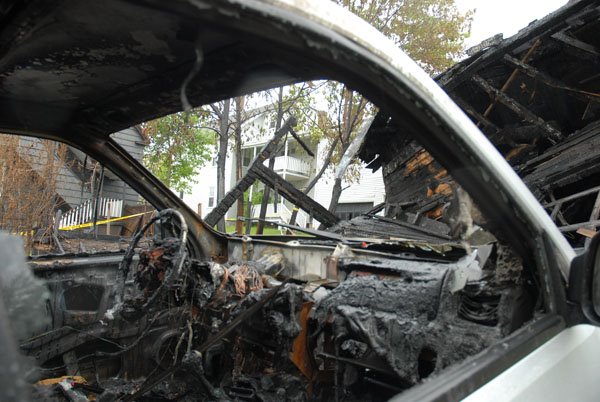
One more weekend, one more fire. Today I made it over to the garage that burned Saturday night. The garage was behind an empty house, and it caught the neighboring house where someone was sleeping on fire. The woman got out unharmed, but the house needs repairs. Firefighters were able to save it, and Karen Bradley, the owner, was amazed at how effectively they fought the fire. The garage, however, didn’t fair so well, and several cars were also badly damaged or destroyed.

Now the big question: how does it all get fixed? Mrs. Bradley has insurance, but the remains of the garage are leaning on her house, and she doesn’t know who owns it. She is a lifelong Berlin resident, and this city isn’t big enough for anonymity. The owner most likely lives out of state or out of the area, which is the central challenge for Berlin. As I wrote in my last post, it is often worth it for landowners to walk away from burned out properties instead of fix them up. But where does this leave the landowners who want to rebuild? Usually it doesn’t matter, because if a house burns down it only affects itself, or even if it catches other houses on fire it doesn’t stick around for the cleanup. But Mrs. Bradley needs the garage moved before she can go to work. If this property owner is like many in the area, this may prove a challenge.

Berlin has a host of challenges, between fires, absentee landlords and property owners, job losses and a declining population. My job, as I see it, is to sort them all out for the citizens of Berlin. It is amazing to watch this large group of people, all with the same general goal but with a million competing specific self-interests, wrestle to work together.
The fire department can’t tear down houses because they’re private property. The property owner can’t rebuild because she needs the abutting owner to raze his property. The landowner might not want to put money into a property essentially devoid of value, and for the city to tear it down it’s a year long process and takes $25,000 to complete.

Last week, at the meeting about the fires that almost no one showed up to, people were complaining about a property on Gilbert Street. I stopped there today as part of a story I’m working on. At first I couldn’t tell which property they were talking about — there were too many abandoned properties on Gilbert Street. But then I looked around, and the one they were upset about became obvious. But what is the city to do? It is private property, and they can’t just tear it down. And what is a landowner to do? In this incendiary environment every vacant house looks like a target. No one wants to be the next Mrs. Bradley.

How do you sort out competing interests all headed in the same direction? How can the city preserve the rights of out of state landowners and the safety of residents? They have to stay within the law, they can’t just bulldoze all the empty properties in the city, of which there are more than 100. The city and its residents are caught in a battle fighting themselves for the same goal.

I’m working on a piece about this for next week’s paper, but it is hard to put all these issues into one story. The fires, the long distance landlords, the city’s efforts and the residents’ fears all coalesce into something too big for a thousand words. But it’s hard to imagine who will tell it in cities and towns across America if print journalism fails.
Pick up the Berlin Reporter and there is a week’s worth of conversations and interviews, events and insights from the residents of Berlin and Gorham. I find it hard to understand how this city, or any city for that matter, can function without a paper. Too much goes on every hour, every day and every week in any town or city for people to just pick it up. People can filter the world through the Internet, or television, or radio news, but that doesn’t filter the local. And the local doesn’t matter, perhaps, until you wake up at 2 a.m. to your dog barking and your house burning. Then, all the sudden, what the reporters in your town are doing matters.

I have a job!

I’ve been trying to find work as a newspaper reporter for years. YEARS! Honestly, as I watched newspapers nationwide crumble, I thought it was a pipe dream. I was looking into going to grad school for economics, because the possibility seemed too remote.
Part of that is my fault. I love the outdoors, so I chose to move back to rural New Hampshire after college. If I was completely consumed by a drive for a job in print I would have moved to NYC, or Boston, or at least an urban center. But in order to rock climb and ice climb and ski I moved to Glen, NH, right next to the greatest climbing town in the world. (Check this out for proof.)
And I tried to find work in journalism. Northern NH is not the place to job search, I soon found out, and I had a lot more trouble than I’d hoped. I was able to piece things together, working as an ice climbing guide and doing freelance graphic design work, but the only journalism work I could get was the occasional freelance piece for NHPR. It was not nearly enough to eek out a living, much less to satisfy my professional ambitions. I needed more.
Not a lot more, but forward progress. I love journalism. I always thought I wanted to work for a daily paper, but now I know better. I want to tell stories, to get human experience across, whether it is on a page, through photographs, video or sound. I took a job at a radio station through college because I wanted to learn how to tell stories like they do on This American Life. That is what I want to do, because journalism is the greatest tool for positive change available in a free society. I cannot, as one man, make abortion legal or illegal through political means. I cannot make gay marriage legal or illegal. I cannot stop violence in Sri Lanka, Somalia, the Sudan or South-central L.A. through any application of political, military, or economic force, as one man.
But I can by writing. I can by photographing. I can by recording, and editing, and broadcasting, and showing.

The first piece I did for New Hampshire Public Radio was about methadone. In Conway, NH, a group tried to open a methadone clinic, but they couldn’t muster support within the community. Eventually the plan disintegrated. People were divided on whether they liked the idea or not, sometime rather vehemently. It was a decisive issue that made people angry on both sides.
I didn’t feel like rehashing one side’s argument, then the other. And the news director at NHPR didn’t feel like airing that story. But he did like the story I wanted to tell: people drive from Conway to Somersworth, home of the nearest methadone clinic, 62 miles way, every day to get their treatment. Agree with the clinic or not, their story, their experience, should be told. They are part of the argument, part of the town, and their story needs to be told too.
It is a universal fact: no story isn’t worth telling. No one’s life isn’t worth showing. A corporate executive, a president, a thief or a child, all of their stories are valid. Some people tell their stories with pictures. Some tell it with art. Some tell it with Twitter. And some tell it in Print.

I work for the Berlin Reporter. That’s Berlin, NH, not Berlin, Germany, and it is pronounce BER-lin, with the emphasis on the first syllable. They changed the pronunciation during WWII to disassociate themselves with the Third Reich. It is “the city that trees built,” according to its motto. It was a mill town. The city is proud of its heritage, but it is still trying to figure out how it fits into the present. I am the only reporter for the paper. It comes out once a week, made up mostly of the stories I write and the photos I take.
It is a wonderful thing, the paper, because it is for a city that does not get its news from the Internet. It is for a city where everyone has a home telephone, and not everyone has a computer. The paper costs 50 cents and people are willing to pay for it. It is a city with only its big toe in the 21st century; the rest is unsure how to dive in.
Berlin has empty mills, houses and storefronts, but people with a passion for the city that makes them do strange things. At the last city council meeting the council had to fill a vacant seat until the next election. Five people showed up to interview for the seat, and a sixth, a high school student, wasn’t able to make the meeting. Not one of the applicants had served in a political position before, but each one said this was their city, and they wanted to lever it forward, to regain its past glory. One of them, a homemaker with two kids, said honestly she didn’t know many specifics about the most recent issues the town was dealing with, but she loved Berlin and wanted to help it prosper again.
Prosper again. Berlin prospered once. Earlier in the 20th century, Berlin had 22,000 residents. Now it has 10,300. Berlin was the third largest city in NH, a city quite literally built by trees. The paper mills, and pulp mills, and industrial production that fueled the city’s growth have withered, and only their hulking remnants remain. Berlin was left behind by the American Century, and it has a long way to catch up. It is a city not clear where it is going or how to get there, but passionate people help it along.

I can’t help but notice the parallels between Berlin, NH and the profession I’ve chosen. I don’t see the light at the end of the tunnel for Berlin or print, but I am amazed by their noble histories. I can’t imagine a world where the people who love either would allow them fail. It seems both ludicrous and painfully obvious that the city of Berlin and the institution of print journalism are past their prime.
I work in city that is a relic from America’s industrial age, chronicling its slow decay. And I do it in a medium doomed to follow suit. I hope print journalism has people as dedicated to it as the residents of Berlin are to their city. And I hope to be here watching as they are both reborn. I hope I am not the Last Print Journalist.