Ten Years

Ten Years

I woke with a start and flipped a calendar: 10 years ago tonight we met. We climbed together at the indoor rock gym and then went to the Front Room, an intimate setting a short distance from the ocean. You wore a wool skirt and a smile. I was still in my climbing clothes. It was a Tuesday. I said I wouldn’t have time to see you again that week.

On Thursday we met at the Top of the East, Portland’s rooftop bar. You introduced me to your work friends and we got takeout. You spent the night.

On Friday we slept together. I asked you, “Are you for real? Is this really you.” You said yes. I knew then I would marry you.

A year later I asked. It was my birthday. Again climbing, I knelt down halfway up a cliff in New Hampshire. You started crying even before I finished. Your legs wouldn’t hold, couldn’t carry a body so overwhelmed by laughter and tears. We were 600 feet up. You didn’t trust yourself to hold the ring. You put it on, cried out with joy, and then asked me to keep it until we got to the top. I put it in my backpack and went. When you reached the top you kissed me, crying.

I don’t remember if that last part is true, but it has to be.

A year later I waited on a bridge. It was autumn, rain falling. It was getting dark. Japanese lanterns hung from the roof supports. Candles marked our walkway. The Swift River ran beneath. I remember when I saw you: You stood in white, your hair twisted in a knot of curls, hints of purple brushed over your eyes. Rain spit against the umbrella your father held but could never touch you. Nothing could touch you. You looked so beautiful, soft as snow. I don’t remember music, or sound, or the other people. Or anything. I remember you walking towards me, smiling again, your eyes searching for mine.

The rain and the river closed out the world. Your footsteps and breathing were all I heard. I don’t remember “I do,” but I can still feel your hand sliding the gold band up my finger, solid and heavy and light at the same time.

But that was after. Before and after. Before it fell apart, before court documents and divided possessions, before life seemed too fast and too slow, too ordinary and too silent. Before we moved into separate houses. Before it was over.

And after. After that first night I saw you walking towards me. After wondering if this was the same girl or if in the short drive from the rock gym to the restaurant she’d somehow gotten lost. We’d just spent two hours climbing, sweating and playing, but here walking towards me was a stunning woman, beauty in a skirt, her hips clicking in time to her heels. Her smile lit up the night.

That was you. Your smile grew as you reached me. I remember that too.


Two Months

Two Months

13682554_606482239532046_749095496_oIt’s been two months since I left Belize.

Two months. Two full moons. Two cell phone bills. It seems like a decade ago.

Here in New England the leaves are changing. There is a bite in the air each morning. The ocean looks grey, no longer warm and inviting.

In Belize, however, it’s still summer, or at least some version of it. It’s that season where shoes and shirts are optional. The salt air along the coast hangs thick and fans are mandatory for sleeping. It’s always that season in Belize, a perpetual Caribbean waltz where “Go slow” is more than a suggestion. It’s a way of life.

In the Cayo District 100 students are cracking their books. They have names like Chris and Karen and Joshua. They are wearing uniforms, pouring over worksheets, sitting at attention while the teacher talks and then goofing behind her back each time she turns. They are laughing, smiling, passing notes, switching from English to Spanish to Creol as comfortable as dancers, a veritable language cacophony.

And if you listen close each time they switch to English you might notice something: their mastery has grown. They use the language with a slice more confidence than last year, something over the summer made it build, thicken. They are learning to wield it rather than be driven by it. They don’t just know English, they are becoming English speakers.

What happened?

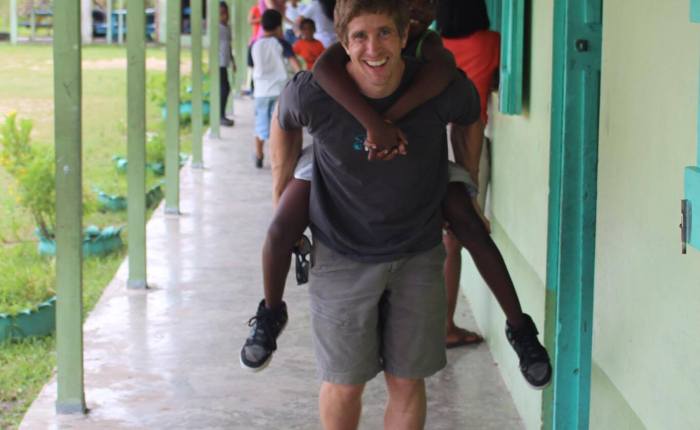
Us. We happened. Me and 30 other volunteers ages 14 to 40 spent two weeks sweating through the Belizean summer to get these 100 Belizean students talking that way. For that two weeks they were sitting at attention for us, and then of course goofing behind our backs. They learned our language and our names, played our games and sang our songs. They made us laugh, and when we left made us cry.

That was two months ago. Today sitting with my cup of hot apple cider in my kitchen watching the autumn wind pull leaves across the lawn it seems much further away than that. It seems like another lifetime, another world, a distant past.

But.

But there is always next summer. There is always another classroom, another 100 students. There is always a roomful of kids excited to sing songs and play. But next time they won’t be strangers. They won’t be students or kids. Next time I will call them friends.


This piece appeared on the blog of Global Service Partnerships, a Boise, Idaho-based nonprofit that runs English literacy programs in Belize.

From the Backseat: MECA, Me and Swirling Eddies

From the Backseat: MECA, Me and Swirling Eddies

14444663_1636164186409660_5623119052921151833_oI’ve always loved the Porteous Building. The home of the Maine College of Art sits regal and square, a hub spinning eddies of creative energy into surrounding streets. Behind its department store facade hides an economic engine, a piston of Portland’s arts economy, sweeping windows and cascading stairways that breathe life to center Congress.

I first noticed it in 2001, the first time I moved to Portland. I was 20, dropped out of college a second time, working a warehouse shift at L.L. Bean. I lived diagonal from MECA crashing on the couch of my sister’s third floor apartment for token rent, woke each morning before dawn to catch a carpool to Freeport, home by early afternoon. Life was rote, routine, boring.

But just down the street MECA was a cauldron of creation, pluck and juice. There was an energy in the punk-style of the art kids who poured through her doors each day. A fire draped the work that hung in her windows. From my perch I could watch it stream past like artistic magma, stirred and prolific but too far to touch. I left Portland having never walked through her doors.

Four years later I was back, my second try at Portland aimed to finish college; this time as a double-major in political science and media studies. MECA’s creative curriculum wasn’t my syllabus. But I needed money and MECA needed models.

The first time I took my clothes off in a roomful of students was for an evening class. Painting. We were on the third floor in a room with the floor-to-ceiling windows that make Porteous so beautiful. I sat naked on a couch holding a 45-minute pose.

At first I thought I was comfortable. But after 10 minutes my neck grew tight. Soon my shoulder ached, my legs trembled with fatigue and my back cramped. By 25 minutes I was in agony, resigned to stillness among shuffling palettes. Sitting there naked I wondered if anyone outside could see in; if the glow lured peering eyes perhaps from some third floor apartment across the way.

When the teacher called a break I collapsed, wrapped myself in a second-hand bathrobe I’d brought for modesty and walked to the window. I looked out at the street dreading the next pose’s 45 minutes of pain.
Then I turned around. In front of me ran canvas after canvas of bold readings of my body, interpretations like twisted mirrors of paint and light and skin tone. I wandered from easel to easel mesmerized by translations striking and alive, bound by darkness, light and mystery. And I was a part of all of them.

I walked back to the podium transfixed. Suddenly the next 45 minutes became a different dance: I now knew the creative fires being lit around me, and that knowledge steadied my pose. I sat engaged, part of the process, a willing actor, no longer concerned with who might look in. I wasn’t there for the money anymore but a witness to the creation unfolding around me, a central ingredient to its birth. I would not miss it for the world.
Two days later I was back for a drawing class. Then for comic class. Then another, and another. I had a front row seat to unselfconscious expression and every class was opening night. Porteous was hemmed by reckless creation and inspiration. And I sat in its center.

But all good things die. It lasted a year, then my modeling career came to an end.

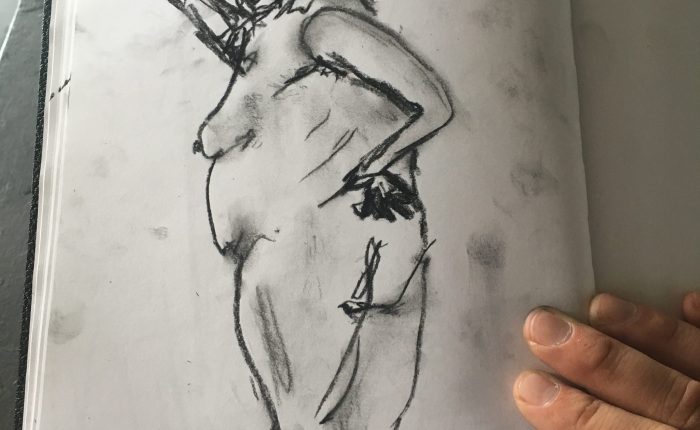
This past Sunday I walked into Porteous once more, this time a student. I carried my drawing pad to a room where I once stood naked. Our model, a woman of perhaps 60, sat casually in the corner. When it was time she stripped her dress and took to the podium like a prizefighter, she the captain, the room her ship. I did my best to anchor her poise and certainty in charcoal, but untrained fingers tripped and fumbled. My renditions were colorless. Only she could do her body justice.

Porteous’ windows and stairwells, however, knew better: Mine was one more act of creation born within her walls. One more mesmerizing eddy.


This column appeared in this week’s Portland Phoenix.

CDS Column: Freedom, Iceland and Campervans

14188326_1604753102884102_6073273407149284030_oIn Iceland it’s easy to rent a camper van.

They are everywhere, little Citroens, Peugeots and Ford Transit Connects rigged with curtains, beds, sinks and stoves. They zip up and down the two-lane highways like miniature delivery trucks pulling over wherever to offer overnight accommodation.

There are bigger Mercedes Sprinter vans and full campers, too, and even rigs that look like a cross between an RV and military transport, go-anywhere-campers equipped with huge tires and undercarriages that ride feet above the road, but it’s the little camper vans that buzz around the desolate isle like bees, their occupants in search of adventure.

And there are adventures to be had in Iceland — glaciers, mountains, geysers and waterfalls, hiking trails and hot springs, whale watches and black sand beaches. The country is crawling with visitors, mostly Europeans but Americans and Canadians, also, there to see volcanoes and ice caps, to ride horses and explore ice caves.

And when the day is over, they pile into their delivery vans, find an empty parking lot and go to sleep.

This isn’t like New Hampshire, where landscape and pine forests might conceal the little red cars with names like “Happy Camper” and “KuKu Camper” pasted on the side. Iceland is a barren place; lava flows coated in emerald moss stretch for miles. It would be easy to veer off the blacktop and just drive almost anywhere, no obstructions for miles. Far-off mountains, plateaus and camper vans dot the landscape, all in clear view. Scenic viewpoints and dirt pull-offs everywhere become impromptu campgrounds each night, three or four cars to a lot.

14124927_1603110626381683_7502455490426160407_oBut no one minds, and no one complains. The police — there are few in Iceland — aren’t about to break up the party. No one is asked to move along. It’s just not a problem, something part of the culture.

And it’s not just the cars: In Iceland you can go almost anywhere. There are trails crisscrossing private land, and tourist sites sit adjacent to homes. Iceland is just open. Anyone can go anywhere. Roads might be posted for vehicles, but walkers can go pretty much anywhere.

The rules are codified in the Icelandic Nature Conservation Act, which stipulates “everyone has the right to travel around the country and enjoy its nature,” according to the website of the Environment Agency of Iceland, “as long as the traveller is tidy and careful not to damage or otherwise spoil natural resources.”

It is “permissible to cross uncultivated private property without seeking any special permission” in Iceland. “Landowners may not hinder passage of walkers alongside rivers, lakes and ocean, or on tracks and paths.”

The result? A country where everyone is free to wander, welcome to roam. Backpackers pitch tents in any open field, walkers wander along exposed clifftops, and car-campers park for the night anywhere they please.

Another result is less concrete by no less real: a feeling of openness, of freedom, of unrestrictedness, a right to be where you are. It is a feeling unfamiliar in America. But in Iceland no one is ever going to ask you to move. They aren’t going to ask you to explain yourself, to demand you produce your ID. The default assumption is you have the right to be where you are, to stand where you are standing and walk where you are walking. Private property is not so private to exclude you access to it.

It is a different version of freedom, one that runs deep on the island of fire and ice. It even extends to the national parks: There are no entrance fees, no gates or rangers. The mountains, waterfalls, natural hot springs and glaciers are all open; there are no ticket sales. Iceland may be expensive — it is an island, after all, and imported goods cost accordingly — but to gain access to the land is free.

Contrast that with our version of freedom, the version so vehemently celebrated in the Live Free or Die state. Here the word means not universal access to the land but the right not to be bothered. “My home is my castle.” “Don’t tread on me.” Freedom is a celebration of a place where I do not have to fear interruption.

Here in New Hampshire — and in America — freedom is a form of protection, a cloak, a warm blanket to wrap ourselves in. It shields us from the darkness and the night, all the terrifying and unwanted things crowding outside our doors.

But freedom doesn’t have to mean that. Iceland lives a different version. Freedom there is not the protection of a closed door but the chance to throw open the windows. It is a chance to abandon home completely and explore the world, to wander and get lost without fear of persecution, to head for the horizon without risk of reprisal. It is the right to exist exactly where you are, to not apologize for standing in place no matter where that place is.

Maybe everyone grows accustomed to the version of freedom they are born into, the version they grow up with. But those camper vans dotting the highway, those hikers pitching tent in empty fields, they represent a different version of the word, some meaning long since forgotten at home. Somewhere between the White Mountain parking passes, the Do Not Enter signs and Echo Lake entrance fees, we got lost. Suddenly, our land wasn’t ours anymore. It was yours, and only yours, to keep free.

But that’s not everywhere. In Iceland, little red cars with beds in the back swarm the land, buzzing their way freely wherever they like. The wind carries them past the lava and snow, over rivers and next to oceans. It’s all free, and it’s theirs. Because “everyone has the right to travel around the country and enjoy its nature.”


This column appeared in the Conway Daily Sun.

CDS Column: A Shot in the Dark

CDS Column: A Shot in the Dark

IMG_7944-1I’m not much of a hunter.

Last year was my first season. I took the hunter safety course in the southern part of the state, a consequence of waiting until the last minute to sign up. But three days of spoon-feeding later — information distilled so simply failure wasn’t an option — I had state approval to walk the woods with a gun.

A hunting license, paired with no idea what I was doing. An old hand-me-down 20-gauge I’d been given in high school would serve as my long sword, and a few stops at the L.L. Bean outlet set me up in blaze orange. I was suddenly poised to kick around the woods with a loaded firearm, crisply dressed and legal but still far from lethal.

So, for my first day out I recruited an experienced friend to lead me in my pursuit of ruffed grouse, an appropriate-seeming challenge. We walked Jackson woods on overgrown logging trails waiting for an explosion of wings or the sound of their distinctive drumming, but we saw nothing. Instead of entering the arena of primordial provider, I took a pleasant afternoon stroll.

Lots of hunting days, my friend explained, are spent like this, more wandering through empty woods than shooting. The gun on those days is a hiking accessory.

Two days later, I was back, this time on my own. A grouse, I was determined, would find its way to my table. I drove the same dirt road looking for deciduous forests along sunny slopes, the sort of place a healthy grouse might opt to make roost. I parked at a pullout, donned my orange vest, loaded my shotgun, laced my boots and set off into the forest.

The explosion caught me off guard, barely five minutes in. A rustle catapulted a bird into the sky, and it streaked from left to right like a football bound for the endzone, wheeling around trees and darting out of sight.

My gun never came up. The lightning bolt erupted faster than I’d imagined, and I stood dumbfounded. This was going to be harder than I’d thought, I realized.

But I’d seen it, noted its general direction. It wouldn’t go far. This was its territory and it’d stick close. So, I followed it, tromping dead trees and downed limbs looking for wherever the football had landed.

Fifteen minutes later, my steps triggered another explosion, this time streaking back right. I’d found it, but again I was flat-footed. My gun hung across my thighs, never approached my shoulder. I didn’t have a chance. This bird was better equipped for survival than I was, and another hour of walking failed to scare it up for a third time. I walked back to my car with nothing but a shotgun in hand.

More wandering in the woods than shooting. It was proving true.

But the shooting was what drew me to the woods, what pushed me to hunt: Not the sport of it, but the killing. Like most of us, I am happy to eat a hamburger or chicken on my Caesar salad. But I have never killed a cow, never chopped the head off a hen. Our food does not demand such commitment. It’s easy to eat steak without ever coming face-to-face with a living, doe-eyed cow, much less having killed one. Our killing today, like so much in our economy, has been outsourced, and not just to the neighborhood butcher.

Not that I’m opposed to the killing. Every carnivore and omnivore does it, all without the guilt humans wrestle with. But our habit is to kill from a distance, to leave it to others while reaping the benefits. It’s a tendency that engenders complacency. Ignorance in the face of death lets things to get messy in dark corners.

Across Idaho, Utah and Kansas vast feedlots line the highway. Herds stand crowded into brown squares stripped bare of grass. Cows stained dark with mud and feces stand resigned to lives hemmed in on four sides, the bovine equivalent of cubicle-bound.

These are not happy cows. They live this way as a consequences of distance, the result of ordering the sandwich without having to raise the meat. It is a system built to maximize efficiency at the expense of humanity (or bovinity perhaps). Bullfights may be decried as cruel, but the ring offers more life than the feedlot, and everyone winds up hamburger by dinnertime.

The factory farm, however, lets us keep our hands clean. The bullfight, meanwhile, occurs center stage in blood red. How curious one is banned while the other is good business.

Hunting was my reckoning. I went into the woods to walk among feedlots, to take my part in the killing up close, a shotgun filling the space of captive bolt pistol, no more handing off the task at reduced rates.

But it didn’t happen. I didn’t even raise my gun, not that day nor any of the following. I wandered woods and watched birds streak like footballs through the foliage, but my reflexes were too slow, my gun never reached my shoulder.

Left to my own devices, I determined, I would starve. Ideas about ethics and ideology would play no part. The only meat would be store-bought, and questions about the veracity of my carnivorous spirit remain unanswered. The ferocious hunter I was not.

It is, however, that time of year again. Lucky for the birds I’m not much of a hunter.


This column appeared in Wednesday’s Conway Daily Sun.

Traveling.

Traveling.

I have lots of thoughts. They begin with this:

If that is where your heart is, go.
Be prepared to be lonely, hurt, scared, lost, overwhelmed. And go.
If you wander you are accepting instability. It will overwhelm you at times, and it will show you tremendous beauty.
It will remind you of the impermanence of things.
It will give you the space and the emptiness to recall all of your failures, all of your imperfections.
And in facing those you’ll find courage, remember your heart. And you’ll also drown.

It is worth it.
But the things you are seeking to escape will still be there when you return home.
Life is a balance of movement and stillness, and it is in the stillness that we recover our hearts.
But the movement is necessary. It uproots what is otherwise hidden.
So that in stillness you can consider how to move through it.

Your heart is amazing. You are looking for it, trying to learn how to remember yourself. I get that. My heart is the same. All hearts are the same. The base ingredient of this world is love. Beauty and love. But we forget. Sometimes we need to shake things up to remember.
But in truth they are there all along.
You are those things.
In movement and in stillness.
Yet it is so hard to remember.
If you need to go to remember, go.
If you feel going may offer something, go.
And when it is time for stillness again, you’ll know.

It’s already there in you. Perfect, beautiful, amazing. But sometimes we need to remind ourselves.
And sometimes we need to wander.
But there are 1,000 ways to wander.
Some mental, some physical, some emotional.
If you have been in one place for too long, perhaps geography is what needs to change.
But.
A shift in place will not fill that space.
It will distract you for a time, an elongated moment, and then the emptiness will come screaming back.
But wandering will give you fresh eyes to see the connections you already have, the community you left behind.
It will remind you of its richness.
That is its gift.
That is why I say “Be prepared to be lonely, hurt, scared, lost, overwhelmed.”
Leaving will allow you to see what you have with fresh eyes.
But what you feel is missing is not missing.
Nothing is missing. Nothing is ever missing.

You are in this moment now because you need to be. Nothing is missing, nothing is broken. Your heart is reminding you it is up to you to create the world you love, the one that feeds you. Your seeking is about something else, something more elemental.
Movement may be part of recognizing what that thing is.
It may be an important part.
But the struggles inside you are your heart, not your place in the world. The place you are in is exactly the place you are meant to be. It is in recognizing how to move from that place that we get lost.
And in thinking there is a right way to do it.
Go or stay, you are doing what you need to do.
And stripping your heart bare—that is the key. To everything. No matter what.

Do not seek to be happy.
Seek to experience life.
Seek moments like now, where you are wondering what to do.
Those are life’s experience.
They are worth holding onto, moving within, breathing in, swallowing until they drown you, sharing.
You are worthy of sharing. Of being reckless with your heart and your choices. In whatever way fits for you, feeds you.
Love cannot hurt you. It cannot bleed, maim or kill you. It only seems to when we look to bend it to our own purpose, when we seek to control it, to force it to feed only us.
Instead, let your love feed the world. Offer service and kindness to others. That is the key. It is what feeds our hearts.

I cannot do this, what I aspire to do.
So I keep practicing.
You understand. I know you do.
The world wants us to see love as a gift, not a cage, not a binding contract. And yet we fight against the world. So it keeps reminding us.

If I sleep with you I’m going to want to keep you.
And that is OK.
It is the place I am at.
This life is about learning to let go.
So I keep learning.
But I do not start from a place of fear.
I start from a place of recognizing and accepting myself.
And gently leaning into the struggle.
Without judgement for myself.
That is love: a practice ever evolving.
You will slip and fall.
Yet that is not failure.
That is THE POINT.
It is you, you being perfectly you. It is beautiful.

We are all searching for a place to be ourselves, fully ourselves.
Most love is a box.
You are worthy of more than a box. You are worthy of everything.
Can I offer that?
Can you?
No.
But that is what we are yearning to become, where we yearn to be, not some other place but in a space where both we and the world can be ourselves.
So we practice.
Practice however you have to.
Nothing is missing.
We are just confused about love, the world and everything in it.
When someone else hurts you, remember they are confused.
When you fuck up, remember you are confused.
Never understand anything.
Just wonder.
I wonder about you.
It feels good to be wondered about. Amazing.
That is love.

Love everything.
Everyone.
Understand nothing.
Love the world. All of it.
Then you’ll see nothing is missing.
Your job is not to be perfect. Your job is to be a mess. To be confused. Lost. Drowning. Overwhelmed.
To let go of judgement. Of yourself and others.
When someone hurts you, you still love them. Love them fully. Openly. With everything. With your all.
Accept them as perfect, even when they are a mess.
The point isn’t to be happy. The point is to feel: sadness, hurt, loneliness, these are what you are searching for.

Confusing, but worth it.


13497627_1521654587860621_4683670894975756410_o

Ended Hiatus

Ended Hiatus

13730801_1553661621326584_6611188446585815400_oOK. So I’ve been working in Belize for the last month, which has meant I’ve not been keeping up with my posting duties. Internet access was temperamental, time was limited, etc., etc. But I fly back to the U.S. in a few days (currently hanging out on one of the most beautiful beaches in the world), back to my car (parked just north of Seattle), and figure out whatever is next.
And honestly I don’t have any real idea what is next for me. I had thoughts of staying out west, but over the last month a number of things have been calling me back to New England. Not enough that I know I’m heading directly there, but I’m looking harder at a handful of opportunities near what has long been my home.

It feels good to have that pull. Belize has been amazing—working with American high school kids running a summer camp for Belizean middle and elementary students focused on improving their literacy skills. It was a time out, time off from the road, from climbing and adventure, time for human contact and connection and cultural exchange.

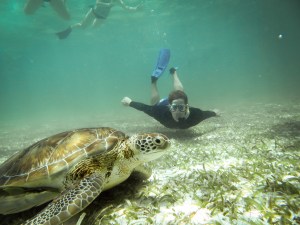
Belize-3503And it was an ecological exploration. Belize is home to the second longest barrier reef in the world, multiple ecosystem zones, caves, jungle, mountains and savannah. Iguanas crouch in the trees, tarantulas roam the forest floor, toucans haunt the air. I saw a manatee, two Harpy Eagles, a jaguar, held a boa constrictor, swam with sea turtles, pondered over leafcutter ants and got bitten by thousands of bugs. It was an awesome amazing trip, one I’ll be writing about more. But before that happens I wanted to share a video. My dance with sea turtles reminded me of it. At 2:25 is the job I think is probably most interesting in the world: sea turtle wrestler. Heck yeah! Lifetime aspirations! 🌊🐋
Flipping Sharks

Flipping Sharks

IMG_8391The Washington state ferry from the San Juan Islands to the mainland was the end of the trip. It’d been a day of chasing whales—an orca museum combined with Lime Kiln State Park, the best spot in the world to see whales from land. We did not, however, see any whales. Tim, Lev (Tim’s two-year-old son) and I had made a day of it, but now we were on our way back to Mount Vernon, Wash., and Tim’s farm.
Then an announcement came over the loudspeaker: “There will be a presentation on whales at the rear of the boat. Anyone interested is welcome to attend.”

Whales. I’d be there.

The naturalist presented to several rows of kids and families, but the kids quickly lost interest. I stayed, peppering her with questions about orcas. And she told me something peculiar. I was asking if changing ocean temperatures were causing more interactions between local orcas and great white sharks, and if so what was the outcome. “It’s pretty remarkable,” she told me, “they are meeting, and they fight. And when they fight the orcas win.”

“The orcas are pack hunters,” she said. “The sharks are loners. The orcas have learned that if they can flip the sharks upside down they essentially can put them to sleep. Killer whales are smart enough to take advantage of that fact. They’re pairing up and using the technique to put the sharks to sleep. Then they drown them.”

Whale versus shark, the whale wins. Awesome. And what’s this about putting sharks to sleep?

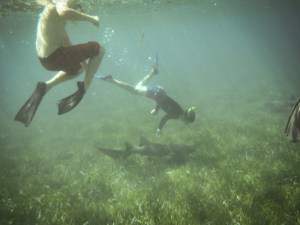
Less than a week later I found myself in Belize, snorkeling “Shark Alley” on the second longest barrier reef in the world. The sharks there are nurse sharks, a tame cousin to the white shark. Our guide Carlos took the opportunity to demonstrate exactly what the naturalist 2,600 miles a way had explained—he swam directly over a 6-foot nurse shark, put one hand on its back, another on its belly, then rolled. Instantly the shark went limp. He carried it in his arms and swam it over to us, let us pet it and touch its skin.

I wanted to try. I could see them swimming just six feet below, brown arcing bodies in the reeds. I dove down several times before I could work up the nerve to touch them. But then I went after one, put my hand about where its shoulder blades would have ben if the man-sized shark were human. Its skin was course as sandpaper. I swam with it, tracing its path, one hand on its back, then kicked myself down close and slid the other hand under its belly. We were tight together then, the shark and I. I rolled.

The shark rolled with me, and as it flipped and its belly rose toward the surface it went limp. I held it close, kicked my way upward, cradling the ancient beast in my arms. It felt about like holding a worn out Rottweiler in my arms—things were fine, but how long would they stay that way? After a few kicks I rolled the shark back over. It flicked its tail and instantly resumed swimming. I released my arms. It carved away.

I did this three times. One of the group members caught it with a camera.

Belize-0986

Belize-0987

Belize-0988

Belize-3589

It was amazing to be so close. I have since learned that what our guide was doing is frowned up, and that I shouldn’t have followed his example. I probably could have guessed that had I thought about it, but I didn’t. I looked to him for direction, and when I saw an opportunity to do something that scared me, something that seemed both amazing and stupid at the same time, I swam at it full steam. Literally. And so I got to carry a shark in my arms. Life is an experience and that was a unique one, even if it was foolish, illicit and perhaps damaging. Now I know. So don’t flip sharks. But it works. Orcas do it, and I have too.

IMG_8393

Shattered Glass Beach

Shattered Glass Beach

IMG_8192.JPGThe idea sounded cool when I read about it a month ago: a beach made of sea glass, stones replaced with ground shards of white, green and brown. Rare specks of blue and rose radiating in the sun, waves lapping the shore, giving the glass below the waterline an even more powerful sense of iridescence. Glass Beach, Fort Bragg, California. I wanted to see it.

I left Oakland on Saturday, the end of a month sleeping in beds (none of them mine and in four different states, but still). I had two weeks to get up the Pacific Coast to Seattle, where I’ll fly south at the end of the month to Belize. The Plan: surf, climb, paint, read, write and flyfish my way through Northern California, Oregon and Washington before my flight. See beautiful things, beautiful places. Maybe fall in love with one of them and decide to live there forever. You know, the usual roadtrip stuff.

I crossed the Bay Bridge and the Golden Gate, aimed for Point Reyes National Seashore, where two lanes snake across highlands, surrounded by ocean on all sides. It juts into the Pacific, America’s left-coast thumb. Stiff breezes rake over grasslands and grazing cows, an unceasing roar from the north. Sand beaches stretch for miles, some lined by dunes, others by cliffs. Elephant seals bask in the sun. Seabirds glide on endless thermals overhead.

13497627_1521654587860621_4683670894975756410_oI drove to North Beach and watched waves pound the shore. It was a desolate place. I wanted to stay, to take in the starkness. The sun had warmth, but not enough to fight the wind. I pulled on my jacket, wandered down to the lighthouse at the point, then over the peninsula to a protected harbor. All of it wild, lonely and exposed.

I spent the night in a boat launch parking lot. Coyotes yipped in the dark; the wind carried their calls. I read by headlamp until I couldn’t keep my eyes open. I went to sleep still wearing my jacket.

The next morning I work up and drove the beach. The wind had died, the ocean was calmer, more orderly, but breaking against the sand. It would not be a surfing day.

Or so I thought. I got back to my car and saw a slip of white under the wiper. “Live Free or Die. 🙂 🙂 :-)” it said. It was a note scrawled in pen on the back of a paper receipt. “I moved here 21 years ago from North Hampton. No more ice cream headache! Come over to Drake’s Estero, wind will be offshore. Enjoy! Tony Szabo”

Surfing beta. The board strapped to the roof had given Tony the message I might need some direction about conditions. He was right. The estuary—I’d seen signs for it.  I climbed back into the Element and headed that way.

I came to Drake’s Beach and watched lazy rolling waves cut towards shore. The swell came north, the wind pushed its way south; a perfect combination. Small, but enough. I grabbed my board and wetsuit and headed for the water.

I’m not much of a surfer, the Pacific is a different animal than the North Atlantic, but it was fun, friendly but cold. After an hour I climbed out shivering, my hands numb. I fumbled my way out of my wetsuit, changed and headed north again.

Dinner, a podcast and a map later I knew I had 100 miles to go Glass Beach. I would be there by the morning.

IMG_8191.JPGThe morning was cloudy when I pulled into Fort Bragg, the ocean calm. I turned left of Highway 1 and parked, following signs to Glass Beach. “Please leave all cultural artifacts,” a note said. I descended cabled stairs to the shore.
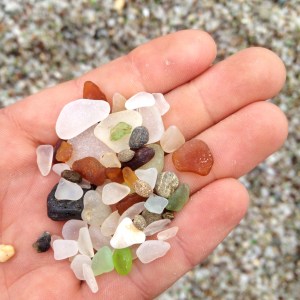
And there it was—a beach of mostly seaglass. People were everywhere picking their favorite pieces, dropping them in bags, digging through the glass, mostly white, green and brown, the blues and reds long ago picked out.

This beach is a former dump. Until 1959 residents tossed all manner of trash off the cliff, and over the decades the ocean transformed much of it. Now it’s a park.

But a park with a past. Dig through the glass for a bit and your hands turn dark, grimy. The ocean did what it could to wash this beach clean, but even a half century of rinsing cannot rub the trash truly clean. Instead of a glow, the beach is a dull hue, still has the feel of a refuse heap. Down at the waterline it’s better, with the ocean actively rinsing, but even there bits of metal and old springs show through. The garbage dump is still home to garbage.

A few miles in either direction are more beaches, endless beaches. They are without glass, but they are also without the grime. The waves lap and coat them with salt, nothing more. These stretch in either direction, south to Mexico, north to Canada, broken by more cliffbands than roads. I went looking for the glass, for the one expired trash dump on 3,000 miles of beautiful coast. Thank goodness I made some stops along the way. I will be making many more.

13475114_1520378547988225_5068683986955992495_o

Climbing for Brian

Climbing for Brian

10553818_903535722993720_2619385696188103555_oTwo years ago my friend Brian died. He was climbing on Cathedral Ledge, doing laps on a route I’ve been on countless times before. I was in Peru at the time, a long way from home, a long way from the people I turn to when things get difficult.

I had plans to spend eight months in South America, plans to bounce from Peru to Chile to Argentina and all over and up to Central America. But it didn’t fit. After a month traveling in Chile I flew home.

Instead I went climbing: Red Rocks, Zion, Eldo, Rifle. Looking Glass. Rumbling Bald. The Obed. I wandered through 14 states over five weeks, clipped bolts, jammed cracks and hung on gear. I got scared. I got lost. I fell. I saw old friends and made new ones. I took the type of trip Brian loved taking. He and I had discussed a trip to the desert or to Yosemite, though it never happened. But I felt a connection to him out there, a recognition that “gone” and “with us” can be indistinct.

A month ago was Brian’s birthday. Facebook was kind enough to remind me. It popped up in my feed like he was still here, like I should send him a card or a gift. But he’s not.

13172996_1480482645311149_7238612379710389030_oA few weeks earlier I made it to one of the desert towers Brian and I talked about. The North Face of Castleton is a beautiful 5.11- up steep orange rock. My friend Jim just happened to be in Moab at the same time as me, and it was his birthday. He put a post on FB asking if anyone wanted to climb the next day. “Seriously?!” I said. “You’re in Moab?? Let’s climb Castleton!”

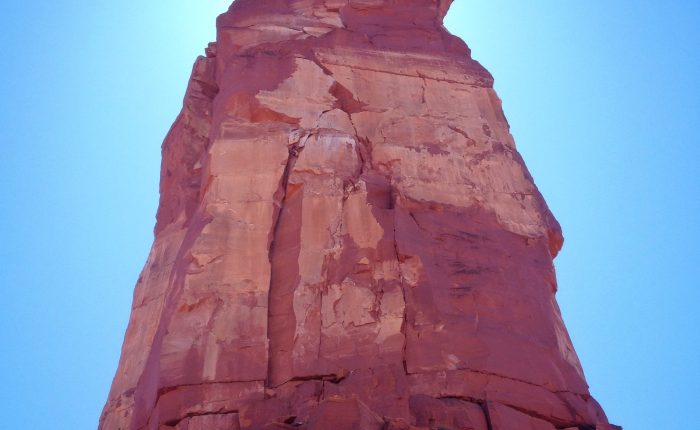
We met the next morning around 10 a.m. and drove to Castle Valley. It was noon by the time we reached the route, but at only three pitches we figured it would go quick. I took the first lead, a steep blue Camalot crack that ended in thinner cracks through a patch of white calcite. Two guys were repelling off as I started up. “Mountain Project says you need 6 number threes,” one of them said. We had two. Jim looked at me. “Maybe leapfrog that one below you?” I heeded his advice.

But the crack was straightforward, the climbing uncomplicated. I jammed and I jammed, making quick progress. I hit the calcite rested and laughing, enjoying the movement and exposure. No wonder Brian so loved such places—the red of the sandstone gleamed, and every jam felt handcarved. This was climbing at its best.

13147451_1480754145283999_7137182934756421799_oJimmy followed, pushing his way up the final exposed crux with a grunt, and we scampered up two more pitches, both excellent.

From the summit the Valley ran off in every direction, a landscape carved out from the red stone with snow-covered mountains as a backdrop. It felt like paradise, God’s country, the kind of place Brian would smile at.

There is a photo of Brian taken on top of another tower. He is sitting, his legs outstretched, writing in the summit register. A valley spills out below him. The sun is high, the sky blue. It looks peaceful. This is how I like to remember him. He was joyful, at ease.

It’s been nearly two years since Brian fell. I’m on another trip, roughly 20 states in, another handful of climbing areas. There has also been surfing and freediving and random beach visits. And yet this still feels like an homage to him. He keeps popping up. I started this post a year and a half ago, while I was on that first trip. It came back to me today, begging to be finished. I couldn’t ignore that call.

There is a sense of being lost in wandering, but there is also an open door, a chance to be reminded of people, events, places that otherwise fall into darkness. So quickly we forget, but wandering we remember. Some of that can be painful. Other parts are beautiful. Perhaps every visit to the desert will in part be Brian’s. I hope so. I see him in the beauty of the landscape. I feel blessed to share it with him. It may only be in my heart, but that is enough.

13123037_1480754148617332_8038899256409081962_o