Part of The Sharp End

The Access Fund announced their 2012 Sharp End awards yesterday, recognizing the people, businesses and organizations that go above and beyond to protect climbing access.

The official announcement was yesterday, but last week I got an email from Zach at the AF telling me I was one of the winners. I volunteer as a regional coordinator for the Access Fund in New Hampshire (and sometimes assisting with issues in Maine), and this past year I was part of an effort to get the state of New Hampshire to include climbing among the activities landowners could open their property to without fear of liability. After a lot of emails, phone calls and conversations with lawmakers the effort to recognize bouldering, rock and ice climbing as protected activities succeeded, making it into law over the summer. I was thrilled then to learn our effort (with the help of a few sympathetic legislators) succeeded, and I was thrilled last week to hear I would be getting the Sharp End award for that victory.

It’s pretty cool to be listed alongside the likes of Black Diamond, the Red River Gorge Climbers Coalition and the Western Mass Climbers Coalition. I didn’t expect such recognition, and I can think of several others (Tim Kemple Sr., Sen. Jeb Bradley of Wolfeboro) who are at least as deserving, but I have to admit the news made me smile. I’m looking forward to getting my sandstone plaque in the mail. I just hope it isn’t made of rock from a climbing area the AF was unable to save…

Joking aside, if you aren’t an Access Fund member, sign up here. The AF is one of the two organizations I believe everyone who enjoys climbing should belong to.

Soloing, the Edge, and Finding the Center

After I soloed Dracula last month I got worried. I had climbed it seeking clarity, the clarity I found soloing Standard Route several weeks earlier, clarity that became elusive by the third Standard ascent. “What if the same thing happens with Dracula?” I thought. “What if I get comfortable here too? What then? Do I climb The Black Dike? Dropline? Those don’t seem like reasonable risks.” I had discovered a potentially fatal danger on my path: soloing for centering is unsustainable. If a few laps could transform a seemingly impossible challenge into a routine outing, would I keep pushing the grade to find that feeling?

It’s been a month since Dracula, and I haven’t been ropeless again. It’s not that I decided NOT to solo; the right opportunity just hasn’t fallen across my path. In the meantime, though, I’m beginning to wonder if the reason that feeling was so elusive was a matter of perception, not because it truly is ever elusive. Is soloing even necessary to attain clarity, or is that just one path?

Soloing is embracing fear rather than running away from it, hiding from it, rejecting it. Climbing roped offers the same opportunity, usually without the extreme consequences, but soloing purifies the effort. As humans we are never perfect, but an ascent, whether on rock, ice, sport or trad, can be flawless. Take away the rope, and the ascent demands no less than perfection. It’s easy to see why it demands clarity, and it’s easy to see how it could become addicting.

Clarity, however, is only as elusive as we make it. The extreme presence I found on Dracula was a result of being forced into the moment by my fear, but that isn’t the only way to get there. Fear is not the only path.

Do you remember where you were on Sept. 11, 2001? I do. I was on the floor of the L.L. Bean warehouse just a few weeks into a seasonal job when I learned two planes had hit the World Trade Center. We got out early, after the second plane hit, and the next few days unfolded in surreal time.

My wedding day was the same way — I was overwhelmed as I watched the evening unfold. It felt like an out-of-body experience, an extended moment of hyper-awareness, the most beautiful day of my life.

What links soloing, 9/11 and my wedding day? Extremity. The emotions, all extreme, form the connecting thread. Extreme risk, extreme fear, centers me. It brought me back to consciousness, back to the moment, as effectively as extreme sadness and extreme happiness had in the past. Emotions, when they become overwhelming, DEMAND attention. Fear, love, sadness all force us to stop wasting attention on superflous distractions and get in the moment.

Why is consciousness limited to those moments? Because we spend the rest of life trying to avoid living the moment. We sit at work waiting for 5 p.m., spend our week thinking about the weekend, spend months looking forward to our next vacation, leaf through magazines to look at places we’d rather be, surf websites about what we’d rather be doing and spend hours shopping for the new products that will somehow make our free-time more fun. We spend so much time looking to the future or thinking about the past we fritter away the NOW, and it takes a plane crash, overwhelming warmth or the risk of a 75-foot groundfall to bring us back.

Who wants to be present all the time? It’s a fair question, particularly when most of our time is spent at jobs we detest or navigating social situations that never seem to become comfortable. On its face it seems rational to live outside the moment, the only problem is selective deadening is impossible. I can’t check out all day and expect to check back in each night. I can’t check out all week and expect to be present all weekend. Attention forms habits and flows to the path of least resistance. It doesn’t come and go by our leave. Spend your life checked out and it will take a plane crash to bring you back. Maybe that won’t even do it. Stay checked in, however, and clarity becomes life. Life becomes clear. Simple concept, right? Now try to put it into practice.

The feelings I associate with soloing don’t have to be fleeting, but just like soloing they require constant evolution, constant inquiry. When my attention tended towards fleeting I needed harder and harder routes to center myself. That process may have brought me clarity for a moment, but in another respect it pushed me closer and closer to the edge. That edge was instructive, but some who venture too close to it eventually fall off. I’d prefer not to be one of those.

So instead I’ve been seeking another path, one that pulls clarity to me rather than insists I go to it. I’ve found it in other ways — practicing yoga, on my skis, sitting quietly with myself. I found it by concentrating on my breathing, by noticing the subtleties around me, by quieting my mind regardless of my surroundings. I’ve done it without wrestling with monsters.

Will these other paths always work? I doubt it. A friend who meditates told me recently he used to get more out of his practice when he first started. These days, he said, it’s become routine. The fact is, it doesn’t matter what it is, soloing or meditation, we can become acclimated to any path. But if the path is always changing, always evolving, if we never know how to maintain clarity, if we are always looking for new methods for centering, if we are willing to accept whatever path shows up today, the path will forever renew. If I don’t KNOW how to center myself I will always be open to new possibilities and new opportunities. By being ready to quit anything at any time I hope to recognize when a path doesn’t work. I strive to test any new practice anytime, so long as it fits.

I will lose my path. I will not be perfect, on the rock, ice or in life. I will lose my center, my clarity, and allow the fog to filter back it. But those challenges are part of the path, integral to it. They are opportunities to recommit, to rediscover forgotten lessons and learn new ones. To find those opportunities I need to embrace forgiveness, cultivate trust and be willing to let go, just like I had to for soloing. But the path is also about nothing at all, because the moment I know what it’s about I might stop looking, which is one way to lose the path.

And for me, there are still reminders on the ice. The path still includes soloing, but it’s not about chasing clarity. It’s about finding it on grade two, not just on grade five. Because the grade does not matter, only our attention that makes the moment.

The Last Route

Pretend climbing is life. Pretend one route equals your life. You are born when you tie in, you gain consciousness when you hear, “On belay.” If it’s a single pitch climb, every move equals a year. If it’s a longer route, each pitch equals a decade. When the climb is over, so are you — reaching the top equals death.

Life is a route. How are you climbing it?

I’ve climbed lots of routes with the expressed interest of reaching the top. Sending was the goal. I wasn’t there to celebrate the movement, to enjoy the day, to appreciate the time on the rock. I was there to summit. On the route of life I was racing for the chains.

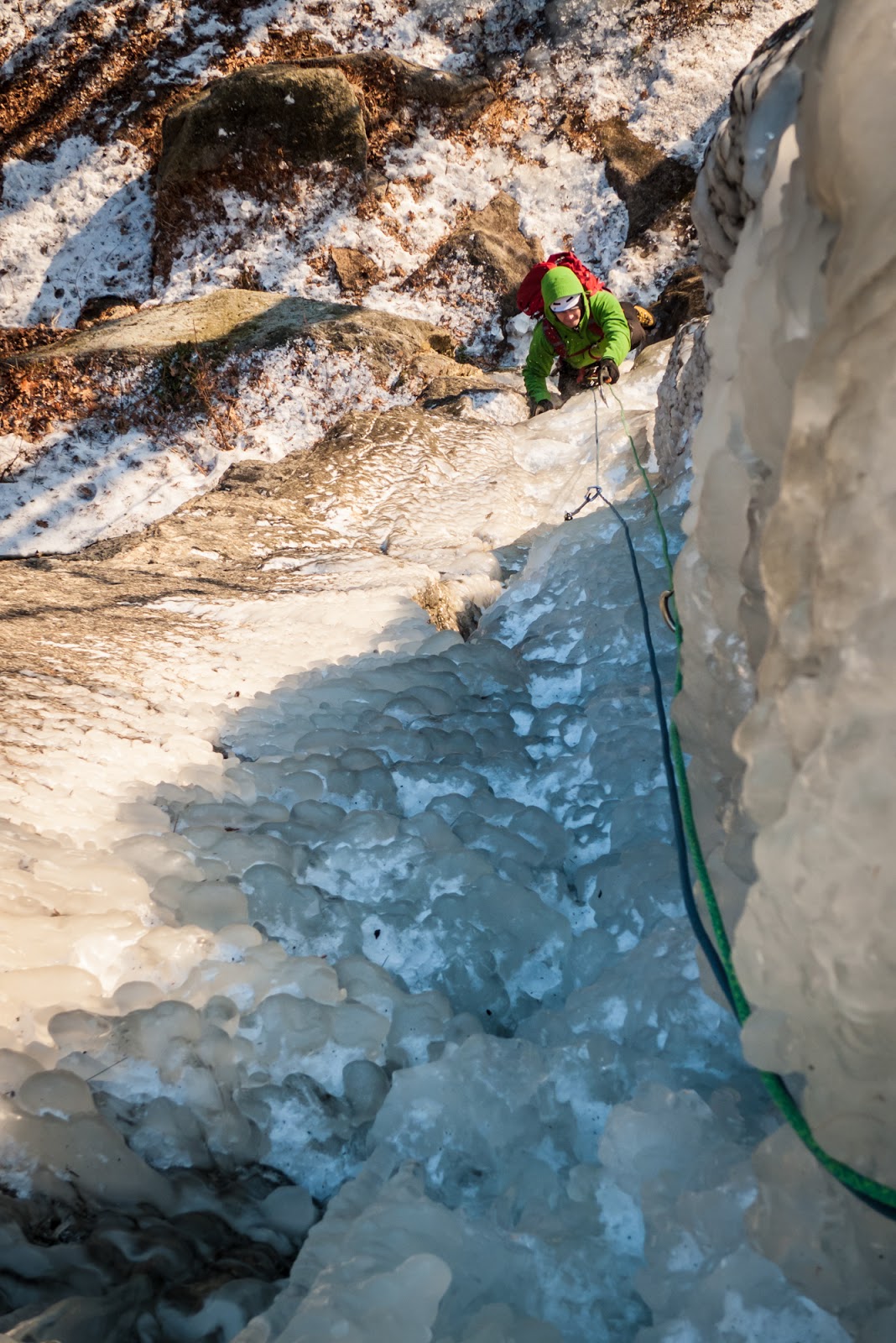
Today, however, I climbed deliberately. I savored every second, looking no further than the move in front of me, striving to embrace every moment in the vertical. I never rushed, instead flowing upward at whatever pace fit. I climbed with my eyes open, my head and heart engaged. I felt the warmth of the sun, listened to my picks as they creaked in the ice. I was there to be there, not to reach the anchor. Once I reached the anchor, after all, the climbing was over.

Whether climbing rock or ice, sport or life, my “goal” has become the experience, not the summit. The process itself is the reason for action. Every individual moment has become infinitely important. The top, the summit, the chains, the end, has become an abstraction. It will inevitably show up, but the real cause for joy is contained in all the moments that led there. Every moment, every movement, every year and every decade is worth noticing, worth celebrating. Whatever you do, don’t rush.

Quitting

Quitting

Yesterday I quit climbing.

It was 5:30 p.m. and growing dark. I was standing in my living room, naked from the waist up, a pile of outdoor clothes draped on the arm of the couch beside me. I had been waiting for this moment all day, for work to end so I could go climbing in Crawford Notch, but now that the moment had arrived I was faltering. “Should I go?” I thought, wearing nothing but blue Capilene tights. “Do I really want to? Or am I just going climbing because climbing is what I do?” Would my plan leave me smiling and satisfied, or would I just wind up wishing I was back at home? I didn’t know, so I just stood there in my long underwear watching the sky grow darker.

I tied into a rope for the first time at 17, and ever since I’ve poured myself into my passion. I’ve spent weekends, vacations and thousands of dollar on climbing. Now I can just describe it as what I do. It’s intricately linked to my closest relationships, my work and where I choose to live. It’s how I meet people, what I talk about with friends, how I relax, what social occasions are centered around, the focus of the organizations I donate to and how I volunteer my time. It has become more than a passion — it has become life.

And yet I quit.

I stood in my living room yesterday, lost in my head, naked, exposed, and I didn’t want to go climbing. “No,” I thought, pulling off my Capilene, “I’m not going. It isn’t me, not today. I’m not a climber. I’m just not.”

It wasn’t the first time I’d quit. I quit the day before too. I had plans to go to Tohko on Sunday with Scott, but after two days out at Ice Fest I was tired. I got home and didn’t feel it. “Not today,” I thought as I sat down to read. “I’m not climbing. Not now. Not today.”

It feels good to quit, to reject the passion that in many ways has come to define me. It feels good to put it down, to let it rest, to let the pressures and expectations that built up around it dissolve. Will I send my project? Who knows. Probably not, because I quit. And that’s OK. After weeks and months of doing nothing but climbing, I just walked out the door.

It doesn’t take long to fall into habits, and climbing is an easy one to fall into. When you climb every weekend, every vacation and every free moment it can be difficult to determine whether you are climbing today out of passion or simply because you climb. For me at some point the climbing flips from being a passion to being work. “It is the weekend again. Where are we climbing?” The desire to tick the next project, to push to through the next grade, takes over, and when it does the passion is gone. But I keep climbing because I know nothing else. What meaning does it bring at that point? What value? None. The feelings climbing can elicit are gone, and yet I stick to it. It’s become a habit, just what I do.

When that happens, I quit. I walk away. I put down my gear, fuck it, and do something else. I did it yesterday. I pulled of my Capeline, did some Googling, and instead went to a yoga class. It felt fantastic. I spent an hour and a half trying not to fall over. Every pose was taxing. I embraced sucking at something, free from any self-imposed pressure to perform. It felt the way climbing felt that first day. It felt the way it felt when I quit this summer — instead of tying in I went surfing, and I spent hours just trying to stand up. Ego stayed home during those sessions — I couldn’t afford its critique.

Quitting is liberating. It is freeing. It takes the thing that you allow to define you and puts it back in its place. Climbing isn’t life, it is an activity. It is a way to spend time, no more, no less. It can be fun or it can be miserable, depending on the day, but it is neither good nor bad. And when it starts to feel overwhelming, like it has become a job rather than a passion, the best thing I can do is quit.

And so yesterday I did just that. I quit. I walked away. I said fuck it, and in rejecting climbing I found freedom. It was in every yoga pose — the same feeling discovered 14 years ago, that first day I tied into a rope — the wonder of movement, the high of self-awareness, the intense connection between mind, body and breath. Instead of searching for that feeling in climbing like a heroin addict seeking another fix I looked somewhere else. And there it was. I found it. All that because I quit.

I’ve quit so many times before. I spent a year barely climbing once, and three years off the ice. I went on sailing and bicycling trips, spent weekends camping and watching movies, blew money on cameras, concerts and plays. I’ve quit countless times since too, and each time I discover how much I truly love my other passions. Quitting has allowed me to I train and compete in a triathlon, and it afforded me a stint in Iraq and Kuwait reporting for public radio. Quitting has given me much more than it ever took away.

Quitting has also let me discover, once I finally tie back in, how much I love climbing. The quitting helps me see my passion within a proper context, as one passion among many, all of which are rewarding and expand my perspective. Embracing the quit and the subsequent resurrection refills my passion. It allows the beauty of what climbing offers wash over me. It helps me grow.

Passion are meant to support us, to engage us and push us to new heights and levels of understand about ourselves, but if they come to define us they do the opposite — they make us contract. They can help us seek our own self-imposed boundaries, or they can form the foundation for those same walls. Climbing runs that risk for me. It is in so much of my life it can easily box me in if I sit back and let it. But in quitting I reject that mold and embrace the growth. Quitting allows me to look around with clear eyes and see all the other things I am missing.

It also gives me a chance to recommit. Every time I quit I get to rediscover the wonder climbing brought me that first day. Quitting reinvigorates my passion. Yesterday I decided I would not climbing. I quit, and rejecting climbing as a definition. I won’t go again, I told myself, until the drive comes from a place of passion, a place of love, a place of growth and willingness to accept the unknown. If the thought of climbing provokes a question about to whether I want to be there, whether or not I was making the right decision, I wasn’t going. Climbing should provoke feelings of elation, I reasoned, not exhaustion, so I quit. I just walked away.

Then today I got up and packed my bag for the rock gym. I’ll be there tonight, back on the wall, back among friends. My quit has run its course. My willingness to walk was the ingredient necessary to see my passion with fresh eyes again. After years of pitched battles (within myself always), it now takes just days to be ready again (except for those times it takes weeks or months). Today I’m back to climbing out of love rather than obligation. Quitting kicked the habit, and it no longer rules me. I cannot deny I my passion, but through quitting I let it re-bloom into a passion, a love, of my choosing. If it were any other way I’d have to quit.

Profiled

Last month my friend Dustin came out to shoot video of our Diagonal ascent, and I talked to him a bit as we suited up. He turned the climb and the discussion into a video:

It’s funny to watch and listen to myself. Words must be available to describe what climbing means to me, but I can’t find them when a camera is in my face. My SOG posts provide an interesting contrast to this video interview — it’s almost like there is too many thoughts inside me to force into sentences of spoken words. Still, this video is awesome, and I’m glad Dustin asked to come along.

Plastic Friends

There’s something restorative about plastic.

Ice climbing has been difficult in recent weeks — first temperatures rocketed to near 60, then they swung 70 degrees in the other direction. I get a few pitches in each weekend, but weekday sessions have either been unavailable or unsafe. Soloing moderate ice before work had been a grounding ritual in recent months, but my practice has been forced to the wayside by the weather. Enter plastic.

For the last three weeks I’ve skirted south after work for indoor sessions at the Maine Rock Gym. The MRG is the first place I went climbing 14 years ago. It’s where I learned to belay, where I climbed my first 5.9, then 5.10, back when I believed gym routes corresponded with climbing outside. It’s where I built fitness during college before ice season, where I trained cravasse techniques before Rainier and prepared for trips to Yosemite and the Southeast. It’s where I stopped off for a workout when my dad had cancer and I was driving back and forth to see him twice a week. It’s where I met and first became captivated by my wife (Josh — you were there). To call it a special place would be underselling it — home is a more apt description. It isn’t fancy — there is no lead wall and the whole place is coated in chalk — but it’s comfortable as an old tee shirt. I can’t walk in without facing a wall of smiles and shaking hands with a dozen people — Chuck, Dennis, Joe, Rebecca, Michael, Rajiv, Jamie, Nick, Dave, Hasan, Eli, PC, Brian, Ben, Dominic, Hazel, Jim, Ran, Brian, Chuck, Jody, Andrew and more. And every visit makes me smile. Every session is hanging out with old friends, even when (like last week) I’ve just met them. Even when I’m there all alone. I don’t care if I’m falling off everything or crushing, the atmosphere doesn’t change. It’s always warm, always welcoming.

I was describing my fondness for the MRG to some friends the other day, and I compared it to most people’s college outing club wall. My friend Janet’s eyes lit up. “That’s the Dover Rock Gym for me,” she said, a warm smile spreading across her face. It was clear she knew the feeling I felt every time I turn onto Marginal Way and throw on my blinker.

I don’t really have more to say than that, I mostly just want to thank the people I run into there day after day, week after week, month after month and year after year. Thank you for being the people they are. As much as my past experiences at the MRG make it feel like home, so do you. Thank you.

No Regrets?

It’s Monday. The weekend is over. My boots, gloves, screws and ropes are all hung to dry, and I’m at work. I’m sitting in front of my computer, recovering from the weekend, wondering if I made the right call. The climbing is over, but it’s weight still hangs over my head. Physically I’m at my desk, but in my mind I’m staring up at a blood-splattered column, a screw at my feet, horizontal cracks both above and below me, wondering: “Up or down? Up or down?”

A week ago Peter and I made a pilgrimage to Grafton Notch to fire Hackett-Tremblay, a stellar grade 5 that rarely appears. I was all set to climb the first pitch when a chunk of ice slammed into my helmet, transforming my lead head from a galvanized piece of steel into a spongey mess. After a brief attempt I turned the sharp end to Peter, and he did what he does best — went to the top.

I didn’t blame myself for backing off — that chunk of ice hit me pretty hard — but I wanted another shot at H-T. I knew it would go, I just needed to be there 100 percent, no excuses, to reach the top.

So Sunday I went back. Scott and I piled into the car at 7:45 a.m., and we made the same pilgrimage I’d made a week before. We parked in the same spot, and booted up the same trail, and at 10 a.m. I found myself racking up at the base of the route I’d seconded a week ago.

But lots of things were different this time. First off, the week before it had been 30 degrees. This time it was closer to 10. Last week the route was running with water. This week there wasn’t a drip. Last week the ice was soft and forgiving. This week it was glistening and bulletproof. But I still wanted my shot, a chance to prove myself against the ice. I racked and roped up, tightened my boots and readied my head. “You know what you’re in for,” I thought. “Just breathe, just climb, and this will go.”

One swing into the ice, however, rattled my resolve. My tool made a CLUNK as it swung into the curtain. The ice, detached from the rock by the warm weather, had not reattached with the cold, it had just stiffened and turned brittle. I moved up, down and side to side trying to find good ice, but every tool placement sliced to the air behind the curtain.

“I don’t like that sound,” I shouted down to Scott.

“Me either,” he shouted back.

But I was committed. I wanted the send. I didn’t like where I was, but I wanted the top. Doubt began creeping in, but I pushed it aside. I took a breath, entrenched in my belief that UP was my direction, kicked in my feet and started climbing. A handful of moves got me to good ice, and then I was at a shelf staring at the base of a column, the true crux. I wound in a screw, then a second, hooked my tool into the back of the column just below a quarter-inch horizontal crack clear through the pillar, and made an awkward mantle. Standing on the shelf I could see a gap of several inches behind the pillar, space that wasn’t supposed to be there. The black rock and the warm sun a week earlier had cooked away the bonds, and now the column was just hanging.

Or was it? I swung into it about six feet up and felt it vibrate. I looked up and saw a second horizontal crack about a foot above my tool, again almost a quarter-inch wide. I tugged on the placement, and the column groaned. The screw in the shelf at my feet was solid, but I knew with slack and momentum I would reach the ledge below if I fell. It wasn’t a question — the next few moves were akin to soloing. I looked around. The ice above looked better, like it would take a screw, like if I could get there I would be set. I knew from my ascent the week before this was the section most detached, the riskiest. The next six feet were the key to the route. I thought back to Peter, who reached up and placed a high screw from this same stance. I couldn’t do that, however — all I would be doing is attaching myself to the detached, groaning column. If it came off I’m be anchoring myself to a bull, and I had better be ready to ride it. No way. I looked back at my feet. The ice was smeared with a deep red-brown the color of rust that melted pockets into the column. “Blood,” I thought. “Someone had worse luck than me in the last week.” I looked back up. I would have to make two, maybe three moves on the column to get tools in the good ice. If it popped with me on it I would break. It wasn’t hard for me to decide. “Down,” I said aloud. “I’m coming down.”

That didn’t just happen yesterday, it happened right now, in my head. In my mind it just played out again, as it did on the drive home, as it did in bed last night. I wonder to myself if the column would have held me, if I made the “right” decision, if I somehow let myself down by backing off. Did I fail myself? Could I have made it past there? Could I have taken that key and used it to unlock the climb? It’s Monday, and I am carrying with me the weight of my “failure.”

Failure — a term only I use to describe my decision — is harsh, a judgement, one that hurts only me, one that calls into question my value as a person as well as my value as a “climber.” It is a foolish view, one without value, one that does injury to both myself and my climbing, and yet I have trouble letting it go. Every day I struggle to live in the moment, to not carry my decisions with me. In this instance my only “failure” is not embracing my decision to descend.

What is living in the moment? It is being present ALWAYS, knowing there is no future and no past, only NOW. Tomorrow will never get here. Yesterday can never change. Today, right now, this moment, is the only one we have. I can’t go back and change my decision, and therefore there is no use thinking about it. There is no “right” and no “wrong,” only actions and consequences. Time cannot be saved, it can only be spent, and living in the past is spending time poorly. How do I let go of that? How do I embrace my decisions, trust it was the “right” one and move on? I’m not sure. I’m learning. It’s the reason I’ve enjoyed soloing lately — it requires presence in a way most other things don’t. It requires ignoring the world around me, trusting myself, shutting of my mind and just being. Thinking is enemy of now. Fear of consequences, judgements of past actions, rehashing and reevaluating — those are the things that keep us from experiencing this moment. This one. Here. Now. NOW.

How do we stop thinking? I do it through embracing fear, and not just fear of heights. Fear of rejection, fear of embarrassment, fear of emotional pain — all of those do the same thing for me as climbing. I stop thinking by doing whatever the thing I think I don’t want to be doing is. Embracing that thing creates stress and forces me to face fear, and in that moment I am present.

How do I do that everyday? Easy: I don’t. I forget. I fall back into habits. I get comfortable. I start to drift from my practice, from my embrace of the unknown. I drifted on Sunday when I stood on that ledge thinking of “all the things that could go wrong” rather than opening myself to the experience and accepting whatever challenges (opportunities) I found. And I have been drifting since with every rehash of my decision, every replay of that moment in my mind. Could I have made it up? Could that column have held? Who cares. I opted not to test it. That is what happened. Let that choice be.

“If we were to put our minds to one powerful wisdom method and work with it directly, there is a real possibility we would become enlightened. Our minds, however, are riddled with confusion and doubt. I sometimes think that doubt is an even greater block to human evolution than is desire or attachment. Our society promotes cleverness instead of wisdom, and celebrates the most superficial, harsh, and least useful aspects of our intelligence. We have become so falsely ‘sophisticated’ and neurotic that we take doubt itself for truth, and the doubt that is nothing more than ego’s desperate attempt to defend itself from wisdom is deified as the goal and fruit of true knowledge.” 

– Sogyal Rinpoche

I seek out fear in an effort to find enlightenment, knowledge, emptiness and personal growth. Those things are elusive, but I am not failing on that journey. The path is not clear. But in recognizing that I strayed I have moved a little closer to the light. It is still the early morning, the first rays of sun are peaking. Full brightness is on its way, just keep your eyes open.

3, 6, 9, 12 Down

My day job is working as a reporter and news editor for the Conway Daily Sun, the daily newspaper that covers the Mount Washington Valley. Most of the time my job has little to do with climbing, but on Thursday an avalanche caught 12 climbers on Mount Washington. Nine of them slid, and three took the full ride. The story I wrote Friday is here, and it’s worth reading. It is NOT the full story (no news story ever is), but it was as much as I could throw together before deadline. I wrote a followup today, and it should be out in a few hours. I’ll put that up here as well as soon as it is. In the meantime, stay safe out there.

Update: Here is the followup article, as well as a writeup from the U.S. Forest Service Snow Rangers.

Derailed

Some days plans just don’t work out.

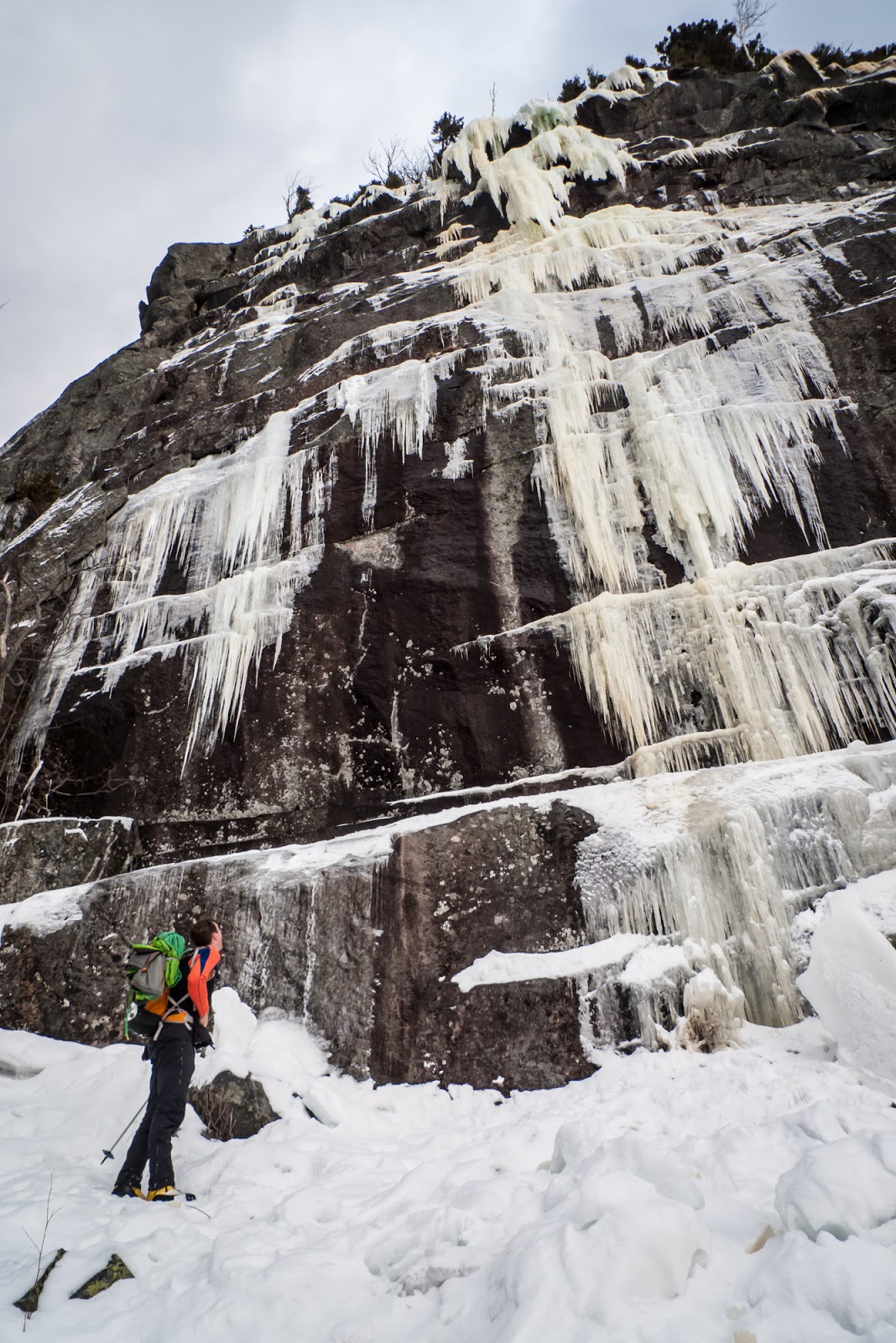
Peter and I met at 8 a.m. this morning in a grocery store parking lot. He tossed his pack in my car, and we started the hour and a half drive from Glen to Grafton Notch. A friend had let it slip that Hackett-Tremblay, a classic grade 5 that makes rare appearances, was in. The ice in the Mount Washington Valley was looking haggard so we were skeptical, but we figured it was worth a shot. 60 miles later we saw it: a dribble of yellow ice spilling down 200 feet of rock. Perfect. Time to go ice climbing.

We tumbled out of the car, packed our bags and started up. It was barely freezing as we followed a snowshoe track up the side of the mountain. Eventually we split off toward the cliff, with Peter leading through the boulders and trees. I was close behind, excited to get back on ice after a week or more of scratching rock.

Huge chunks of ice dotted the base. This was not the place to hang out on a warm, sunny day. The cold temperatures the night before consoled us, but it was clear large sections of ice down low were delaminated. The black rock behind the ice was ready to capture the sun’s rays, so we weren’t disappointed to see the blue sky gathering clouds.

We dropped packs and started sorting gear. I wanted the first pitch, which looked scary but straight-forward. I figured Peter could easily manage the upper columns and curtains, which from the road looked more like grade 6. I started racking screws on my harness as Peter flaked the rope. I breathed deep, knowing the pitch would go only if I was fully committed.

Sometimes you never see it coming, the thing that knocks your plans clear off the tracks. Sometimes you are moving forward perfectly, doing exactly what you should, and still there it is — BAM! — slamming into you, tossing you off balance, derailing you completely.

I was arranging the rock rack when something rocketed past my head. It made a whizzing sound as it passed my ear and exploded into the snow. A second later I heard another, then another — ice, let loose from 200 feet above, slicing the air inches away. I stood up straight and froze. For a moment my neck arched — I considered looking up to see what was coming next — but my body overruled the reflex. I kept my face down and pulled in under my helmet, standing still and straight as an arrow, trying to hide every inch of me underneath the three-quarters-of-an-inch of foam on my head, my only protection. Chunks of ice slammed into the snow all around me. I pulled my shoulders in, desperately trying get everything under my shell, like a turtle on the highway feeling cars rocket past in both directions. Then… CRACK! A piece of ice somewhere between the size of a golfball and a baseball glanced off the center of my helmet. My neck snapped back, but I stayed standing. I kept straight as possible, my head ringing. My body swayed gently back and forth as a final hail of frozen shrapnel splashed around me. Then it was over.

“You OK?” Peter said from 40 feet away. The ice bouncing off my helmet was the first indication he had anything was up. I felt like I’d withstood a half-hour assault, but it was probably less than 10 seconds. “Yeah,” I said, grabbing my stuff and moving behind a nearby rock for the illusion of shelter it offered. “I’m good.”

But I wasn’t. My neck hurt a little, but what really suffered was something more foundational: my commitment. That bullseye shot not only spiked me, it ricochet through the part of me that had what it took to fire steep delaminated ice. I didn’t know it yet, but in cracking my helmet (which it did, barely) the ice knocked away my confidence, my knowledge that this pitch will go. It slammed me into a place of self-doubt. Suddenly I kept seeing everything that could go wrong, knowing if I tried to LAUNCH, it all would go wrong.

But I wasn’t ready to admit it. I tied in, grabbed my tools and started up. Even the first step was arduous. Every swing felt terrible, and the ice sounded more hollow than it was. I got up to where things got steep, and even good sticks felt insecure. “What am I doing?” I thought, looking up at the umbrellas far above. They must have weighed 500 pounds. “One of those won’t snap your neck back, it’ll kill you.” And with every passing second I knew it was about to. I made a few half-hearted moves up, then down, then up, then all the way down. I looked back at Peter. “You’re up,” I said. “I don’t have this.”

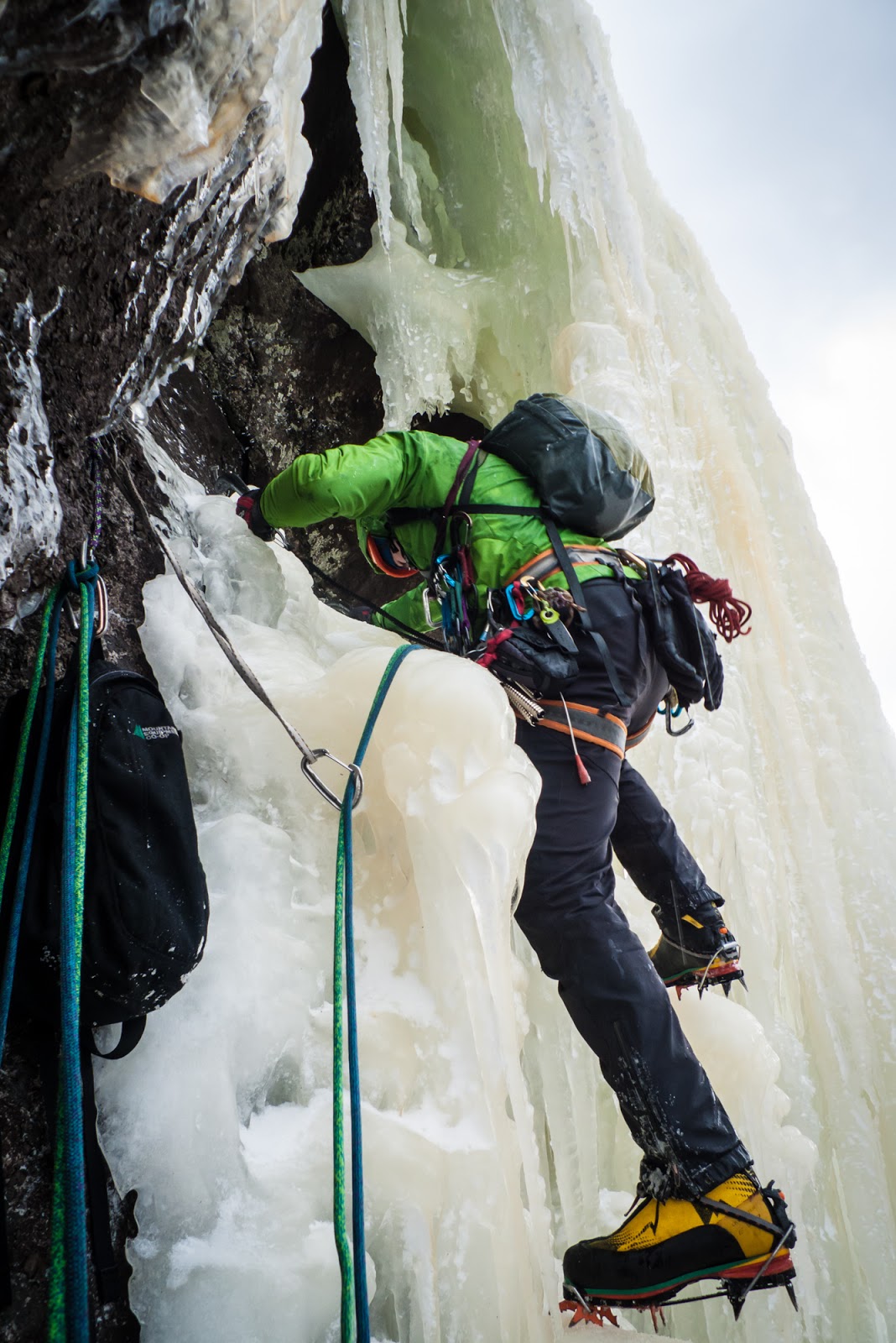
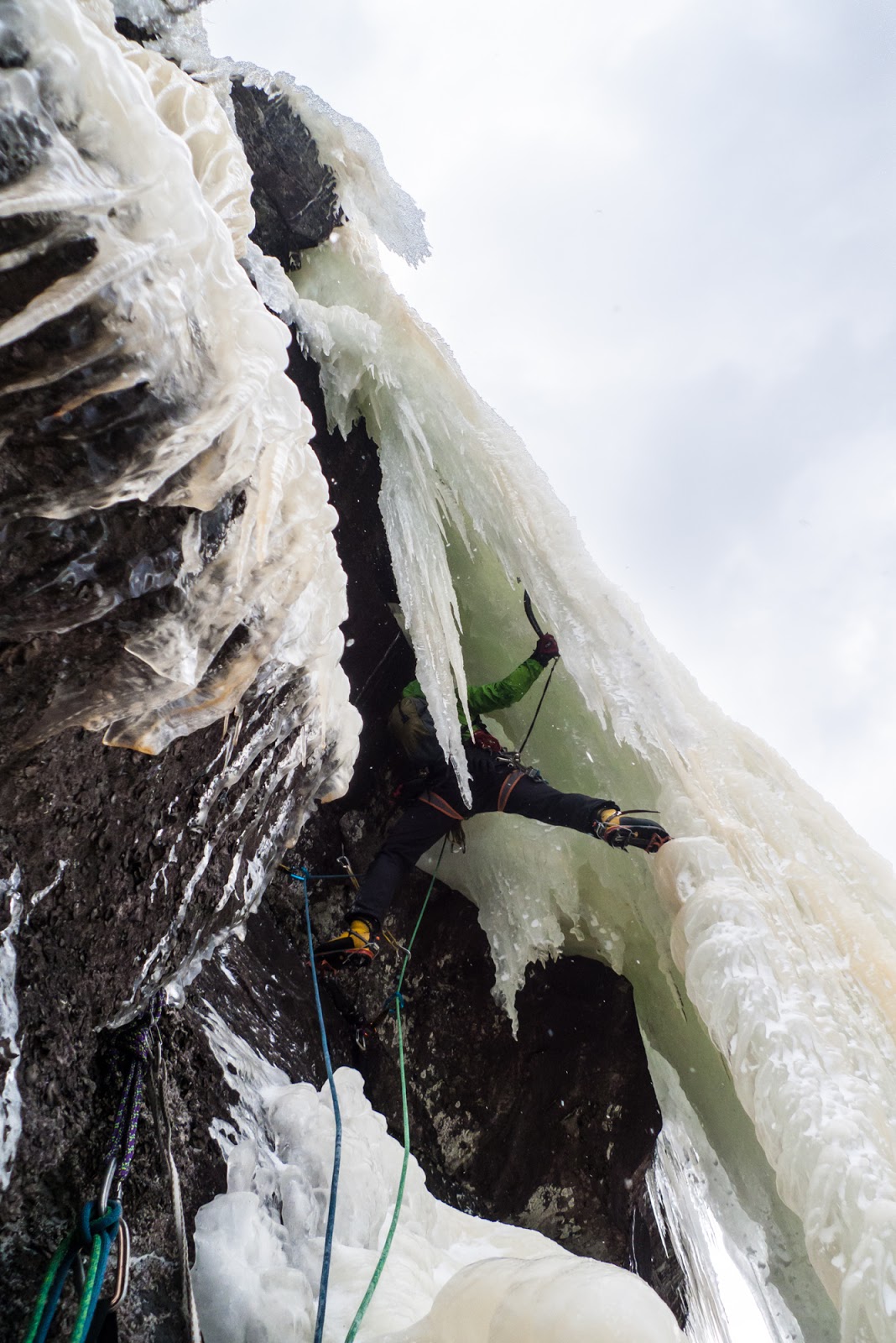
The ice was OK. Peter, as usual, fired it. There were delaminated sections, and above the first steep section he knocked down a good portion of a column, but all in all it was reasonable climbing. It was the sort of thing on a good day I would have sung my way up. But not today. My plans didn’t come together they way I meant for them to. As Peter climbed, the clouds descended. Soon the wind was whipping, and snow was wiping across the face in horizontal sheets. Peter built a belay below and to the side of one of the daggers as it poured roughly a gallon of water per hour. When I got to there I pulled on my Das parka and told him get to the top. He obliged, working his way up awkward formations with finesse. By the time I started climbing again all four layers below my Das were soaked. The wind howled as I worked my way up the cave and out onto the column. With every gust I watched the dagger above me sway and moan. I yanked gear out as fast as I could, trying to traverse out from below it, sure I would die if it let loose. I still had my Das on, but water was oozing down my left side. My hands were frozen into claws. Carabiner gates refused to open. It was not ideal conditions. I wanted to be done, to be down, to go home.

But I kept going. I worked my way up through the cave and popped out onto the column, where finally nothing was dangling above me and the sticks came easier. I kept going, and as I moved upwards I started to feel my hands again. I started to remember why I wanted to be there.

Sometimes plans get fucked. Somedays shit just goes wrong. Today, one of those days. It sucks. Its hurts. It makes you want to go down, go home, to put away the gear and call it a season. But I didn’t start out this morning to go home. I started out this morning with a mission, and although chunks of ice seemed to be flying at my head all day long I kept moving forward. When a piece knocks you over, that’s when you have to decide what’s next. Today, I kept going. I’m not sure that’s always the best plan, but it was what I stuck with today. Maybe next time I’m out there will be less ice falling my way.

Replace? It may be time…

Epilogue: By the time we topped out the wind had died down and the sun was back out. The day had swung from beautiful to ferocious back to tranquil. I’m glad I kept going up, and I was even happier to have a toprope. Hopefully a few days off will restore my psych, confidence and commitment.

Hackett-Tremblay from Route 26