What does it take to climb a 3,000-foot cliff?
For Enoch Glidden, a 37-year-old wheelchair-bound climber born with spina bifida, it might sound like a complex challenge built around planning, hundreds of feet of rope, specially designed climbing equipment and more.
But ask him what it takes, and he doesn’t give a complex answer. The Western Maine native keeps it simple: Climbing a 3,000-foot cliff requires friends.
“Nobody does anything without help, disabled or not,” he said.
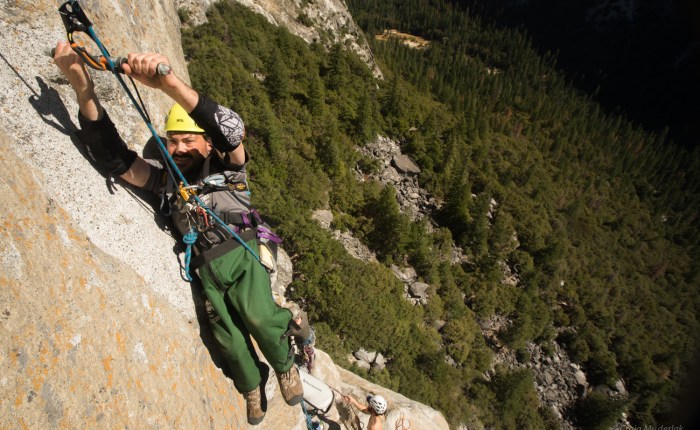
Next fall Glidden is headed to Yosemite Valley, Calif., the mecca of American rock climbing, with plans to climb El Capitan, the massive granite touchstone for rock climbers worldwide. He’s been there once, last year, and despite his inability to move his legs, he climbed 600 feet up a towering granite rock face.
“It’s possible,” he said. It just comes down to a question he’s asked himself over and over: “How can I?”
That is the theme of the slide show Glidden will be giving Saturday night at International Mountain Equipment in North Conway. “Go Beyond the Fence” discusses his trip last fall and is a step on the road to his next challenge, El Capitan.
“That question has come up my whole life,” Glidden said. “How can I?” He got his first wheelchair when he was 4. Paralyzed from the waist down, he refuses to let that hold him back: He skis (both downhill and cross-country), competes in wheelchair races, plays basketball and is close to getting his pilot’s license. When he sees a challenge he runs at it, and four years ago the new challenge he discovered was climbing.
“It’s just kind of the ultimate challenge,” he said. “It’s all me to get up there.”
He started in New York with Paradox Sports, a Colorado-based nonprofit dedicated to adaptive sports. That led him to ice climbing closer to home — he’s attended Paradox Ice events in North Conway the past three years.
In Yosemite last year, he and a team climbed up Washington Column, a granite tower a few miles north of El Capitan.
But as he said, these kinds of climbs don’t happen alone.
“Pretty much everywhere I go, someone volunteers,” Glidden said. Last fall they had a team of four the night before the planned ascent. By the next morning, their team was up to double digits. People just seem to want to be involved, Glidden said. “I did one presentation, and a whole bunch of people volunteered.”
The group hiked to the base of Washington Column, carrying Glidden over broken rock and talus. They climbed 500 feet up, spent the night, then climbed another 100 feet the next day.
“Two climbers go ahead and set the rope,” Glidden said, “and then I do pull-ups on the rope.”
He has a special rope-climbing device rigged with a mini pull-up bar, he said, which he uses to climb the rope.
“The hardest part is living on the wall,” he said. He can’t stand up, so he can’t move around easily. That makes routine tasks like dressing and going to the bathroom difficult. “You can train for pull-ups. You can’t train for the portaledge,” the fabric platform he uses for resting and sleeping, he said.
But he learned a lot on that trip, worked out many of the kinks. Now “I’m pretty much dialed in,” he said. For his trip this year he won’t be scouring around Yosemite for partners. “This time I’m bringing people with me.”
The climb will take five days and nights, and involve sleeping on the side of the cliff. Glidden will again ascend a rope strung up by partners, doing thousands upon thousands of pull-ups over the course of the ascent. This will be by far the biggest climbing challenge he’s attempted.
But in some ways the vertical world is easier than some of the challenges that come before. First, he has to get to the wall. It’s a steep walk over rough terrain to get to the base of Zodiac, his planned route up El Capitan’s right flank.
That’s where the friends come in: helping get him to the climb, not just up it, and then also off the top of El Capitan and down. He’s got 14 people planning to join for some part of the mission, but it’s still up to him to do all those pull-ups. There will be a crew shooting video, plus Glidden blogging, and Paradox Sports and the Spina Bifida Foundation of Greater New England will be broadcasting the climb as well.
But all that is in October. For now, Glidden is still training, still getting ready for the challenge ahead. He’s been taking lessons from Sean O’Neill of Brownfield, Maine, who pioneered many climbing techniques for paraplegics. O’Neill climbed El Capitan by the same route in 2006, also doing thousands of pull-ups.
“He basically taught me everything,” Glidden said.
And along with training, he’s pulling together the funds to get himself out there. He just finished his degree in computer information systems, and he’s planning to intern for the summer in Palo Alto, Calif.
“The day that ends I’m going to Yosemite to go climbing,” he said.
But Saturday night at IME, 2733 White Mountain Highway, North Conway, the Mount Washington Valley will get a taste of his ascent, with video shot from his trip last fall. And Glidden wille discussing that all-important question, “How can I?”
The event will be held upstairs at IME on Main Street in North Conway Village. Doors open at 6:30 p.m. with free beer courtesy of Tuckerman’s Brewery. The film portion will begin at 7 p.m. There is a suggested donation of $10.
This story appeared in today’s Conway Daily Sun.
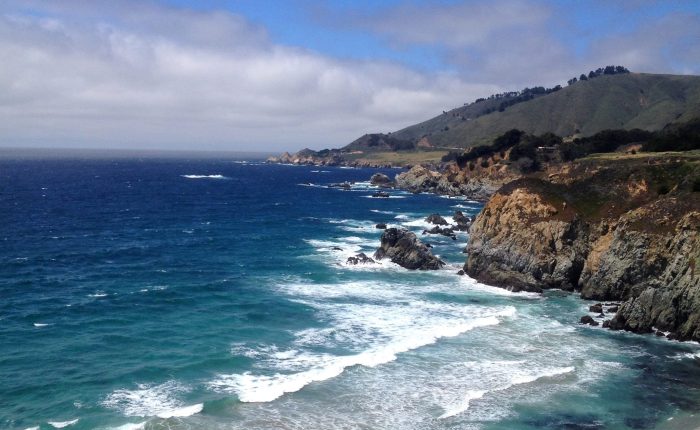
 It’s a long drive from Monterey Bay to San Diego, punctuated by towering seacliffs and emptiness. It’s the kind of drive were you find yourself pulling over every five minutes, where the landscape looks sculpted by god. Big Sur. Kerouac’s coast. Every photo looks magnificent, but none are able to capture the spirit of the place.
 Then I started driving. I skirted my way out of Monterey, past Carmel and onto the Pacific Coast Highway. Hours clocked past. The landscape grew into lofty hills above an azure sea. First cell phone coverage faded, then the radio stations. “Next gas 62 miles,” the sign said.
 The ceilings hung squat and low, traced by fluorescent lights dotted among recessed tiles. The hallway was dingy, scraped paint along bare walls and floors that wouldn’t shine no matter the scrubbing applied. Worn signs hung on the bathroom doors, faded now after too many handprints, only half the words now visible. Someone redrew the head on the men’s bathroom symbol, but they’d drawn it square. Inside, a black Magic Markered smiley face stared out.
 I was working this morning when
 In freediving they teach you to protect your ears. Don’t go down if you feel any pressure, they tell you. Equalize constantly using the Frenzel Maneuver as opposed to the more air-intensive Valsalva Method. If your wetsuit is hooded poke holes at the ears to ensure no unintended barriers disrupt clearing.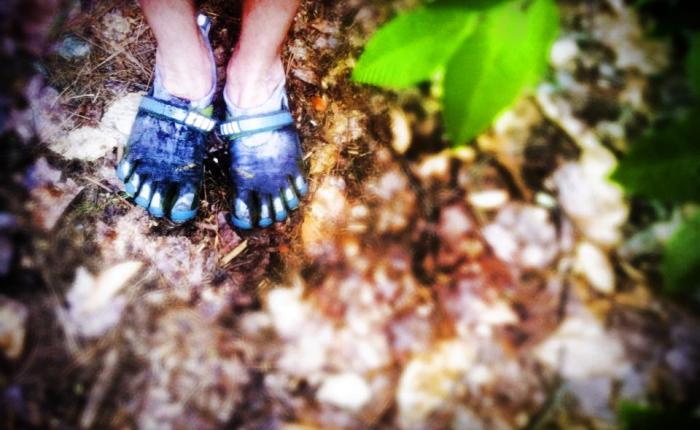
 Water. In Fryeburg, Maine, it’s a big deal: 603,000 gallons a day, a multinational company, a legal battle, a state Supreme Court ruling. Water is a very big deal.
 I stood by the side of U.S. 191 waving my arms. Another car slid past. Then another. And another.
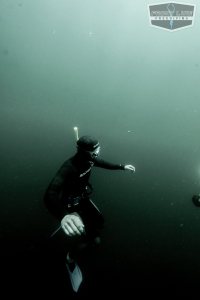 From there I drove on to Wilmington, North Carolina, for a weekend of freediving, descending like a SCUBA diver but without a tank, holding my breath as the light faded through the meters of oceanwater. Stealth-camping in my Element, eating meals out of Wholefoods, it felt like any climbing weekend, except that the worst advice you can give is “BREATHE!”
 “This route is five stars,” my friend told me again and again. He was right. Beautiful sandstone, and to ourselves. We put up a new 5.12 with a fun bouldery crux near the ground and bolt after bolt of devious climbing above, 16 bolts of perfection. The Southeast is still full of hidden gems.
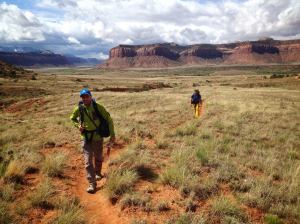 That’s how I landed on the side of the U.S. 191 waving in vain at passing cars.
 In families there are always stories. Some become legend, told and retold until every cousin knows them by heart. Others become myth so intertwined with hyperbole they only shadow the truth. And many become lost altogether, victims of time.
 ErikEisele.com