CDS Column: Socialized Soldiers on Quieter Battlefields

CDS Column: Socialized Soldiers on Quieter Battlefields

Iraq-1020772The ceilings hung squat and low, traced by fluorescent lights dotted among recessed tiles. The hallway was dingy, scraped paint along bare walls and floors that wouldn’t shine no matter the scrubbing applied. Worn signs hung on the bathroom doors, faded now after too many handprints, only half the words now visible. Someone redrew the head on the men’s bathroom symbol, but they’d drawn it square. Inside, a black Magic Markered smiley face stared out.

It didn’t look like a hospital. Or it didn’t look like an American hospital, particularly not one in a major city. American hospitals are shiny and well-lit, with glass walls and artwork lining the corridors. They are regal, siblings to university buildings and museums and federal government offices.

But this wasn’t. What came to mind was Cuba — the dark hallways and simple plastic-upholstered seats lining the waiting room walls in the public clinics, the cement stairwells and overcrowding.

But even in Cuba the lines of patients move. People get seen promptly. Not here.

The emergency department was full. Some people stood along the walls. The woman behind the desk said it was a five-hour wait, maybe more.

“Busy day?” my friend asked.

“No,” the woman said looking apologetic. “This isn’t bad.”

We sat down beneath an overhead television. It was 1 p.m. The afternoon soaps were on.

Seven hours later, the evening news was coming to a close. Our wait also was ending.

Welcome to the VA system.

I’ve heard not every Veterans Affairs hospital is the same. Some, I’m told, don’t feel caught in the Soviet era. I don’t know; I’m not a veteran, and I’ve only ever been to one VA hospital. But that one visit was disturbing enough.

My friend and I were in San Diego. Our visits to California overlapped by a few days, so we decided to team up for some surfing, snorkeling and exploring the city.

But on day two she began complaining of lower back pain. An Air Force vet, she Googled the local VA services. There was a hospital on the outskirts of the city, just outside La Jolla Cove where we’d been snorkeling the day before.

She looked at me. “This should be fun,” she said.

Being a veteran, she knew. I did not. But within a few steps of walking in the door I understood viscerally. All the news stories I’d heard in recent years came flooding back, about long wait times and how the head of the VA had resigned and the system was again due an overhaul. It was akin to walking into an inner-city school — one look was enough to know the facility was under-resourced, that the job it was expected to do far exceeded its capacity. Long waits, substandard care, lost files and missed diagnoses seemed to ooze from every exam room. This was less a hospital than a holding pen. Prisons are better equipped.

And sitting there I had ample time to consider the string of ironies I was witnessing. Here I was in a VA hospital, and I kept having flashbacks to Cuba, a country where the population lives on a fraction of the American standard. But despite appearances, Cuban hospitals get better results. Their version of socialized medicine competes favorably with the profit-driven system employed by the United States, and it blows the VA system out of the water. I was looking at America’s finest — the soldiers, airmen, seamen and Marines of the U.S. military — as they were served up the worst of American health care. Some of them may have even served on Cuban shores, may have stood guard on Guantanamo Bay, Cold War warriors who fought the spread of communism.

What did they earn in return for their service? Socialized medicine.

It almost made me laugh: Fight in honor of American values and you earn guaranteed free government-run health care. “Oppose communism to secure your place in socialism.” I doubt that made it onto many recruiting posters.

But there is a tragedy hidden within the comedy: The modern American application of socialized medicine offers veterans few gifts. They give us their best, and we give them our worst. The VA system is known for wait times that sometimes outlast patients, for diagnoses that come too late. “Support our troops” seems to only hold until the fighting is over. After that we leave them to die on quieter battlefields.

The problem, of course, is not socialized medicine. Plenty of countries pull that off at a high standard — most of Europe, Canada, Costa Rica. But the United States has proven incapable at setting up its own system, even for soldiers. That U.S. soldier who was stationed at Guantanamo Bay may have done better to wander off base to see a doctor than visit the hospitals provided by their own government.

So, every day we rob veterans of what they have earned. We underfund and understaff and under-resource to the point of no return, to the point that servicemen and women die as a result.

It’s easy to blame the bureaucracy, to rest at the myth government can’t run anything well and move on. But that is a farce. Government-run health care works worldwide, just not here.

But the VA has to work. Not marginally, not sluggishly, but well. Efficiently. Smoothly, with dynamism and grace. We owe it to every American willing to pledge more than taxes and a vote every four years for his or her country. It may not have been on the recruiting poster, but it is the promise we made.

And we’ve failed. For a generation now we’ve failed. We’ve accepted the myth that government can’t work, that socialized medicine is doomed to fail, and our soldiers have paid the price for it. Sagging buildings and five-hour wait times are not the best we can do. Our veterans are worth more than that.

This piece appeared in today’s edition of the Conway Daily Sun.
CDS column: Water, and the Power to Destroy

CDS column: Water, and the Power to Destroy

13246360_1490935164265897_2513155182757045179_oWater. In Fryeburg, Maine, it’s a big deal: 603,000 gallons a day, a multinational company, a legal battle, a state Supreme Court ruling. Water is a very big deal.
I remember when the Fryeburg Water Co. agreement with Nestle/Poland Spring first made headlines. It was the first time I’d seen liberals act like scared conservatives.

As a reporter you get used to hearing Republican fears — who is going to take their guns, their jobs, their money. It’s part of the modern conservative message: We have something to lose. We need to protect it.

Among liberals, however, the same fear-based rhetoric doesn’t sell. Issues like abortion and gay rights are pitched without resorting to demagoguery. Government, for Democrats, isn’t something to cower from; it’s something that can be controlled.

Republicans, meanwhile, want to starve the beast, kill it if they can.

But I remember that first meeting after the Nestle deal, the activist stances, the sharp words of trepidation that spilled out. I remember the petition campaigns, the heated elections of the Fryeburg Water District, neighbors shouting at neighbors, outside entities called in for logistical and activist support. Replace the word “government” with “corporation” and suddenly liberals become as fearful as conservatives.

But fear provokes knee-jerk reactions, and knee-jerk overreactions, regardless of party. Republicans fear for their guns to the point that they stymie common-sense gun regulations aimed at reducing school shootings and other tragedies. It’s foolish, but it’s impossible to reason with fear.

The same irrationality has been on display locally. But this time it’s a different crowd, a liberal crowd, raising the alarm: Corporations are evil! Our water is not for sale!

But corporations, just like governments, are not evil. These are not autonomous entities, Frankensteinian monsters wielding supreme power. They are run by people. They are governed by laws. They can be tamed.

But not through fear. The fear response Fryeburg Water activists employed was akin to blindfolded swings at a pinata — a lot of fury, but little meaningful contact. Water activists threw everything they had at the Nestle deal, took it to the highest court in Maine, but it is moving forward nonetheless. The fearful blows failed to land.

And why should they? The deal is legal, fitting neatly within the framework set up by the state of Maine. There was an administrative review, then a legal review. Beyond vocal objections, there was nothing to derail the project.

But here’s the thing: the Fryeburg Water activists had a point, and it was a good one. There are tremendous questions about resource extraction. It’s conversation not limited to water: When a resource buried beneath the earth is turned into a salable commodity, who should benefit? Whether water, oil or ore, what is owned by the individual, what is owned collectively, and what is free for the taking? Who owns what? What is the citizenry entitled to when extraction occurs? Should anyone be able to bottle a resource, cart away all they can and pocket the income? Or is something owed for this action?

This is not a new question, but it was also not the one Fryeburg Water activists were asking. Like gun activists thwarting the latest background check legislation, they were shouting in an all-or-nothing fight to stop the deal. They were not calmly looking to put in reasonable safeguards. And in all the shouting, they yelled themselves hoarse.

They had a point; they just failed to aim where it matters.

And where does it matter? In the Legislature, not the courts.

Water is a precious resource. It is a Maine resource, a Mainer’s resource, one currently open to extraction. To change that will require changing the law, which requires working within the bogeyman entity liberals are comfortable with: government.

Activists need to put down the picket signs and trade them for cell phones. They need to push lawmakers to create of a resource fund built on extraction revenues, something similar to Alaska’s Permanent Fund, which is funded through oil sales.

A small tax on water extraction — a half-cent per gallon, or even a quarter-cent — accrues quickly at 603,000 gallons a day. And it would serve as a bulwark against the risk that large scale extraction might someday deplete Fryeburg’s aquifer.

That is the middle road, threading the needle between government and corporations. And it works: In Alaska every resident gets a check, a payout every year, funded by the extraction industry. In 2015, that check was for $2,072 for every resident. The payout is a dividend — the fund itself has grown to more than $53 billion since it launched in 1977.

That money came from oil, not water, and required a change in the state constitution. But extraction is extraction, and bottled water sells at prices similar to gasoline.

Maine doesn’t have oil. Maine has water. It’s a resource, understandably, in which Mainers have a tremendous stake. Currently, the legal and legislative recognition of that stake is minimal, and nothing in the past few years has been done to change that. Activists opposed to Nestle went to battle with empty hands. Instead of looking to arm themselves, they wandered into the fields to get slaughtered. The Maine Supreme Court decision dispatched the last of their hopes.

But Mainers have power. It sits in the tremendous value of bottled water. Residents sit on a commodity, a valuable one. Shouting in the face of its being packaged into profits isn’t going to change things, but taxes do change things. It would be the middle way, accepting that businesses have a right to do business rather than an all out victory against an “evil” corporation. But it would create real value for Mainers rather than just noise.

And should the battle rise again, it would give activists an actual weapon. “The power to tax,” after all, “involves the power to destroy,” U.S. Supreme Court Chief Justice John Marshall said nearly 200 years ago.


This column was featured in the Conway Daily Sun newspaper.

The Smoke and the Fire

The Smoke and the Fire

e597d-dsc_0047Heroin. I’ve wanted to write about it for a while, about addiction and its affect on our state, our communities, but what do you say? It’s a drug, cheap, powerful and terrible. It destroys lives, families, futures. Column finished.
But it’s not that simple. Heroin is a symptom, the smoke that evidences fire. The actual disaster, however, runs deeper.
I’ve written several stories on opiate addiction, interviewed local officials, pulled court records, police logs, etc. A few years ago it was pills, but now it’s the street stuff. The tools themselves change, but the underlying story remains — people caught chasing the sweet release of poppies.
Among the conversations I had while writing those stories was one with a treatment specialist. Back in the 1960s and 1970s, he told me, during the Vietnam War, thousands of soldiers became heroin addicts. It was in easy supply in Southeast Asia, and in the chaos of war GIs turned to drugs to cope. There were fears at the time that returning troops would flood the streets of America as addicts, still searching for a fix.
But they didn’t. The flood never came. The soldiers returned home and settled back into their lives, rejoined their families and got jobs. They put the needles down and stepped back into the world.
That was 40 years ago, a very different world. Today the drugs are cheaper and more powerful, and many get hooked at the hospital, not at war. But the addictions remain, and this time they hold. They do not let go when people get home.
So what is different? What made it possible for veterans to let go of something that today swallows so many?
Community. Family. Opportunity. Connection. Those were the things that soldiers came home to, the treatment specialist told me, and they are missing now. The world is different. Decades ago returning veterans plugged back into communities, family units and an economy that was anticipating them, hungry for their participation. They came back to something, became part of something. They turned to heroin and other drugs to cope with a war, when they were lost and alone and disconnected, but upon reentry they found themselves surrounded by all the things that make life rich. In that environment, the needles lost their appeal.
When I look around today, that explanation makes sense. The land of the lost has migrated. Today we call it home.
What are the middle class opportunities today, the jobs that take those millions of Americans from struggling to standing on their own two feet? The mills are gone. So are the furniture making and logging jobs. Elsewhere it’s the auto industry that has evaporated, and the steel industry. And fishing. And manufacturing. Those places that four decades ago offered a stable middle class life to millions willing to work hard are shrinking or gone. They’ve been replaced by Walmart, by openings at hotels and restaurants, by service industry employment that makes ends meet only when you have two or three jobs.
Those are the opportunities now open to the same people who were once the backbone of America’s manufacturing might — the hardworking high school graduates, the people with “some college” or even degrees. No longer building, they instead serve, and they struggle to survive.
Families, meanwhile, have also splintered. The social fabric is now torn, and where parents and siblings might at one time have had the resources to catch a loved one slipping through the cracks, today everyone sits close to the edge. Parents whose retirement evaporated in the 2008 housing crash are in no position to buoy up their grown children in moments of crisis. It takes two incomes to build a life today, but families are split by more divorces than ever. Everyone is caught alone in their own race against insolvency; there is no time to look over your shoulder to check on someone else.
This stark landscape is now the foundation of entire communities — people struggling and alone, disconnected, unable to make ends meet, unable to look out for one another. The economic and family demographic transformation of 40 years, has wreaked havoc on the larger social structure that once made neighbor accountable to neighbor. More and more we are alone.
The Granite State in particular, with “Live Free Or Die” emblazoned on our license plates, takes pride in its independent streak. But in this instance our independence exacerbates our isolation — fierce libertarianism and community make confused bedfellows.
This is the land we live in. It may not be your reality, but it is the reality of many of our neighbors. They struggle to survive, to make ends meet, often alone or in relationships caught under massive strain, few family or community supports available as buffers. They are never far from the cracks, their options few and dwindling in a world with seemingly less and less space for them. A health problem, car issue or home repair can easily push them over the edge.
So, like the soldiers, they turn to drugs.
Like the soldiers, they turn to something that lets them escape reality, frees them for a moment from unsustainable lives. Like the soldiers, they turn to something to forget today, what they saw and lived, the sadness and disconnection, if only for a moment.
The soldiers, however, eventually got to come home. Our neighbors are not so lucky. Heroin is the smoke, but the fire is in our homes. In our families, our communities, our economy. Put out the flames, and the smoke will dissipate.
Our neighbors, then, will come home too.

This story appeared in the Conway Daily Sun in January 2016.

Cold December?

Cold December?

CMG-1020592I wonder if people are worried.

It’s December. Do you remember December? There may not always be snow on the ground, but before Christmas approaches things up high things grow white. The air cracks, dry and cold. The skies are grey, hard as flint, and flurries are common.

This, what we are having now, is not December.

I thought about this in October, when summer seemed unwilling to end, when the leaves held way past normal. And I thought about it again in November, when the “Indian Summer” stretched week after week. But it seemed my concern was maybe jumping the gun. Maybe, like last year, winter would rear itself forcefully and all my worrying would be for naught.

But now it’s December. Mid-December. But the sun still carries warmth. The nights seldom to dip to freezing. The mountains are looking like late October. Christmas is almost here, and “white” seems very unlikely. Some days smell distinctly of spring. Something feels off, way off, a long way from normal. I’m worried.

I hope it’s not just me.

Not that I’m complaining exactly. The warm days have been marvelous, and it’s nice to wear a T-shirt when the calendar recommends two fleeces and a puffy jacket. But this is bigger than personal comfort. When things get weird like this it starts to feel like maybe the Earth’s orbit is off-axis, like maybe the planet’s tilt is spinning aloof. What the heck is going on, when April and December switch?

There is politicized discussion/debate about global warming and the role we play in it. I’m not looking to wade into that. Or the equally politicized conversation about whether or not we should be taking steps to counteract it. Like so much today, those issues are too muddied to approach openly. Each side has its staked-out position, and every conversation devolves into a shouting match. Opponents lob rhetorical grenades across a divided no man’s land. I have no desire to walk headlong into that.

But this December feels weird. Like September, the hottest on record. And October, also the hottest. The National Oceanic and Atmospheric Administration will release November numbers this week, at which point we’ll see if the trend holds for last month too. The December data won’t be out until January, at which point perhaps the hills will be white and the 55 degree days will seem like a distant memory but, no matter what the final numbers settle out to, something is askew with this month.

And regardless of the data, global temperature rise will remain a schism point, a political fracture. Here in New Hampshire it’s hard not to be pleased with reduced home heating bills, fewer mornings spent scraping the car windshield and a few extra days of tolerable temperatures.

But the Mount Washington Valley winter economy is built on Attitash, Wildcat, Cranmore, Black Mountain and King Pine. Bretton Woods and Great Glen. Bear Notch and Jackson Ski Touring Foundation. Mount Washington Valley Ski Touring, snowmobile vacations and ice climbing trips. Snowshoers and winter hikers. Winter is the unique gift the North Conway area offers, and right now we can’t offer it to anyone. Without 32 degrees Fahrenheit and below, the driver that marks the fourth season sputters.

And it isn’t just the fourth season: Foliage is getting harder to predict, harder to plan around, as temperatures buck and weave. Replacing cold nights with strings of warm days takes a toll on the colors. Springtime warmth, which drives maple sap skyward, is also erratic of late. And rainless summers have an effect on river levels, meaning an excursion on the Saco can be more of a walk than a paddle. So much of what makes the Mount Washington Valley thrive is built upon its seasonal fluctuations, built on a consistency that has allowed entire industries to develop and thrive. What happens if the ski slopes are brown on Christmas week? Right now that doesn’t seem so far-fetched.

And that is the beginning. From there, what happens to the rest of the valley economy without the tourist crowds those recreation opportunities drive? What happens to the hotels and restaurants, to the ski shops and the outdoor stores, to the outlets that entertain non-skiing family members? They will suffer the same weather pinch.

And if those businesses suffer, how long will it take for the impact to be felt down the line, at the local doctor’s and dentist’s office, at the accountant’s? In this valley everyone’s livelihood is tied to tourism, and tourism is tied to the weather. Even the newspaper prays for snow.

This is not an abstraction; the ski industry has been wrestling with this problem for decades. Snowmaking, once a small part of mountain operations, became a focal point after winter storms proved insufficient to coat the trails by Christmas. Today almost every Northeastern mountain can paint the whole hill white with guns, but they need cold temperatures. What if those are gone too? What if December truly is the new autumn? I’m worried.

But in truth, there is no use in worrying. If that is the trajectory, if winter is truly on its way out, then it is a boulder bouncing downhill — there will be no turning it around quickly.

And if not, then I’ve just written an entire column for nothing.

But.

But the conversation about rising temperatures is not an abstract political argument about ice caps, polar bears and Polynesian islands. It is a conversation about this valley, about an economy built on seasons, a conversation about our jobs. If global warming is real it will hit us where it hurts. And this December it is feeling very real.

This piece appeared in the Conway Daily Sun in December 2015.

No Resolution

No Resolution

12419170_1370918652934216_2490529582253069540_oIt’s that time of year again: New Year’s. A time to reflect on the past year, review what we’ve done and haven’t done, and ponder the next 365 days. A time for self-examination and resolutions. Sometimes, it seems to sneak up so fast.

I don’t remember what my resolutions were for last year. I actually don’t think I had any. It’s never been my thing to peg a behavior shift to the flip of the calendar. But like everyone the end of the year has me reflecting on 2015. Which in turn has me thinking forward to 2016, considering things I’d like to do differently.

To start, it’s important to remember resolutions are not redos. There are no redos. If there were, I might not write the column I wrote last week. Did you read it? It was about the presidential race, about Marco Rubio, about how wooden and impersonal he seemed visiting the Sun office.

At least, that’s what most people seemed to get out of it. That’s what made it popular enough to bounce its way around the Internet until it eventually landed on MSNBC and the Drudge Report.

But to me that was not what the column was about. It was written in frustration not at Rubio but at how the modern presidential contest forces candidates to aim for perfection, to be always on, always be cognizant of any missteps. That expectation of perfection forces them to close the door to authentic interaction, to limit what they show to talking points only. Being a person, as well as a politician, is not allowed. I wrote it knowing Rubio has little choice — those candidates willing to be authentically themselves (Rick Santorum comes to mind) say things that keep them at the fringe. They let voters know what they think on controversial issues, and in so doing never risk a serious shot at the office.

Winners, meanwhile, never say anything of substance, anything revealing. Such risks are not the way to the White House today. This is the democracy we have inherited.

That is what I was looking to say last week. I thought I wrote one thing, but readers thought I wrote something completely different. And once the words hit paper, my thoughts are no longer my own. They become open to interpretation, and readers’ interpretation, not mine.

From a writer’s perspective, it’s a confusing position to be in. What I put down in print is not always what the reader picks up. It’s like watching words coming out of my mouth get jumbled, reorganized and reenergized before they reach your ears. The resulting conversation leaves me frustrated and confused. I am not saying what you think I’m saying. At least, I don’t think so.

It might be my fault. Maybe what made sense in my head didn’t land cleanly on the page. Maybe the salient points were left unstressed, and my delivery carries the blame.

Part of it, though, lies in the political atmosphere today, one that reduces democracy to a binary scorecard of wins and losses. I write about Rubio getting caught in an impossible system with impossible expectations, and readers interpreted my words as a condemnation of Rubio. A Rubio loss. Minus one.

That interpretation, the binary version of life, is exactly the sad state of affairs I was hoping to point out.

Candidates are caught only looking for wins, and that’s what makes them choose an affect that comes across as something other than human. Maybe my words were poorly chosen. Maybe they were just wrong. But watching the story unfurl as a loss for Rubio felt like I’d fallen down the rabbit hole I’d only intended to point out.

This is not the first time. I’ve often had people unwittingly tell me about stories I’d written, and explain in great detail what was really going on not realizing I was the original author. I would listen dumbfounded, wondering where in my story was all this subtext I never intended.

But as readers, and as people, we come to the world with our own interpretations. They silently steer us, even when we think of ourselves savvy. We all do it. I, for instance, did it in last week’s column, interpreting Rubio’s wooden affect through the lens of a broken political system rather than some personality flaw. Perhaps I twisted the truth to match a narrative I was looking to comment on. Perhaps Rubio has no interest in warmth — I spent 20 minutes with the man, so in all honestly I have no idea.

But there are no redos. I cannot take back my column, any more than I can take back readers’ interpretations that were not what I intended.

I can, however, remember that my interpretations are as steered by assumptions as my readers. Is Rubio caught in a broken system, or simply a cold person? Or both? Or neither? I have no idea. I can only write the world as it seems to me, transformed as it is by my assumptions, into words for publication.

Every one of those words is then interpreted a second time, this time by the reader. These interpretations are again rife with assumptions.

The result? A fleet of stories produced and consumed through twisted lenses. Like all stories, they are infinitely more complex than the page suggests. They aren’t broken, but they are not crystalline either.

This is the mess that is the modern media environment.

So my resolution? To remember each time I write that no story exists outside the rabbit hole. Every piece is a tumbling of assumptions falling through the blackness. The words on the page may print in black and white, but in truth they will only ever reveal dim shadows. Readers create the full version by filling in the dark spots with their own assumptions. Corruption is part of the reading process. No narrative will ever be perfect.

There aren’t enough pages to say it all. Hopefully readers remember that, too.

This piece appeared in the Conway Daily Sun in December of 2015.

In the Face of Terror

In the Face of Terror

national_park_service_9-11_statue_of_liberty_and_wtc_fireIn the days immediately following 9/11, President George W. Bush visited the Islamic Center of Washington D.C. Standing before a lectern, sandwiched between a dark-skinned bearded man and a woman wrapped in headscarf, he addressed cameras directly.
“The American people were appalled and outraged at last Tuesday’s attacks,” he began, “and so were Muslims all across the world. These acts of violence against innocents violate the fundamental tenets of the Islamic faith, and it’s important for my fellow Americans to understand that.”
“The face of terror is not the true faith of Islam,” he said. “That’s not what Islam is all about. Islam is peace. When we think of Islam we think of a faith that brings comfort to a billion people around the world.”
He quoted the Quran. He urged Americans to treat their Muslim neighbors with respect. “Muslims make an incredibly valuable contribution to our country,” he said. “Women who cover their heads in this country must feel comfortable going outside their homes. Moms who wear cover must be not intimidated in America. That’s not the America I know. That’s not the America I value.”
“Those who feel like they can intimidate our fellow citizens to take out their anger don’t represent the best of America,” he said. “They represent the worst of humankind, and they should be ashamed.”
That was six days after the towers fell. What a difference a decade makes. Today, Donald Trump, the leading candidate for the Republican presidential nomination, is advocating putting certain mosques under surveillance. He also told a reporter he would support a database to track American Muslims.
“That’s not the America I know,” President Bush said in 2001. “That’s not the America I value.”
But Trump is not alone. In the wake of Paris, where 130 were killed and 368 wounded, people are scared. We Americans are scared. Paris reminds us of our own loss, of our own brutal encounter with terrorism, and calls for enhanced security have understandably poured out as a result.
But in the scramble to protect ourselves, we are forgetting ourselves. We are forgetting the things that, as President Bush said, “represent the best of America.”
This isn’t just in international circles or in Washington, D.C. This is right here at home, in New Hampshire.
In the wake of a crumbling Syria, 4.3 million Syrians have fled their country. They left in hopes of evading Assad and ISIS, and escaping civil war. They now sit stranded in Turkey and Europe, unable to return home, with nowhere to go. To date, Germany has accepted more than 38,000 of these refugees; Canada, more than 36,000. America, meanwhile, has opened its doors to 2,200.
That number was poised to jump to 10,000 in 2016, but with Paris serving as a punctuation point, governors across the country are demanding the border closed to Syrian refugees. A terrorist could be in their midst, they argue; the risk is too great.
French President Francois Hollande, meanwhile, said France will accept 30,000 Syrian refugees over the next two years.
The American fear is real, palpable. And it is understandable: Terrorism, the extremists’ chosen tactic, is designed to foment, to amplify, the fear response. The true victim of terrorism is society: Those killed are simply murdered, but the fear generated by the act reverberates among the survivors. Terrorism reigns among the living, and in the wake of Paris we are the survivors.
America is 320 million scared. Terrorism is proving its effectiveness.
“That’s not the America I know,” President Bush said in 2001. “That’s not the America I value.”
The lens of fear has twisted us. We are in the throes of the greatest refugee wave since World War II, but instead of seeing 4.3 million victims of terror we see 4.3 million possible terrorists. We stand in the land of the Statue of Liberty, “Give me your tired, your poor, your huddled masses yearning to breathe free” still emblazoned on its base, and shut the door. Why? Out of fear.
“That’s not the America I know,” President Bush said in 2001. “That’s not the America I value.”
Terrorism is real. The threat is real. But the threat is not the number of victims it claims by murder but the pressure it puts upon free societies to abandon their freedoms. We are fighting a war of ideas, and in the scramble to make our lives safe we are losing our principles. The roots of our strength are in our pluralism, our openness and our diversity. ISIS cannot change that. Only we can.
And we are. Last week, Gov. Maggie Hassan joined that call to put a pause on the Syrian refugee resettlement. Sen. Kelly Ayotte echoed close behind. And Rep. Frank Guinta and Rep. Annie Kuster both voted to add additional screening measures to the refugee resettlement process when Syrians are involved.
“Live Free or Die” be damned. New Hampshire marches to the chorus of fear.
Only Sen. Jeanne Shaheen has staked out an alternative position: “After the Vietnam War we took 750,000 Vietnamese,” she told WMUR. “We took over 500,000 Cubans when Castro took over Cuba. We’ve taken Somalis, we’ve taken people from all over the world.”
“We do need to vet them,” she said, “but we also need to look at how we can expedite that process so it’s as efficient as possible.”
An America that sees victims of terror and is unafraid to respond? One that rushes to wrap them in her cloak, to welcome them to her shores? That’s the America I know. That’s the America I value.

This piece appeared in the Conway Daily Sun in November of 2015.

The Candidate Race

rubio-marcoThe pointman for Sen. Marco Rubio wore a sport coat and thick beard and talked with a southern accent. In his late 20s, he arrived an hour before the candidate was scheduled and sat in the front room of the Sun offices surfing the Internet on his phone. His name was Trip, and he was waiting for his boss to arrive. His job, he told me, was to get things ready. That means his phone battery dies every three hours.
The Sun, however, doesn’t require much prepping. When candidates arrive we pull a pair of armchairs side-by-side, one for the candidate and one for the publisher, and the rest of us form a semicircle. The chairs were still in place from the last interview, so there wasn’t anything to prep. With 15 minutes to Rubio-time the Sun staff was still working on other things. Trip’s trip was being wasted.
But after some strategic texting Trip jumped up to let everyone know the senator was four minutes out. The campaign was going into action. But again, this was met without fanfare — late afternoons are deadline time at a newspaper, no time for distractions, and people kept working.
When the senator finally arrived, however, everything shifted. Phones hung up, notebooks closed, computers went into sleep mode. Rubio made his way around smiling and shaking hands, and everyone stood to meet him. He took a comfy chair, thus beginning one more job interview for 2016’s toughest opening.
In New Hampshire we’re lucky. We guard the frontline of presidential politics. Every four years the candidates come, wave after wave, to sit and discuss the issues, to interview for the job. It’s a democratic utopia, a dreamland for reporters, where the action is.
But it’s a weird place too. It’s a place where you interact on a human level with people more prepared to address a television camera. It’s like they train to address crowds from podiums and lose the ability to engage a room of a dozen.
That was Rubio. We had roughly 20 minutes with him on Monday, and in that time he talked about ISIS, the economy, his political record and his background. But it was like watching a computer algorithm designed to cover talking points. He said a lot, but at the same time said nothing. It was like someone wound him up, pointed him towards the doors and pushed play. If there was a human side to senator, a soul, it didn’t come across through.
That might sound like harsh critique, but in essence that is the point of the New Hampshire primary, to test candidates in a retail politics setting. Rubio said it himself: “New Hampshire is very town hall based,” he told us, the politics “retail-oriented.” After the New Hampshire primary, he said, it transforms into a media race, not a human race.
But then he talked at us for 20 minutes. To him, we might as well have been television cameras.
Now maybe he was in a hurry. Or was tired after a long day of campaigning. Maybe our little paper wasn’t worth putting in the full retail effort. Whatever it was, if Rubio is charismatic, he wasn’t when he visited us.
But he was smart. It was easy to see he is brilliant, capable of winning political arguments. And maybe that’s what we should be looking for in a president — the smart guy. Maybe the transformation from human to politician is just part of the game today. In the modern media environment cell phone cameras run 24/7. There is always someone watching for any potential slip, looking to turn an offhand comment into a career-ending soundbyte.
Remember a dozen years ago when Howard Dean let out “the scream” that ended his campaign? Now multiply that risk by the number of smartphones introduced since 2004. Moments of idiocy, of poor word choice and brain farts are now captured and broadcast around the world. And it’s not uncommon for Fox News or NBC to broadcast to the world something recorded on a cellphone.
The result? An expectation of perfection, and candidates like Marco Rubio, a man so stuck on script it doesn’t even matter when the cameras are off. Living in a political environment where only the script makes sense, where the race is about the television audience rather than the general electorate, why deviate? Those willing to risk off-message interaction also risk alienating. It’s too great a risk, and retail politics drops by the wayside as voters are courted only by the millions, not one-by-one.
New Hampshire sits as the bulwark against that world. We are here to meet and greet, to be the face of the country, to gauge individual interactions and then broadcast that gut feeling on to the nation. New Yorkers will never get to meet every candidate. Nor Californians, nor Texans, nor Floridians. Those states have sway in November. New Hampshire sways now.
In New Hampshire, the presidential contest is recast as a local race. And in local races — the New Hampshire House or Senate, for example — it’s nearly impossible to vote straight ticket. When you know the candidates it’s not just enough to agree with their ideas; we need to trust the individual as well, to believe they are the kind of person we should elevate to power. It’s no longer just party. Here it’s personal.
That ability to build connections is what kept Ray Burton in office for three decades despite shifting political tides. People knew him, liked him and, regardless of political affiliation, supported him. That is a rare thing today. It’s a New Hampshire thing.
And that’s what we offer the country: The chance to face presidential candidates like local politicians. The chance for them to prove they hear us. The chance to support the person, not just the politician.

This piece appeared in the Conway Daily Sun in December of 2015.

One Page, Typewritten

One Page, Typewritten

12466190_1372029352823146_3197915331627306497_oJune, 1947. Page, 24, sits at the bar in the Sheraton Plaza Hotel in Daytona Beach, Fla. It’s hot, Florida in summer hot. She sips a drink alone.
A man walks in. A sport coat and pressed shirt drape over his lanky frame. His nose is sharp, eyes the color of coffee. As he crosses the room he seems to point to the floor — his eyes, his nose, his head, his chest. He served in the war. It’s that walk, she can tell. He comes toward her.
“Hi,” he says. “May I sit down?”
“Yes, of course,” Page replies.
He pulls open the chair and sits. “Thank you.”
The past can be hard to picture, it leaves only shadows. The impression remaining is cobbled together like scenes from old movies — the characters are real, but the settings are wooden, the dialogue imagined, almost fiction.
But Page is real. And so was he.
They talk. He’s witty, makes her laugh. She orders a second drink. He finishes his first. Late afternoon slips to evening, but the dark Florida June is still stifling. Soon he has to leave.
“I’m giving a talk,” he says. “It’ll be an hour. Will you wait?”
She smiles. “Wait for what?”
“I’d like to have dinner with you,” he says, standing.
“An hour?” she says. “Yes, I’ll wait.”
When he returns they leave together, walk out of the bar, out of the hotel and into a restaurant. They keep talking — him telling stories and her laughing. When they finish dinner they go to another bar, then a third. It’s after midnight when they walk back to the Sheraton Plaza.
“Thank you,” Page says, leaning against the door to her room. “I had a wonderful night.”
“Me too,” the man says.
She steps inside, closing the door behind her as he walks away.
The next morning early there is a knock. Page pulls on her robe. “Yes?”
“I wanted to thank you again,” the man says. She opens the door and he hands her his card. His fingers trail across hers as she takes it. “It was the perfect night.”
He smiles. “Write me,” he says, and then turns.
She looks at the card: J.D. Salinger, writer.
1947, four years before “The Catcher in the Rye.” Page is now 92. Her birthday just passed. She lives in South Carolina, still drives, still lives in her home. She is my grandmother.
I knew none of the story when I visited last fall. She’d fallen, broken her pelvis and was in a rehab center awaiting surgery. I drove down to offer help. Aside from the break she was healthy and strong, “This place is full of old people,” she told me. “Not like me. I’m old, but these people have no idea what day it is.”
But not her. Ninety-two or not, she remembers.
“You’re a writer, so you might appreciate this,” she said, and she told me the story: the bar, how he came in then left then came back. Dinner. The next morning. All of it.
“Go in my desk,” she said. “In the back there’s an envelope. Look inside.”
“Write me,” he said. And she did. And he wrote back.
The envelope was yellow and stuffed with clippings. The return address — P.O. Box 32, Windsor, VT 05089 — lacks a name; the postmark read May 23, 1976, 29 years after the hotel.
“Dear Page B.,” the letter begins, typed in the irregular stroke of a typewriter. “Mainly, I suppose, because of the kind of work I’ve got myself into, my memory seems to be almost extinct. Or so cluttered and cross-cluttered that I can get at things only at their convenience, not mine. Not that it doesn’t all come back if someone very kindly presents me with an artifact or two — the seating plan of some old dining room, say, or a sketch of the way deck chairs were placed around the swimming pool, or sometimes just a plain wet black bathing suit does the trick.”
But even faded, the memory survived: “I was back at that Daytona hotel a couple of winters ago, with my children, but the place had turned seedy and the weather was cold, and we cleared out in a hurry.”
One page only, signed “JDS.” He referred to her children (“I’m aware of what goes into having just two. The algebra of seven is too much for me.”) and her separation, indications of past correspondence. Her words, however, are silent, only echoed on the page of a man who splashed letters like paint.
“You do sound intact, but very much, though, and I’m glad. For what very little it must be worth, I send you all these inanities with warm apologies.”
He is dead now. She is 92. But the letter remains. Thirty-nine years later, 68 years later, the past is still cluttered and cross-cluttered. Memories fade, then disappear, and from the rearview it sounds almost like fiction.
Almost.

This story appeared in The Conway Daily Sun in July of 2015.

Goodbye

Goodbye

Four days is a long time. A lot can happen.

Four days ago Sgt. Brian Abrams was alive. Four days ago he hadn’t lost control of his motorcycle, he hadn’t crashed into a stone wall, he hadn’t hit his head on a rock. Four days ago he hadn’t needed an airlift to Maine Medical Center, where surgery did nothing to revive him. Four days ago his family didn’t have to decide whether to remove the machines that were keeping Brian alive. Four days ago Brian could breathe on his own. Four days ago Brian wasn’t dead.
Today he is dead. Brian died last night at approximately 4:50 p.m., surrounded by friends and family. I was at IME when I heard the news. I was also surrounded by friends. It did little to soften the blow, however. When I got home I wrote an email to a friend, not really with the intention of hearing back, but more as a journal entry shot into space. I wanted it to land somewhere green, somewhere vibrant and alive, where death doesn’t exist and sorrow, suffering and pain are just echoes. I reread that email today and realized it was more a note to myself than to anyone else. I though maybe it belonged here.

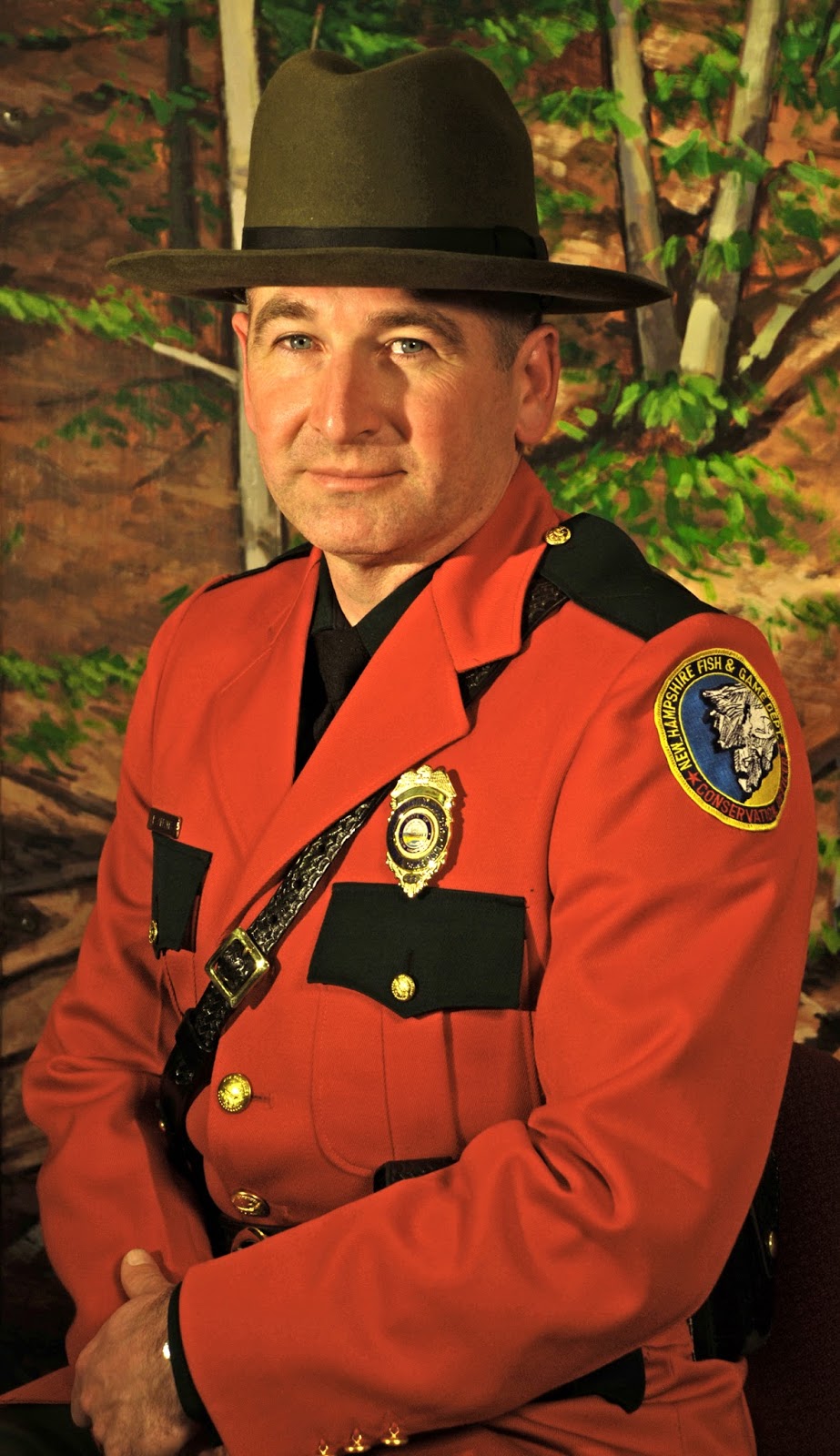
Hi. I need a few minutes to unwind. A friend, a local Fish and Game officer who I had regular contact with through the paper, got in a motorcycle crash over the weekend. He hit his head (he wasn’t wearing a helmet), and suffered a serious brain injury. He was airlifted to Maine Med, but he never woke up. His family turned off life support this evening. He had two daughters, seven and 10, and he was quite possibly the nicest man I ever met. I spent today reporting on the story, calling state officials trying to convince them to release a statement about my friend, then calling around to friends in the climbing/rescue community who had worked with him to get them to share their stories about Brian. I cried a dozen times at my desk today, thinking about the pain his family was going through and what it was going to be like for those two little girls. I skipped singing class and stopped at IME after work. The owner, Rick, was a close friend of Brian’s. While I was there Celia, Rick’s wife, got the call that they had pulled the plug. There were two other rescue team members there. We all cried.

It’s just been a long day. I want more than anything to just melt into the covers and cry. And, well, I can’t. So I’m groping for a little bit of connection.

In my heart I know Brian’s suffering is over, or at least moved beyond any form I recognize. His moment, his life, has passed. This pain in my heart is about me, about my fear, my uncertainty, my own feelings of loss. But there those feelings sit. I’m doing my best to be gentle with them, to not be mad at myself for getting so upset. I want to celebrate him and his life, but the sense of loss is like a wet cloth draped over my nose and mouth — it makes it hard to breathe. And I know my feelings of loss are illusory compared to those of his children and family.

I can’t stop thinking about a short story I heard several weeks ago about three kinds of death. First your body dies — that is one kind of death. Then the last person who ever knew you dies — that is another kind of death. Then there is the last time your name is ever spoken — that is a third kind of death. I don’t know why today made me think of that, but it’s been in my head all daIt’s all a dream. The impermanence, the meaning of plans and expectations, the interpretations of good and bad, right and wrong, it’s all just a crazy mess of electromagnetic pulses across gray matter that starves in minutes without oxygen. There is no up, no down, but our minds yearn for clarity and so they assign such markers. It’s madness, and in the end we all die anyway. The clarity we seek is just a game, an illusion, smoke. 

I’ve stopped making sense. I guess today didn’t make sense, which makes sense because the world doesn’t make sense, no matter how hard we try to make sense of it. The only thing we have is the ability to connect, and even connection is impermanent, transient, fleeting. In this moment, tonight, I’m searching for connection, for someone to tell me I won’t die alone, that I am not alone in the vastness of the space. Because how do I know I’m not? Maybe everyone else is just part of a movie — players with a set script that rolls ever on with no notice of my contribution. Maybe I’m the only one without a copy, the only one with these thoughts, these fears. Maybe I am truly alone.

Either way I will die alone, even if it is among friends. That is a trip we can’t partner up for, which is terrifying. A few months ago I discovered a phrase, “I may die today,” that carried me through dark days. It served as a reminder not to be afraid, because life is not within our control. Carefully tiptoeing doesn’t change the fact that I STILL may die today. So live BOLDLY, without the weight of fear. Only I’m not sure how to do that, so I just act the way I think someone who knows how to do it would act. Maybe that way I can get there.

Life is a mess. Not mine, but life in general. It gets places through messing up, through killing off hearts and souls without rhyme or reason. I laugh at the way I used to look at it, trying to understand it all, judge it all, take it all in and make statements of fact like I had any idea. I don’t even know if I’m alive, or if I’m just caught in a dream in the moments before death. Who even knows? It’s all just a play, and the script is burning as it’s written.

Moments of connection are fleeting. Maybe they’re not even real. But when a friend dies you realize you never told them how inspired you were by their kindness, their gentle grace. I remember this same feeling when I learned my high school friend Bill Ballard was dead. At 18 he was the best man I’ve ever known, and I never told him. I’ll never live up to the ideal of telling everyone all the time how much they mean. If I did the words would lose their value, their meaning, their truth. But in this moment, in losing Brian, I realize how much love is out there, how much love is in my life, and how much love is in my heart. So much it fills me up, drowns me, knocks me off guard, confuses and leaves me breathless. I hope that never changes. I’m pretty sure it never will. Life’s beauty overwhelms me.

I haven’t got much else to say. In fact, I’m not really sure I said anything at all, or that what I said made any sense. I was/am just looking for a lantern in the fog, another marker along the way that promises warmth, light, life. They seem spread far apart some days, but I have to trust they are there, even on the nights I can’t see them. I try not to make sense of their blinking patterns and instead just let them be what they are. They float like fireflies in the night — too magical to hold in your hand for more than the briefest moment.

It’s just after midnight, and I have to work in the morning. I’m going to bed. Thanks for giving me a place to just unload. You are not expected to respond.

It was a lot to digest, but I thought it fit here. And you are already missed, Brian. Thank you for the smiles, the quiet honesty of your presence, and all the lessons. They are unfolding still.

Truth in Politics

It isn’t often that small papers have the time or the resources to really catch national politicians in lies, half-truths or misrepresentations. Last week, however, several things landed in my lap that were just too obvious to ignore. I was able to pull them together into a story that I hope gets across the problems with today’s political system. Either way, it was fun to take both parties to task for their indiscretions. It’s not every day a small paper gets to do it.