A Tale of Two Studies

A Tale of Two Studies

9129d-ski-1080245The scientist who uncovered acid rain in North America 50 years ago now sees a parallel struggle waging around climate change and the effects of global warming.

“The pushback was just like it is now,” ecologist Gene Likens said on Tuesday, talking about how his research in the White Mountains was received when it went public in the mid-1970s. Big vested business interests and their allies rejected his findings, he said, until he and his teams could show scientifically where the pollutants causing acid rain were coming from—industrial polluters in the Midwest.

From initial discovery to the enactment of new rules limiting those polluters took nearly a generation. Or, as Likens likes to put it, “27 years, three presidents and one pope.”

Now, he said, he’s watching something similar happen with climate change.

Likens research and his legacy are intimately tied to the White Mountains. It began in 1963 when Likens was a professor at Dartmouth College. He was the lead scientist of a team studying streamwater chemistry in the Hubbard Brook Experimental Forest outside Lincoln, the U.S. Forest Service’s forest-laboratory of the White Mountains. His team wanted to know how the forest worked, to understand the inputs and outputs, what made it tick. They weren’t looking for anything specific, Likens said, but what they they found surprised them: water infused with sulfur dioxide and nitrogen oxides, a concoction capable of leaching aluminum from the soil and depositing it downstream in lakes and rivers, and also capable of killing insects, fish and plants along the way.

What they found was acid rain.

“The very first sample of rain we collected was very acidic,” said Likens, with acidity levels 100 times above normal. “Nobody knew there was a problem,” he said. “It was pure serendipity. So much of science is that way. We didn’t set out to discover acid rain. It was there and we ran with it.”

Their research led to an article in the journal Environment in 1972. Two years later Likens, now a professor at Cornell University, replicated the experiment in the Finger Lakes region of central New York, where again they found sulfur dioxides and nitrogen oxides in the water. He and a colleague published again published their findings, this time in the journal Science.

That’s when their research got noticed.

“It was picked up by the New York Times,” Likens said. “It ran on the front page.”

The year was 1974. Acid rain for the first time was in national headlines. It would be another 16 years before Congress passed revisions to the Clean Air Act to curb the industrial pollution that was the cause.

From acid rain’s discovery in 1963 to Congressional action in 1990, all of it started in the White Mountains, in the Hubbard Brook Experimental Forest, which Likens calls one of the most studied ecosystems on the planet.

“We are much more effective stewards when we have long-term monitoring to guide us,” Likens said, “but the reality is such studies are quite rare.”

Likens research has included collecting decades of stream water chemistry data and associated rainfall information, creating one of the longest such records for any site on Earth. “And I’m still doing it,” he said.

And scientists in other disciplines have been doing similar work, leaving long records that allow researchers to see trends over time.

“So with climate change we can say what happened,” Likens said, “and what is happening.”

Birds in the forest, for example, are arriving earlier. Buds sprout earlier. Mirror Lake, “probably one of the most studied lakes in the world,” he said, is now covered by ice 20 days less each winter than in years past. The planet is definitely warming.

But when it comes to climate change some people push back against the science. And they doubt human involvement. Likens said he seen this before, that it was the same debate over causation that raged with acid rain.

But as a researcher, Likens said, his job is not to get lost in those arguments. A researcher’s job is to continue working, he said, to explore and examine, to collect data and ensure a record exists of what happens in the world.

“I’m not an advocate,” Likens said. “I’m not a politician. I’m a scientist.”


A version of this story ran in Saturday’s Conway Daily Sun.
The Road, and Everything Else

The Road, and Everything Else

IMG_7411.JPGThere’s something about the road.

It doesn’t matter how many times people write about it, how many times people say it, the truth of it always resonates: There is something about the road. Maybe it’s the unsteadiness of it, the unpredictability. It cracks people open, leaves them vulnerable, open to spark and tangents. It pulls us in unforeseen directions, leaves us with fresh perceptions. There is something beautiful about it. Something primal.

I was outside just after dusk last night. 100 steps from the house was silent, dark. Then a flash of green, and another. Slowly they multiplied, a sea of beacons blinking around me: fireflies. The first of the season? I couldn’t tell. I hadn’t noticed them before last night, but was that because they weren’t there, or because I’d been distracted? I don’t know. But seeing them was like magic.

How much to we forget to see? How often do we look at the world as mundane because we have grown accustomed? And once we’ve stopped seeing, how do was see again?

That is the gift of the road. It brings us back to our senses, to our sense of wonder. The things that we grow accustomed to at home become new again in our absence. The fireflies regain their spark.

I hit the road in a few days. A week of freediving in the Florida Keys, then out to California for some friends, diving and climbing, then up the Pacific Coast to surf, climb and explore the Pacific Northwest. From there I catch a flight to Belize where I’m working with high school students on a service-learning project for three weeks, then diving for a week. Then it’s back to the PNW, and who knows, maybe more climbing, maybe Canada, maybe drive east.

But as much power as the road has for revealing the richness of our existence, I’m still caught among a mixture or emotions. It’s strange to be preparing to leave again. Today marks two weeks since I got home, barely time to settle after two months of climbing, diving, surfing and friends, adventures that began on one coast and ended on the other. It’s been two weeks of family, friends, oceans, rivers and lakes, cliffs and mountains, coffees and laughter. There are so many things that make life rich, and adventure is but one of them.

Adventure, however, is the one I know well. My heart can throw itself into lost wandering at a moment’s notice, barely a change of clothes in hand. When I was 15 I started carrying a toothbrush, a towel and a fresh pair of underwear with me everywhere I went. I wanted to be ready to wander, always. It’s a habit I’ve only built on over the last two decades.

IMG_0400But there is another version of adventure, a kind that doesn’t require plane tickets and mountains; an emotional kind, a personal kind. It is standing in front of a roomful of people and speaking honestly about something that scares you. It is taking the stage to sing, talking to a friend and admitting you were wrong. Saying “I don’t know” in a roomful of colleagues. It is revealing your heart, your beautiful raw self, with openness and vulnerability, being your true you in a crowd. Those are a different kind of adventure, the kind that build build bonds not just to ourselves or to one another, but to society, to community. They are nature, but not as we normally seek it. They are us in our natural state, us as us.

Those, I find, are rarer on the road. They may be there with one person, or with a few, but to throw ourselves into the depths of our community and be our richest, rawest selves, we need society. We need a critical mass of humanity. We need room to be among the members of our tribe.

That is not the adventure I’m known for. That is the adventure of musicians, artists, dancers, not those we typically call “adventurers.” But it is in the same spirit, lives within the same reckless heart, that someone takes to the stage for the first time to act in a play. To climb a mountain is no more daunting. This is the full spectrum of “adventure.”

My life of late has been full of the mountain kind. It has been full of rope and remote places, plane tickets and passports, oceans and overhangs. Some call it “Living the dream,” but lost along the Pacific Coast Highway is only one kind of adventure, and many versions call. The Dream includes every version of risk.

The Road. That is one thing, and I will soon be back on it. It is a course I can easily take—my bags are still always packed. But the other version of recklessness—the vulnerable human kind—calls too. And to access it takes more than plane tickets, more than wandering. It takes people. It takes community. It takes a crowded room. It takes a willingness to cut through the mundane, to reveal things normally kept hidden. It takes a bold heart, one poised for emotional destruction, not just physical.

And just like wandering the remote enclaves of nature, there is tremendous beauty hidden on these adventures, moments full of richness and light. But they are seen together, shared, not lived alone.

There is something alluring about that. As alluring as the road.

For B, in Gratitude

For B, in Gratitude

10491231_958451607514258_8227570007696309004_n“Life and love are confusing things, and too many nights are spent sleepless.”
A friend sent a note the other day, and those were my words typed in solidarity with someone trying to figure it out. It had a certain ring to it, flowed in a writerly way I strive for all in all my work.

And it’s true: whether in life or in love I have no idea what I’m doing, and many nights are spent tossing. If the world overwhelms you, if it seems too bright or too fast or too complicated, I get it. I too am doing my best to hold on.

I read a book the other day by Oliver Sacks, now-deceased professor, writer and neurologist. The book was called Gratitude. It’s small, took barely an hour, four essays Sacks wrote in his final years. It chronicles turning 80, the revelation he has cancer, and his final thoughts before his death at 82. It’s short enough to read in an hour. And like any book addressing death directly, it’s powerful. A Washington Post reviewer called it Sacks’ posthumous gift.

Perhaps anything that grows so directly from death is bound to be moving, bound to contain poignant reminders our days are few, that life will not continue forever. A year ago my step-grandmother died, and the piece I wrote about her was similarly affecting.

But death is not only sad; it also a doorway, a secret entrance, the key to god and the universe and life and love and everything. It is both. It is everything. It is all of it at the same time.

How? Simple: You are already dead, so there is nothing to fear. Ever. Nothing.

How easily we forget. How easily we get distracted by work and bills and advertisements and immediate needs. But we will die. We will not escape. We are there already. Time has bent and death is upon us and every thought we have from now until it arrives is but a dream, the briefest hallucination.

Death will come, and when it does it will come fast, fully, completely. And in that moment it will feel like your life was a blink, a sneeze, a flurry of activity ended premature. There is no way to sidestep, no way to avoid that which everyone before has succumbed, which everyone we know will succumb, that which we ourselves will eventually also submit.

But there is something comforting in that. You will die, and I will die, and no matter how many people surround us in the end it will inevitably be alone. But it is a doorway everyone passes through. We all walk together to that aloneness, united in something we cannot but do by ourselves.

So we know it is coming. There is no stopping it. And we know it will happen alone. But in that truth we are united and no one is ever alone. So let go of the fear. To fear death is to expend energy that makes no change. Instead we can welcome it, look with openness and wonder as it approaches, greet its coming with a willingness to see what adventure it holds, the final and most brilliant version following a life of mini-adventures.

That switch, that walk through death’s doorway with openness and grace, makes all the difference. It transforms everything. Death is coming, but exorcised from fear it loses control of us. It becomes just another step, another dance we are lucky enough to experience. And in becoming that it allows us to let go of ourselves. Death’s inevitability becomes just one more step, one more mystery to uncover, one we can do with grace.

Because mysteries are the most amazing parts of life. Falling in love is the mystery of meeting someone new, watching the story of them unfold before you. Life is but the unfolding of your own mystery. Death is just another version, a new step in a dance we are privileged to practice. Like life, like love, it is an experience to cherish, something to be lived fully, felt fully.

And stripped of fear, stripped of the need to control every step, those moments before death arrives become brighter, richer. There is no reason for fear, no reason for regret, no reason to look back and say “I wish.” Because stripped of fear, stripped of angst and worry, we live fully. Love falls deeply, wildly, uncontrollably. Life runs reckless, perfect and free. Every moment becomes a chance to fill the space we are offered with beauty, grace, wild blasts of perfection, moments that breathe and then die just like we do. We do not look to hold onto them after they are over, because they, just like us, are temporary. And in the briefest spark burns the full essence of life.

Life, love, sleepless nights and the promise of an adventure far greater than anything our memories hold—it is all before us, within us, surrounding us completely. We cannot get away from it, the raw beauty of a world stripped clear of pretense and fear. It whispers in the wind, hides the air we breathe, courses alongside the blood in our veins. It is all that we are.

But we forget. We wander and stray. We fall into ourselves, trapped in a conversation so easily distracted.

But not to worry, Death will greet us all someday. You will be reminded. And when that time comes, I will be next to you. As will everyone.


On Science

On Science

IMG_7944-1Yesterday I woke up to a bear in the yard.
He wasn’t doing anything really, just milling about. I watched him through the window, basked in orange sunlight as he snooped. Then I packed my things to go swimming.

I’m not much of a swimmer. I did a lap across the lake, pausing in the middle to lie on my back, float and stare upwards. I could feel my heartbeat in my ears as I let my wetsuit suspend me, limbs dangling in the water. When I exhaled I sunk. When I inhaled I rose. I watched clouds track overhead, felt the ripples as they brushed my face, then closed my eyes, floating. I stayed like that, motionless, just breathing, for what felt like hours. It may have only been a minute; I lost track of time. Then I turned into the water and aimed for the near shore.

Driving home my phone rang. I didn’t recognize the number, but I answered anyway. “Hi, this is Erik.”

On the other end was Gene Likens, the scientist who 50 years ago discovered acid rain. An ecologist and former Dartmouth College professor, his most recognized work took place at the Hubbard Brook Experimental Forest, a site an hour drive from where I spent my swim. Likens co-wrote a book on the forest, and I thought it might be worthy of a story. We spent 20 minutes talking. He described the surprise of discovering acid rain.

“Nobody knew there was a problem,” he said, but “the very first sample of rain we collected was very acidic,” up to 100 times the normal levels.

What got them to look at rainwater? Curiosity.

“It was purely serendipity,” he said. “So much of science is this way.”

“We didn’t set out to discover acid rain,” he said. “It was there and we ran with it.”

A quote has sat on my desktop for several years:

The beauty of science is not in the answers it provides, but in the act of questioning. And each question leads to more questions. There are no answers, only infinite questions.”

It’s not a quote from some book or from anybody famous. It’s mine, just some musings I scribbled. I jotted it down one day when it popped into my head, something I didn’t want to forget, even though I’ve now forgotten the context it came from.

But yesterday I heard echoes of it in Likens. He was not studying stream water to prove some point. He was there to learn, driven by curiosity. It was a search of wonder, devoid of ego, even though it eventually made a name for Likens.

Science is built on such wonder. It is the act of questioning, of exploration and answers so tenuous they are subject to constant revision. But through the soft passage of time, through the constant brushstrokes of curiosity, a truth emerges. What emerges is the heart, the soul of our world, something foundational. But no part is so sacred it cannot be discarded, slain. Everything is open to more questions. There is something beautiful in that.

I can’t help but wonder if religion is born from the same roots, if at one point humans looked at the majesty of the universe and couldn’t help but exclaim, “Who could have made such a beautiful thing?!” and the answer they came up with was God.

That question is a perfect one. Who could have made such a beautiful thing? What could have led to this, to this world and this life? They echo the question scientists ask today. Look into the heart of the world. Whether your launch point is science or religion it is impossible not to be overcome by wonder, by beauty and grace and the perfect harmony of things larger than ourselves. How does the Earth spin around the Sun? How did life come into being? How did so much order grow out of seemingly infinite chaos?

Those questions were with me too. They were in the bear sitting outside the window yesterday morning, in the beat of my heart in my head, in the caress of the water and the color of the sky. They are questions I asked the lake lying on prone in the water, buoyed up by a force I will never fully understand, asked the sky gazing at clouds dotting a blue so striking it felt like more water. Neither revealed their secrets, but they shared gifts just the same.

Wonder. Beauty. Grace. These are both the heart of science and the heart of religion. Indeed, they are perhaps the heart of everything. The magic of creation is captured in a piece of music, a Van Gogh painting, in Shakespeare and Hemingway. In the movie that speaks to our hearts, in the play that touches our souls, in the book that we come back to and back to. Science, religion, music, art—it is all the same. It is all one thing, different versions of the same dance.

And that dance can take place in the world, with the Earth as your partner: the perfect wave to the surfer, the long winding trail to the runner, the sweep of immaculate stone to the climber. The friend that stands opposite you in dark times. The lover who shares your bed. Creations all. Art, science, religion, beauty all. Questions, infinite questions, too big to ever contain in something so small as an answer, all.

I wrote the piece on Likens today. It will never do justice to his story. But his answers are not the point. He is a scientist; the point is always the questions.

Barefoot Warrior

Throwing yourself at something completely, recklessly, with no thought of success and overflowing compassion and love is not limited to climbing. A friend of mine is a yoga instructor here in North Conway. She directed the same emotions, that same release of control, that I’ve poured into climbing into her yoga. I sat down and talked with her about it briefly this week. This was the result:

I love the idea of the Failure Project, but I also love the idea of the Passion Project — capturing the passions people launch into with no thought of hitting the ground. Surfing, art, music, yoga, running, cycling, dancing, skiing, auto racing, skydiving, sailing, cooking — they can all be launchpoints. Anything can all teach us what it means to be alive, so long as we have the ears to hear the lessons they offer. Thank you, Nichole, for sharing some of the lessons with me.

A Moment Forever

Yesterday I cut out of work for an extended lunch to meet my friend Majka for a two hour session at Humphrey’s Ledge. We got four pitches in, and it was so nice I got sunburned. When we finished I went back to work, but when 5 p.m. came I found myself driving back across the Saco River, this time aimed for Cathedral. I coud see from the parking lot much of the cliff was wet, but not everything. I changed back into my climbing clothes, pulled on flip-flops (perfect for Cathedral approaches), and scurried to the base of Funhouse, the classic 5.7. Dry.

As I’ve said before, I do not have much experience soloing. Before this winter I’d never climbed anything harder than Pinnacle Gully without a rope. On rock my only solo was Pinnacle Buttress, which I have always felt has enough ledges to mitigate the risk. Yesterday, however, I chose once again to lean into the discomfort of being ropeless. I wanted to clear my mind and move upward deliberately, something clouded by a harness, belay and gear. I got to the base of Funhouse, tied my rock shoes, opened my chalk bag and sat. I closed my eyes, rested my hands on my knees and breathed deep. With every exhale I pushed the thoughts from my mind, clearing myself, searching for the moment I was living, that moment, the one that lasts for eternity and yet we are so seldom aware of. As I sat my heart rate slowed, by breath became calm. I opened my eyes, stood and began climbing.

I didn’t move fast. I was methodical, taking my time, letting the movement flow naturally, letting the moment carry me. More than once when I felt my mind speeding up, my thoughts racing, I stopped, closed my eyes and went back inside, searching for myself, my trust, my strength and my conviction. I was going up. Everything was OK. This was life — LIFE. Death wouldn’t disappear if I chose to stay on the ground, chose to ignore risk. If that was the path I chose death would still find me, it would just find me withered, spent. That is not for me. I choose to meet it ALIVE. I kept going up.

I was alone when I reached the top, an experience I’ve never had on Cathedral. I smiled, turned around so I was facing the valley below and sat down. I softened my eyes and took a breath. The moment was there, sitting next to me, caressing me. I was ALIVE, and I knew it. It wasn’t alive in a “I just braved death” sort of way, but in an “O Capitan, My Capitan” sort of way, in a moment of presence sort of way. I stared out, breathing even and deep, the heat of my exertion washing over me. Alive, and free. Alive and free.

The Fear That Isn’t Mine

A life well lived includes risk. It includes lessons and failures, dangers and setbacks. It is those moments, I believe, where people can rise, launch, and shine. Such a life includes fear, but fear is just another emotion, passing over us like cloud shadows on the earth. Fear is often tied to our decisions, something we accept and embrace or reject and walk away from. But not always.

About six years ago my best friend since I was five, the man who introduced me to climbing, went to Iraq. I don’t remember how or when I learned Bryan was being deployed, but the news spawned a weight in my stomach, my heart and my soul reeking of blackness and tar. I had no control, and I knew it. There were people there intent on hunting him, on doing whatever they could to kill him, and I could do nothing to protect him. I loved him, but there was nothing I could do to keep him safe. Life was about to come at Bryan full speed, and I was powerless to help. My only choice was to trust he was ready to meet the unknown, no matter what that meant. I sent him a package with everything I could think of that he might need, but otherwise I was left waiting. I sat was a feeling I’m not sure my brian will let me ever fully remember, but one I also won’t ever forget.

I am reminded of that feeling, however, every spring and every fall — every time it’s climbing season in the big mountains. Bryan completed his tour and now lives in Texas with his wife and children. Today expeditions, not deployments, revive that weight. When my best friends leave for Alaska, Patagonia, Pakistan and Nepal, the blackness, the fear, returns. The love and the loss of control I felt when my best friend put himself squarely in harm’s way comes rushing back, renewed, fresh and alive. It’s something I’m not sure I truly acknowledge until its over, until the moment has past, but until everyone is out of the mountains I’m not sure air ever reaches the depths of my lungs.

As I said yesterday, Michael, Bayard and Elliot are out. They were in Alaska to climb Mount Deborah, but now they aren’t. Since they got back I’ve texted with Elliot and talked to both Michael and Bayard. I told them how happy I am they returned safe, but I’m not sure I’ll ever get across in words how it feels to have them home. I love them. They are astronauts, best friends. I want them safe always. I want them in my life always. But I don’t get that, no matter what I do. Nothing and no one is static. Life overtakes us all, even those willing to step into its depths and scream into the blackness. Bryan, Bayard, Michael and Elliot will all scream until they are horse, until all they have left are whispers. I would never ask them to do otherwise. My fear, my feelings of loss of control, is not worth them stepping back from the brink, not worth backing down from Iraq, Alaska, Patagonia. That drive, that passion, which at times may border on recklessness, is what makes them spectacular, what makes them astronauts. Death is a side effect to life, unfortunate but unavoidable, a possibility in all things. Sitting at home isn’t safe, and even if it were I wouldn’t wish it upon these people. They stepped into life intent to live it at full speed, and it is that passion that endears them to me. That reckless beauty is what makes them exceptional. I, in turn, have to release them to love them. I must give up control, take pleasure in the risk of loss their friendship allows. I don’t get to keep them anyway. They aren’t mine to lose.

In a community like mine there is always someone “in country.” It’s a risk of surrounding yourself with passionate people, particularly with a passion that has real consequences. The weight never fully goes away — when Bayard is home, Freddie is gone. Or Peter. Or Silas. Or Kevin. Or Jimmy. And, if I think about it, I guess I wouldn’t want the weight to disappear. That would mean a life without risk, a life without passion, a life without life. That is no way to live.

But it sure is nice to have a few spaceshuttles back on the ground, a few more astronauts back on Earth. Breathe the fresh air, my friends. I will join you, but I won’t breathe too deep — a few others are still in orbit. I look forward to hearing they’ve come home too.

The Failure Project

I woke this morning gripped by an idea. It seared its way into my mind and wouldn’t let go. It had me enough at 6 a.m. that I had to get up, put clothes on, go outside and say it into the camera. Maybe that was enough to push it forward, to catapult it into action. I’m not sure. But here it is:

I’ve fallen a lot in climbing. In life too. SOG is a place to be honest about those experiences. I can only reflect on my own life, the conversation within my own head, but there are so many more perspectives out there. Does everyone struggles with “the tyranny of success,” the spectre of failure? They must, I imagine, because even amidst our uniqueness we are all the same. I want to hear what others think. Time to pull out the camera and microphone.

M.W. prior to a “successful” trip.

On a separate but related note, yesterday three friends—Bayard, Michael and Elliot—returned home from Alaska. They were there for three weeks to attempt an unclimbed face on Mount Deborah. Temperatures hovered around 40 below zero, however, so they never made it on their objective. When I heard they were home, though, I didn’t care about “success” versus “failure,” I was just happy they were safe. For the entire time they were in Alaska their vissages hid in the back of my mind. I’m not sure I ever acknowledged it, but when I saw on Facebook that they were home a weight dropped from my shoulders and my heart. For a brief moment I was able to relax—one of the teams I care about had left the shooting gallery. Success? Failure? All I cared was they were alive.

Welcome home guys.

Last Days

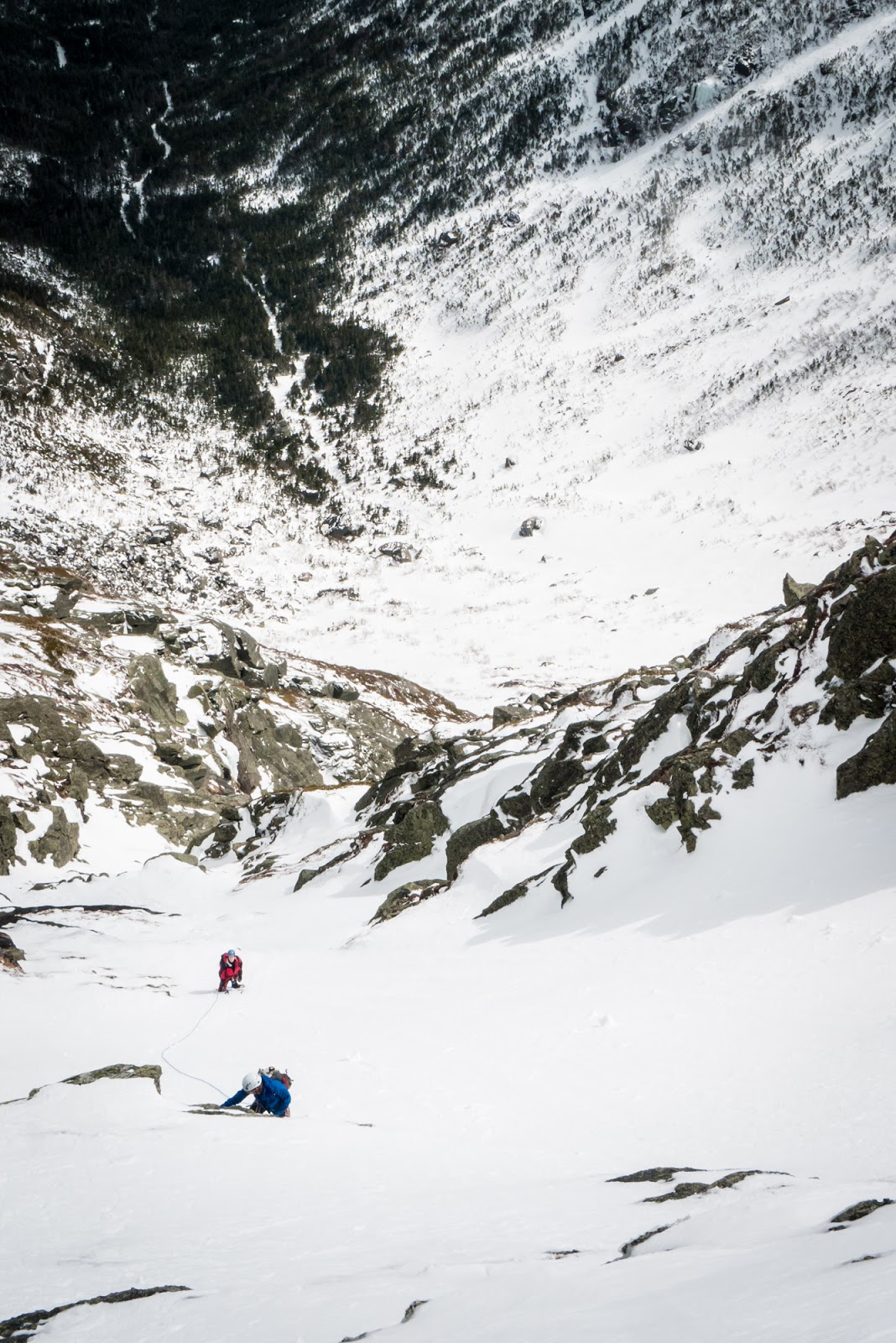
I can’t imagine I’ll be getting out for anymore days on ice after today, but considering how good todays was I don’t really care. At about 9:30 a.m. this morning I decided to go see if Cloudwalker was in up in Huntington Ravine. I figured it was worth a solo attempt since it doesn’t really take screws anyway. I didn’t get up to Pinkham Notch until 11 a.m. or so, so I trucked up the trail as fast as I could. I got to the base of Cloudwalker around noon, nowhere near in time to climb it. There were remnants up high, but it looked like rain decimated it several days ago. So I shifted to Plan B — solo Pinnacle and Damnation. I was right at Pinnacle, so I hopped on that first, then I trucked over to Diagonal, downclimbed that, and went up Damnation. I had planned to head out via Lion’s Head, but the wind was bad enough I opted to climb down Central rather than cross the Alpine Garden. I hustled down the trail and got back to my car at Pinkham just before 4 p.m. It was a beautiful day, nice enough for my face to get sunburned. I saw only a handful of people in the ravine — one party on Pinnacle, one on Damnation, and then two skiers heading up Central. I know lots of people are thinking rock climbing (as am I), but when days like this arrive they aren’t for passing up.

I shot some video of the day, which I pulled together here:

Also, I got a pretty good shot of one pair of the four guys climbing Damnation. It was great to run into you guys! Hopefully we’ll catch up again.

Other than that, I think this officially marks the last hurrah of ice for me. I got in a few thousand feet today. It’s going to have to last me through next fall, at which point I’ll be gunning for the Black Dike as soon as it’s cold for three nights in a row. Until then.

Additional Verses

It’s currently sleeting out, which is perfect Cathedral Cave weather. I took a few burns on Satanic Verses this morning before work and shot some video. What a line. Unfortunately I did not get footage of the top, where the three figure-fours in a row come in. Next time!