Saving Caucasian Snow

Saving Caucasian Snow
11935159_10206619945471708_9033694213573887170_o
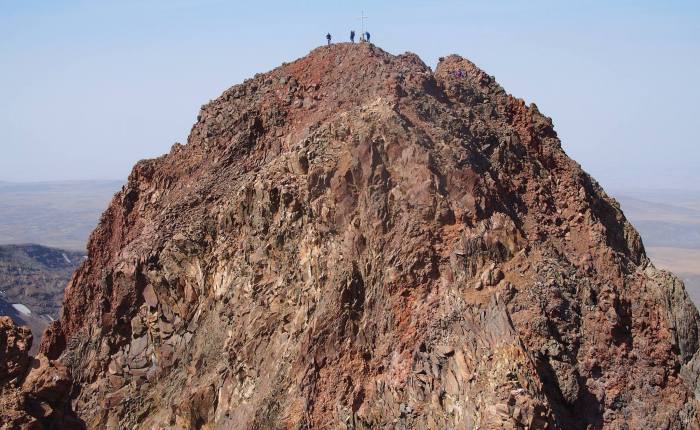
Part of our team on the north summit of Aragats. Tim Terpstra photo

Last September I took a flight from Boston to Yerevan, the capital of Armenia, a country I had barely heard of and knew even less about. Tucked in between Turkey, Iran and a handful of former Soviet republics, it is an arid plain with a history of invasion and cross-invasion.

It is also home to the Lesser Caucus Mountains, part of the mountain range that divides Europe from Asia. I was there on an American Alpine Club climber exchange, teamed up with Americans, Armenians and Iranians climbing our way across Armenia and Georgia, everything from single-pitch sport and trad routes to alpine snow and ice up 5,000 meter peaks. It was a tremendous three weeks, one full of new friends and meaningful connections.

One of the mountains we climbed along the way was Mount Aragats, the tallest peak in Armenia. (Historically Mount Ararat was the tallest peak in Armenia, but it’s now part of Turkey, and the border is closed. This is a painful fact for Armenians.) Aragats has four distinct summits, the north being the tallest at 13,420 feet. Climbing it means clambering over loose shale and boulders to windswept ridges. Most of the mountain feels unstable, like stacked blocks barely held together. There was one small patch of snow tucked beneath the southern and western summits, but otherwise it was dusty, dry and hot.

Historically, however, the snows of Aragats have held through the summers. They have kept creeks flowing in hotter months. Prior to escalating global temperatures, Aragatan snowfields would last through the year and provide a stable source of water through dry times.

Today, however, high temperatures melt things quickly, leaving the valleys flooded in the spring and parched by fall.

This short documentary by Armenian filmmaker Vardan Hovhannisyan lays out what is happening, and what local scientists are trying to do about it:


Yep. Thermal blankets. Several of us noticed them on our descent—white mounds squirreled away beneath the south summit. We didn’t realize what they were, that they were an attempt to save Aragats’ last few patches of snow. I remember discussing them when we got back to camp, but no one could tell exactly what they were. Now we know.

Blankets. Is that the solution to global warming? For now, the answer in Armenia seems to be yes. But it’s a lot of pressure for a few swath of fabric. What if the blankets insulate too well? Or not well enough? How many do they need to makes sure there is enough water? Do they have to cover the mountain? What happens if things don’t last through the summer?

These are complex questions, ones previously left to nature to ponder. But lately her answers have left Armenians parched. Now it’s up to Armenian scientists to see if they can do better.

When we were there in September our team didn’t know the difference. We didn’t realize we were walking over fields usually covered with snow. We scrambled the bare rocks unaware they normally would be entombed by snow.

To us Armenia was just dry. Now we know why.

No Resolution

No Resolution

12419170_1370918652934216_2490529582253069540_oIt’s that time of year again: New Year’s. A time to reflect on the past year, review what we’ve done and haven’t done, and ponder the next 365 days. A time for self-examination and resolutions. Sometimes, it seems to sneak up so fast.
I don’t remember what my resolutions were for last year. I actually don’t think I had any. It’s never been my thing to peg a behavior shift to the flip of the calendar. But like everyone the end of the year has me reflecting on 2015. Which in turn has me thinking forward to 2016, considering things I’d like to do differently.

To start, it’s important to remember resolutions are not redos. There are no redos. If there were, I might not write the column I wrote last week. Did you read it? It was about the presidential race, about Marco Rubio, about how wooden and impersonal he seemed visiting the Sun office.

At least, that’s what most people seemed to get out of it. That’s what made it popular enough to bounce its way around the Internet until it eventually landed on MSNBC and the Drudge Report.

But to me that was not what the column was about. It was written in frustration not at Rubio but at how the modern presidential contest forces candidates to aim for perfection, to be always on, always be cognizant of any missteps. That expectation of perfection forces them to close the door to authentic interaction, to limit what they show to talking points only. Being a person, as well as a politician, is not allowed. I wrote it knowing Rubio has little choice — those candidates willing to be authentically themselves (Rick Santorum comes to mind) say things that keep them at the fringe. They let voters know what they think on controversial issues, and in so doing never risk a serious shot at the office.

Winners, meanwhile, never say anything of substance, anything revealing. Such risks are not the way to the White House today. This is the democracy we have inherited.

That is what I was looking to say last week. I thought I wrote one thing, but readers thought I wrote something completely different. And once the words hit paper, my thoughts are no longer my own. They become open to interpretation, and readers’ interpretation, not mine.

From a writer’s perspective, it’s a confusing position to be in. What I put down in print is not always what the reader picks up. It’s like watching words coming out of my mouth get jumbled, reorganized and reenergized before they reach your ears. The resulting conversation leaves me frustrated and confused. I am not saying what you think I’m saying. At least, I don’t think so.

It might be my fault. Maybe what made sense in my head didn’t land cleanly on the page. Maybe the salient points were left unstressed, and my delivery carries the blame.

Part of it, though, lies in the political atmosphere today, one that reduces democracy to a binary scorecard of wins and losses. I write about Rubio getting caught in an impossible system with impossible expectations, and readers interpreted my words as a condemnation of Rubio. A Rubio loss. Minus one.

That interpretation, the binary version of life, is exactly the sad state of affairs I was hoping to point out.

Candidates are caught only looking for wins, and that’s what makes them choose an affect that comes across as something other than human. Maybe my words were poorly chosen. Maybe they were just wrong. But watching the story unfurl as a loss for Rubio felt like I’d fallen down the rabbit hole I’d only intended to point out.

This is not the first time. I’ve often had people unwittingly tell me about stories I’d written, and explain in great detail what was really going on not realizing I was the original author. I would listen dumbfounded, wondering where in my story was all this subtext I never intended.

But as readers, and as people, we come to the world with our own interpretations. They silently steer us, even when we think of ourselves savvy. We all do it. I, for instance, did it in last week’s column, interpreting Rubio’s wooden affect through the lens of a broken political system rather than some personality flaw. Perhaps I twisted the truth to match a narrative I was looking to comment on. Perhaps Rubio has no interest in warmth — I spent 20 minutes with the man, so in all honestly I have no idea.

But there are no redos. I cannot take back my column, any more than I can take back readers’ interpretations that were not what I intended.

I can, however, remember that my interpretations are as steered by assumptions as my readers. Is Rubio caught in a broken system, or simply a cold person? Or both? Or neither? I have no idea. I can only write the world as it seems to me, transformed as it is by my assumptions, into words for publication.

Every one of those words is then interpreted a second time, this time by the reader. These interpretations are again rife with assumptions.

The result? A fleet of stories produced and consumed through twisted lenses. Like all stories, they are infinitely more complex than the page suggests. They aren’t broken, but they are not crystalline either.

This is the mess that is the modern media environment.

So my resolution? To remember each time I write that no story exists outside the rabbit hole. Every piece is a tumbling of assumptions falling through the blackness. The words on the page may print in black and white, but in truth they will only ever reveal dim shadows. Readers create the full version by filling in the dark spots with their own assumptions. Corruption is part of the reading process. No narrative will ever be perfect.

There aren’t enough pages to say it all. Hopefully readers remember that, too.

This piece appeared in the Conway Daily Sun in December of 2015.

Cuba: Island found, or lost?

Cuba: Island found, or lost?

Cuba-2570“How do you get there?” It’s always the first question whenever I tell someone I guide trips to Cuba. Maybe they’ve heard of Americans slipping in illegally through Canada or Mexico. Maybe they figure I’m doing the same.

“Miami,” I reply. “By charter. It’s less than an hour flight.”

The next line is also scripted: “Well, now’s the time to visit. Before the Americans get there and screw it up.”

To be clear, these aren’t Europeans, Canadians, or Mexicans I’m talking to, they are Americans. Most of them haven’t visited, but they know Cuba is opening, and they know when it does Americans are going to ruin it.

The Cubans I talk to aren’t so sure. When they hear “American,” they smile and reach with both hands. “It’s about time,” they say, eager to shake.

View Story
Cuba: An island seeks to connect
I hate to be the one to do this, but I’m here to tell you that the frozen-in-time utopia is not a realistic picture of present-day Cuba.

My job as guide to Cuba is a new one. Before last December, before President Obama announced reestablishing US-Cuban relations and loosening travel restrictions, just visiting could have landed me in jail. Even now the US government forbids tourists from going; our groups are classified as “people-to-people” exchange trips, and they require US Treasury approval.

There are no beach visits or snorkeling trips on our tours. We go to meet Cubans, experience the culture, and explore a country hidden behind 60 years of embargo.

That’s why participants go. I go to watch history unfold. If those Americans are right and we are going to ruin Cuba, then I am the leading edge of the invasion force. The destruction — the Starbucks, McDonald’s, and Marriotts — will come in my wake.

But despite the risk, Cuba’s excitement for what comes next is palpable. On our April trip, every time someone learned our group was American, they got excited.

“Do you think it will happen?” they said. “Will the blockade end?”

Then President Obama shook hands with Cuban President Raul Castro, and overnight we became celebrities. Whenever we were in the street and people learned we were American, they’d grab us.

“You’re Obama,” they’d say, grabbing our hands, “I’m Castro.” Then they’d shake vigorously, smiling. This didn’t happen once or twice. This happened a lot. Our group was there to meet Cubans, and the Cubans used the opportunity to re-create an emblematic moment of their expanding future.

It’s a moment that keeps moving forward: My last trip coincided with the US announcement it would reopen its embassy in Havana. Next time I visit, the embassy will be open. Things are changing fast.

But not everything. The streets are still flooded with 1950s Fords and Chevys, and the faces of Fidel, Che Guevara, and Hugo Chavez still loom large on countless murals and billboards. Soviet-style architecture still dots the Havana skyline, and when the sun goes down, crowds still swarm the Malecon, Havana’s iconic 8-kilometer seawall.

Cuba seems caught somewhere between the developing and developed world: Everyone has health care and a university degree, but buildings are falling down and basic goods can be scarce. But it’s that juxtaposition that makes Cuba remarkable. There are few places in the world where I would encourage people to go out after dark to wander the streets and look to strike up conversations, but social hour in Havana doesn’t begin until 9 p.m. and crime is rare. If “people-to-people” interaction means meeting Cubans where they are, then it begins at dusk on the Malecon.

Other parts of the Cuba experience, meanwhile, seem cribbed from old jokes about the ills of central planning: the three elevators in the upscale Habana Libre hotel that have been down for months; the stores that just keep running out of bottled water.

Then there’s the undercurrent of hard currency that lubricates every interaction; nothing happens without a few dollars exchanged in the palm of a handshake. There are two sides to this game: One is that the government pays so little, everyone must supplement their income with “tips,” the other is that without a contribution, you might be turned away next time. The restaurant might be closed. The tour could be cut short. It’s part of how Cubans get by, and after 60 years in the shadow of the embargo, Cubans know how to survive.

And that’s the truth I come back to each time an American tells me we’re going to ruin it. A half-century of sanctions, spies, and submarines didn’t succeed. Instead, that time taught Cubans to think on their feet, to adapt and endure. As the country opens, Americans will come — for both vacations and business ventures — and Cuba will greet them openly, with a handshake and a smile.

But I’m willing to bet it will still be Cuban palms that wind up filled with folded bills, and again without losing their island.

I’ll tell you for sure after my next trip. Or the next.


This story appeared in the Boston Globe in August of 2015.