
 The Washington state ferry from the San Juan Islands to the mainland was the end of the trip. It’d been a day of chasing whales—an orca museum combined with Lime Kiln State Park, the best spot in the world to see whales from land. We did not, however, see any whales. Tim, Lev (Tim’s two-year-old son) and I had made a day of it, but now we were on our way back to Mount Vernon, Wash., and Tim’s farm.
Then an announcement came over the loudspeaker: “There will be a presentation on whales at the rear of the boat. Anyone interested is welcome to attend.”
Whales. I’d be there.
The naturalist presented to several rows of kids and families, but the kids quickly lost interest. I stayed, peppering her with questions about orcas. And she told me something peculiar. I was asking if changing ocean temperatures were causing more interactions between local orcas and great white sharks, and if so what was the outcome. “It’s pretty remarkable,” she told me, “they are meeting, and they fight. And when they fight the orcas win.”
“The orcas are pack hunters,” she said. “The sharks are loners. The orcas have learned that if they can flip the sharks upside down they essentially can put them to sleep. Killer whales are smart enough to take advantage of that fact. They’re pairing up and using the technique to put the sharks to sleep. Then they drown them.”
Whale versus shark, the whale wins. Awesome. And what’s this about putting sharks to sleep?
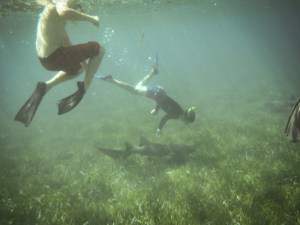
Less than a week later I found myself in Belize, snorkeling “Shark Alley” on the second longest barrier reef in the world. The sharks there are nurse sharks, a tame cousin to the white shark. Our guide Carlos took the opportunity to demonstrate exactly what the naturalist 2,600 miles a way had explained—he swam directly over a 6-foot nurse shark, put one hand on its back, another on its belly, then rolled. Instantly the shark went limp. He carried it in his arms and swam it over to us, let us pet it and touch its skin.
I wanted to try. I could see them swimming just six feet below, brown arcing bodies in the reeds. I dove down several times before I could work up the nerve to touch them. But then I went after one, put my hand about where its shoulder blades would have ben if the man-sized shark were human. Its skin was course as sandpaper. I swam with it, tracing its path, one hand on its back, then kicked myself down close and slid the other hand under its belly. We were tight together then, the shark and I. I rolled.
The shark rolled with me, and as it flipped and its belly rose toward the surface it went limp. I held it close, kicked my way upward, cradling the ancient beast in my arms. It felt about like holding a worn out Rottweiler in my arms—things were fine, but how long would they stay that way? After a few kicks I rolled the shark back over. It flicked its tail and instantly resumed swimming. I released my arms. It carved away.
I did this three times. One of the group members caught it with a camera.


It was amazing to be so close. I have since learned that what our guide was doing is frowned up, and that I shouldn’t have followed his example. I probably could have guessed that had I thought about it, but I didn’t. I looked to him for direction, and when I saw an opportunity to do something that scared me, something that seemed both amazing and stupid at the same time, I swam at it full steam. Literally. And so I got to carry a shark in my arms. Life is an experience and that was a unique one, even if it was foolish, illicit and perhaps damaging. Now I know. So don’t flip sharks. But it works. Orcas do it, and I have too.


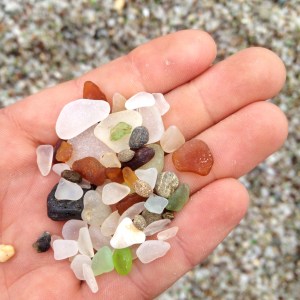 The idea sounded cool when I read about it a month ago: a beach made of sea glass, stones replaced with ground shards of white, green and brown. Rare specks of blue and rose radiating in the sun, waves lapping the shore, giving the glass below the waterline an even more powerful sense of iridescence. Glass Beach, Fort Bragg, California. I wanted to see it.
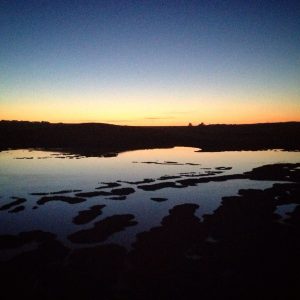 I drove to North Beach and watched waves pound the shore. It was a desolate place. I wanted to stay, to take in the starkness. The sun had warmth, but not enough to fight the wind. I pulled on my jacket, wandered down to the lighthouse at the point, then over the peninsula to a protected harbor. All of it wild, lonely and exposed.
 The morning was cloudy when I pulled into Fort Bragg, the ocean calm. I turned left of Highway 1 and parked, following signs to Glass Beach. “Please leave all cultural artifacts,” a note said. I descended cabled stairs to the shore.
 It can be tough
  Then there is the work of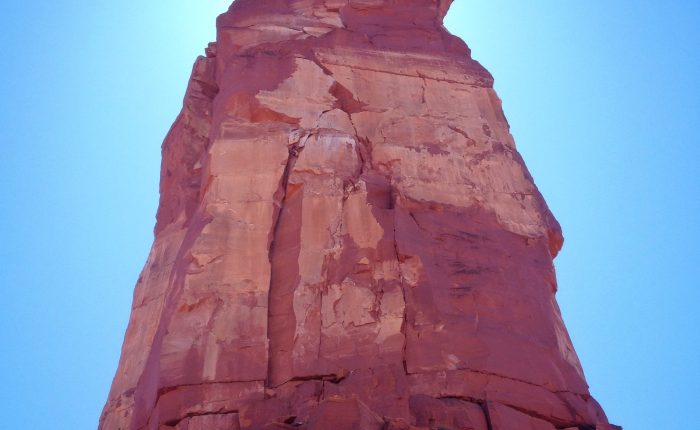

 A few weeks earlier I made it to one of the desert towers Brian and I talked about. The North Face of Castleton is a beautiful 5.11- up steep orange rock. My friend Jim just happened to be in Moab at the same time as me, and it was his birthday. He put a post on FB asking if anyone wanted to climb the next day. “Seriously?!” I said. “You’re in Moab?? Let’s climb Castleton!”
 Jimmy followed, pushing his way up the final exposed crux with a grunt, and we scampered up two more pitches, both excellent.

 So that’s one. The other Australia story is also from the Great Barrier Reef, but this time from land:
 It’s happened again: Another shooting. In Orlando this time, 49 victims plus wounded.
 I have an idea.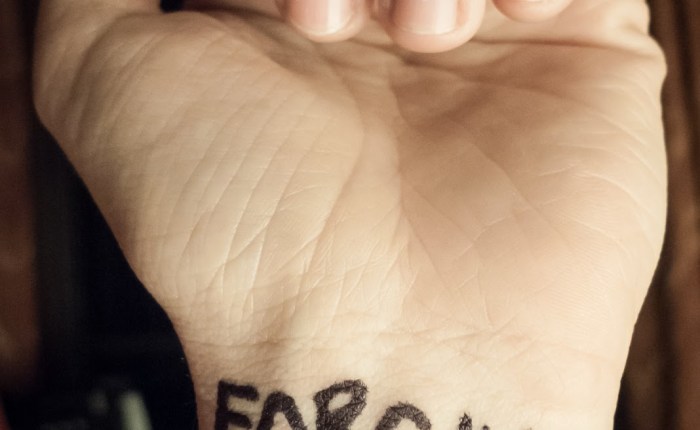
 Sometimes a conversation seems impossible to begin.
 How do you let go of control?
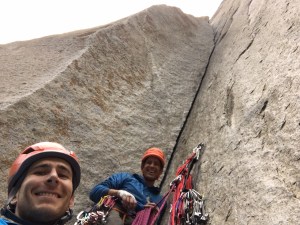
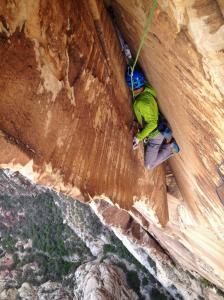 We met in Indian Creek, started the tour with sandstone splitters. From there I took a detour to Castle Valley and a quick run up the North Face of Castleton, then on to Red Rocks, where the Armenian (his name is Mkhitar, which he helpfully shortens for Americans to MAH-heek) and I ran up the nine-pitch Texas Hold Em. Things felt good. Astroman was waiting.
 A few days later we were back. We eschewed the second rope, got an early start, sprinted up the first few pitches and were soon looking at the Enduro once again.
 ErikEisele.com