A Collaborative Dance

A Collaborative Dance

Moz-1020781Nothing gets accomplished alone.

We are a country of rugged individualists with celebrity dreams. We dream of making it big, succeeding, pulling ourselves up by our bootstraps, a metaphor that indicates we can create our own salvation.

But nothing happens alone.

I have amazing friends. Some are climbers, adventurers, others photographers, videographers, others writers, teachers, environmentalists, businesspeople. Massage therapists and waitresses. Nurses, engineers and retirees. Together they make my world.

I have big ideas. All the time. Once I came up with writing a book. It died on the vine. Once I tried to fly to Haiti after the earthquake. That didn’t go anywhere either. Another time I came up with another book idea. It ended the same place as the first. All of these were ideas I took on alone.

Once I had an idea to go to Iraq and work as an embedded journalist. This idea I shared with a friend who also happened to be the news director at New Hampshire Public Radio. “Alright,” he said, “let’s make it happen.”

Three months later I was flying into Baghdad, utterly terrified about what I’d gotten myself into.

But I wasn’t alone. That made all the difference. Three weeks later I flew home having done what I set out to do. Nothing else compares to that.

klementovich-20160531-_JCK2368A few weeks ago I came up with an idea. It’s an idea bigger than I am, one that has to do with writing, reporting, adventure, the environment, the future of the Earth and the human race. It’s an idea I don’t want to let go of, one I don’t want to die like so many ideas before it. It’s an idea I need help with. So while it was still fresh, instead of rushing headlong into it I did something simple: I picked up the phone. I called my friends.

My friends can do anything. I watched them climb mountains, write books, build rock gyms, start photography businesses, start nonprofits, reinvent themselves and then reinvent themselves again. I’ve watched them change the world. I’m lucky to have such friends.

But I never understood how they did it. I always looked at my efforts, looked at my ideas, how quickly they withered, and wondered what they knew that I didn’t, what they had that I lacked.

Then one of them asked for my help. She had an idea, a project bigger than herself, something involving climbing and mountains and scientists and conservation and a documentary and college kids, something overwhelming and beautiful. She asked for my help, and then she asked for help from everyone who would listen. And the project grew. It built speed, became something real, took off. There were setbacks, but she kept pushing. It was a beautiful, inspiring dance, one I was honored to have a hand in. It was so big, so complex and powerful and challenging and different, I couldn’t understand how she kept it all going. But then I realized: she asked for help.

Want to do something amazing? Don’t do it alone. Share your idea. Trust it with people who inspire you, with people whose vision matches yours. Let them water it alongside you. Loosen control. Let it see where it takes you. You will not be disappointed.

I am making phone calls now. And my friends, those people capable of doing anything, are answering. It’s almost as inspiring as my idea. Maybe more so.

Gulfside Fire, Light and Life

Gulfside Fire, Light and Life

IMG_8066We pulled in after dark. A burning orange sun had plunged into the Gulf, streaking clouds red and purple and gold, and now the sky was a cool bluish-black. The night was warm and wet as lion’s breath. A stiff wind blew palm fronds skyward. Waves slapped the jetty. Our houseboat, Lil’ Bamboo, sat rocking at the pier.

“It’s perfect!” Sineah said. “I call the hammock.” Bethany laughed. We all went inside.

The ceiling hung low but the cabin was spacious, with three beds, a small kitchen, a bathroom and good air conditioning. One bed sat tucked under the helm. “I feel like Harry Potter,” Bethany said crawling in. Another hung in the back; I took that. Sineah claimed the third, a deep bench couch that served double duty. Our host showed herself out, but not before pointing to the roof deck: “Best sunsets in the Keys,” she said.

The three of us made our way topside without a word. Waves licked the hull 10 feet below, pushed tall by the breeze. We sat quietly, a bamboo awning overhead surrounded by miles of Gulf sky. Sineah was right: it was perfect.

The next morning the stiff wind held. I called a dive company to ask about going to the reef. “Anyone who takes you snorkeling today is just stealing your money,” the man said. “It’s three-to-four foot seas, far too rough for snorkelers. Tomorrow will be better.”

I hung up the phone and looked outside. Even here on the Gulfside there were whitecaps, I could imagine what things would look like offshore. But I was here to dive. The whitecaps outside didn’t look imposing, mild chop, so I grabbed my fins and mask. “I’m going in,” I said.

“I’m going with you,” Sineah replied.

Sometimes wildness seems far away. Sometimes it lives at your doorstep.

I waded into the water, fins tucked under my arm. The bottom was sandy, but soon it turned to seagrass filled with upside-down jellyfish. I would need to lift my feet and be swimming before I got to the grass, even in water barely waist-deep. I spit in my mask and rubbed it around the lenses, then pulled the mask over my head and put the snorkel in my mouth. Sinking into the water I pulled the fins on and set out. Sineah followed close behind wearing goggles.

We swam. 40 feet from Lil’ Bamboo was barely eight feet of water. The seagrass swayed everywhere, festered with bottom-dwelling jellies. Parrotfish jetted about. We dove and resurfaced, dove and resurfaced, exploring the world beneath the waves. Anemones hung from pilings and drowned mooring buoys, two-foot barracudas lurked nearby. Even here there was much to see. I held my breath and dove, clearing my ears as I sank, awash and floating in Caribbean warmth.

That’s when it came: dark, the size of a small grizzly floating just beneath the surface—a manatee, mere feet away. His face looked like a bulldog, nose pressed too close to his eyes. He flaunted a disk the size of a large pizza for a tail. It swayed up and down like a tremendous wave propeller. His body, both fat and sleek, glided. I saw him first, but Sineah was right at my side. I let out a shout through the snorkel, a twisted version of “OH MY GOD!” His head hovered a few inches from the surface as he drifted past, an underwater ghost. Nothing so ungainly ever looked so graceful.

I did not follow him. He moved peacefully, and I didn’t want to disturb him. He disappeared into the inky distance. In his wake the water seemed quieter.

“If you want to see wildlife, it is on foot, and quietly, that you must explore a forest. It is the same with the sea. You must stroll at a walking pace, so to speak, to see the wealth and abundance that it holds.”

– Yann Martel, Life of Pi

Sineah and I kept swimming, kept poking around for more, waiting for another encounter with such a majestic sea mammal. But the show was over. We worked our way back to the beach. Climbing out I pulled my fins off.

“What time do you think it is?” I asked, spitting out my snorkel.

“I don’t know,” she said, “maybe 9 a.m.?”

Morning of day one. Welcome to the Keys. ⛵️

Turning the Ship and Changing the Tide

Turning the Ship and Changing the Tide

PP-1030179How long does it take to turn a ship? How long does it take to change course, to do something different, to avoid the metaphorical icebergs?

I say “metaphorical icebergs” because the risk of real icebergs is dwindling. It’s a warming world. Things they are melting, and there are real risks hiding behind the warmth: rising sea levels, drought, severe storms. These are the icebergs. Which of the levers do the turning? Does anyone understand the controls?

I spoke to ecologist Gene Likens last week, the scientist who discovered acid rain in North America. It took a generation to get from initial discovery to the passage of legislation aimed at curbing the pollution that caused it, or as Likens puts it, “27 years, three presidents and one pope.”

There are important things to note in that timeline: his first study, for example, came out 9 years after the discovery, meaning 27 years falls to 18 from when the information was publicly available. And it wasn’t until a 1974 study that newspapers picked up the story. That’s when acid rain really became a household issue; now we’re down to 16 years.

16 years is not the generation 27 years nears. It is, however, a long time. Likens said his science faced pushback from industry. Entrenched interests like oil and coal rejected the premise they had any responsibility for acid rain. It took proving that link scientifically to end the argument.

Of course such proof is important—there is no use in regulating an industry innocent of the charges. If it wasn’t oil and coal those laws would have just been more wasted time.

But every day that passed was a lost opportunity. More acid fell from the sky. There is a saying that the only two days that are impossible to change are yesterday and tomorrow. A lot of todays, however, went by in inaction, todays that could have turned the ship.

arctic-death-spiral
Arctic sea ice volume since 1979.

Now we face a different iceberg. Scientifically climate change is undisputed. The argument over human involvement remains, but the planet is getting hotter. And every today gets us closer to whatever comes next. Perhaps it is nothing. Perhaps it is catastrophe.

Likens compared the struggle over acid rain science with what’s happening today with climate change. “The pushback was just like it is now,” he said, again pointing to entrenched interests. Another generation-long fight could be in store.

A decade ago An Inconvenient Truth exploded the conversation about climate change, much like the New York Times coverage of the 1974 acid rain report. So if we benchmark the two, we’re at 10 years. Maybe we can match 16; maybe some course alteration will come down in 2022. That is a long way off, but it’s also almost here.

And what would it mean? What would turning the ship at this moment do? Are we surrounded by icebergs already? Are the coming changes beyond our power to affect? Are we simply too late, caught in a disaster impossible to avoid?

Who knows.That falls to tomorrow, one of those days you can’t change. But we can change today. But to do that we need to have faith in science, something seemingly in short supply with some.

spiral_optimized
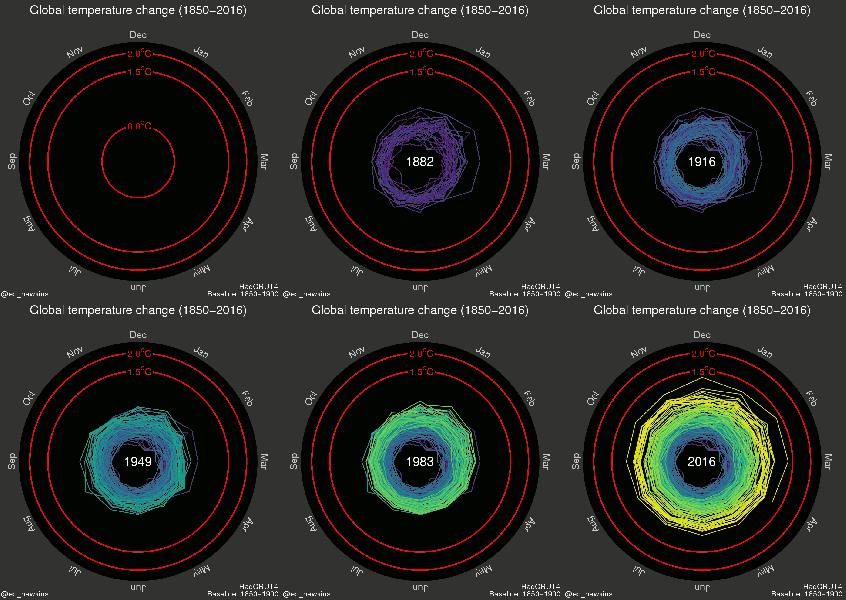
An illustration of global temperature change for the last 166 years.

Science is not the conspiracy of one man. It’s multilayered work, an exploration of chance, a process of search more than an answer. And while it can be mistaken (think of early experiments aimed to determine whether light was a particle or a wave—it behaves like both), those missteps are part of the process. The call is always daring to be proven wrong. Scientists strive for that, and yet climate change is not proving wrong.

Industry, meanwhile, as Likens pointed out has a mixed record, much more so than science. Tobacco companies, for example, showed the willingness of big business to subvert science for their own ends. Science’s agenda, meanwhile, has no choice but to bend toward truth. It’s built into the method, the practice of the discipline. It may be hard to put the two on a scale, but if you could the weight of replicable results would trump corporate claims, particularly when huge revenue losses enter the conversation. The skeptic sees industry with strong motivation to deceive; scientists, meanwhile, do not gain by being controversial, or by being wrong. They succeed by being right, precise and verifiable.

And these debates are the fulcrum on which the ship turns. Is there still time to spin the wheel? Even science doesn’t know. But we may all get a chance to find out. Tomorrow.

Storms, Rays and Cyclones

Storms, Rays and Cyclones

IMG_7875The ocean hides amazing things.

I grew up on the ocean. As a kid I spent my summers playing among schist outcroppings and granite boulders on the coast of Maine, hopping from rock to rock and splashing in tidepools.

In middle school, however, my relationship with the ocean changed: I got my lobster license, a dingy and a handful of traps. A 10-year-old kid, my working days began early, often before sunrise. I would row around, hand-hauling traps off the stern, collecting lobsters, rebaiting as I went.

It sounds idyllic—summer sunrises over a glass-calm ocean—but to middle-school-me it was not. It was hard work, and I didn’t really know what I was doing. I remember finding out I’d brought in several lobsters that were just under the legal limit; I didn’t understand at 10 that “close” didn’t count in measuring shellfish. No one had gone over it with me step by step. I had a boat. I had traps. But when it came to the details, I was on my own.

Everybody has to muddle their way through youth somewhere. Much of mine was done on a lobster boat. The fish oil would permeate my skin, causing my hands to swell then the skin to die, peeling off in long strips. Back at school each fall I would have to explain why my hands were shedding. I spent off days working sternman (think “lobsterman assistant”) for a friend of my stepfather’s. His name was Earl. He was older, groaned every time he had to sit or stand, but he was kind, loved to tell jokes.

He also loved cheap cigars. And his black lab came fishing every day. I spent 1o hours a day filling baitbags with dead fish, breathing a combination of them, diesel fumes and cigar smoke. It was enough to put me off the ocean.

That was when I was 15. Almost 20 years later, after two decades spent among mountains, the call of waves came back to me. The space I needed from water was over.

Then last week I came across this:


I spent my youth at the ocean’s edge, whether that was at the shore or the surface. But of late I’ve been looking below. Or more accurately, within.

Today I fly south to spend more time within: the Florida Keys. I’m headed there for four days on the water, in the water, within the water. My blown eardrum is hopefully healed, and the third named storm of the Atlantic hurricane season is hopefully going to blow out to sea, leaving the water calm enough to enter. We’ll see.

But a dream of mine is a cyclone of another kind: the one of manta rays pictured in Peschak’s talk. That is a rekindling of the oceans draw that might leave me spinning, but this time I wouldn’t object.

Next trip. Or soon at least.

5 a.m.

5 a.m.

13403970_1509050489121031_6107610005133950721_o5 a.m. The wind and rain from the night before had died. Low tide would hit in an hour and a half, the same amount of time it would take to drive to Higgins Beach.

“The waves look better tomorrow,” Nick told me as we pulled off our wetsuits. “Want to come back?”

I did. We’d spent an hour in the Maine water, riding small waves and slicing across foam. It was the kind of day that leaves you smiling after weeks away, but also the kind that leaves you wanting more.

But the ocean heard our call: the remains of Tropical Storm Bonnie, the second named storm of the season, were still churning the North Atlantic, throwing waves due to hit Northern New England the next day.

So this morning, at 5 a.m., I woke up. I rolled out of bed, pulled clothes on (no need to shower when the first appoint of the day is an ocean), grabbed a biscuit and orange juice carton and started driving.

“Morning,” Nick said, still in need of coffee. “I looked at the webcam. It’s a bit mushy.”

“The tide just switched,” I said. “Maybe it’ll be fine.”

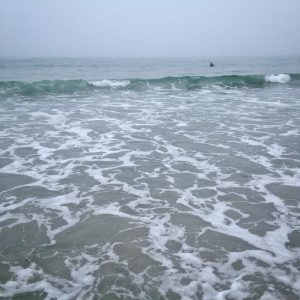
We shoved boards and wetsuits into his SUV and drove the last leg to Higgins. It was still early. A grey light hung over the ocean, clouds unwilling to abandon the morning turned the water dark. Waves barreled toward shore in haphazard fashion, smashing and grinding into each other.

“Oh, this should be fun,” I said. Nick sipped a coffee from Higgins Beach Market .

We parked, suited up and headed for the water. There were a dozen surfers in already. I strapped on my leash and headed in. Nick did the same.

When the first wave hit, a wall of foam and white, it pushed me off my board, spun me and slammed me down. Then another. And another. My board, too big to push under the surface, became a launchpad with each blow. I gasped for breath, regrouped and paddled as best I could, but there was always another wave, and then another.

I watched Nick flip and go under. A wave slammed his overturned board. He popped back up, paddling hard, water churning around him. He got slammed again, but he kept pushing. He was making it out. I was not. Another wave-wall came, pushing me back further. The next one flipped me. I groped for my board, gasping for breath. Then another came. Then another. My arms were left slapping at the water. I was barely moving. They kept coming in fast and from every direction, spilling into each other. I wasn’t making it, the wall had me. So I turned.

It’s a strange thing, giving up. It makes sense sometimes, like when your breath is slowly running dry, but it doesn’t feel good. And if you don’t keep diving into unknown challenges it’s easy to forget what it’s like. In rock climb I don’t often back off a route without at least an honest try. But surfing isn’t rock climbing, and “honest try” means different things in different places. The ocean is something I know far less about. This wasn’t the mountains, wasn’t the dance of movement over stone. So I turned around.

I caught the whitewater of the next wave and rode it in. I was on the beach in seconds, still panting and heaving from the effort. I turned around and watched the surfers in the distance rising and falling, rising and falling. Nick was among them.

Sometimes the waves are just too big. But there is something wonderful in stepping up to the plate at a new challenge, something special in trying while not knowing. When the dance is not endlessly rehearsed there are bound to be failures. I sat on the shore watching the churn.

Then, as I looked out, a pattern emerged. The waves to the right were breaking in chaos, but to the left there was less white, less overlap, not a gap but more quiet. It wouldn’t be enough for an unobstructed paddle, but it offered one with fewer hammer strokes. I kept watching to make sure I wasn’t seeing things. No, it was there. I could get out that way. Or I could at least try.

I waded in up to my waist, still fighting whitewater, popping above it when I could, but watching as I went. I worked my way slowly, waiting for the moment the sea would open for me, the pause that would allow me passage.

Then it came: I saw a gap, pulled my board underneath me and paddled hard. The waves rose but not as high, crested but didn’t break. My arms held, tired but able to pull through the lull. They carried me far enough; I glided past the kill-zone and into the calm. Nick was there, his wetsuit hood pulled around his neck. He waved, then turned back to the ocean. I did the same.

There is something wonderful in movement unrehearsed, in a dance of not knowing. Maybe it makes you give up. Maybe it drowns you. But sometimes it lets you through. Those time are special.


IMG_8046

Free Pens, Fish, and the Effort to Outlast

Free Pens, Fish, and the Effort to Outlast

IMG_7896I love free pens.

As a reporter and someone who writes copiously in my free time, always scribbling in notebooks both for work or for myself, free pens are awesome. They’re like being sponsored—free equipment!

If I had a pen sponsor the company would have to be TD Bank. Their pens are basically my go-to: every time I pop in to deposit a check I grab one, maybe two. Green TD Bank pens are stashed in four different spots in my car, live in my computer bag, hide alongside my notebooks and ride shotgun all day in my front right pants pocket.

In exchange TD Bank gets lots advertisement out of me. The other day I was in line at the post office and a woman was looking around for a pen. I pulled one out of my pocket and handed it to her. “Keep it,” I said, “I get them for free.”

Cashiers and servers are often impressed when you pull your own pen out of your pocket to sign the slip. “TD Bank” — there it is again.

And there’s no feeling more satisfying than using a pen until it’s bled dry. When it scratches its way across a notepad, empty of its usual inky glide, I feel a sense of accomplishment: it’s proof I’ve dedicated a certain measurable amount of time to writing, that I’ve invested in my craft. Years ago I never used to run pens dry; I would lose them well before that was ever a risk. But these days I write enough that it occurs fairly regularly.

Lately, however, I’ve been looking askew at those stacks and stacks of pens. Every one I run dry makes me wince. I toss them in the trash after their last word and I hesitate: isn’t that a lot of waste?

Think about it: when I run a pen dry, it still works. The spring mechanism that clicks the point from retraction into action still operates perfectly. The plastic shell is intact. Even the ink cartridge remains. Everything about the pen is fine, still in perfect working order, it’s just out of ink.

But for my TD pens, this is the point they becomes useless. The only thing left to do is discard them, then swing by the bank to grab two more.

It’s a bit like driving a car until it runs out of gas and deciding to walk away: there’s no problem with the machine, but the liquid that makes it useful is spent. Fill up station? No, there are none of those.

When I just lost pens I never had to think about it—they disappeared without me ever considering their end. But when I’m running them dry, bleeding them to the point they have nothing more to give, I am forced to stare their untimely death in the face. And like I said, as a writer I find myself doing this a lot.

But then I go into my local TD Bank branch, where the bucket of pens is always full. From one perspective there is an endless supply; the cars will keep running out of gas, but there will always be another full one available. And apparently for free.

But really? Are these pens really “free”? I don’t mean in a monetary sense; I mean in the sense of consequences, in the sense of an endless supply. Plastic pens are not apples—they do not grow on trees. They are not the result of some miraculous act of nature that transforms sunlight and rainwater into ballpoint and ink. Pens are plastic, an oil-based technology. They require fossil fuel to make, and when they find their way into the garbage they do not decompose. They are offered up as free gifts, but the are only “free” in the banking sense of the word.

In the global sense, however, plastic is plastic, and it’s not going away. It is turning up everywhere: filling landfills, clogging up the oceans, killing wildlife. A new study found that microplastics—tiny shards of polymers now found throughout the world’s waterways—are stunting the growth of some young fish and killing others.

Some young fish have been found to prefer tiny particles of plastic to their natural food sources, effectively starving them before they can reproduce.

The growing problem of microplastics – tiny particles of polymer-type materials from modern industry – has been thought for several years to be a peril for fish, but the study published on Thursday is the first to prove the damage in trials.

Microplastics are near-indestructible in natural environments. They enter the oceans through litter, when waste such as plastic bags, packaging and other convenience materials are discarded. Vast amounts of these end up in the sea, through inadequate waste disposal systems and sewage outfall.

“Convenience materials.” That sounds like my pens. And my grocery bags (I have two fabric bags, but I don’t always remember them). And my food packaging. It sounds like so much and so many of the everyday things we buy: toothbrush packaging and the toothbrushes itself; sunscreen bottles; electronic accessories; a new windshield ice scraper. Kayaks. Car parts. Tupperware. Printers. Plastics. Plastics everywhere. They are literally everywhere.

IMG_1043What does “disposable” mean? Where does “disposable” go? These are questions we don’t really wrestle with. There is not time to wrestle with them. They are big and unwieldy and quite frankly depressing. They seem too big to tackle, a societal issue that will never get solved.

But it has real implications. In the Pacific Ocean there is a patch of floating garbage roughly the size of Texas. It is called the Pacific Trash Vortex, a place where discarded refuse goes to swim. And as most of it is plastic, it will swim forever.

Add that to climate change, to ocean acidification, to coral bleaching and glaciers melting. There is a Texas of trash out in the ocean. And the Texas estimate is a conservative guess.

But I get free pens. So it’s convenient at least.

This is not someone else’s problem. This is something that is happening because of my doing, my contribution. Like so many of us, I live in a world of convenience. Like so many of us, I recognize I’m contributing to a bleak outcome but have no idea how to approach it differently. How do you change a society? How do we change our reliance on ease, find our way back to an era when what we “threw away” had a shot at actually going away? Even more basic, how do I change myself, my habits that make up a small part of the whole? Can I even do that.

That is ours to wrestle with, and we better wrestle fast: Trash Texas is growing. If our habits remain unchanged it will eventually cover the Earth.

I read a book recently by Italian physicist Carlo Rovelli. In the final chapter he wrote:

I believe that our species will not last long. It does not seem to be made of the stuff that has allowed the turtle, for example, to continue to exist more or less unchanged for hundreds of millions of years, for hundreds of times longer, that is, than we have even been in existence. We belong to a short-lived genus of species. All of our cousins are already extinct.

What’s more, we do damage. The brutal climate and environmental changes that we have triggered are unlikely to spare us. For Earth they may turn out to be a small irrelevant blip, but I do not think that we will outlast them unscathed…

Watching another pen fall into the trash, I can’t help but hear his words echoing in my ears. I too wonder if we can outlast them unscathed.


Note: In researching this I found a place in California that recycles pens! Not enough to solve things, but hey, it’s a start. Also TD Bank recommends removing the internal mechanisms and recycling the plastic shell with other plastics. They were very quick in getting back to me:

IMG_7994

The Road, and Everything Else

The Road, and Everything Else

IMG_7411.JPGThere’s something about the road.

It doesn’t matter how many times people write about it, how many times people say it, the truth of it always resonates: There is something about the road. Maybe it’s the unsteadiness of it, the unpredictability. It cracks people open, leaves them vulnerable, open to spark and tangents. It pulls us in unforeseen directions, leaves us with fresh perceptions. There is something beautiful about it. Something primal.

I was outside just after dusk last night. 100 steps from the house was silent, dark. Then a flash of green, and another. Slowly they multiplied, a sea of beacons blinking around me: fireflies. The first of the season? I couldn’t tell. I hadn’t noticed them before last night, but was that because they weren’t there, or because I’d been distracted? I don’t know. But seeing them was like magic.

How much to we forget to see? How often do we look at the world as mundane because we have grown accustomed? And once we’ve stopped seeing, how do was see again?

That is the gift of the road. It brings us back to our senses, to our sense of wonder. The things that we grow accustomed to at home become new again in our absence. The fireflies regain their spark.

I hit the road in a few days. A week of freediving in the Florida Keys, then out to California for some friends, diving and climbing, then up the Pacific Coast to surf, climb and explore the Pacific Northwest. From there I catch a flight to Belize where I’m working with high school students on a service-learning project for three weeks, then diving for a week. Then it’s back to the PNW, and who knows, maybe more climbing, maybe Canada, maybe drive east.

But as much power as the road has for revealing the richness of our existence, I’m still caught among a mixture or emotions. It’s strange to be preparing to leave again. Today marks two weeks since I got home, barely time to settle after two months of climbing, diving, surfing and friends, adventures that began on one coast and ended on the other. It’s been two weeks of family, friends, oceans, rivers and lakes, cliffs and mountains, coffees and laughter. There are so many things that make life rich, and adventure is but one of them.

Adventure, however, is the one I know well. My heart can throw itself into lost wandering at a moment’s notice, barely a change of clothes in hand. When I was 15 I started carrying a toothbrush, a towel and a fresh pair of underwear with me everywhere I went. I wanted to be ready to wander, always. It’s a habit I’ve only built on over the last two decades.

IMG_0400But there is another version of adventure, a kind that doesn’t require plane tickets and mountains; an emotional kind, a personal kind. It is standing in front of a roomful of people and speaking honestly about something that scares you. It is taking the stage to sing, talking to a friend and admitting you were wrong. Saying “I don’t know” in a roomful of colleagues. It is revealing your heart, your beautiful raw self, with openness and vulnerability, being your true you in a crowd. Those are a different kind of adventure, the kind that build build bonds not just to ourselves or to one another, but to society, to community. They are nature, but not as we normally seek it. They are us in our natural state, us as us.

Those, I find, are rarer on the road. They may be there with one person, or with a few, but to throw ourselves into the depths of our community and be our richest, rawest selves, we need society. We need a critical mass of humanity. We need room to be among the members of our tribe.

That is not the adventure I’m known for. That is the adventure of musicians, artists, dancers, not those we typically call “adventurers.” But it is in the same spirit, lives within the same reckless heart, that someone takes to the stage for the first time to act in a play. To climb a mountain is no more daunting. This is the full spectrum of “adventure.”

My life of late has been full of the mountain kind. It has been full of rope and remote places, plane tickets and passports, oceans and overhangs. Some call it “Living the dream,” but lost along the Pacific Coast Highway is only one kind of adventure, and many versions call. The Dream includes every version of risk.

The Road. That is one thing, and I will soon be back on it. It is a course I can easily take—my bags are still always packed. But the other version of recklessness—the vulnerable human kind—calls too. And to access it takes more than plane tickets, more than wandering. It takes people. It takes community. It takes a crowded room. It takes a willingness to cut through the mundane, to reveal things normally kept hidden. It takes a bold heart, one poised for emotional destruction, not just physical.

And just like wandering the remote enclaves of nature, there is tremendous beauty hidden on these adventures, moments full of richness and light. But they are seen together, shared, not lived alone.

There is something alluring about that. As alluring as the road.

For B, in Gratitude

For B, in Gratitude

10491231_958451607514258_8227570007696309004_n“Life and love are confusing things, and too many nights are spent sleepless.”

A friend sent a note the other day, and those were my words typed in solidarity with someone trying to figure it out. It had a certain ring to it, flowed in a writerly way I strive for all in all my work.

And it’s true: whether in life or in love I have no idea what I’m doing, and many nights are spent tossing. If the world overwhelms you, if it seems too bright or too fast or too complicated, I get it. I too am doing my best to hold on.

I read a book the other day by Oliver Sacks, now-deceased professor, writer and neurologist. The book was called Gratitude. It’s small, took barely an hour, four essays Sacks wrote in his final years. It chronicles turning 80, the revelation he has cancer, and his final thoughts before his death at 82. It’s short enough to read in an hour. And like any book addressing death directly, it’s powerful. A Washington Post reviewer called it Sacks’ posthumous gift.

Perhaps anything that grows so directly from death is bound to be moving, bound to contain poignant reminders our days are few, that life will not continue forever. A year ago my step-grandmother died, and the piece I wrote about her was similarly affecting.

But death is not only sad; it also a doorway, a secret entrance, the key to god and the universe and life and love and everything. It is both. It is everything. It is all of it at the same time.

How? Simple: You are already dead, so there is nothing to fear. Ever. Nothing.

How easily we forget. How easily we get distracted by work and bills and advertisements and immediate needs. But we will die. We will not escape. We are there already. Time has bent and death is upon us and every thought we have from now until it arrives is but a dream, the briefest hallucination.

Death will come, and when it does it will come fast, fully, completely. And in that moment it will feel like your life was a blink, a sneeze, a flurry of activity ended premature. There is no way to sidestep, no way to avoid that which everyone before has succumbed, which everyone we know will succumb, that which we ourselves will eventually also submit.

But there is something comforting in that. You will die, and I will die, and no matter how many people surround us in the end it will inevitably be alone. But it is a doorway everyone passes through. We all walk together to that aloneness, united in something we cannot but do by ourselves.

So we know it is coming. There is no stopping it. And we know it will happen alone. But in that truth we are united and no one is ever alone. So let go of the fear. To fear death is to expend energy that makes no change. Instead we can welcome it, look with openness and wonder as it approaches, greet its coming with a willingness to see what adventure it holds, the final and most brilliant version following a life of mini-adventures.

That switch, that walk through death’s doorway with openness and grace, makes all the difference. It transforms everything. Death is coming, but exorcised from fear it loses control of us. It becomes just another step, another dance we are lucky enough to experience. And in becoming that it allows us to let go of ourselves. Death’s inevitability becomes just one more step, one more mystery to uncover, one we can do with grace.

Because mysteries are the most amazing parts of life. Falling in love is the mystery of meeting someone new, watching the story of them unfold before you. Life is but the unfolding of your own mystery. Death is just another version, a new step in a dance we are privileged to practice. Like life, like love, it is an experience to cherish, something to be lived fully, felt fully.

And stripped of fear, stripped of the need to control every step, those moments before death arrives become brighter, richer. There is no reason for fear, no reason for regret, no reason to look back and say “I wish.” Because stripped of fear, stripped of angst and worry, we live fully. Love falls deeply, wildly, uncontrollably. Life runs reckless, perfect and free. Every moment becomes a chance to fill the space we are offered with beauty, grace, wild blasts of perfection, moments that breathe and then die just like we do. We do not look to hold onto them after they are over, because they, just like us, are temporary. And in the briefest spark burns the full essence of life.

Life, love, sleepless nights and the promise of an adventure far greater than anything our memories hold—it is all before us, within us, surrounding us completely. We cannot get away from it, the raw beauty of a world stripped clear of pretense and fear. It whispers in the wind, hides the air we breathe, courses alongside the blood in our veins. It is all that we are.

But we forget. We wander and stray. We fall into ourselves, trapped in a conversation so easily distracted.

But not to worry, Death will greet us all someday. You will be reminded. And when that time comes, I will be next to you. As will everyone.


On Science

On Science

IMG_7944-1Yesterday I woke up to a bear in the yard.

He wasn’t doing anything really, just milling about. I watched him through the window, basked in orange sunlight as he snooped. Then I packed my things to go swimming.

I’m not much of a swimmer. I did a lap across the lake, pausing in the middle to lie on my back, float and stare upwards. I could feel my heartbeat in my ears as I let my wetsuit suspend me, limbs dangling in the water. When I exhaled I sunk. When I inhaled I rose. I watched clouds track overhead, felt the ripples as they brushed my face, then closed my eyes, floating. I stayed like that, motionless, just breathing, for what felt like hours. It may have only been a minute; I lost track of time. Then I turned into the water and aimed for the near shore.

Driving home my phone rang. I didn’t recognize the number, but I answered anyway. “Hi, this is Erik.”

On the other end was Gene Likens, the scientist who 50 years ago discovered acid rain. An ecologist and former Dartmouth College professor, his most recognized work took place at the Hubbard Brook Experimental Forest, a site an hour drive from where I spent my swim. Likens co-wrote a book on the forest, and I thought it might be worthy of a story. We spent 20 minutes talking. He described the surprise of discovering acid rain.

“Nobody knew there was a problem,” he said, but “the very first sample of rain we collected was very acidic,” up to 100 times the normal levels.

What got them to look at rainwater? Curiosity.

“It was purely serendipity,” he said. “So much of science is this way.”

“We didn’t set out to discover acid rain,” he said. “It was there and we ran with it.”

A quote has sat on my desktop for several years:

The beauty of science is not in the answers it provides, but in the act of questioning. And each question leads to more questions. There are no answers, only infinite questions.”

It’s not a quote from some book or from anybody famous. It’s mine, just some musings I scribbled. I jotted it down one day when it popped into my head, something I didn’t want to forget, even though I’ve now forgotten the context it came from.

But yesterday I heard echoes of it in Likens. He was not studying stream water to prove some point. He was there to learn, driven by curiosity. It was a search of wonder, devoid of ego, even though it eventually made a name for Likens.

Science is built on such wonder. It is the act of questioning, of exploration and answers so tenuous they are subject to constant revision. But through the soft passage of time, through the constant brushstrokes of curiosity, a truth emerges. What emerges is the heart, the soul of our world, something foundational. But no part is so sacred it cannot be discarded, slain. Everything is open to more questions. There is something beautiful in that.

I can’t help but wonder if religion is born from the same roots, if at one point humans looked at the majesty of the universe and couldn’t help but exclaim, “Who could have made such a beautiful thing?!” and the answer they came up with was God.

That question is a perfect one. Who could have made such a beautiful thing? What could have led to this, to this world and this life? They echo the question scientists ask today. Look into the heart of the world. Whether your launch point is science or religion it is impossible not to be overcome by wonder, by beauty and grace and the perfect harmony of things larger than ourselves. How does the Earth spin around the Sun? How did life come into being? How did so much order grow out of seemingly infinite chaos?

Those questions were with me too. They were in the bear sitting outside the window yesterday morning, in the beat of my heart in my head, in the caress of the water and the color of the sky. They are questions I asked the lake lying on prone in the water, buoyed up by a force I will never fully understand, asked the sky gazing at clouds dotting a blue so striking it felt like more water. Neither revealed their secrets, but they shared gifts just the same.

Wonder. Beauty. Grace. These are both the heart of science and the heart of religion. Indeed, they are perhaps the heart of everything. The magic of creation is captured in a piece of music, a Van Gogh painting, in Shakespeare and Hemingway. In the movie that speaks to our hearts, in the play that touches our souls, in the book that we come back to and back to. Science, religion, music, art—it is all the same. It is all one thing, different versions of the same dance.

And that dance can take place in the world, with the Earth as your partner: the perfect wave to the surfer, the long winding trail to the runner, the sweep of immaculate stone to the climber. The friend that stands opposite you in dark times. The lover who shares your bed. Creations all. Art, science, religion, beauty all. Questions, infinite questions, too big to ever contain in something so small as an answer, all.

I wrote the piece on Likens today. It will never do justice to his story. But his answers are not the point. He is a scientist; the point is always the questions.

Failing and Making It Worth It

Failing and Making It Worth It

IMG_7931.JPGI fail a lot.

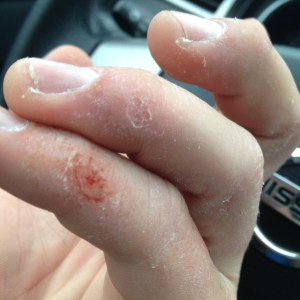
Yesterday, for example, I climbed Heather, 12b trad. Or more accurately I fell off Heather. A lot. After the initial crack things get thin, the protection gets small, and I started flying. I jammed so hard I took chunks out of my pinky and ring finger, left blood in the crack. I eventually pulled through the first crux on gear after repeated whippers on a slotted microstopper. The jams were so painful they left my knuckles aching. Onto the second crux, a series of sport climbing-esque slaps up an overhanging wall above a fixed pin—I backed up the pin with another microstopper, but on my first whip the rock around it blew. The stopper and quickdraw scurried down the rope to my hanging waste. The pin held, so I yarded back up and placed something else nearby. I took a few more whips and then lowered.

It wasn’t that I didn’t have the finish in me. It was that I was finished. I’d hung enough, my head was spent. I was just tired of being scared. I wanted to stand on flat ground. I was over it. I’d failed.

FullSizeRender-1That was yesterday. Two days before I lowered off Confederacy of Dunces, a crimpy “sport climb” that requires as much gear as quickdraws. Earlier in the day I’d fallen off Promise Land, a route I’ve climbed a bunch before.

Before that it was Astroman, the classic Yosemite 11c. I’ve been up there four times with two different partners, and everytime I’ve retreated. Even the Steck Salathe, a long Yosemite 10b, I had to hang on this trip.

Coyne Crack. Sanctuary. Mean Streak. Fat Lady. Flesh for Lulu. Tight Rope. The Prow. Women in Love. White Eye. The last pitch of The Underground. There are more routes out there I’ve fallen on or backed off of than routes I’ve sent. A lot more.

I fail a lot. A lot a lot.

The last few years this has been particularly acute—my drive to push has ebbed and surged in waves. One day I’ll be fixated on a route, and the next I won’t care about climbing at all. Until I’m standing at the base, until the route is towering overhead, I have ZERO gauge on where my head will be.

Yosemite, for example, three weeks ago: I was feeling lukewarm about the huge projects I’d set out for myself, Astroman and a one-day ascent of the Nose. But then we came through the tunnel and I saw the towering bulk of El Cap. We pulled over, parked with the rest of the tourists, and snapped a few photos. I could feel the excitement rising from somewhere deep inside me. Suddenly I was jumping up and down, eyes wide, my hands on my partner Andre’s shoulders. “Let’s do this!” I shouted, energized, alive. “LET’S CLIMB THAT BEAST!”

We didn’t. We failed. We tried Astroman three times but never reached the top. Even climbing the Sentinel was a close one. We never even got on the Nose.

I remember as a beginning climber backing off everything. I could practically downclimb as well as I could ascend; almost every route wound up including a retreat. The first time I tried the Whitney-Gilman Ridge I backed off three pitches up; I had no idea where to go, and I was too afraid to get stranded. I didn’t have the confidence in myself, the sense of adventure required, to continue. It was the same feeling that came flooding back yesterday.

I also remember when I stopped failing, stopped always backing off stuff and started getting to the top. It felt like a victory, a gaining momentum, like I’d crested some hill and the battle that had ragged for years was finally turning in my favor. Call it confidence, call it whatever, but there was a tipping point and it allowed me to start sending. The foundation was built and it was now time to climb.

There is a power in possibility, power in believing in yourself, believing you are successful, can succeed, power in believing the next hold WILL show up, the next piece of gear WILL be bomber. There is Truth in that. And yes, you might get stranded, there may not be any gear, but most times it will work out. Climbing has the power to get you killed, but when you climb with openness and possibility, when you ask the question “How do I use the holds before me?” rather than “When will the holds get good?” the best of us shows. We meet the challenge with our all. And suddenly you find yourself at the top.

But that doesn’t happen every day. Not in climbing, or elsewhere.

I fail a lot. And not just in climbing. I tried writing a book once, a guidebook to Western Maine rock. I never got past collecting topos and building a website. My “career” is a handful of fits and starts, nothing to write home about, a small town writing gig that keeps going with some adventure on the side. And I was married once. That didn’t work out either. Life has a way of handing us failure, adversity, reminders we are imperfect, routes we can’t seem to get to the top of. Our best efforts of the moment aren’t enough to crest the hill. The summit might just be out of reach. Life has a way of reminding us of that.

I failed yesterday. A lot. It came at the end of a week marked by failure, and a trip marked by failure. At the end of a few years marked by failure.

And in the midst of those lessons on failure the failures can compound. They can transform from a single moment to a storyline, from one climb to climbing, from event or sequence of events to a life narrative.

Blah.

But each of those moments are single moments, blips on the screen, instantaneous and individually inconsequential. “Failures” in name only.

As I bailed off Heather yesterday my friend Pat walked past on his way to Airation, a Cathedral finger crack. I’d seen him working the route a year ago, but he’d fallen at the crux.

“I’m getting back on it,” he said. “I’ve still got to send it.”

Not a failure, an ongoing challenge.

Life does a lot of smacking around. It is about mistakes and missteps, confusion and corrections. Climbing is a stupid, pointless way to spend the weekend. And I love it. It has a tendency to mimic the rest of existence, remind us of the challenges we face every day.

Today my fingers hurt. And my abs. I’m thinking a bike ride, or a trail run, fits more than climbing; I’m thinking I need a mental break from falling, fear, and visions of failure.

But yesterday as I walked down the descent trail after retrieving my gear I turned to Nick, my climbing partner. “Thanks man,” I said, “today couldn’t have been more fun.”

He smiled. “Yeah,” he said, “that was awesome.”

Failure can still be worth it.

And I’ll be back. I’ll be up there again, fingers jammed to the bleeding-point, gear smaller than I want disappearing below me. No matter how many tries it takes me it won’t truly be a failure, just an ongoing challenge, just one more route I have yet to send. And there are lots of those. I’ll never send them all.