CDS Column: Socialized Soldiers on Quieter Battlefields

CDS Column: Socialized Soldiers on Quieter Battlefields

Iraq-1020772The ceilings hung squat and low, traced by fluorescent lights dotted among recessed tiles. The hallway was dingy, scraped paint along bare walls and floors that wouldn’t shine no matter the scrubbing applied. Worn signs hung on the bathroom doors, faded now after too many handprints, only half the words now visible. Someone redrew the head on the men’s bathroom symbol, but they’d drawn it square. Inside, a black Magic Markered smiley face stared out.

It didn’t look like a hospital. Or it didn’t look like an American hospital, particularly not one in a major city. American hospitals are shiny and well-lit, with glass walls and artwork lining the corridors. They are regal, siblings to university buildings and museums and federal government offices.

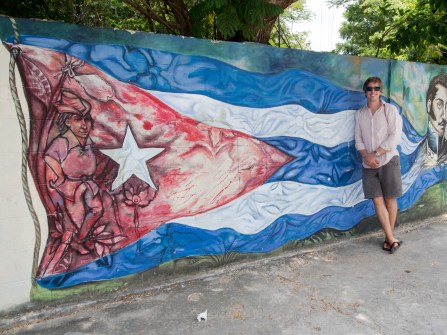
But this wasn’t. What came to mind was Cuba — the dark hallways and simple plastic-upholstered seats lining the waiting room walls in the public clinics, the cement stairwells and overcrowding.

But even in Cuba the lines of patients move. People get seen promptly. Not here.

The emergency department was full. Some people stood along the walls. The woman behind the desk said it was a five-hour wait, maybe more.

“Busy day?” my friend asked.

“No,” the woman said looking apologetic. “This isn’t bad.”

We sat down beneath an overhead television. It was 1 p.m. The afternoon soaps were on.

Seven hours later, the evening news was coming to a close. Our wait also was ending.

Welcome to the VA system.

I’ve heard not every Veterans Affairs hospital is the same. Some, I’m told, don’t feel caught in the Soviet era. I don’t know; I’m not a veteran, and I’ve only ever been to one VA hospital. But that one visit was disturbing enough.

My friend and I were in San Diego. Our visits to California overlapped by a few days, so we decided to team up for some surfing, snorkeling and exploring the city.

But on day two she began complaining of lower back pain. An Air Force vet, she Googled the local VA services. There was a hospital on the outskirts of the city, just outside La Jolla Cove where we’d been snorkeling the day before.

She looked at me. “This should be fun,” she said.

Being a veteran, she knew. I did not. But within a few steps of walking in the door I understood viscerally. All the news stories I’d heard in recent years came flooding back, about long wait times and how the head of the VA had resigned and the system was again due an overhaul. It was akin to walking into an inner-city school — one look was enough to know the facility was under-resourced, that the job it was expected to do far exceeded its capacity. Long waits, substandard care, lost files and missed diagnoses seemed to ooze from every exam room. This was less a hospital than a holding pen. Prisons are better equipped.

And sitting there I had ample time to consider the string of ironies I was witnessing. Here I was in a VA hospital, and I kept having flashbacks to Cuba, a country where the population lives on a fraction of the American standard. But despite appearances, Cuban hospitals get better results. Their version of socialized medicine competes favorably with the profit-driven system employed by the United States, and it blows the VA system out of the water. I was looking at America’s finest — the soldiers, airmen, seamen and Marines of the U.S. military — as they were served up the worst of American health care. Some of them may have even served on Cuban shores, may have stood guard on Guantanamo Bay, Cold War warriors who fought the spread of communism.

What did they earn in return for their service? Socialized medicine.

It almost made me laugh: Fight in honor of American values and you earn guaranteed free government-run health care. “Oppose communism to secure your place in socialism.” I doubt that made it onto many recruiting posters.

But there is a tragedy hidden within the comedy: The modern American application of socialized medicine offers veterans few gifts. They give us their best, and we give them our worst. The VA system is known for wait times that sometimes outlast patients, for diagnoses that come too late. “Support our troops” seems to only hold until the fighting is over. After that we leave them to die on quieter battlefields.

The problem, of course, is not socialized medicine. Plenty of countries pull that off at a high standard — most of Europe, Canada, Costa Rica. But the United States has proven incapable at setting up its own system, even for soldiers. That U.S. soldier who was stationed at Guantanamo Bay may have done better to wander off base to see a doctor than visit the hospitals provided by their own government.

So, every day we rob veterans of what they have earned. We underfund and understaff and under-resource to the point of no return, to the point that servicemen and women die as a result.

It’s easy to blame the bureaucracy, to rest at the myth government can’t run anything well and move on. But that is a farce. Government-run health care works worldwide, just not here.

But the VA has to work. Not marginally, not sluggishly, but well. Efficiently. Smoothly, with dynamism and grace. We owe it to every American willing to pledge more than taxes and a vote every four years for his or her country. It may not have been on the recruiting poster, but it is the promise we made.

And we’ve failed. For a generation now we’ve failed. We’ve accepted the myth that government can’t work, that socialized medicine is doomed to fail, and our soldiers have paid the price for it. Sagging buildings and five-hour wait times are not the best we can do. Our veterans are worth more than that.

This piece appeared in today’s edition of the Conway Daily Sun.

Cuba: Island found, or lost?

Cuba: Island found, or lost?

Cuba-2570“How do you get there?” It’s always the first question whenever I tell someone I guide trips to Cuba. Maybe they’ve heard of Americans slipping in illegally through Canada or Mexico. Maybe they figure I’m doing the same.
“Miami,” I reply. “By charter. It’s less than an hour flight.”

The next line is also scripted: “Well, now’s the time to visit. Before the Americans get there and screw it up.”

To be clear, these aren’t Europeans, Canadians, or Mexicans I’m talking to, they are Americans. Most of them haven’t visited, but they know Cuba is opening, and they know when it does Americans are going to ruin it.

The Cubans I talk to aren’t so sure. When they hear “American,” they smile and reach with both hands. “It’s about time,” they say, eager to shake.

View Story
Cuba: An island seeks to connect
I hate to be the one to do this, but I’m here to tell you that the frozen-in-time utopia is not a realistic picture of present-day Cuba.

My job as guide to Cuba is a new one. Before last December, before President Obama announced reestablishing US-Cuban relations and loosening travel restrictions, just visiting could have landed me in jail. Even now the US government forbids tourists from going; our groups are classified as “people-to-people” exchange trips, and they require US Treasury approval.

There are no beach visits or snorkeling trips on our tours. We go to meet Cubans, experience the culture, and explore a country hidden behind 60 years of embargo.

That’s why participants go. I go to watch history unfold. If those Americans are right and we are going to ruin Cuba, then I am the leading edge of the invasion force. The destruction — the Starbucks, McDonald’s, and Marriotts — will come in my wake.

But despite the risk, Cuba’s excitement for what comes next is palpable. On our April trip, every time someone learned our group was American, they got excited.

“Do you think it will happen?” they said. “Will the blockade end?”

Then President Obama shook hands with Cuban President Raul Castro, and overnight we became celebrities. Whenever we were in the street and people learned we were American, they’d grab us.

“You’re Obama,” they’d say, grabbing our hands, “I’m Castro.” Then they’d shake vigorously, smiling. This didn’t happen once or twice. This happened a lot. Our group was there to meet Cubans, and the Cubans used the opportunity to re-create an emblematic moment of their expanding future.

It’s a moment that keeps moving forward: My last trip coincided with the US announcement it would reopen its embassy in Havana. Next time I visit, the embassy will be open. Things are changing fast.

But not everything. The streets are still flooded with 1950s Fords and Chevys, and the faces of Fidel, Che Guevara, and Hugo Chavez still loom large on countless murals and billboards. Soviet-style architecture still dots the Havana skyline, and when the sun goes down, crowds still swarm the Malecon, Havana’s iconic 8-kilometer seawall.

Cuba seems caught somewhere between the developing and developed world: Everyone has health care and a university degree, but buildings are falling down and basic goods can be scarce. But it’s that juxtaposition that makes Cuba remarkable. There are few places in the world where I would encourage people to go out after dark to wander the streets and look to strike up conversations, but social hour in Havana doesn’t begin until 9 p.m. and crime is rare. If “people-to-people” interaction means meeting Cubans where they are, then it begins at dusk on the Malecon.

Other parts of the Cuba experience, meanwhile, seem cribbed from old jokes about the ills of central planning: the three elevators in the upscale Habana Libre hotel that have been down for months; the stores that just keep running out of bottled water.

Then there’s the undercurrent of hard currency that lubricates every interaction; nothing happens without a few dollars exchanged in the palm of a handshake. There are two sides to this game: One is that the government pays so little, everyone must supplement their income with “tips,” the other is that without a contribution, you might be turned away next time. The restaurant might be closed. The tour could be cut short. It’s part of how Cubans get by, and after 60 years in the shadow of the embargo, Cubans know how to survive.

And that’s the truth I come back to each time an American tells me we’re going to ruin it. A half-century of sanctions, spies, and submarines didn’t succeed. Instead, that time taught Cubans to think on their feet, to adapt and endure. As the country opens, Americans will come — for both vacations and business ventures — and Cuba will greet them openly, with a handshake and a smile.

But I’m willing to bet it will still be Cuban palms that wind up filled with folded bills, and again without losing their island.

I’ll tell you for sure after my next trip. Or the next.


This story appeared in the Boston Globe in August of 2015.

One Page, Typewritten

One Page, Typewritten

12466190_1372029352823146_3197915331627306497_oJune, 1947. Page, 24, sits at the bar in the Sheraton Plaza Hotel in Daytona Beach, Fla. It’s hot, Florida in summer hot. She sips a drink alone.
A man walks in. A sport coat and pressed shirt drape over his lanky frame. His nose is sharp, eyes the color of coffee. As he crosses the room he seems to point to the floor — his eyes, his nose, his head, his chest. He served in the war. It’s that walk, she can tell. He comes toward her.
“Hi,” he says. “May I sit down?”
“Yes, of course,” Page replies.
He pulls open the chair and sits. “Thank you.”
The past can be hard to picture, it leaves only shadows. The impression remaining is cobbled together like scenes from old movies — the characters are real, but the settings are wooden, the dialogue imagined, almost fiction.
But Page is real. And so was he.
They talk. He’s witty, makes her laugh. She orders a second drink. He finishes his first. Late afternoon slips to evening, but the dark Florida June is still stifling. Soon he has to leave.
“I’m giving a talk,” he says. “It’ll be an hour. Will you wait?”
She smiles. “Wait for what?”
“I’d like to have dinner with you,” he says, standing.
“An hour?” she says. “Yes, I’ll wait.”
When he returns they leave together, walk out of the bar, out of the hotel and into a restaurant. They keep talking — him telling stories and her laughing. When they finish dinner they go to another bar, then a third. It’s after midnight when they walk back to the Sheraton Plaza.
“Thank you,” Page says, leaning against the door to her room. “I had a wonderful night.”
“Me too,” the man says.
She steps inside, closing the door behind her as he walks away.
The next morning early there is a knock. Page pulls on her robe. “Yes?”
“I wanted to thank you again,” the man says. She opens the door and he hands her his card. His fingers trail across hers as she takes it. “It was the perfect night.”
He smiles. “Write me,” he says, and then turns.
She looks at the card: J.D. Salinger, writer.
1947, four years before “The Catcher in the Rye.” Page is now 92. Her birthday just passed. She lives in South Carolina, still drives, still lives in her home. She is my grandmother.
I knew none of the story when I visited last fall. She’d fallen, broken her pelvis and was in a rehab center awaiting surgery. I drove down to offer help. Aside from the break she was healthy and strong, “This place is full of old people,” she told me. “Not like me. I’m old, but these people have no idea what day it is.”
But not her. Ninety-two or not, she remembers.
“You’re a writer, so you might appreciate this,” she said, and she told me the story: the bar, how he came in then left then came back. Dinner. The next morning. All of it.
“Go in my desk,” she said. “In the back there’s an envelope. Look inside.”
“Write me,” he said. And she did. And he wrote back.
The envelope was yellow and stuffed with clippings. The return address — P.O. Box 32, Windsor, VT 05089 — lacks a name; the postmark read May 23, 1976, 29 years after the hotel.
“Dear Page B.,” the letter begins, typed in the irregular stroke of a typewriter. “Mainly, I suppose, because of the kind of work I’ve got myself into, my memory seems to be almost extinct. Or so cluttered and cross-cluttered that I can get at things only at their convenience, not mine. Not that it doesn’t all come back if someone very kindly presents me with an artifact or two — the seating plan of some old dining room, say, or a sketch of the way deck chairs were placed around the swimming pool, or sometimes just a plain wet black bathing suit does the trick.”
But even faded, the memory survived: “I was back at that Daytona hotel a couple of winters ago, with my children, but the place had turned seedy and the weather was cold, and we cleared out in a hurry.”
One page only, signed “JDS.” He referred to her children (“I’m aware of what goes into having just two. The algebra of seven is too much for me.”) and her separation, indications of past correspondence. Her words, however, are silent, only echoed on the page of a man who splashed letters like paint.
“You do sound intact, but very much, though, and I’m glad. For what very little it must be worth, I send you all these inanities with warm apologies.”
He is dead now. She is 92. But the letter remains. Thirty-nine years later, 68 years later, the past is still cluttered and cross-cluttered. Memories fade, then disappear, and from the rearview it sounds almost like fiction.
Almost.

This story appeared in The Conway Daily Sun in July of 2015.

Fire

Fire

pic-0007The two lanes wound through the city, cars streaming like a river towards the downtown. Colin banked right then left, steering from memory, pressing the gas pedal as the road began to climb. The leaves, fresh and green, rustled in the breeze. Colin pulled to a stop at a traffic light and felt the wind dance in his open window. It was cool and fresh. The light turned green. He pressed the gas.

As the car climbed, Colin saw smoke. It was billowing skyward from something over the crest of the hill. With every turn of the tires the horizon sank, revealing more smoke whirling in the breeze, dark against the blue sky.
The wheels turned, the car climbed, and Colin looked. The horizon dropped. What was burning? He couldn’t see.

Then the flames were there, dancing over the pavement skyline, red and yellow among the bricks. The fire strained for the sky, leaping and jumping. One more revolution and Colin would see what was burning. The car crested the hill at a stoplight—red—and Colin pushed the brake pedal. Across the street, standing on the sidewalk next to the intersection, stood a man engulfed in flames, burning.

His eyes were closed, Colin could see that. And his face was taut. His teeth glistened through a grimace. He held his arms out from his sides at an angle, both hands balled into fists. He seemed to be dancing, hopping from one foot to the other, red flames licking their way up his body.

His clothes were not yet burned away. They seemed to breathe fire all around him, drawing it down his shoulders, along his legs, up into his hair. A soft breeze fanned the flames like a flag and left the leaves shuddering in the trees behind him.

Colin sat at the light, both hands on the wheel. A woman in the next lane was also staring. A man and a woman were walking together on the sidewalk, laughing, unaware of the man and his flames.

Colin’s gaze returned to the man, still caught doing his strange shuffle. His clothes were melting, fusing into his skin. His lips were burning away from his teeth. The man opened his eyes—Colin couldn’t tell their color beneath the flames—and scanned around him through a veil of fire.

And then he stopped, his eyes on Colin. Through the intersection, the windshield, the glare of the traffic light, the red of the flames, the man’s eyes locked on Colin’s, even as the fire ate his eyelids.

And Colin stared back. They were transfixed—the burning man shuffling from foot to foot, Colin with his hands on the steering wheel, eyes locked across the divide. Colin could feel the sweat on his back, beaded and cool, something the man would never feel again. He held the man’s gaze and watched as the tissues around his eyes charred and turned black. He was unable to look away.

The light turned. Green. Colin rolled forward, still transfixed, still unable to turn. The burning man followed him as he passed.

Colin crossed the intersection, pulling the wheel to the left and glided into an open space. He leapt out of the drivers seat. The burning man had lost control of his muscles and fallen to the ground. From either side people ran towards the charred body. One was carrying a fire extinguisher, bright and red.

Quitting

Quitting

Yesterday I quit climbing.

It was 5:30 p.m. and growing dark. I was standing in my living room, naked from the waist up, a pile of outdoor clothes draped on the arm of the couch beside me. I had been waiting for this moment all day, for work to end so I could go climbing in Crawford Notch, but now that the moment had arrived I was faltering. “Should I go?” I thought, wearing nothing but blue Capilene tights. “Do I really want to? Or am I just going climbing because climbing is what I do?” Would my plan leave me smiling and satisfied, or would I just wind up wishing I was back at home? I didn’t know, so I just stood there in my long underwear watching the sky grow darker.

I tied into a rope for the first time at 17, and ever since I’ve poured myself into my passion. I’ve spent weekends, vacations and thousands of dollar on climbing. Now I can just describe it as what I do. It’s intricately linked to my closest relationships, my work and where I choose to live. It’s how I meet people, what I talk about with friends, how I relax, what social occasions are centered around, the focus of the organizations I donate to and how I volunteer my time. It has become more than a passion — it has become life.

And yet I quit.

I stood in my living room yesterday, lost in my head, naked, exposed, and I didn’t want to go climbing. “No,” I thought, pulling off my Capilene, “I’m not going. It isn’t me, not today. I’m not a climber. I’m just not.”

It wasn’t the first time I’d quit. I quit the day before too. I had plans to go to Tohko on Sunday with Scott, but after two days out at Ice Fest I was tired. I got home and didn’t feel it. “Not today,” I thought as I sat down to read. “I’m not climbing. Not now. Not today.”

It feels good to quit, to reject the passion that in many ways has come to define me. It feels good to put it down, to let it rest, to let the pressures and expectations that built up around it dissolve. Will I send my project? Who knows. Probably not, because I quit. And that’s OK. After weeks and months of doing nothing but climbing, I just walked out the door.

It doesn’t take long to fall into habits, and climbing is an easy one to fall into. When you climb every weekend, every vacation and every free moment it can be difficult to determine whether you are climbing today out of passion or simply because you climb. For me at some point the climbing flips from being a passion to being work. “It is the weekend again. Where are we climbing?” The desire to tick the next project, to push to through the next grade, takes over, and when it does the passion is gone. But I keep climbing because I know nothing else. What meaning does it bring at that point? What value? None. The feelings climbing can elicit are gone, and yet I stick to it. It’s become a habit, just what I do.

When that happens, I quit. I walk away. I put down my gear, fuck it, and do something else. I did it yesterday. I pulled of my Capeline, did some Googling, and instead went to a yoga class. It felt fantastic. I spent an hour and a half trying not to fall over. Every pose was taxing. I embraced sucking at something, free from any self-imposed pressure to perform. It felt the way climbing felt that first day. It felt the way it felt when I quit this summer — instead of tying in I went surfing, and I spent hours just trying to stand up. Ego stayed home during those sessions — I couldn’t afford its critique.

Quitting is liberating. It is freeing. It takes the thing that you allow to define you and puts it back in its place. Climbing isn’t life, it is an activity. It is a way to spend time, no more, no less. It can be fun or it can be miserable, depending on the day, but it is neither good nor bad. And when it starts to feel overwhelming, like it has become a job rather than a passion, the best thing I can do is quit.

And so yesterday I did just that. I quit. I walked away. I said fuck it, and in rejecting climbing I found freedom. It was in every yoga pose — the same feeling discovered 14 years ago, that first day I tied into a rope — the wonder of movement, the high of self-awareness, the intense connection between mind, body and breath. Instead of searching for that feeling in climbing like a heroin addict seeking another fix I looked somewhere else. And there it was. I found it. All that because I quit.

I’ve quit so many times before. I spent a year barely climbing once, and three years off the ice. I went on sailing and bicycling trips, spent weekends camping and watching movies, blew money on cameras, concerts and plays. I’ve quit countless times since too, and each time I discover how much I truly love my other passions. Quitting has allowed me to I train and compete in a triathlon, and it afforded me a stint in Iraq and Kuwait reporting for public radio. Quitting has given me much more than it ever took away.

Quitting has also let me discover, once I finally tie back in, how much I love climbing. The quitting helps me see my passion within a proper context, as one passion among many, all of which are rewarding and expand my perspective. Embracing the quit and the subsequent resurrection refills my passion. It allows the beauty of what climbing offers wash over me. It helps me grow.

Passion are meant to support us, to engage us and push us to new heights and levels of understand about ourselves, but if they come to define us they do the opposite — they make us contract. They can help us seek our own self-imposed boundaries, or they can form the foundation for those same walls. Climbing runs that risk for me. It is in so much of my life it can easily box me in if I sit back and let it. But in quitting I reject that mold and embrace the growth. Quitting allows me to look around with clear eyes and see all the other things I am missing.

It also gives me a chance to recommit. Every time I quit I get to rediscover the wonder climbing brought me that first day. Quitting reinvigorates my passion. Yesterday I decided I would not climbing. I quit, and rejecting climbing as a definition. I won’t go again, I told myself, until the drive comes from a place of passion, a place of love, a place of growth and willingness to accept the unknown. If the thought of climbing provokes a question about to whether I want to be there, whether or not I was making the right decision, I wasn’t going. Climbing should provoke feelings of elation, I reasoned, not exhaustion, so I quit. I just walked away.

Then today I got up and packed my bag for the rock gym. I’ll be there tonight, back on the wall, back among friends. My quit has run its course. My willingness to walk was the ingredient necessary to see my passion with fresh eyes again. After years of pitched battles (within myself always), it now takes just days to be ready again (except for those times it takes weeks or months). Today I’m back to climbing out of love rather than obligation. Quitting kicked the habit, and it no longer rules me. I cannot deny I my passion, but through quitting I let it re-bloom into a passion, a love, of my choosing. If it were any other way I’d have to quit.

Morning with Monsters

Morning with Monsters

Fear is a funny thing. Run from it and it is always at your back, embrace it and its capacity to overwhelm you evaporates. Like darkness each morning, it can be pushed aside by the light. But as the sun rises in one place, darkness falls somewhere else. Face fear once, twice, a thousand times, and it inevitably crops up. We have a choice: keep facing our fears again and again forever, or try to run and hide from them for just as long.

This morning I got up before sunrise. My bag was already packed, tools strapped to the outside. I pulled on my Capilene, ate a small breakfast and jumped in the car. The road was coated in snow as I pulled onto Route 302.

About a month ago I soloed Standard Route at Frankenstein for the first time. It was an amazing experience, a moment where I embraced the fear of being ropeless and kept going. My brain screamed “NO” the whole way, and yet I continued upward, rejecting logic and letting trust and faith guide me.

Now, weeks later, the fear of being ropeless on Standard has dissipated. A week or two ago I ran up it again, this time before work. That time the tether anchoring me to the ground tugged but never grew taught. I was able to climb in control the entire time. The fear was gone, at least on Standard.

But there is always a bigger monster around the corner. As I drove to Frankenstein this morning I knew Standard was just the warm up. My fear, my test, was named Dracula.

The idea of soloing Dracula, the classic grade 4 at Frankenstein, first popped into my head on the descent from that first Standard solo. It wasn’t in yet, but as I walked past I knew in my heart it would go. This morning I went to Frankenstein determined to embrace that knowledge.

I got to the parking lot before the plows. It was still dark when I started walking down the railroad tracks. It was warm, above freezing, but I was dressed light enough I had to walk fast to stay warm. I followed deer prints in the fresh snow to the ice.

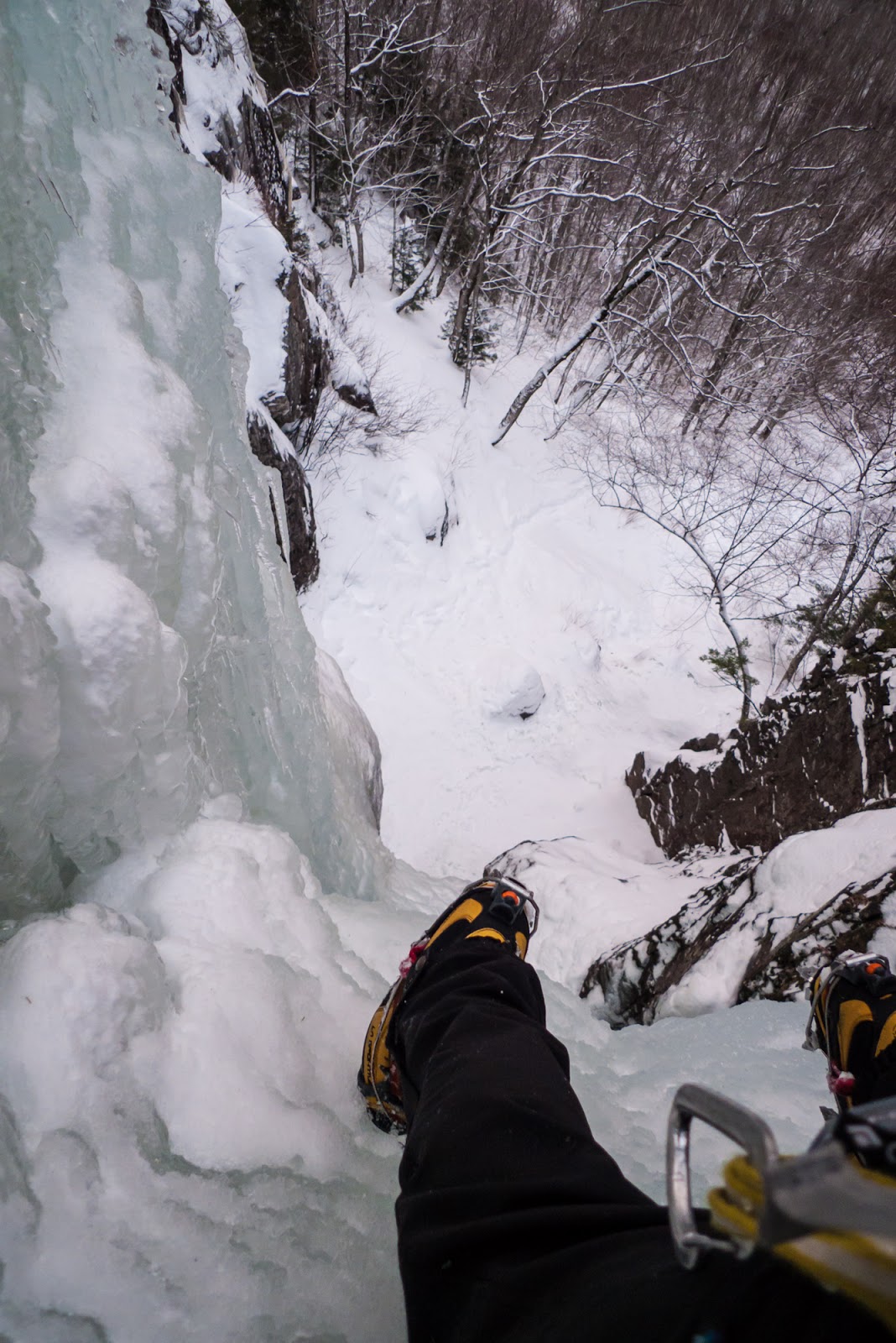
I got to the base of Standard and dropped my pack. The snow and ice above me glowed an eerie blue. I pulled on my harness, racked up and tethered into my tools in the pre-dawn light. I sighted the straightest, bluest line and started climbing. Standard flowed beneath my picks, an old friend accustomed to sitting together in silence. The first oranges and reds of morning sparked to the south. I snapped a few pictures as I climbed, but mostly I just cleared my head and concentrated on floating. “Breathe,” I thought time and time again. “Breathe.” In less than 10 minutes I reached the top and was walking back down.

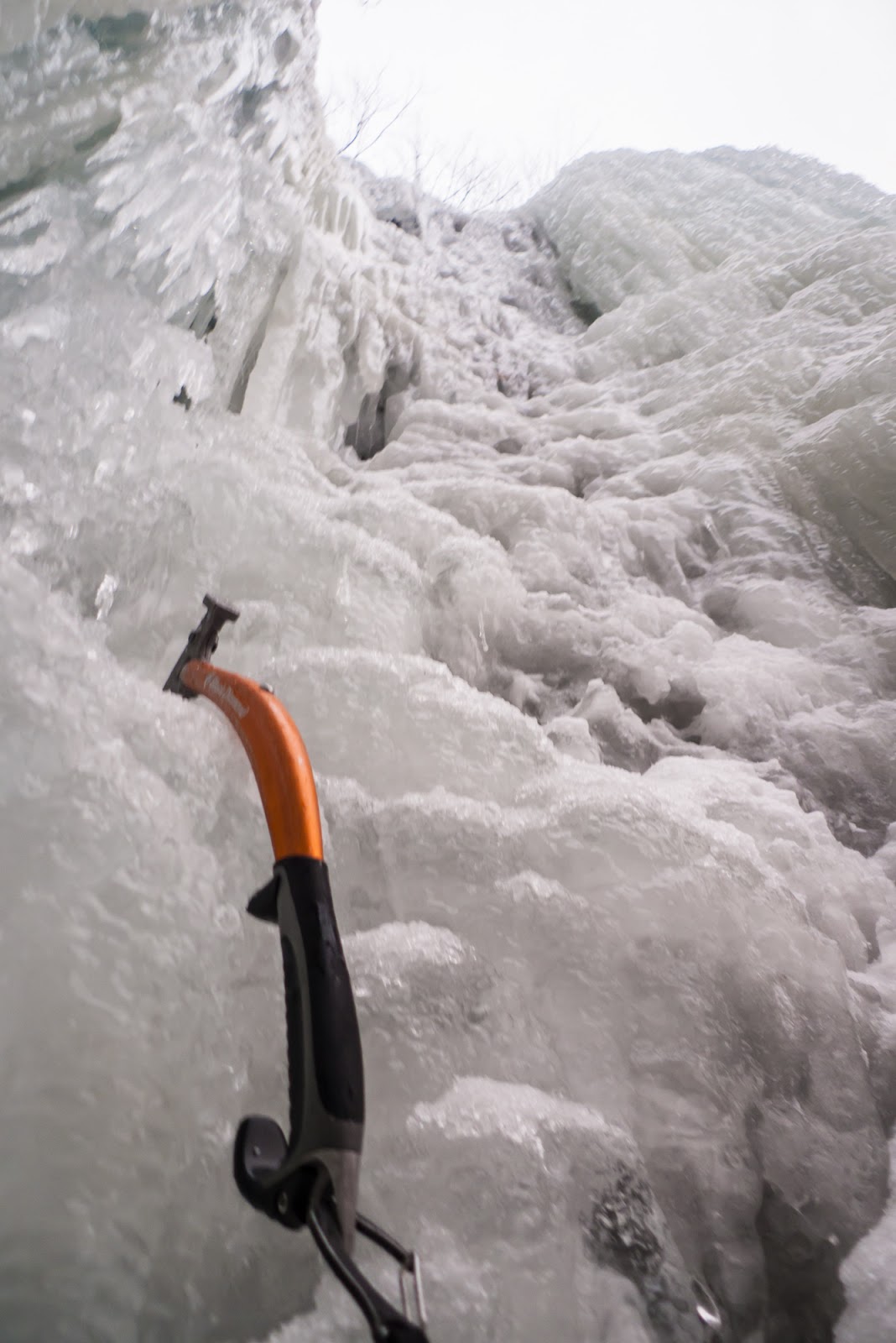
The descent from Standard makes it easy to consider a second act. Most days I don’t have time to consider such things before work, but this morning I’d started early. Dracula looked soft, forgiving and beautiful. I walked to the base and stared up at it. I knew it would go. I took a sip of water, ate a snack, pulled on a dry pair of gloves from inside my jacket and swung a pick into the column. The ice was wet, pliable, perfect. I swung in the other tool. “This will go,” I thought, and I began climbing.

The first steep section went quick, a handful of moves up to a ramp. From there I kept going, swinging and kicking into dryer conditions. The ice was an open book as it flowed down a corner, so I stemmed my way skyward.

About halfway up, though, doubt crept in. My feet felt too wide. I was off balance, and the ice cracked more than I liked. I glanced down. A fall would break my legs and maybe my back. I’d bounce off the ramp, shoot out over the first column, hit the base and then tumble down the approach gully. I could see myself dying. “Shit,” I thought, “I don’t want that. Why am I here? This is stupid.” The terrestrial tether suddenly felt stretched to the limit. I prepared to climb down.

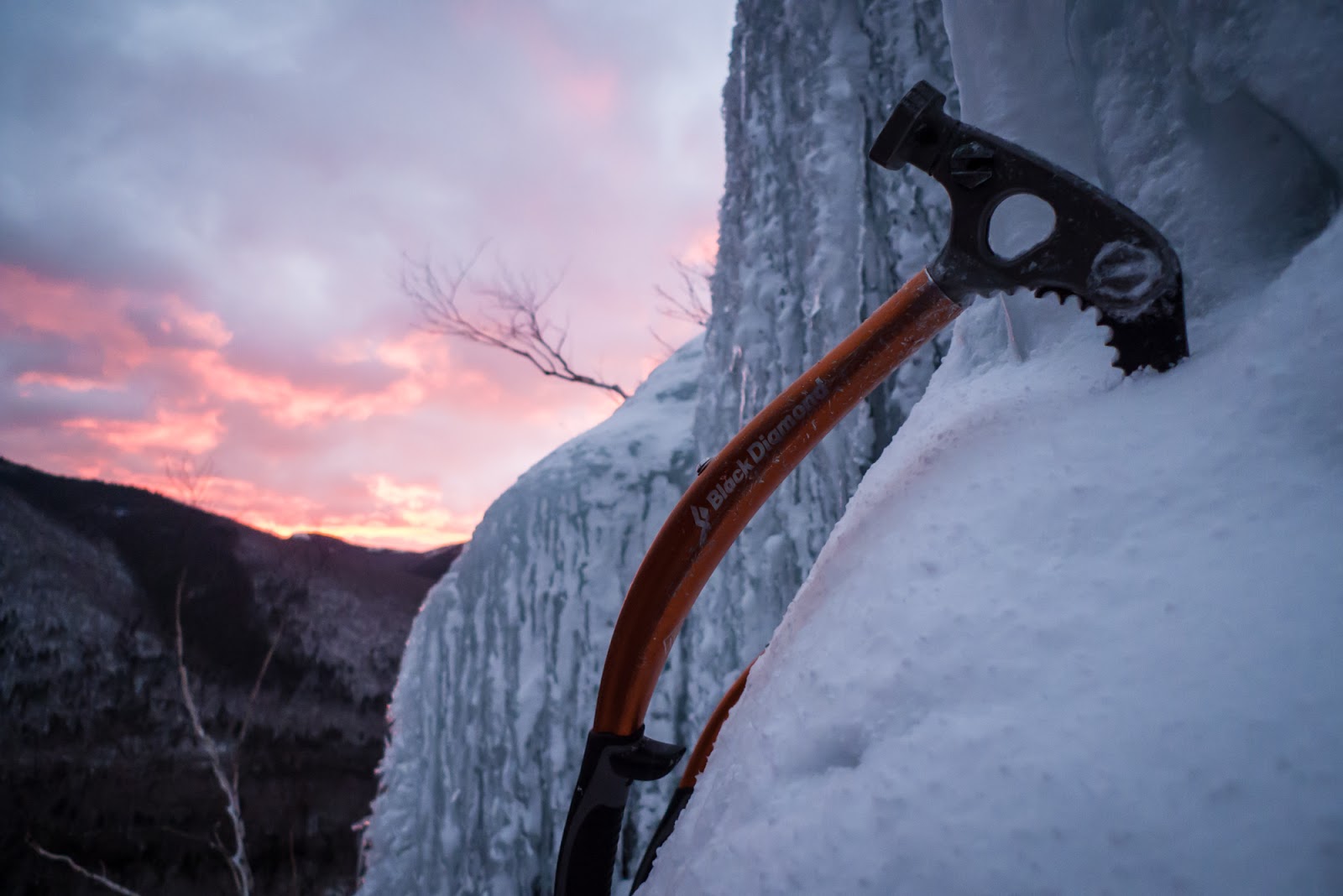
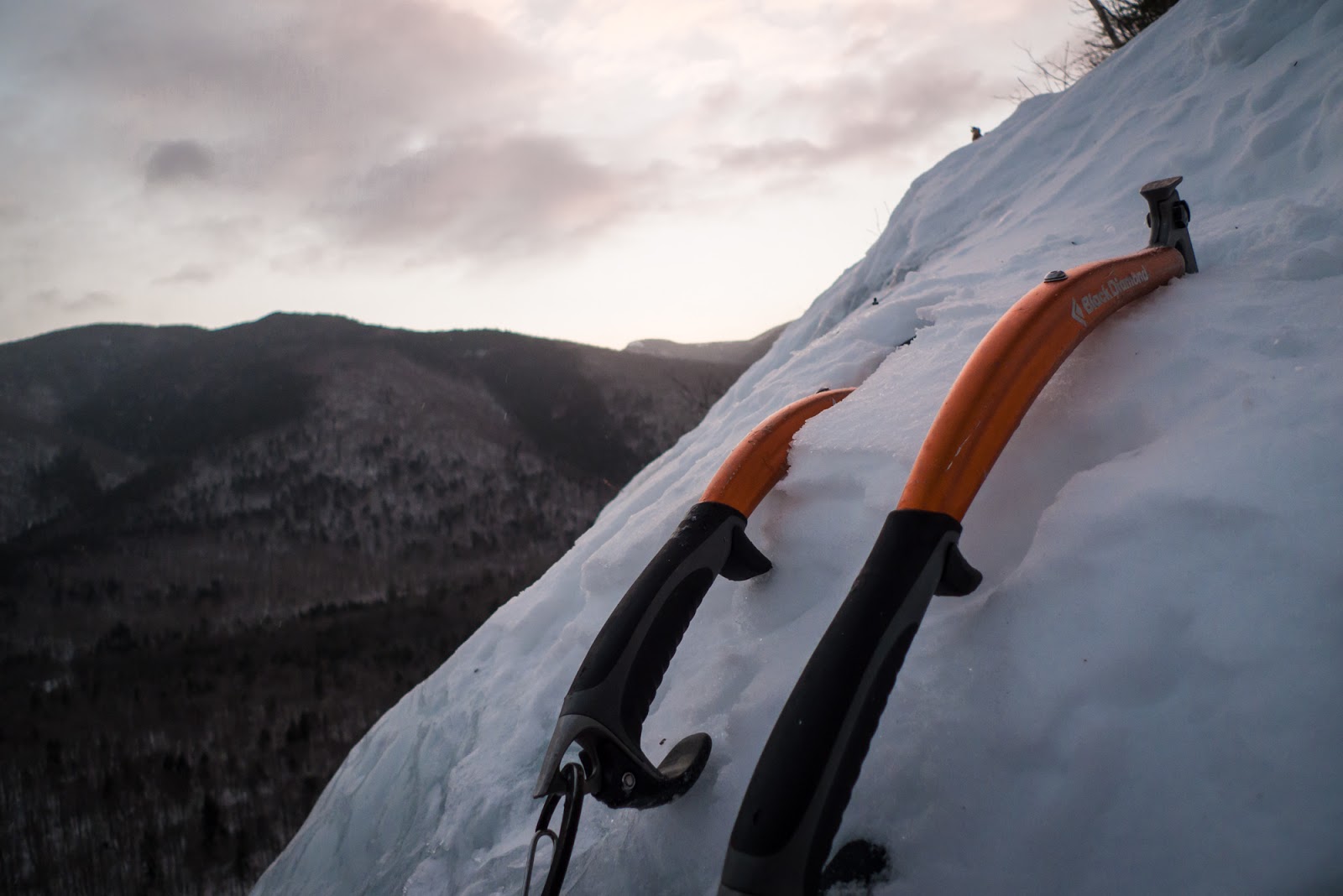
But I knew — KNEW — I could climb it. I’ve climbed Dracula countless times and never fallen. That doesn’t mean I never will, but I knew at that moment the thing holding me back wasn’t my strength or my skill, it was my head. The thing holding me back was me. I worked my way down, out of the corner and back to the ramp. I found a stance and buried my tools in the ice. I pulled off my gloves and tightened the laces on my right boot, took a deep breath, then another. “OK,” I thought, “you know the consequences. There is no logic to going upwards. None.” I switched feet and tightened the laces on the left boot. “Keep going and you could die.” I thought. “Just go down. The ground is safe.” I looked at my tools, drops of water glazing the orange paint, and then raised my eyes up. There were miles of steep ice above me. I looked at the sky, then down at the ground, and I felt a wall inside me crumble.

“That is wrong,” I thought, knowing in that instant I would continue climbing. “The ground isn’t safe. You think it is, but you may die there too. I might crash my car on the drive to work, or die of a heart attack at my desk, or get cancer. In fact, if I spend my entire life on the ground, it is inevitably where I’ll die. Going up isn’t about dying, going up is about living.” I swung my pick into the corner and started for the trees.

Every day we arrive at work on time, or make it to school, or meet a partner at the crag, we are fooling ourselves. We think because we made plans we were in control, that things worked out the way they did because we decided they would work that way. We’re wrong. We trick ourselves into believing we live in control, into believing that tomorrow will come just as today did, particularly if we avoid risk, never realizing the world can blow our plans off course at any moment. In a second we could die of a blood clot, or wind up shot dead in a movie theater. When it doesn’t happen each day we start thinking it won’t. We forget life is random, fleeting and final. We make plans for the future — a week, a month, a year, 30 years — thinking, KNOWING, we’ll be here to enjoy it. We walk through the world sure our lives will work out, wrapped in our own ignorance.

And we are wrong. I may die today. I may die as I write this, or tomorrow, or the next day. Life doesn’t wait and it isn’t guaranteed. It shows up wherever we make it, however we make it, whether on the ground or in the air. We will die someplace, that is the only guarantee. Darkness, fear may keep us from embracing LIFE, but it does nothing to stave off death. It rolls towards us nonetheless. The ground is not safety, and the route is not danger. They are simply the ground, and the route. There is risk in both, in all.

So I embraced the risk before me. “Breathe,” I thought as I moved up the final headwall. “Breathe.” It was the same thought I’d let fill my mind for the last 40 feet, the same thought I kept to the summit. It was my mantra, the thought that kept me in the moment, that pushed the fear of falling out, the fear of death out, the fear of failure and everything else out. I let the thought wash over me, let it carry me over the ice. It filled my mind, leaving my hands and feet to do the climbing they are so accustomed to. “Breathe,” I thought as I crested the ice and swung into turf. “Breathe,” I thought when I reached the trees.

I stood in the snow and let out a long, slow breath. “Today I lived,” I thought, rather than just survived. I smiled, clipped my tools to my harness and started the walk down.

Light is always looking for darkness. Allow it into one more place. And one more place. And one more place.

What is a Climber?

What is a Climber?

What is a climber? Am I a climber? Are you?

There is a thread on NEIce.com right now asking how many climbers people think there are. In that question there is an inherent assumption about what it means to be a climber, and in the first few responses the discussion takes a hard left turn into who is really a climber. The back and forth got me thinking.

Am I a climber? I moved to North Conway a decade ago with no job, no clue how I was going to survive. I had led a handful of 5.9 rock climbs, but none of the classics on Cathedral. Grade 4 ice was within grasp, but I didn’t have a clue how to survive steep ice or mixed climb. I didn’t know how to aid climb, haul, bivy, belay off the anchor, belay a leader with a Grigri, sport climb, handjam, place a pin or do half the things I now take for granted.

But somehow I fell into a job at IME, the heart of all things climbing in the Mount Washington Valley, and began my introduction to climbing as a lifestyle choice. Since then I’ve climbed across the U.S., in Central America, South America and Europe. I’ve put up new rock climbs, new ice lines, new mixed routes, climbed alpine peaks, guided clients, soloed thousands of feet of ice in a day, onsighted 5.12 sport routes, climbed multipitch Yosemite 5.11s, fallen all over 5.13 projects, suffered my way up grade 6 ice and tied into a rope with some of the best people on this planet. So am I a climber?

A few months ago I would have said yes. I would have pegged my identity to my sport. I would have said, “I am a climber,” and my chest would have puffed out when I said it. Now I realize no, I am not a climber. I am a man. And by embracing that simple definition I climb harder.

What came with defining myself as a climber? Expectation, and through expectation I set myself up for failure. If I define myself as a 5.11 trad leader, does that mean I can lead every 5.11 trad route? What happens if I fall off a 5.10? If I call myself a grade 5 ice leader, what happens on the day I back off a grade 4? Easy — I feel disappointed. I feel like a failure. I feel like I can’t live up to my own expectations, like I am a fraud. By defining myself I set myself up for failure if I ever don’t meet that self-imposed definition.

This past May I climbed El Cap via The Nose. It was a 30th birthday present to myself. “I am a climber,” I thought, “so I should have climbed El Cap.” I had a fantastic partner and a wonderful trip, but I suffered through the climbing. The weight in my stomach only increased as we moved upwards. With every pitch my desire to be back on the ground grew. I wanted to have climbed El Cap, not to be climbing El Cap. I was climbing El Cap because I felt it was something a climber should do, not because it was the thing in that moment I wanted to be doing. My decade of climbing experience and dedication (plus an amazing partner) allowed me to reach the summit, but it was not me at my best. Why did I suffer my way through a sea of granite? Because in my mind, “a climber should have climbed El Cap.”

What happens when a climber gets injured, loses fitness or gets old? They stop climbing. They start making excuses for why they can’t do what they expect they should be able to do, what they have told their friends they can do. They stop having fun, and they stop climbing.

I have my reasons for climbing, and the truth is they aren’t about grades. They aren’t about summits, they are about the experience. They are about movement, friendship, connection and personal challenge. They are about personal growth. If I get injured it doesn’t matter, I can still find all those things in climbing. If I lose fitness it doesn’t matter, I can still find all those things in climbing. And when I get old I’ll still be able to find all those same things in climbing if I choose to.

Last year I injured tendons in both hands. I couldn’t climb at my normal level, so my projects fell by the wayside. Did I quit climbing? No. I picked up my nuts and hexes and tried to lead everything I could on only passive protection. I never climbed harder than 5.9, but I was still moving, still climbing with my best friends, still connecting and embracing the personal challenge climbing offers.

These reasons are not grade dependent, not experience dependent. A brand new leader can embrace movement too. A client getting guided can face personal challenge, which leads to personal growth. Any two partners can see the rope as a connection that does more than just arrest falls.

This is what climbing offers — a chance at growth, a chance to step outside the ordinary and embrace life. But when I considered myself a climber I stopped seeing this. I started to see climbing as something plain, regular, routine, just part of life. But it isn’t. Every step into new territory, every move above a bolt is a fantastic journey into the unknown. Nothing about it is ordinary. We are humans, men and women. We were built for flat ground. Every journey into the vertical is a space mission. Every new exploration is a window into our own souls. What holds us back? Can we face that fear? Can we meet that challenge? Can we do the impossible?

I do not call myself a climber because defining myself as such would set up boundaries, build walls. I am a man, that is all. Climbing is something I do, something I love, and yesterday I went climbing, but it does not define me. And by releasing myself from the definitions, from the expectations, I learn to float. Free of expectation I continue upward in spite of gravity, in spite of fear. Released from myself, from my own self-erected barriers, embracing the emptiness within, I float to the chains of The Mercy, to the chains of Baghdad. Releasing myself from myself got me up Standard without a rope. Shedding expectations, shedding definitions, lets us see what we can really do. I might go mixed climbing, or alpine climbing, or bouldering, or sport climbing, or aid climbing, but I will fight letting any or all of those activities define me.

And, if I can help it, nothing else will define me either. I might choose to ski, surf, write, paint, sing or love, but none of those things will change the fact that I am simply a man, a man in search of fear, in search of a shift in perspective, in search of a window into myself. Anything that will push me is welcome, so long as it gets me outside my comfort zone, outside the known. I will search everywhere I can for ways to launch. I will look without boundaries, both within myself and in the world, in search of whatever I can learn. Embrace the unknown. Grow. Launch above that screw, that bolt, that piece of gear, but realize it is only one way to reach outer space. There are others. Go find them.

Reasons to Climb

Reasons to Climb

I’ve been writing bullshit about climbing for years.

I write about handjams, pick placements and descents, about hauling and bivying, rope recommendations and runouts. The truth is it’s all bullshit.

I don’t climb for the summit or the send. Those are just excuses. The reasons I climb are Scott, Ryan, Peter, Michael and Paul. Josh and Juliet, Paul and Sasha and Jim. Katie and Majka and Jay. Pat, Jack, Adam, Silas, Ray, Elliot, Bayard, Eric, Brent and Jay. Chuck, Michael, Chris and others. People I forgot, others I don’t even know, names I don’t recall. Those are the reasons I climb.

I have been swimming upstream for months now, struggling against something I’m not even sure I fully have my hands around. It catches me at home, at work and in the car and takes me down. It knocks me off my feet and leaves me screaming, crying. In a moment it can rip me ragged, but when I get to Shagg, Shell, Cathedral or Cannon with one of my reasons none of it matters.

Yesterday was that way. Friday night I didn’t sleep. I ate consistently last week for the first time in a month, but that ended Thursday night. I met Ryan and Michael in a parking lot in Jackson at 7 a.m. Saturday. Ryan left Western Massachusetts at 4 a.m. to join Michael and I without asking us to delay our start. I offered, but he said no.

The two of them piled into my car, and we rolled uphill to Pinkham Notch. On the way up we joked, but once we started up the Tuckerman Ravine Trail I began talking. As we hiked I unloaded my pain, frustration and exhaustion. They just listened. We hiked fast, passing party after party. At times I didn’t want to keep talking, but I couldn’t stop. I kept at it until we got to the ravine, at which point I had to sit down. I felt like I’d lost a quart of blood. The weather matched my mood.

When we got to the base of the route I asked if I could lead the first two pitches. I wanted to warm up on the first pitch and then be fresh for a shot at the crux. Neither Ryan or Michael hesitated: Of course, they said.

I never stopped to belay. I had enough rope at the top of the first section to launch into the crux, and I took it. I had an outlet, and I was blasting for the moon.

The rest of the day went smoothly. Michael took the next pitch, then Ryan got the third, and we topped out around 2 p.m. We packed our gear, stripped off our crampons and walked down. I walked silently, knowing with each step I was closer to re-entering orbit. Ryan and Michael carried the conversation, allowing me to drift inside my head.

When we drove back into Jackson they invited me to dinner, but I declined. I’d had enough for one day. I needed to get home and brace myself for whatever was coming next.

A few hours later I got a text from Michael: “Proud work today. Killed it.”

I didn’t feel like I killed it. I felt like I got up, stepped out of bed and start falling. I fell all day, and I was getting ready to crawl back under the covers when his text arrived, sleep serving as my only net. I’m not crushing, I thought, I’m getting crushed.

But every few days I meet one of my reasons for climbing, and I stop falling and start flying. With Scott and Peter as copilots I get to crush, if only for a few minutes on Wednesday morning in the Cathedral Cave. With Paul I get to launch off the bouldering pad into the stratosphere, even if I never make it past the rock gym rafters.

Climbing is not about summits or redpoints, it’s about partners. It’s about sharing a rope with someone who can save your life. And that isn’t limited to when you are in the mountains.

We are astronauts, Peter says, and we are going to the moon. Thank you Peter, Scott, Ryan, Michael and Paul, for shepherding me. Without you I’d have missed my target. Alone I’d be lost in space.

[Author’s note: Peter reminded me that his references to astronauts and the moon were originally coined by Colby Coombs, the founder of the Alaska Mountaineering School.]