Free Pens, Fish, and the Effort to Outlast

Free Pens, Fish, and the Effort to Outlast

IMG_7896I love free pens.

As a reporter and someone who writes copiously in my free time, always scribbling in notebooks both for work or for myself, free pens are awesome. They’re like being sponsored—free equipment!

If I had a pen sponsor the company would have to be TD Bank. Their pens are basically my go-to: every time I pop in to deposit a check I grab one, maybe two. Green TD Bank pens are stashed in four different spots in my car, live in my computer bag, hide alongside my notebooks and ride shotgun all day in my front right pants pocket.

In exchange TD Bank gets lots advertisement out of me. The other day I was in line at the post office and a woman was looking around for a pen. I pulled one out of my pocket and handed it to her. “Keep it,” I said, “I get them for free.”

Cashiers and servers are often impressed when you pull your own pen out of your pocket to sign the slip. “TD Bank” — there it is again.

And there’s no feeling more satisfying than using a pen until it’s bled dry. When it scratches its way across a notepad, empty of its usual inky glide, I feel a sense of accomplishment: it’s proof I’ve dedicated a certain measurable amount of time to writing, that I’ve invested in my craft. Years ago I never used to run pens dry; I would lose them well before that was ever a risk. But these days I write enough that it occurs fairly regularly.

Lately, however, I’ve been looking askew at those stacks and stacks of pens. Every one I run dry makes me wince. I toss them in the trash after their last word and I hesitate: isn’t that a lot of waste?

Think about it: when I run a pen dry, it still works. The spring mechanism that clicks the point from retraction into action still operates perfectly. The plastic shell is intact. Even the ink cartridge remains. Everything about the pen is fine, still in perfect working order, it’s just out of ink.

But for my TD pens, this is the point they becomes useless. The only thing left to do is discard them, then swing by the bank to grab two more.

It’s a bit like driving a car until it runs out of gas and deciding to walk away: there’s no problem with the machine, but the liquid that makes it useful is spent. Fill up station? No, there are none of those.

When I just lost pens I never had to think about it—they disappeared without me ever considering their end. But when I’m running them dry, bleeding them to the point they have nothing more to give, I am forced to stare their untimely death in the face. And like I said, as a writer I find myself doing this a lot.

But then I go into my local TD Bank branch, where the bucket of pens is always full. From one perspective there is an endless supply; the cars will keep running out of gas, but there will always be another full one available. And apparently for free.

But really? Are these pens really “free”? I don’t mean in a monetary sense; I mean in the sense of consequences, in the sense of an endless supply. Plastic pens are not apples—they do not grow on trees. They are not the result of some miraculous act of nature that transforms sunlight and rainwater into ballpoint and ink. Pens are plastic, an oil-based technology. They require fossil fuel to make, and when they find their way into the garbage they do not decompose. They are offered up as free gifts, but the are only “free” in the banking sense of the word.

In the global sense, however, plastic is plastic, and it’s not going away. It is turning up everywhere: filling landfills, clogging up the oceans, killing wildlife. A new study found that microplastics—tiny shards of polymers now found throughout the world’s waterways—are stunting the growth of some young fish and killing others.

Some young fish have been found to prefer tiny particles of plastic to their natural food sources, effectively starving them before they can reproduce.

The growing problem of microplastics – tiny particles of polymer-type materials from modern industry – has been thought for several years to be a peril for fish, but the study published on Thursday is the first to prove the damage in trials.

Microplastics are near-indestructible in natural environments. They enter the oceans through litter, when waste such as plastic bags, packaging and other convenience materials are discarded. Vast amounts of these end up in the sea, through inadequate waste disposal systems and sewage outfall.

“Convenience materials.” That sounds like my pens. And my grocery bags (I have two fabric bags, but I don’t always remember them). And my food packaging. It sounds like so much and so many of the everyday things we buy: toothbrush packaging and the toothbrushes itself; sunscreen bottles; electronic accessories; a new windshield ice scraper. Kayaks. Car parts. Tupperware. Printers. Plastics. Plastics everywhere. They are literally everywhere.
IMG_1043What does “disposable” mean? Where does “disposable” go? These are questions we don’t really wrestle with. There is not time to wrestle with them. They are big and unwieldy and quite frankly depressing. They seem too big to tackle, a societal issue that will never get solved.

But it has real implications. In the Pacific Ocean there is a patch of floating garbage roughly the size of Texas. It is called the Pacific Trash Vortex, a place where discarded refuse goes to swim. And as most of it is plastic, it will swim forever.

Add that to climate change, to ocean acidification, to coral bleaching and glaciers melting. There is a Texas of trash out in the ocean. And the Texas estimate is a conservative guess.

But I get free pens. So it’s convenient at least.

This is not someone else’s problem. This is something that is happening because of my doing, my contribution. Like so many of us, I live in a world of convenience. Like so many of us, I recognize I’m contributing to a bleak outcome but have no idea how to approach it differently. How do you change a society? How do we change our reliance on ease, find our way back to an era when what we “threw away” had a shot at actually going away? Even more basic, how do I change myself, my habits that make up a small part of the whole? Can I even do that.

That is ours to wrestle with, and we better wrestle fast: Trash Texas is growing. If our habits remain unchanged it will eventually cover the Earth.

I read a book recently by Italian physicist Carlo Rovelli. In the final chapter he wrote:

I believe that our species will not last long. It does not seem to be made of the stuff that has allowed the turtle, for example, to continue to exist more or less unchanged for hundreds of millions of years, for hundreds of times longer, that is, than we have even been in existence. We belong to a short-lived genus of species. All of our cousins are already extinct.

What’s more, we do damage. The brutal climate and environmental changes that we have triggered are unlikely to spare us. For Earth they may turn out to be a small irrelevant blip, but I do not think that we will outlast them unscathed…

Watching another pen fall into the trash, I can’t help but hear his words echoing in my ears. I too wonder if we can outlast them unscathed.


Note: In researching this I found a place in California that recycles pens! Not enough to solve things, but hey, it’s a start. Also TD Bank recommends removing the internal mechanisms and recycling the plastic shell with other plastics. They were very quick in getting back to me:

IMG_7994

A Tale of Two Studies

A Tale of Two Studies

9129d-ski-1080245The scientist who uncovered acid rain in North America 50 years ago now sees a parallel struggle waging around climate change and the effects of global warming.
“The pushback was just like it is now,” ecologist Gene Likens said on Tuesday, talking about how his research in the White Mountains was received when it went public in the mid-1970s. Big vested business interests and their allies rejected his findings, he said, until he and his teams could show scientifically where the pollutants causing acid rain were coming from—industrial polluters in the Midwest.

From initial discovery to the enactment of new rules limiting those polluters took nearly a generation. Or, as Likens likes to put it, “27 years, three presidents and one pope.”

Now, he said, he’s watching something similar happen with climate change.

Likens research and his legacy are intimately tied to the White Mountains. It began in 1963 when Likens was a professor at Dartmouth College. He was the lead scientist of a team studying streamwater chemistry in the Hubbard Brook Experimental Forest outside Lincoln, the U.S. Forest Service’s forest-laboratory of the White Mountains. His team wanted to know how the forest worked, to understand the inputs and outputs, what made it tick. They weren’t looking for anything specific, Likens said, but what they they found surprised them: water infused with sulfur dioxide and nitrogen oxides, a concoction capable of leaching aluminum from the soil and depositing it downstream in lakes and rivers, and also capable of killing insects, fish and plants along the way.

What they found was acid rain.

“The very first sample of rain we collected was very acidic,” said Likens, with acidity levels 100 times above normal. “Nobody knew there was a problem,” he said. “It was pure serendipity. So much of science is that way. We didn’t set out to discover acid rain. It was there and we ran with it.”

Their research led to an article in the journal Environment in 1972. Two years later Likens, now a professor at Cornell University, replicated the experiment in the Finger Lakes region of central New York, where again they found sulfur dioxides and nitrogen oxides in the water. He and a colleague published again published their findings, this time in the journal Science.

That’s when their research got noticed.

“It was picked up by the New York Times,” Likens said. “It ran on the front page.”

The year was 1974. Acid rain for the first time was in national headlines. It would be another 16 years before Congress passed revisions to the Clean Air Act to curb the industrial pollution that was the cause.

From acid rain’s discovery in 1963 to Congressional action in 1990, all of it started in the White Mountains, in the Hubbard Brook Experimental Forest, which Likens calls one of the most studied ecosystems on the planet.

“We are much more effective stewards when we have long-term monitoring to guide us,” Likens said, “but the reality is such studies are quite rare.”

Likens research has included collecting decades of stream water chemistry data and associated rainfall information, creating one of the longest such records for any site on Earth. “And I’m still doing it,” he said.

And scientists in other disciplines have been doing similar work, leaving long records that allow researchers to see trends over time.

“So with climate change we can say what happened,” Likens said, “and what is happening.”

Birds in the forest, for example, are arriving earlier. Buds sprout earlier. Mirror Lake, “probably one of the most studied lakes in the world,” he said, is now covered by ice 20 days less each winter than in years past. The planet is definitely warming.

But when it comes to climate change some people push back against the science. And they doubt human involvement. Likens said he seen this before, that it was the same debate over causation that raged with acid rain.

But as a researcher, Likens said, his job is not to get lost in those arguments. A researcher’s job is to continue working, he said, to explore and examine, to collect data and ensure a record exists of what happens in the world.

“I’m not an advocate,” Likens said. “I’m not a politician. I’m a scientist.”


A version of this story ran in Saturday’s Conway Daily Sun.

The Road, and Everything Else

The Road, and Everything Else

IMG_7411.JPGThere’s something about the road.

It doesn’t matter how many times people write about it, how many times people say it, the truth of it always resonates: There is something about the road. Maybe it’s the unsteadiness of it, the unpredictability. It cracks people open, leaves them vulnerable, open to spark and tangents. It pulls us in unforeseen directions, leaves us with fresh perceptions. There is something beautiful about it. Something primal.

I was outside just after dusk last night. 100 steps from the house was silent, dark. Then a flash of green, and another. Slowly they multiplied, a sea of beacons blinking around me: fireflies. The first of the season? I couldn’t tell. I hadn’t noticed them before last night, but was that because they weren’t there, or because I’d been distracted? I don’t know. But seeing them was like magic.

How much to we forget to see? How often do we look at the world as mundane because we have grown accustomed? And once we’ve stopped seeing, how do was see again?

That is the gift of the road. It brings us back to our senses, to our sense of wonder. The things that we grow accustomed to at home become new again in our absence. The fireflies regain their spark.

I hit the road in a few days. A week of freediving in the Florida Keys, then out to California for some friends, diving and climbing, then up the Pacific Coast to surf, climb and explore the Pacific Northwest. From there I catch a flight to Belize where I’m working with high school students on a service-learning project for three weeks, then diving for a week. Then it’s back to the PNW, and who knows, maybe more climbing, maybe Canada, maybe drive east.

But as much power as the road has for revealing the richness of our existence, I’m still caught among a mixture or emotions. It’s strange to be preparing to leave again. Today marks two weeks since I got home, barely time to settle after two months of climbing, diving, surfing and friends, adventures that began on one coast and ended on the other. It’s been two weeks of family, friends, oceans, rivers and lakes, cliffs and mountains, coffees and laughter. There are so many things that make life rich, and adventure is but one of them.

Adventure, however, is the one I know well. My heart can throw itself into lost wandering at a moment’s notice, barely a change of clothes in hand. When I was 15 I started carrying a toothbrush, a towel and a fresh pair of underwear with me everywhere I went. I wanted to be ready to wander, always. It’s a habit I’ve only built on over the last two decades.

IMG_0400But there is another version of adventure, a kind that doesn’t require plane tickets and mountains; an emotional kind, a personal kind. It is standing in front of a roomful of people and speaking honestly about something that scares you. It is taking the stage to sing, talking to a friend and admitting you were wrong. Saying “I don’t know” in a roomful of colleagues. It is revealing your heart, your beautiful raw self, with openness and vulnerability, being your true you in a crowd. Those are a different kind of adventure, the kind that build build bonds not just to ourselves or to one another, but to society, to community. They are nature, but not as we normally seek it. They are us in our natural state, us as us.

Those, I find, are rarer on the road. They may be there with one person, or with a few, but to throw ourselves into the depths of our community and be our richest, rawest selves, we need society. We need a critical mass of humanity. We need room to be among the members of our tribe.

That is not the adventure I’m known for. That is the adventure of musicians, artists, dancers, not those we typically call “adventurers.” But it is in the same spirit, lives within the same reckless heart, that someone takes to the stage for the first time to act in a play. To climb a mountain is no more daunting. This is the full spectrum of “adventure.”

My life of late has been full of the mountain kind. It has been full of rope and remote places, plane tickets and passports, oceans and overhangs. Some call it “Living the dream,” but lost along the Pacific Coast Highway is only one kind of adventure, and many versions call. The Dream includes every version of risk.

The Road. That is one thing, and I will soon be back on it. It is a course I can easily take—my bags are still always packed. But the other version of recklessness—the vulnerable human kind—calls too. And to access it takes more than plane tickets, more than wandering. It takes people. It takes community. It takes a crowded room. It takes a willingness to cut through the mundane, to reveal things normally kept hidden. It takes a bold heart, one poised for emotional destruction, not just physical.

And just like wandering the remote enclaves of nature, there is tremendous beauty hidden on these adventures, moments full of richness and light. But they are seen together, shared, not lived alone.

There is something alluring about that. As alluring as the road.

For B, in Gratitude

For B, in Gratitude

10491231_958451607514258_8227570007696309004_n“Life and love are confusing things, and too many nights are spent sleepless.”
A friend sent a note the other day, and those were my words typed in solidarity with someone trying to figure it out. It had a certain ring to it, flowed in a writerly way I strive for all in all my work.

And it’s true: whether in life or in love I have no idea what I’m doing, and many nights are spent tossing. If the world overwhelms you, if it seems too bright or too fast or too complicated, I get it. I too am doing my best to hold on.

I read a book the other day by Oliver Sacks, now-deceased professor, writer and neurologist. The book was called Gratitude. It’s small, took barely an hour, four essays Sacks wrote in his final years. It chronicles turning 80, the revelation he has cancer, and his final thoughts before his death at 82. It’s short enough to read in an hour. And like any book addressing death directly, it’s powerful. A Washington Post reviewer called it Sacks’ posthumous gift.

Perhaps anything that grows so directly from death is bound to be moving, bound to contain poignant reminders our days are few, that life will not continue forever. A year ago my step-grandmother died, and the piece I wrote about her was similarly affecting.

But death is not only sad; it also a doorway, a secret entrance, the key to god and the universe and life and love and everything. It is both. It is everything. It is all of it at the same time.

How? Simple: You are already dead, so there is nothing to fear. Ever. Nothing.

How easily we forget. How easily we get distracted by work and bills and advertisements and immediate needs. But we will die. We will not escape. We are there already. Time has bent and death is upon us and every thought we have from now until it arrives is but a dream, the briefest hallucination.

Death will come, and when it does it will come fast, fully, completely. And in that moment it will feel like your life was a blink, a sneeze, a flurry of activity ended premature. There is no way to sidestep, no way to avoid that which everyone before has succumbed, which everyone we know will succumb, that which we ourselves will eventually also submit.

But there is something comforting in that. You will die, and I will die, and no matter how many people surround us in the end it will inevitably be alone. But it is a doorway everyone passes through. We all walk together to that aloneness, united in something we cannot but do by ourselves.

So we know it is coming. There is no stopping it. And we know it will happen alone. But in that truth we are united and no one is ever alone. So let go of the fear. To fear death is to expend energy that makes no change. Instead we can welcome it, look with openness and wonder as it approaches, greet its coming with a willingness to see what adventure it holds, the final and most brilliant version following a life of mini-adventures.

That switch, that walk through death’s doorway with openness and grace, makes all the difference. It transforms everything. Death is coming, but exorcised from fear it loses control of us. It becomes just another step, another dance we are lucky enough to experience. And in becoming that it allows us to let go of ourselves. Death’s inevitability becomes just one more step, one more mystery to uncover, one we can do with grace.

Because mysteries are the most amazing parts of life. Falling in love is the mystery of meeting someone new, watching the story of them unfold before you. Life is but the unfolding of your own mystery. Death is just another version, a new step in a dance we are privileged to practice. Like life, like love, it is an experience to cherish, something to be lived fully, felt fully.

And stripped of fear, stripped of the need to control every step, those moments before death arrives become brighter, richer. There is no reason for fear, no reason for regret, no reason to look back and say “I wish.” Because stripped of fear, stripped of angst and worry, we live fully. Love falls deeply, wildly, uncontrollably. Life runs reckless, perfect and free. Every moment becomes a chance to fill the space we are offered with beauty, grace, wild blasts of perfection, moments that breathe and then die just like we do. We do not look to hold onto them after they are over, because they, just like us, are temporary. And in the briefest spark burns the full essence of life.

Life, love, sleepless nights and the promise of an adventure far greater than anything our memories hold—it is all before us, within us, surrounding us completely. We cannot get away from it, the raw beauty of a world stripped clear of pretense and fear. It whispers in the wind, hides the air we breathe, courses alongside the blood in our veins. It is all that we are.

But we forget. We wander and stray. We fall into ourselves, trapped in a conversation so easily distracted.

But not to worry, Death will greet us all someday. You will be reminded. And when that time comes, I will be next to you. As will everyone.


On Science

On Science

IMG_7944-1Yesterday I woke up to a bear in the yard.
He wasn’t doing anything really, just milling about. I watched him through the window, basked in orange sunlight as he snooped. Then I packed my things to go swimming.

I’m not much of a swimmer. I did a lap across the lake, pausing in the middle to lie on my back, float and stare upwards. I could feel my heartbeat in my ears as I let my wetsuit suspend me, limbs dangling in the water. When I exhaled I sunk. When I inhaled I rose. I watched clouds track overhead, felt the ripples as they brushed my face, then closed my eyes, floating. I stayed like that, motionless, just breathing, for what felt like hours. It may have only been a minute; I lost track of time. Then I turned into the water and aimed for the near shore.

Driving home my phone rang. I didn’t recognize the number, but I answered anyway. “Hi, this is Erik.”

On the other end was Gene Likens, the scientist who 50 years ago discovered acid rain. An ecologist and former Dartmouth College professor, his most recognized work took place at the Hubbard Brook Experimental Forest, a site an hour drive from where I spent my swim. Likens co-wrote a book on the forest, and I thought it might be worthy of a story. We spent 20 minutes talking. He described the surprise of discovering acid rain.

“Nobody knew there was a problem,” he said, but “the very first sample of rain we collected was very acidic,” up to 100 times the normal levels.

What got them to look at rainwater? Curiosity.

“It was purely serendipity,” he said. “So much of science is this way.”

“We didn’t set out to discover acid rain,” he said. “It was there and we ran with it.”

A quote has sat on my desktop for several years:

The beauty of science is not in the answers it provides, but in the act of questioning. And each question leads to more questions. There are no answers, only infinite questions.”

It’s not a quote from some book or from anybody famous. It’s mine, just some musings I scribbled. I jotted it down one day when it popped into my head, something I didn’t want to forget, even though I’ve now forgotten the context it came from.

But yesterday I heard echoes of it in Likens. He was not studying stream water to prove some point. He was there to learn, driven by curiosity. It was a search of wonder, devoid of ego, even though it eventually made a name for Likens.

Science is built on such wonder. It is the act of questioning, of exploration and answers so tenuous they are subject to constant revision. But through the soft passage of time, through the constant brushstrokes of curiosity, a truth emerges. What emerges is the heart, the soul of our world, something foundational. But no part is so sacred it cannot be discarded, slain. Everything is open to more questions. There is something beautiful in that.

I can’t help but wonder if religion is born from the same roots, if at one point humans looked at the majesty of the universe and couldn’t help but exclaim, “Who could have made such a beautiful thing?!” and the answer they came up with was God.

That question is a perfect one. Who could have made such a beautiful thing? What could have led to this, to this world and this life? They echo the question scientists ask today. Look into the heart of the world. Whether your launch point is science or religion it is impossible not to be overcome by wonder, by beauty and grace and the perfect harmony of things larger than ourselves. How does the Earth spin around the Sun? How did life come into being? How did so much order grow out of seemingly infinite chaos?

Those questions were with me too. They were in the bear sitting outside the window yesterday morning, in the beat of my heart in my head, in the caress of the water and the color of the sky. They are questions I asked the lake lying on prone in the water, buoyed up by a force I will never fully understand, asked the sky gazing at clouds dotting a blue so striking it felt like more water. Neither revealed their secrets, but they shared gifts just the same.

Wonder. Beauty. Grace. These are both the heart of science and the heart of religion. Indeed, they are perhaps the heart of everything. The magic of creation is captured in a piece of music, a Van Gogh painting, in Shakespeare and Hemingway. In the movie that speaks to our hearts, in the play that touches our souls, in the book that we come back to and back to. Science, religion, music, art—it is all the same. It is all one thing, different versions of the same dance.

And that dance can take place in the world, with the Earth as your partner: the perfect wave to the surfer, the long winding trail to the runner, the sweep of immaculate stone to the climber. The friend that stands opposite you in dark times. The lover who shares your bed. Creations all. Art, science, religion, beauty all. Questions, infinite questions, too big to ever contain in something so small as an answer, all.

I wrote the piece on Likens today. It will never do justice to his story. But his answers are not the point. He is a scientist; the point is always the questions.

Plastics, the Environment and the Economy

Plastics, the Environment and the Economy

IMG_5458Sometimes the economy and the environment are at odds.

In recent weeks I’ve been reading a lot about plastic, and plastics in the ocean in particular.

It started in April with a stop at the Smithsonian Museum of Natural History. Wandering the exhibits I came across a pair of displays in the Sant Ocean Hall that caught my attention: two piles of trash. One was pulled from the stomach of a seabird, the other from the stomach of a whale. In each pile were hundreds of scraps—pieces of bags, bottle caps and boat parts—almost all of them plastic. Both animals died as a result of their ingestion choices. Plastics look bright and shiny, similar enough to edible tidbits these creatures have eaten for generations to be deadly. So they gobble it up. The result is a belly full of trash.

That was the first thing that got me thinking about plastic. Then I stumbled upon a “say no to straws” campaign highlighting the amount of plastic used each day for the completely arbitrary task of getting our drinks out of our glasses and into our mouths. It seemed absurd: like there isn’t another way to drink a drink? Is that really what we are doing, filling our oceans with garbage in exchange for saving us the trouble of lifting our glasses?

After a bit more research and a few conversations with friends I learned about this initiative:


Apparently the answer is yes, that is exactly what we are doing. Plastic is everywhere. EVERYWHERE. In the ocean, ground up into little bits so small we can’t even see them, rolling among the waves.

That is plastic in the environment.

Then there is plastic in the economy. This morning a news piece from Marketplace.org called “The Next Global Glut: Plastics” popped up on my news feed. The gist is this: with crude oil prices at record lows production of oil-derived goods like plastic are going to increase.

Several new petrochemical plants are being developed, especially around Houston and Louisiana. Vafiadis said the high output from the natural gas industry in the U.S. makes it financially feasible for companies to spend billions of dollars in new plants. 

“There’s enough natural resources available to make the majority of the projects that are being considered today viable,” Vafiadis said. 

As new plants come online, global plastic output will swell. IHS expects that more than 24 million metric tons of new production capacity of polyethylene alone will be added to the market by 2020. About a third of that new capacity will come from the U.S. and will come online within the next few years.

Not mentioned in the story is with increased production comes increased disposal. The giant pile of trash already swirling in ocean will grow.

The environment and the economy—when it comes to plastics there seem to be two distinct conversations: one about growth, the other about impact. Watching these conversations unfold in tandem and without intersection is like watching someone with multiple personality disorder argue with themselves. It’s two halves of the brain unable to connect directly. There are questions of demand, but also of impact. Where is that, the complete conversation, supposed to live?

CDS Column: Cuba, A One-Hour Visit

CDS Column: Cuba, A One-Hour Visit

IMG_8150How do you explain a country?

It’s a presumptuous task. I’ve taken six trips to Cuba in the last year, spent a little over two months there, visited a handful of towns, climbed in the western mountains, swam in the clear blue Caribbean, danced in Salsa wherever I could and wandered the Malecon. I’ve also listened to multiple professors discuss topics from trade to transgender rights, studied their history and talked politics with the people.

But still. The Cuban/American relationship is so embattled, so complex, how do you boil it down to an hour talk?

GEMM9041
Jamie Gemmiti photo

That was Thursday night. The North Conway Public Library asked me about giving a slideshow on Cuba, about what it’s like to go there. I agreed—I fell in love with the country, and after a handful of visits it was clear the island was vastly misunderstood at home.

How? Communism, for example: Cuba is a country of small-scale entrepreneurs running restaurants and rooming houses out of their homes. There is a hustle to these new businesses, a creative energy akin to the growing food truck culture of the United States.

These enterprises exist against a backdrop of state-run restaurants and hotels that Cubans themselves will tell you are bad, not worth visiting. The state-run enterprises get government funding, but they also suffer from the endemic sluggishness of businesses allowed to bloom without fear of competition. Communism exists in Cuba, but it is no longer ubiquitous. It is the dead skin the country is still working to slough off.

And history. Explaining the longstanding Cuban desire for an independent state to Americans is an upstream paddle. We remember the Bay of Pigs and the Cuban Missile crisis but have forgotten the Spanish-American War. Cubans remember both. And their version of those stories are different from ours.

Cuba was a Spanish slave colony for hundreds of years, a satellite possession rich in sugar. But that wealth was siphoned off. The island was populated by serfs and a few wealthy masters who minded the plantations.

But in the mid-1800s a handful of those masters grew distasteful of the inequality surrounding them. Like American patriots 100 years before, they began writing and speaking about a freedom and building a national consciousness where previously there had been none.

Then in the 1890s they went to war with Spain, and the United States joined the fight. Cubans reasoned American assistance was offered in solidarity—America too had once been a colonial possession. But when the war was over and Cuba “liberated” freedom proved to be in name only: the country traded one overlord for another. Their protector became their new master.

That is not history most Americans remember, or how most Americans remember that history. But island stayed as it was: a land of serfs ruled by far off masters. Their dreams of freedom were deferred.

Enter the revolution. In American eyes it was the insidious growth of communism. But to Cubans it was the realization of a long held dream, one of national self-determination and governance. Nearly 200 years after Americans threw off the yoke of colonialism by kicking out the British Cubans got to do the same, but the oppressor they had to expel wore the Stars and Stripes.

Again, not a story Americans are used to hearing. But walk around downtown Havana and you’ll see indications of just how much influence the American Revolution had on Cuban thinking. Statues and depictions of U.S. presidents dot the city. Their words are inscribed on Cuban monuments. Cubans feel a brotherhood with anyone striving for freedom, regardless of past (or current) animosity. It is a refreshing view of the world.

And that’s how the people are too: not once in six trips did I have a Cuban cuss me out for being American. Indeed, what I experienced was the opposite—excitement that I was visiting their homeland, that I was interested in their country. Tell a Cuban you’re from America and they’ll smile wide. They’ll grab your hand and shake it vigorously. They clap you on the shoulder and tell you “Welcome!” This is not the response of an enemy; it is the reaction of a long-missed friend.

And that’s what’s so hard to explain. To Americans Cuba’s isolation and glaring absence from the standard diplomatic worldview has gone largely unnoticed. And when it pops up it is something askew, a decision that is their fault, the result of their bad behavior. That is our reading our history.

But for Cubans the country they feel most akin to walked out on them. Their cultural touchstone, indeed their inspiration for independence, shut the door on them. That it is now cracking back open is a joyous thing.

I gave a slideshow on Thursday about Cuba. It was mostly words and pictures, sunsets and sand beaches. Those things are beautiful, and Cuba is rich with them.

But it’s much harder to capture the island’s palpable emotion, the joy that rekindled relations has brought the Cuban people. It’s a warmth of welcome Americans struggle with—our enemies of 60 years are often deeply demonized, universally denounced as “evil.” Few people say of Iraqis and Afghans, Iranians, North Koreans or Cubans “but the people, they are our kin.” They are more often viewed as hostile collaborators, willing supporters, people to be feared. The governments and the governed are viewed through one lens.

That is where Cubans are most refreshing: 60 years of exclusion and they still haven’t lost their sense of nuance. The American people are not the embargo, nor are they the travel ban. They are people, just like their Cuban counterparts, and people are meant to be welcomed, embraced, warmly greeted, regardless of politics or history. Cubans know that.

Amid the pictures of Afro-Cuban street musicians and colonial cityscapes I would have done well to mention that more.


This piece appeared in today’s Conway Daily Sun.

Failing and Making It Worth It

Failing and Making It Worth It

IMG_7931.JPGI fail a lot.

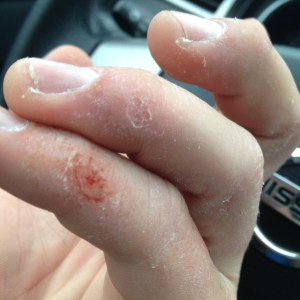
Yesterday, for example, I climbed Heather, 12b trad. Or more accurately I fell off Heather. A lot. After the initial crack things get thin, the protection gets small, and I started flying. I jammed so hard I took chunks out of my pinky and ring finger, left blood in the crack. I eventually pulled through the first crux on gear after repeated whippers on a slotted microstopper. The jams were so painful they left my knuckles aching. Onto the second crux, a series of sport climbing-esque slaps up an overhanging wall above a fixed pin—I backed up the pin with another microstopper, but on my first whip the rock around it blew. The stopper and quickdraw scurried down the rope to my hanging waste. The pin held, so I yarded back up and placed something else nearby. I took a few more whips and then lowered.

It wasn’t that I didn’t have the finish in me. It was that I was finished. I’d hung enough, my head was spent. I was just tired of being scared. I wanted to stand on flat ground. I was over it. I’d failed.

FullSizeRender-1That was yesterday. Two days before I lowered off Confederacy of Dunces, a crimpy “sport climb” that requires as much gear as quickdraws. Earlier in the day I’d fallen off Promise Land, a route I’ve climbed a bunch before.

Before that it was Astroman, the classic Yosemite 11c. I’ve been up there four times with two different partners, and everytime I’ve retreated. Even the Steck Salathe, a long Yosemite 10b, I had to hang on this trip.

Coyne Crack. Sanctuary. Mean Streak. Fat Lady. Flesh for Lulu. Tight Rope. The Prow. Women in Love. White Eye. The last pitch of The Underground. There are more routes out there I’ve fallen on or backed off of than routes I’ve sent. A lot more.

I fail a lot. A lot a lot.

The last few years this has been particularly acute—my drive to push has ebbed and surged in waves. One day I’ll be fixated on a route, and the next I won’t care about climbing at all. Until I’m standing at the base, until the route is towering overhead, I have ZERO gauge on where my head will be.

Yosemite, for example, three weeks ago: I was feeling lukewarm about the huge projects I’d set out for myself, Astroman and a one-day ascent of the Nose. But then we came through the tunnel and I saw the towering bulk of El Cap. We pulled over, parked with the rest of the tourists, and snapped a few photos. I could feel the excitement rising from somewhere deep inside me. Suddenly I was jumping up and down, eyes wide, my hands on my partner Andre’s shoulders. “Let’s do this!” I shouted, energized, alive. “LET’S CLIMB THAT BEAST!”

We didn’t. We failed. We tried Astroman three times but never reached the top. Even climbing the Sentinel was a close one. We never even got on the Nose.

I remember as a beginning climber backing off everything. I could practically downclimb as well as I could ascend; almost every route wound up including a retreat. The first time I tried the Whitney-Gilman Ridge I backed off three pitches up; I had no idea where to go, and I was too afraid to get stranded. I didn’t have the confidence in myself, the sense of adventure required, to continue. It was the same feeling that came flooding back yesterday.

I also remember when I stopped failing, stopped always backing off stuff and started getting to the top. It felt like a victory, a gaining momentum, like I’d crested some hill and the battle that had ragged for years was finally turning in my favor. Call it confidence, call it whatever, but there was a tipping point and it allowed me to start sending. The foundation was built and it was now time to climb.

There is a power in possibility, power in believing in yourself, believing you are successful, can succeed, power in believing the next hold WILL show up, the next piece of gear WILL be bomber. There is Truth in that. And yes, you might get stranded, there may not be any gear, but most times it will work out. Climbing has the power to get you killed, but when you climb with openness and possibility, when you ask the question “How do I use the holds before me?” rather than “When will the holds get good?” the best of us shows. We meet the challenge with our all. And suddenly you find yourself at the top.

But that doesn’t happen every day. Not in climbing, or elsewhere.

I fail a lot. And not just in climbing. I tried writing a book once, a guidebook to Western Maine rock. I never got past collecting topos and building a website. My “career” is a handful of fits and starts, nothing to write home about, a small town writing gig that keeps going with some adventure on the side. And I was married once. That didn’t work out either. Life has a way of handing us failure, adversity, reminders we are imperfect, routes we can’t seem to get to the top of. Our best efforts of the moment aren’t enough to crest the hill. The summit might just be out of reach. Life has a way of reminding us of that.

I failed yesterday. A lot. It came at the end of a week marked by failure, and a trip marked by failure. At the end of a few years marked by failure.

And in the midst of those lessons on failure the failures can compound. They can transform from a single moment to a storyline, from one climb to climbing, from event or sequence of events to a life narrative.

Blah.

But each of those moments are single moments, blips on the screen, instantaneous and individually inconsequential. “Failures” in name only.

As I bailed off Heather yesterday my friend Pat walked past on his way to Airation, a Cathedral finger crack. I’d seen him working the route a year ago, but he’d fallen at the crux.

“I’m getting back on it,” he said. “I’ve still got to send it.”

Not a failure, an ongoing challenge.

Life does a lot of smacking around. It is about mistakes and missteps, confusion and corrections. Climbing is a stupid, pointless way to spend the weekend. And I love it. It has a tendency to mimic the rest of existence, remind us of the challenges we face every day.

Today my fingers hurt. And my abs. I’m thinking a bike ride, or a trail run, fits more than climbing; I’m thinking I need a mental break from falling, fear, and visions of failure.

But yesterday as I walked down the descent trail after retrieving my gear I turned to Nick, my climbing partner. “Thanks man,” I said, “today couldn’t have been more fun.”

He smiled. “Yeah,” he said, “that was awesome.”

Failure can still be worth it.

And I’ll be back. I’ll be up there again, fingers jammed to the bleeding-point, gear smaller than I want disappearing below me. No matter how many tries it takes me it won’t truly be a failure, just an ongoing challenge, just one more route I have yet to send. And there are lots of those. I’ll never send them all.


Tweeting Shrimp

Tweeting Shrimp

IMG_7918-1Last week I wrote a post about chasing snapping shrimp down the Pacific Coast and sent it off into the internet-sphere. The whole piece/story/adventure revolved around a Radiolab podcast on the little crustaceans with the fire of the sun in their palm, so after I wrote it I shot a copy Radiolab’s way just for fun.

AND THEN THEY SHARED IT!!

I love Radiolab. In a world where most science reporting is more about the controversy and who said what about something than on the basic facts and merits of the matter Radiolab brings a sense of wonder to the genre. They tell their stories with nuance and complexity, allowing the pieces of this world that are amazing to stand on their own. (If you want one of the best examples, check out their story The Rhino Hunter, one of the most stunning pieces on the complexity of modern conservation I’ve ever heard.) I wait each week for the next episode to download; their success at telling longform stories in the Twitter Age is remarkable.

So it was nice to see their name tagged next to mine. YEAH!

Chasing Whales

Chasing Whales

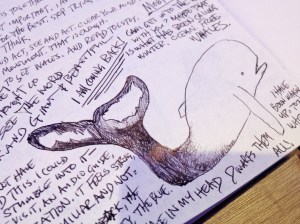
13244231_1490935147599232_2529425574868615330_oI’m not sure how to explain it, but I’m chasing whales.
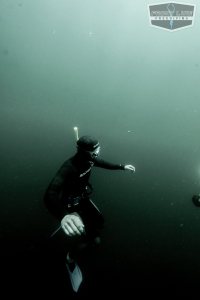
Not metaphorically. Really. I am looking for whales. Everywhere. Anywhere. And when I see them I dive in, swim after them. Follow them down into the blue. No joke. I’ve been training. 🐋

It started in Iceland.

Actually, that’s not true, it started before Iceland. It started last summer. It started in New England.

We were laying around, sprawled on the bed in the middle of the day. “Want to go snorkeling?” she asked.

“You know, I’ve never liked snorkeling,” I said. “I did it as a kid, but I can’t relax. Listening to my breath, all loud next to my ear, I don’t calm down. I wind up on the verge of hyperventilating. I’ve always wanted to get comfortable but I never have.”

She popped up to sitting. “I have masks,” she said. “Let’s go.”

That was the beginning. I have a tendency to run headlong at anything that scares me, and her push was enough. We grabbed wetsuits, masks and snorkels and went to the beach. The water was cold, but I floated around listening to my breath run ragged through the plastic. I calmed my heart, willed myself to relax. Soon we were coursing our way around rock beaches and points, diving down to examine starfish and stripers. The ocean, which had always held a foreboding cast for me, came alive. I was part of it, close enough to touch it. I was hooked.

12961430_1458805094145571_3194725830949882464_oLater that summer we were diving a nearby beach and swam into a shark. A blue shark, nothing dangerous, but it sure felt real as I swam up to him in his territory. In the fall we dove the Florida Keys, where I came face-to-face with a swarm of parrotfish. They looked like a herd of rhinoceroses tromping over seagrass beds; they saw me and parted like swallows, enveloping me. The next day I swam alongside a sea turtle as it made its way over the reef. Two days later on a diveboat, the only two without tanks, we swam with nurse sharks 30 feet below the surface. The ocean’s current had me; it was dragging me down.
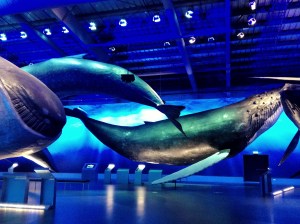
Fast forward to February: Iceland. I had a 24-hour stopover on the way back from climbing in Scotland. I saw it in the Iceland Air magazine, towards the back: “Whales of Iceland. The largest whale exhibition in Europe.”

My head was still in mixed climbing, but it looked interesting. I’d give it a shot, I figured. I had a day. The plane landed and I caught a bus to my hostel. After a shower, a meal and some relaxing time in a bookstore coffee shop I went to bed.

The next day I woke up at 7 a.m. The sun doesn’t rise in February in Iceland until 10 a.m., so I wandered out into the dark. I found a public bathhouse where I relaxed in geothermal water in outside pools. The morning was beginning well.

I plotted my course on a cheap tourist map. The whale exhibit was on the other side of the city, but Reykjavik is small; it took me 30 minutes of walking, buffeted by wind.

I got there right after 10 a.m. just as they opened. The city was bathed in gray, overcast light. The man behind the counter looked up at me.

“You’re the first one here,” he said. “Just go in. Don’t worry about paying.”

IMG_4604Confused, I wasn’t about to complain. I wandered into the entrance, where I met the first of 23 full-sized models of the dolphins and whales that choke Icelandic waters. They were detailed, realistic, hanging from guy-wires, suspended from the ceiling. I turned the corner and the man from the corner came after me. “Wait a minute,” he said, holding up his cell phone. “We just developed a new app, a virtual tour of the exhibit. Will you test it out for us?”

I took the phone without a reply; I was still taking in the massive beluga whale model off to my right. I wasn’t yet ready to answer questions. I hit the play button and began wandering through the sea of mammals.

The tongue of the blue whale weighs as much as an elephant. The heart is the size of a Volkswagen. A sperm whale’s teeth are the size of corn cobs. And I was wandering beneath detailed, full-sized versions, bathed in blue light, listening with a phone to my ear in awe. It felt like I’d stumbled into the real thing, like I’d wandered into a sliver of open ocean. I went from one whale to the next, and slowly they got bigger, and bigger, and bigger, until they were the size of city busses and diesel locomotives. I sat down at the coffee stand at the end, still open to their enormity, and exhaled. They were stunning.

Then I saw it: A virtual reality headset on a nearby table. I walked over and put it on, goggles and headphones both. There were three choices—tropical, temperate or arctic. In each you were underwater, surrounded by whales, and fish, sharks, seals and more. I spent 15 minutes spinning blindly on a chair watching orcas race past me. This. Was. IT. I was chasing whales.

IMG_1043I walked out in a daze, barely remembering to give the guy back his phone. “Come back whenever,” he said.

That’s it. The seed was planted in Iceland. That’s where it started for real. Since then I’ve been watching, waiting for whales. And they keep show up—in conversations about work, in books, tattooed onto the forearms of strangers at the Red River Gorge, along the highway. So I follow them. I trust they are leading somewhere. And I’m preparing to meet them: I took a freedive course in North Carolina so when one pops up before me I’ll be ready. In Moab I swam laps in the rec center pool, holding my breath from one end to the other. I’m going to be ready. When I see one and it dives, I’ll dive with it. They will share their secrets with me. They already have.

If this doesn’t make sense, I know. But I’m following them anyway.