Independent, but…

I was just checking out the Colebrook News and Sentinel to find out what was going on with the explosion that destroyed a gun factory on Friday, and I saw their slogan at the top of their website: Independent but not neutral. I couldn’t agree more. The job of the newspaper is to provide information to citizens so they can better self-govern. The information has to be timely, accurate and without political bias, but it isn’t necessarily neutral. In many arguments someone is wrong. Laying out in print both sides of an argument without first establishing each argument is true doesn’t help citizens make decisions, and it isn’t what papers should do.

Unfortunately for Berlin many of the discussions that dominate the community are not true or false discussions. Was the city better off with the mill? By some measures, yes. Would it be better off without a biomass plant or a prison? In some ways. Is it more important to retain services or maintain the tax rate? It depends on your view.

Those arguments aren’t decided by newspaper coverage. They make it onto the editorial page, but they aren’t matters of fact that make for crisp stories. Ultimately residents have to decide where they want the future to be. At times democracy is a messy business.

Gaining on a year

I’m two weeks away from being with the Reporter for a year. In that time I’ve met a US senator, sat through numerous city council sessions and watched a city change and grow. It introduced me to the North Country, the landscape and its people, which I’ve come to feel connected to because of their willingness to let me in.

I have also come to feel very strongly that this region is ripe for rebirth. It has so much to offer, so much potential, and I feel it isn’t destined to be trapped in the economic condition it is currently.

My wife and I got invited to the Coös Symposium. It will be interesting to visit and talk with other people interested in kick-starting something positive. I don’t really know what to expect, but it should be interesting no matter what.

I’m also working on a side project to raise the profile and the perspective of the region as a destination. I don’t know how it’ll go, but I’m hoping to turn my enthusiasm for the region into tangible economic benefits.

Working in a small city is tough, because the paper is both a critic and a champion of what happens. I am supposed to look over the decisions of the local government and municipality, but I’m also supposed to provide a positive view of the are. It’s a tough balance to strike in a city so small. The year of working has made me feel even more strongly that the time is right for a real push toward change, but at the same time I am trying to watch that change with a critical eye, ready to point out problems so residents can make informed decisions about their self-governance.

I know there are people who read LPJ just for the Laidlaw/CPD debate. That’s only a fraction of the future of this place. In the past year I’ve watched, heard and taken part in hundreds of discussions about the future of the region. There are more forces pushing for success right now than bonds tying the region to failure. Hopefully the last year of LPJ and the Reporter has made more of those positive developments and possibilities clear to residents, who sometimes have more trouble seeing the good than those from away do.

So although it’s a bit premature, thank you for a year, Berlin and Coös County; I don’t see us slowing down anytime soon.

More Site Updates

I got a new photo management system  on here, and a new way to display MP3s. I also did additional revisions to the colors and layout that hopefully no one will notice. It’s all coming together nicely, and now I just need to upload more content.

With town meeting day coming up (not a big deal in Berlin, but in Gorham, Milan, Shelburne, Dummer and Errol, it matters) I’ve been minorly swamped. Plus all the SEC activity has kept me on my toes. I do feel, however, that LPJ needs to be maintained, and so I put in a few hours tonight. I know it wasn’t work on what’s most popular—the blog—but it has to be done sometimes.

Last bit of cleanup that has to happen: the header. The boom pier image is good, but it needs cleaning up. After that I can concentrate on getting more photos, videos and audio pieces up.

Just a brief update. Tomorrow I’m planning on braving the weather over the notch. We’ll see how that goes.

Positivity Projects and Researching Stories

I’ve been deep in Northern New Hampshire lately. Deep enough I almost got lost.

I love covering Berlin and the surrounding communities. It is such a switch from working in other communities, where people barely recognize you the third time you meet them and pedestrians walk down the street with a thousand mile stare.

Coös County deserves better—that’s what a candidate for Gorham selectman told me the other day. I agree, but I’m not sure there is someone to blame for its failings. The industry that supported the community went into decline 40 years ago, and what’s left is the shell that is there now.

But it isn’t just a shell. Berlin and Coös are down, but they aren’t out. My reporting has worked to do two things: inform residents about critical issues and highlight the positive. But there are so many critical issues sometimes it overwhelms my reporting. As I’ve said before, there ought to be a dozen reporters covering just Berlin/Gorham, and then maybe all the news that’s fit to print would get out there.

I’m looking into a side project that might get a bit more of that positive coverage out there. It sounds great to me if I can get it together, and it would create a bit more of the type of stories people always say are missing from the paper. (Honestly, they aren’t missing, but people notice the negative stories and glance over the positive ones. Oh well.)

The future of Berlin, and maybe the region in its entirety, are at a crossroads. What happens if the Fraser mill shuts down? If Groveton doesn’t find something to subsist on? If the economy continues to decline throughout the region? What happens then?

I don’t see that as Coös’ future, however. There are more good developments around the region than bad ones, and the attitude is changing to one of progress. I will admit there are divides in how to move forward, but there is no one who doesn’t look at the current situation and see it as untenable. So what’s next? How can the region stop talking and start moving.

I first thought Roger Brooks was selling a monorail in Springfield (check your Simpson’s trivia if you missed the reference). After listening to him, however, it is clear he knows what he’s talking about. He said the business community needs to take its future into its own hands instead of relying on politicians to do something. After watching the pitched battle that was Berlin’s municipal election, and as I prepare for town meeting day, I couldn’t agree more. Coös residents have to create their own solutions, not just complain about their problems.

And they are. Steve Binette and his family are buying the former Bartlett School to turn into student housing. Talk about members of the community pitching in to resurrect the city. This is exactly the effort the city needs.

I’m working on a project of a similar scale. It will lock me into the region for quite a while, if it happens, and point my energy more directly at changing people’s minds about the county. It would be aimed outside the region, however, rather than in.

If you’re concerned that means I might be leaving the Reporter don’t worry; I have no intention of giving up my fabulous job. I have yet to figure out how this will all work (if it can), but I love the reporting I am currently doing. Think of the project as an expanded, targeted LPJ blog, but with only the good and none of the bad. Normally I would call such a thing Public Relations (shutter), but when the goal is community revitalization and development I can relax the rhetoric. It would basically be finding all the stories I can that are the gems of Coös County, and pooling them in one place. I’m not sure how it will work, but it’s an interesting idea.

In the meantime, there is a lot of political maneuvering and such going on, particularly in reference to energy. There are stories there that aren’t positive or negative but certainly need to be told. I don’t intend to slack off my reporting of those issues. The PSNH/FERC story was a great find, one for which I got several compliments, but that type of reporting is HARD TO SUPPORT. There aren’t the resources around the North Country to consistently do it. Heck, there aren’t the resources around the state or even country to consistently do it. I like that type of research, but I also have to cover every other thing going on in the community, and it takes time. The daily paper runs into the same problems. When it comes to the failures in reporting around the region it isn’t the fault of the reporters; it has more to do with the economic model newspapers are predicated on. Paper just isn’t made in the U.S. anymore, and newspapers just can’t sustain a real staff anymore. Luckily the reporters around Berlin care as much as they do, and they have the support they do from their editors, because otherwise the outlook would be incredibly bleak. Until there is a new model discovered/created/invented it isn’t going to get much better. For now, however, I know the people doing the work up there are doing the best they can with inadequate resources. Sounds like the rest of the region, huh? But like everything else up there, what people get for the money spent is pretty remarkable. Berlin and Coös County aren’t broken; they have a future yet. The papers, both the daily and the Reporter, are going to be more than part of that future—they will be critical drivers of it.
More PSNH, PUC, CPD

and now… FERC!

So I’ve got an exciting piece on PSNH and their efforts at the federal level that CPD claims are intended to circumvent their responsibilities in purchasing power from small independent producers.

It’s all gray area and well worth the read. It gets pretty deep into the nuances of electricity regulation in the US, but it could wind up being rather important to Berlin.

How can a 29 megawatt plant be less than a 20 megawatt plant? When it only generates 17 megawatts. Does that make it a 17 megawatt plant? CPD says yes (sort of), PSNH says no—now let’s see what the Federal Energy Regulatory Committee says.

This was a tough piece, and just the kind I like. It took some digging, and as far as I’ve seen it hasn’t been out anywhere. Both CPD and PSNH were surprised to be talking to me about it and weren’t exactly prepared. It isn’t enough to shake any big apples loose, but it’s the sort of thing the region needs to follow. Informed voters might care about this one.

So what news matters most to you? What is there not enough coverage of? I was talking with some friends about reporting in the region, and we were trying to decide what was lacking most. I said in depth coverage of energy issues would be ideal, from a group with the skill and the knowledge to do it. From transmission issues to taxation, wind farms to biomass—all these issues are going to grow over the coming decades. The two local papers work hard, but they are also covering ice golf stories and the latest Tri-County CAP generous donation drive, with only three reporters between the two of them. What falls through the cracks?

Lots, I’d say, and I imagine most LPJ readers would agree with me. But what is the most important?

I’ve been sick for the entire week, and I’m still trying to pull out of it. I did a fair bit of my work last week, but I’ve still got a story or two to finish before I can go to bed, but I wanted to get the word out that there was something cool worth reading in this week’s paper.

I wish these stories were here every week. I don’t think they aren’t in Berlin; I think the skill to tease them out takes time to develop. I’ve been able to pull together a few of them, but it isn’t a weekly thing. Berlin needs more of this, but to get more of it it needs more reporters. That means a staff that hasn’t been with either paper for years. If there were some other way to get reporters up there to spend time digging around it’d be a gift.

Think about this—imagine you run a 24 hour convenience store, and it’s only you and a partner. Now remember, you need to be there all the time to cover anything that should happen. How do you think that would work?

Doesn’t sound like it’d work great, but that’s what the daily is working with—two reporters. My paper has one, so I’ve got all shifts. Inevitably things fall through the cracks.

With a city as dynamic as Berlin, really it needs more. It isn’t LL Bean, with tons of area to cover, but even a 7-11 requires more than two or three people to ensure the counter is covered all the time.

But the newspaper business isn’t growing, it’s shrinking, and the counter is empty more and more. It’s too bad, because when someones steals a soda, a candy bar, or even the register, it’s hard to stop when you’re alone. In fact sometimes no one even realizes it happened.

I’m ranting. Time to get back to writing for money, not pleasure. Support quality journalism—it makes you pay for your candy bar. And happy Valentine’s Day.

A day of it

Today was a bit of a strange day as a result of the crazy weather. Instead of my normal Monday routine in Berlin I got rained out, only to go to council and put in almost a full day there. Councilors were discussing the rules and policies, which wound up taking nearly three hours. I got home at 11 p.m. and spent another hour writing up the story so it can show up in Wednesday’s paper.

It was quite a show to watch the remnants of the old council and the new members work together. Councilors Robert Danderson, Micheal Rozak and Mayor Paul Grenier dominated much of the conversation early in the night, which pertained to bridge maintenance and sewer construction. Councilor Mark Evans made his mark during the policies discussion, which lasted for several hours.

But then at the end, when Councilor Danderson said he’d like to have one of the councilors who supported writing a letter to the Site Evaluation Committee regarding Clean Power Development rescind their support, the councilors spoke largely in unison. Councilor Lucie Remillard, who I have not noticed to be particularly attached to either the CPD or the Laidlaw camp, said she didn’t want to do anything that might disrupt CPD’s efforts, though the council shouldn’t fight their battles for them. Councilor Evans and Poulin didn’t speak up in favor of supporting CPD’s efforts to move forward without SEC review, but Councilors McCue, Landry, Cayer and Remillard did.

In the end, so did Mayor Grenier. He said he had concerns about the project, but to try to stop it at this point would send an anti-business message around the state.

This is an interesting time for the council—significant transitions all over the place. Mayor Grenier seems intent on running a tight ship, which appealed to several councilors from the last administration. He also made what seemed like deliberate attempts to extend the olive branch. I’m not sure if his comments about CPD count as the latter, or if, as he said, he reached some agreement with Mel Liston of CPD when the two men met on Sunday.

Regardless, I’m interested to see how this plays out. As Councilor Evans said, the clarification of the new rules may be useful when the council gets down to business because there may be a number of close decisions. Keeping to the rules will be key to ensuring residents get the governance they voted for.

LPJ is also on its next step, and I’m hoping it’s a step upwards. I started the blog because I knew I’d need to have one if I ever want a job somewhere else. I don’t want a job somewhere else, but someday I will and now is the time to prepare. Well, the next step after a blog (and a Twitter account) is a website. Check. Granted, I’ve still got more work to do, but it’s passable. I particularly like the header—it reminds me of this great place I go from time to time.

Airless America

Air America, the liberal radio network, declared bankruptcy today. They referred to a “perfect storm” in the media today as part of the cause.
But Fox News, the news station at the other end of the ideological spectrum from Air America, seems to be strong as ever.
This is the second time Air America declared bankruptcy. It led me to wonder if running a for-profit radio station that proselytizes progressive policies is a doomed venture. It’s like the term Communist China; just not quite right. Air America espoused the benefits of government involvement but had none. Unlike NPR, Pacifica or American Public Media, Air America was trying to beat the capitalists at their own game while espousing the evils of capitalism. That just seems like a bad plan—wouldn’t you want to reject the capitalist model if you were trying to engender a more equitable distribution of wealth?
Making money off of conservative politics makes sense—you’re doing exactly what the ideology espouses. Maybe Air America would have had better luck had they stuck to their guns off air as well as on air. The common good, supported by corporations, which could easily become the targets should their business be perceived unethical, seems a shaky foundation.
I’m sad to see another media outlet go down. I wonder if Air America would be in favor of government bailout for itself. How would that affect their journalistic responsibility? If you consider yourself a liberal or conservative news network, do you have journalistic standards anyway? It would be interventionist government, which is what they supported for the five years they were on air.
It’s not that I really ever thought about it before; it’s mostly just food for thought. Wild media world today. Glad I still have my little niche in it.

Haiti Express

So I’ve barely been back a week, and I’m thinking about leaving again. My wife is encouraging me to go to Haiti, to help with the relief effort and to look for stories. I have a contact there who I sent a message, to see if I could help. And I found a $400 airplane ticket, which isn’t cheap but isn’t expensive. During 9/11 and Katrina I considered going to help, but I never got off my butt and went. This time, however, if I can work it out I’ll go. I was thinking a week, but I’ve got to see if I can get the time off.

These last few weeks have been hectic, and I admit I’ve been neglecting LPJ. It took days to resettle after Mexico (including a trip to New York to retrieve the dog from the father-in-law’s house). Honestly, I’d like to just kick into the old Berlin Reporter routine and feel like I’m back in the swing of things, but when a city is destroyed its hard not to notice. It’d be worth another week of minor stresses.

And just as so many interesting things are happening in Berlin. Laidlaw submits its proposal for EFSEC review; CPD gets pressure from residents to do the same. The CPD/PSNH matter should have a next step soon. Fraser is looking for a buyer for the Gorham mill, and a city council transition is about to take place. It’s an exciting time, and I’m glad to be in the middle of it.
I’ve got interesting things going on as well. I’m trying to find out more about that U.K. hero who saved a Berlin resident, so I can put that in the paper. I’m hoping to turn that story into a radio piece as well. I may also do some work for the Maine Center for Public Interest Reporting, which was recently launched to provide investigative reporting for Maine. It a non-profit, and I would get valuable experience digging for stories. That’s experience I hope to transfer to the Reporter. Berlin undoubtedly has a wealth stories that require more expertise than I’ve got, but hopefully not for long.

So my next few weeks are up in the air, but my next few days are not. I’ve got a couple of stories I’m digging into tomorrow, though at this time I’m still looking for more. I have to admit, I still feel out of the loop. The running around all over the place has kept me from sensing Berlin’s pulse. If I wind up in Haiti, it’ll probably be a few more weeks; otherwise it’ll be a few more days. I’ll let you know how things develop and if I’m going. In the meantime, if you hear anything, let me know!

Update: I’ve got the OK from work to go to Haiti. I’m still waiting to hear about some leads there to make it feasible.

Update: I’ve contacted a prominent Haitian from the Manchester area who is going back to Haiti with a small group. He’s agreed to let me come along. I’m still looking for some more contacts to ensure my safety and sufficient material to keep me occupied for a week. Most of the humanitarian groups I’ve heard on the air and on the media are saying they need money at this time, not volunteers, but I’m trying to reach several that are looking for people to go.

Next Step—NYC

I’m trying to improve and expand my reporting skills and repertoire, so I’ve applied to the John Jay College Center for Media, Crime and Justice Guggenheim Fellowship. I’d go to NYC for a weekend, learn a bunch, then come back and do a big story on something related to police and crime. Here’s my pitch, we’ll see if I get it.

Police departments in post-industrial communities

Berlin, N.H., was devastated by the decline of the paper industry, with economic consequences akin to industrial cities in the Midwest. The streets are lined with boarded up storefronts and burned out buildings, and there were 20 suspicious fires last year. Two weeks ago two men were shot during a home invasion; one died. Officers face challenges usually not associated with a community of 10,000 people in rural New Hampshire; challenges they didn’t face 30 years ago, though the city had double the current population.
I will examine how police departments in cities reeling from industrial collapse react to and combat the rise of violent crime as their cities hollow to shells of their former selves.
This phenomenon isn’t limited to Berlin—Lewiston, Maine, two hours east, is on the same river that supported the same industry. It is going through a similar transition, but the transition phase has become everyday life.
Despite efforts to kick-start their economies, the downward spiral continues. Low property values and an abundance of multi-unit properties have made it profitable for landlords to purchase buildings and turn them into slums. The low cost of living entices poor people to migrate to Berlin, or in Lewiston, African refugees to settle. The cities have been changing rapidly, and longtime residents watched from their porches as the transformation unfolded. The police have watched as well.
They are caught in the middle: remembering the old city, policing the new one. They face problems and situations they are ill equipped to handle, with shrinking budgets, changing demographics and limited support. I will report on what those departments do to make up for the shortcomings, and where and how those efforts are lacking.

Sensational News

After a few comments about sensationalism, and then an opportunity for truly sensational reporting, it couldn’t be a better time to talk about the subject.

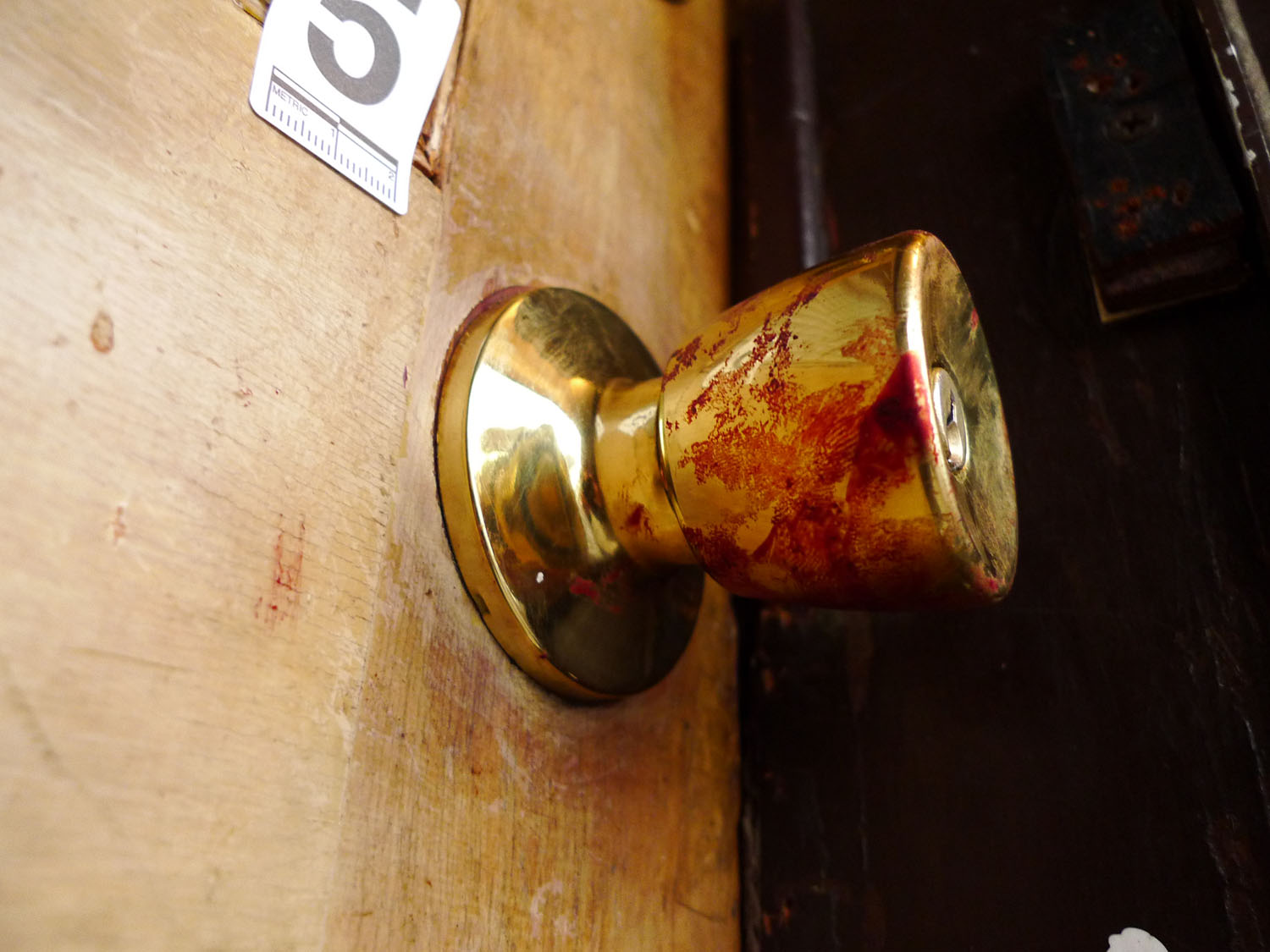
This is a photo of the door knob not at the house on Third Avenue, but at the house on Western Avenue where they found the man now in the hospital. I knocked on the door to see if I could find someone to talk to about the incident on Friday, and then I noticed the blood. Not just on the door handle, but on the door, the floor and the window. It won’t appear in the paper, because any blood is too much for a local weekly like the Reporter, but it’s worth posting here for discussion.

What level or “right to know” do people have? What level of self-censorship should papers exhibit? A dead body would never make it into the local paper, but there are heated debates about publishing photos of caskets returning from Iraq and Afghanistan. How are those discussions separated? Should they be? The funeral for man who was killed is today, and many papers would expect at least a photo. Is that appropriate? How do you react when you see something like that in the paper?

I have no interest in covering shootings. I love to follow the debates and politics, the policy discussions, and tensions between opposing sides in any forum. It is fascinating the agreements people reach, particularly in a small community, because, as one local public official told me recently, the person you are shouting at during a council meeting might be up pulling you out of a ditch the following night. This is an environment ripe for compromises.
Those debates are an integral part of reporting. They are the essence of politics, and I’m always psyched to cover them.

But then someone gets shot. I am the person covering Berlin for my paper, so of course it is my story. I was knocking on people’s doors at 616 Third Ave. in the rain on Friday, thinking how glad I am this is a rare occurrence in Berlin. I heard facts and details that won’t make the paper, and really don’t need to. What is the public’s right to know in this regard? Why do people care about? As a reporter out asking the questions, I had to wonder.

But as a consumer of news, I want to know what is going on. The incident that unfolded in Seattle yesterday, for example, is powerful and nationally significant, and I hope reporters don’t stop covering such stories. Maybe it’s just the wrong beat for me—I know lots of people who dread sitting through a planning board meeting.

I can’t affect any meaningful change by reporting on the shooting, and so I have trouble seeing the value in my doing it. It isn’t like it’s maintaining the press’ watchdog role to find out who shot who. No additional information about the gunshot wounds or the assault the preceded the shooting will do anything to keep a 23 year old man from having died on the street. The social pressures, the economic disparities, the societal influences that led these men to invade a home interest me; the direct result of the incident does not. Reporting about corruption or starvation or war, where someone can still do something to make it better makes sense to me, but it’s hard to see how this story will help people avoid a similar fate.
Other reporters don’t share my view on this. I heard one colleague got a phone call from a friend congratulating them on covering their first shooting. That would be a call I would not take.

City Manager Pat MacQueen compared Berlin to Mayberry several weeks ago. It’s ironic that so soon afterward there is a shooting that leaves one dead and one in the ICU. How is the local paper supposed to cover that? How is it supposed to tiptoe between the good and the bad in a community?
Berlin has lots of both. I’m constantly impressed with the city’s ability to rise above the devastating circumstances surrounding it, but at the same time I can’t ignore or stop reporting the bad. I would rather be covering the opening of ATV trails and new businesses than covering shootings, but I would be remiss if I did only one or the other. I’d rather be following the debate in city hall than avoiding the blood on Western Avenue.

So what is sensational? What is inappropriate? If some people want to know, and some don’t, who should the paper cater to? Normally these would be editorial decisions I wouldn’t be involved in, but because the Reporter is so small they are part of every story I cover. While most people will agree there is no value in a photo of a blood-stained door knob, what is the value of a story about incident that left the stain? How should the paper cover it? If it humanizes the people involved, does that treat ignore the crime they were attempting to commit? How do you tell the story of the life of the man that was shot to death when committing a crime? People sent flowers to his funeral, so some people obviously still care about him. I find it hard to believe anyone is all bad, but how do you do justice to all sides? How can a paper navigate those treacherous waters?
Those questions ought to be above my pay grade. In a small community like Berlin, however, they aren’t. The questions aren’t sensational, and the answers aren’t easy.