CDS Column: Constitutionally Speaking

CDS Column: Constitutionally Speaking

6f8cf-rustIt’s happened again: Another shooting. In Orlando this time, 49 victims plus wounded.

And in the aftermath we fight. Among friends, countrymen, the arguments begin. It didn’t take a day — 2 a.m. shooting, lines drawn by sunrise — that is America.

We are a nation trapped by ourselves.

Omar Mateen was an American Muslim, a U.S. citizen of Afghani roots inspired by foreign extremists to buy guns legally and turn them on gay nightclub goers. In one hateful rampage Mateen put himself into the center of multiple American tinderboxes — immigration, religion, guns, foreign wars, terrorism, homosexuality. If his attack was an act of terrorism it was one well-aimed — these issues we willingly tear ourselves apart over. His spark hit its mark, and it was more than enough to ignite an explosion.

But that is where America is today: Ever ready to draw swords. Fight-or-flight is now our political status quo, and over and over again, America’s choice is to fight, especially among ourselves.

But where does that get us? What kind of country is left when every debate turns brutal? That is our habit, but how do you govern from a never ending cage match?

Take guns, for example, that tinderbox among tinderboxes. What is the appropriate gun policy? Is the current level of regulation enough? Too much? What does the Second Amendment really mean? How does “a well regulated Militia” play into “the right of the people to keep and bear arms,” a right that “shall not be infringed”? How does that fit in the era of the Glock and the AR-15? Is it still relevant?

These are reasonable, basic questions, the sort of conversations that should be raised in the halls of Congress after such an incident as Sunday’s attack. Any modern state would consider such questions foundational to finding a balance between the rights of citizens to own guns and the rights of citizens not to be killed by them.

But we have no such discourse. Opponents of guns declare there is no legitimate use for an assault rifle. Ardent defenders return to the “cold dead hands” refrain. Instead of an articulate conversation on gun policy we are fed campaign slogans. The conversation inevitably goes nowhere.

Two hundred and thirty years ago, the Founding Fathers banded together “in order to form a more perfect Union, establish Justice, insure domestic Tranquility, provide for the common defense, promote the general Welfare, and secure the Blessings of Liberty to ourselves and our Posterity.” This sort of squabbling is not what they meant.

But in America today conversations go nowhere. The greatest country in the world, we can’t talk about our problems. We can’t discuss what is killing our citizens. We need a frank discussion on guns, gun rights and the appropriate balance between individual rights and collective security, but all we get are shouting matches and campaign slogans.

This is one issue. There are more: immigration, terrorism, religion. Mateen touched on many of them. But there are still more: abortion, economic stratification, race, gender equality. These are the tinderboxes that tear America apart, and they are also the issues too tender to address directly and with grace.

They are issues close to our hearts, ones we have stared at too closely for too long, and now all we can do is fight over the details. We measure our progress in battles but have forgotten the point of the war.

And what is the point? “To form a more perfect Union.” To “insure domestic Tranquility” and “provide for the common defense.” To “promote the general Welfare,” to “secure the Blessings of Liberty.”

But what good is liberty when Muslim Americans are killing gay Americans in American streets, and no one is willing to talk about it?

Shout about it? Sure. But not talk.

We are a nation populated by rugged individualists grown too independent to govern ourselves. The general welfare and the common defense are concepts alien to us. We are left with 330 million different burning visions for America that struggle against each other.

Maybe it was always this way. Maybe we have always shouted past each other. Maybe the common defense was never that common, the general welfare never that general. Maybe when the Framers who wrote the Constitution 230 years ago did it it was with a smirk and crossed fingers. Maybe those opening words were window dressing.

But men who conjure a country from thin air aren’t the sort to shy away from tough conversations. Our Founding Fathers knew the importance of discourse, of disagreeing agreeably. They fought, but they did so with a shared goal: “in order to form a more perfect Union.”

Where has that spirit gone? Where is the sense that America is the sum of its parts, and those parts are myriad. This country needs room for ideas, room for discussion, and debate and disagreement safe from being declared tantamount to treason. The problems facing us are global, and in an interconnected world, damage is never isolated. A shooting in Florida sparks fear everywhere. The tinder will light. No one is immune.

Yet we stand by our individualism as it kills us. And all the fires Mateen so efficiently set around immigration, religion, guns, foreign wars, terrorism and homosexuality, they remain burning. To be defused and extinguished will require thoughtful consideration, citizens and legislators working together to hammer out compromises that navigate a sea of conflicting tensions: security versus freedom, security versus privacy, individual rights versus collective rights, religious freedom versus personal freedom. All in an evolving world, where terrorism is the new communism and the new terrorism is only a matter of time.

To do that we have to start talking, we need to be willing to ask hard questions. Of each other. Of all of us.


This piece appeared in today’s Conway Daily Sun.

#RoadLife

#RoadLife

13458592_1515161745176572_1345580628585994972_oHow do you let go of control?

How do I let time become an ocean, trust its buoyancy, its random eddies, breezes and currents? How do I swim with them rather than against?

On Friday I caught a plane out of Fort Lauderdale at 8 p.m. EST. I landed in San Fransisco at 11 p.m. PST with the salt of the Caribbean Ocean still in my hair. I grabbed my car, which a friend had just driven from San Diego to San Fransisco on her own adventure, and drove to another friend’s house who had sent me a note a month before after 10 years of no connection. Barely a few hours before I’d been on a diveboat with two other friends, one new-ish, one brand new, who welcomed me to join part of their roadtrip from Maine to Colorado by way of the Florida Keys. We rented a houseboat, spent mornings practicing yoga on the roof deck, paddled kayaks and paddleboards into the gulf, shared conversations and splendid silence.


Life did that. Life brings magic. It brings connection and friendship and splendid moments. It brings awe and mystery and graceful elegance. This week I got to see it, first in the burning oranges of a sunset, then in the wings of a ray, and again in the smile of old friends.

People ask me about being on the road. “You’re living the dream,” they tell me. That happens a lot.

Whose dream? I often wonder. There is an aloofness, a loneliness to endless travel. There is tremendous emptiness, moments of overwhelming quiet no amount of Facebooking, texting, singing to the radio or laughter can quench. Over miles of stretching blacktop, or waiting at airport gates, or sick in a hostel surrounded by no one you know, the inherent solitude of life comes calling. It’s possible to drown it for a time, maybe with a random conversation, a run, someone else’s warm body for a night, but it comes back. It keeps coming back.

It comes back at home too, but at home it’s possible to pretend you’re building something, that all your running in place is working towards an end, that the empty quiet is outside, has not found its way into your heart.

On the road, however, it’s different. On the road you are bouncing, caught looking for flashes of beauty and moments of connection. There is no keeping out the quiet. It floods in, and you accept the drift of time, the buoyancy of life, trust it to carry you.

And in letting go, the world reveals itself. It reveals both the loneliness, the sadness, and the light. Everything exists in one place. It is overwhelming, painful even. Unsteady. Long.

“Living the dream,” they tell me. I’m not so sure. Their idealized vision of a life unsteady forgets the costs of carefree. It is a practice of accepting constant discomfort, accepting always not knowing. Just like their lives, mine is beset by fears, only different fears. Will the money run out? Will the next opportunity show up? Will I find a place to sleep tonight? If it is all a dream, it is a confused mess of one.

But it is one brightly punctuated, one so full overfull of emotion at times I wish life was a ride I could pause. Nights can be dark and overwhelming, but they can also be stunning, technicolor, so bright it is nearly unbearable. The richness I find over and over again, the connections I make, the fascinating complexity of the world I am lucky enough to bare witness, these are the gifts of living unstrapped, allowing the ocean of the world to carry you, allowing time to sway as it will. Seldom is this existence dull. Life on the road is raw to the quick, and every step is an experience. The only choice is to let go, to release myself into the stream and see where it takes me. Anything else would leave me drowned.

And maybe that is the dream—a life of feeling, even if the feelings run dark at times and always out of control—for all those people leading some different version. I don’t know. I look at my friends homes and growing families and I see the dream there too. A piece of it, at least, an experience punctuated by beauty. The differences between us, between their lives and mine, are few, maybe none. An illusion, perhaps, a dream. The one we are all living.

The Project Stands

The Project Stands
IMG_6736
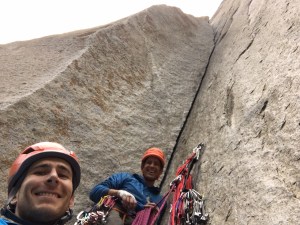
Andre and I below the Enduro Corner.

Not every project goes down easy.

Sometimes a route takes two tries. Or three. Sometimes more. Sometimes it’s days, or weeks, or months.

Then there are those that take years.

I remember the first time I read about Astroman. I was 19, only a handful of leads under my belt. I’d never been to Yosemite, or anywhere really. I’d grown up climbing on scrappy crags on the coast of Maine, made my way to the Gunks and Adirondacks and now was out in Colorado for my second try at college. But the plan was really to climb—Eldo and South Platte rock, ice in Ouray and Vail. School was an excuse to play in the Rockies.

That’s where I first I read about it, “The best rock climb in the world.” 12 clean, hard pitches up the steep east face of Washington Column. The Enduro Corner. The Harding Slot. First ascent by the Stonemasters. Freesoloed by Peter Croft. This was the land of legends.

I, meanwhile, climbed 5.8. I carried around a rack of hexes like cowbells, and if there wasn’t some kind of sling running bandolier-style across my chest I wasn’t leaving the ground. My rope had never seen a leadfall. Astroman was a dream, a myth shrouded somewhere in the distance. I had no idea what such a thing truly meant.

15 years, however, has a way of changing things. Some projects, afterall, take years.

My first swing at the legend was six years ago. My partner Jim was an old school hardman, the kind of guy you want on an over-your-head mission. I’d climbed a lot of Valley moderates, long free climbs up to 5.10 or those with short 11 cruxes, and put few walls under my belt. Now I wanted the prize.

We warmed up, got ourselves reaquainted with the physical nature of Yosemite climbing, and then got on the Rostrum, the supposed training-wheeled version of Astroman. The route went, with Jim and I onsighting pitch after pitch of perfect crack. The 11c crux fell quickly, a few pulls on fingerlocks. The only ugliness came on the offwidth, which I grovelled up pulling on cams. It was a good reminder that in Yosemite the wide is often the crux.

We topped out and over pizza made plans for the main event: rest, then Astroman.

If only things always went according to plan…

We started early knowing the route might need a long day. Jim strung together the first couple pitches. Soon we were below the Enduro Corner, a shimmering dihedral of overhanging thin hands. I racked up.

It started well, I felt solid on the jams, stuffed gear as I climbed. But the Enduro doesn’t relent: 40 feet later I was still in small hands, then still 30 feet after that. Then it pinchs down. The feet were small, the rock so clean it felt like glass.

I fell. I fell again. And again.

Soon I was aiding, so gassed I could barely bare to shove my fingers into the crack. I was miles from the anchors. I shouted “Take!”

Make a move.

“Take!”

Make a move.

“TaketaketaketakeTAKE!”

And again. And again. The pitch felt went on forever. Barely a jam or a stance revealed itself anywhere.

Astroman. The stuff of legends.

By the top I was dry-heaving, my skin was in tatters. My tremendous rack was gone. I built an anchor and just sat down, dejected. This would not be the day.

When Jim made it up he looked at me. “Let’s do another pitch or two and get out of here,” he said. I nodded, still too tired for a discussion. We climbed two more pitches to the base of the Harding Slot and bailed. The greatest rock climb on earth would have to wait.

Fast-forward six years: February 2016. A group of friends are planning a climbing reunion. We met climbing in the Caucasus Mountains of Armenia and Georgia, and now our Armenian host was coming to the States to sample American rock. I called my friend Andre: “Yosemite. Will you meet me? I want to climb Astroman.”

It’s funny how an idea can endure, how it can stick in your brain through tremendous changes and come out unscathed. Barely out of high school, more a hiker than a climber, I first fell across Astroman, printed myself a rudimentary topo. Now 15 years later, just off trips to Cuba, the Caucasus and Scotland, I was itching for another swing. This, I figured, was my shot.

13173571_1482271455132268_4317104870608104184_oWe met in Indian Creek, started the tour with sandstone splitters. From there I took a detour to Castle Valley and a quick run up the North Face of Castleton, then on to Red Rocks, where the Armenian (his name is Mkhitar, which he helpfully shortens for Americans to MAH-heek) and I ran up the nine-pitch Texas Hold Em. Things felt good. Astroman was waiting.

But the Valley is not the desert, as Yosemite would soon remind me.

We crossed through the tunnel into Yosemite Valley at midday. We were packed and ready: I wanted a shot at figuring out the Enduro Corner moves, to treat it like a sport climb almost, so at 2 p.m. we started up.

It was hard, but not impossibly hard. I found feet, and rests, and places to jam. But I still took. A lot. The pitch would go, but it would be no easy feat.

The next day we came back, Andre wanted his shot. We were fired up for the top; after the rehearsal the day before we thought it might go. But it was to no avail. The Enduro spit Andre out, left him as smoked as it had left me. We climbed to the Harding Slot and descended.

No big deal. We had time.

13131031_1484702884889125_5028181883377873951_oA few days later we were back. We eschewed the second rope, got an early start, sprinted up the first few pitches and were soon looking at the Enduro once again.
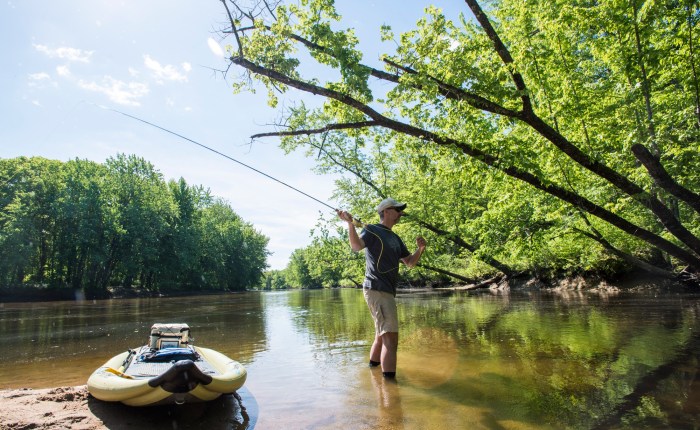
“Go,” Andre said. “You’ve got this.”

I started up. The jams felt solid. I dropped in a cam, climbed, then dropped in another. I punched it, placing less than I’d like but enough to be safe. The clock was ticking. The first rest was 40 feet up, a handjam with a stem. I had to get there. So I went.

Over our repeated missions I’d discovered enough jams of substance to know I could hop between. It meant running it out a bit, but cams in amazing granite kept it safe. I jammed, placed, then punched it. Again. And again. Soon the end was in sight.

Then my foot popped. I was off, flying through the air.

“CRAP!!” I yelled as the rope came tight. “I wasn’t even pumped!”

It was a lie, I was pumped, but I wasn’t out of gas. Inattention that caught me, poor technique, not a lack of forearms. I yarded back to my last piece, got back on route and climbed to the anchor.

Andre was next to me a few minutes later. “Well,” he said, “what do you want to do?”

“Keep climbing,” I said. “I want to send that pitch, but we might as well keep going up.”

The fall, however, broke my resolve. We climbed to the Harding Slot, which I started up, but when things started turned physical I backed off.

“I want to send this thing for real,” I told Andre back at the anchor, “not hangdog my way up it. I want to go down and come back later.”

“Later?” Andre said. We had one day left, and neither of us would be in shape for another go tomorrow.

But some projects take days; others, weeks; others, months. And some last years. The best climb in the world would have to wait.

“Later,” I said threading the rappel.

13116472_1487458877946859_7391871088256538032_o


This piece appeared on the Trango website. Trango generously supports my climbing, so please check them out, buy their gear.

A Collaborative Dance

A Collaborative Dance

Moz-1020781Nothing gets accomplished alone.

We are a country of rugged individualists with celebrity dreams. We dream of making it big, succeeding, pulling ourselves up by our bootstraps, a metaphor that indicates we can create our own salvation.

But nothing happens alone.

I have amazing friends. Some are climbers, adventurers, others photographers, videographers, others writers, teachers, environmentalists, businesspeople. Massage therapists and waitresses. Nurses, engineers and retirees. Together they make my world.

I have big ideas. All the time. Once I came up with writing a book. It died on the vine. Once I tried to fly to Haiti after the earthquake. That didn’t go anywhere either. Another time I came up with another book idea. It ended the same place as the first. All of these were ideas I took on alone.

Once I had an idea to go to Iraq and work as an embedded journalist. This idea I shared with a friend who also happened to be the news director at New Hampshire Public Radio. “Alright,” he said, “let’s make it happen.”

Three months later I was flying into Baghdad, utterly terrified about what I’d gotten myself into.

But I wasn’t alone. That made all the difference. Three weeks later I flew home having done what I set out to do. Nothing else compares to that.

klementovich-20160531-_JCK2368A few weeks ago I came up with an idea. It’s an idea bigger than I am, one that has to do with writing, reporting, adventure, the environment, the future of the Earth and the human race. It’s an idea I don’t want to let go of, one I don’t want to die like so many ideas before it. It’s an idea I need help with. So while it was still fresh, instead of rushing headlong into it I did something simple: I picked up the phone. I called my friends.
My friends can do anything. I watched them climb mountains, write books, build rock gyms, start photography businesses, start nonprofits, reinvent themselves and then reinvent themselves again. I’ve watched them change the world. I’m lucky to have such friends.

But I never understood how they did it. I always looked at my efforts, looked at my ideas, how quickly they withered, and wondered what they knew that I didn’t, what they had that I lacked.

Then one of them asked for my help. She had an idea, a project bigger than herself, something involving climbing and mountains and scientists and conservation and a documentary and college kids, something overwhelming and beautiful. She asked for my help, and then she asked for help from everyone who would listen. And the project grew. It built speed, became something real, took off. There were setbacks, but she kept pushing. It was a beautiful, inspiring dance, one I was honored to have a hand in. It was so big, so complex and powerful and challenging and different, I couldn’t understand how she kept it all going. But then I realized: she asked for help.

Want to do something amazing? Don’t do it alone. Share your idea. Trust it with people who inspire you, with people whose vision matches yours. Let them water it alongside you. Loosen control. Let it see where it takes you. You will not be disappointed.

I am making phone calls now. And my friends, those people capable of doing anything, are answering. It’s almost as inspiring as my idea. Maybe more so.

King of the Reef

King of the Reef

image1I didn’t expect much.

I left on the 1 p.m. boat. The captain had warned me the waves were up, that it would be a bit rough for snorkeling. “Everyone else will be underwater,” he said, “but you might have a hard time.”

But I wanted to go anyway. I’d come to dive, and day one had already been too windy. I figured I could handle a little chop, so I climbed onboard alongside 25 other passengers.

But they were different than me—each one had a wetsuits, rebreather, buoyancy vest, mask, fins, dive computer, camera, seemingly everything. Mountains of gear lined the benches, stacked next to silver airtanks. The hiss of venting tanks filled the air. A teenager struggled into his neoprene. A middle aged women fitted her buoyancy vest.

I took a seat and opened my book.

“Life is a peephole, a single tiny entry onto a vastness—how can I not dwell on this brief, cramped view I have of things?”

– Yann Martel, Life of Pi

The boat roared to life.

“You’re not getting dressed?” the woman next to me asked.

I looked down at my chest and scanned myself all the way to my feet. I was wearing nothing but swim trunks and flip flops. I looked at her. “It doesn’t take much,” I said.

“But aren’t you diving?” she said.

“Yes,” I said. “Or, no. Not scuba diving.” I pointed to my hat, a souvenir from my course in April, Frontline Freediving smeared across my forehead. “I just need a mask, snorkel and fins. I won’t be long.”

She blinked. Paused. “Your snorkeling,” she said matter-of-factly.

“Something like that,” I said. She smiled. I went back to my book.

Something like that.

When the boat slowed everyone started their final fiddling. I didn’t. I grabbed my mask, tucked my fins under my arm and walked to the back of the boat.

“You’re ready,” the captain joked.

“I am,” I said.

“Pool’s open,” he said, smiling.

I jumped.

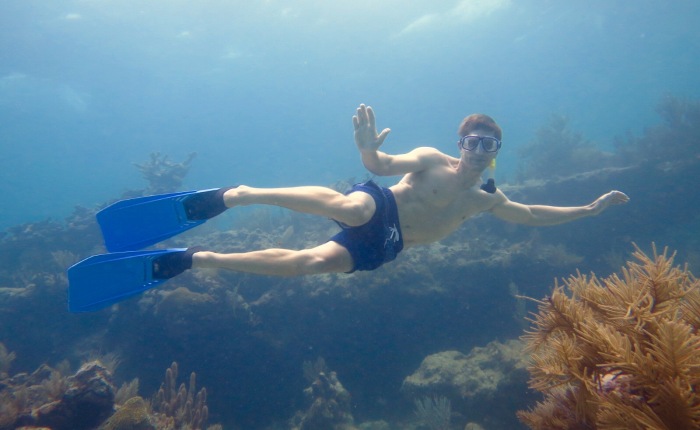
The water was warm, 82 degrees, felt almost bathwater. Fish hung lazily beneath the boat. Sand sparkled 30-plus feet below. Ridges of coral meandered out like starfish arms. I kicked, letting my fins carry me.

The divers slowly made their way in after me. They descended to the floor, casting of long streams of bubbles. I hovered above, letting the air trickle over me, caress me, the photo negative of a shower. I breathed deep through my snorkel, feeling my pulse slow. Then I flipped, kicked and dove.

The act of freediving is built on the first word: FREE. There is no tether, only what your lungs can handle. It is light and fast and peaceful and silent. The scuba divers cross the ocean floor like SUVs, exhaust spewing skyward with every breath. I float silently. It is beautiful.

Three other divers saw the manta. I had just dove, was aiming for the bottom, when a shadow passed overhead. A big shadow. I turned. A kite the size of a coffee table with a mawing hole for a mouth glided by, beating giant wings as he went. Remoras clung to his underside. I froze. My camera was in my back pocket. I fumbled for it as he arced past me. I beat my legs to get astride him, but the great waves of his body sent him slicing through the water at a pace I couldn’t match. I let go of the idea of capturing him digitally; I wanted only to see him, to behold his magnificence. He looked like a king inspecting his subjects below, attended to by two courtiers. He paid no mind to me, just kept flowing.


I returned to the surface. I have no idea how long I was down. But my heart was pounding.

The dive continued. I was up and down, up and down, for two hours, saw a black-tipped shark, a nurse shark, a young sea turtle and several lobster. I saw thousands of beautiful, graceful, brightly streaked fish, and corals of every shade. It was all amazing. And the manta had inspected it all.

I came you at the end, last to climb the ladder back to the boat. I was covered in goosebumps, nearly shivering from diving to the cold waters of the deep. One of the divers looked up at me as I boarded. “Are you the freediver?” he asked.

“Yeah,” I said.

“I got a great shot of you.”

I smiled.

Gulfside Fire, Light and Life

Gulfside Fire, Light and Life

IMG_8066We pulled in after dark. A burning orange sun had plunged into the Gulf, streaking clouds red and purple and gold, and now the sky was a cool bluish-black. The night was warm and wet as lion’s breath. A stiff wind blew palm fronds skyward. Waves slapped the jetty. Our houseboat, Lil’ Bamboo, sat rocking at the pier.

“It’s perfect!” Sineah said. “I call the hammock.” Bethany laughed. We all went inside.

The ceiling hung low but the cabin was spacious, with three beds, a small kitchen, a bathroom and good air conditioning. One bed sat tucked under the helm. “I feel like Harry Potter,” Bethany said crawling in. Another hung in the back; I took that. Sineah claimed the third, a deep bench couch that served double duty. Our host showed herself out, but not before pointing to the roof deck: “Best sunsets in the Keys,” she said.

The three of us made our way topside without a word. Waves licked the hull 10 feet below, pushed tall by the breeze. We sat quietly, a bamboo awning overhead surrounded by miles of Gulf sky. Sineah was right: it was perfect.

The next morning the stiff wind held. I called a dive company to ask about going to the reef. “Anyone who takes you snorkeling today is just stealing your money,” the man said. “It’s three-to-four foot seas, far too rough for snorkelers. Tomorrow will be better.”

I hung up the phone and looked outside. Even here on the Gulfside there were whitecaps, I could imagine what things would look like offshore. But I was here to dive. The whitecaps outside didn’t look imposing, mild chop, so I grabbed my fins and mask. “I’m going in,” I said.

“I’m going with you,” Sineah replied.

Sometimes wildness seems far away. Sometimes it lives at your doorstep.

I waded into the water, fins tucked under my arm. The bottom was sandy, but soon it turned to seagrass filled with upside-down jellyfish. I would need to lift my feet and be swimming before I got to the grass, even in water barely waist-deep. I spit in my mask and rubbed it around the lenses, then pulled the mask over my head and put the snorkel in my mouth. Sinking into the water I pulled the fins on and set out. Sineah followed close behind wearing goggles.

We swam. 40 feet from Lil’ Bamboo was barely eight feet of water. The seagrass swayed everywhere, festered with bottom-dwelling jellies. Parrotfish jetted about. We dove and resurfaced, dove and resurfaced, exploring the world beneath the waves. Anemones hung from pilings and drowned mooring buoys, two-foot barracudas lurked nearby. Even here there was much to see. I held my breath and dove, clearing my ears as I sank, awash and floating in Caribbean warmth.

That’s when it came: dark, the size of a small grizzly floating just beneath the surface—a manatee, mere feet away. His face looked like a bulldog, nose pressed too close to his eyes. He flaunted a disk the size of a large pizza for a tail. It swayed up and down like a tremendous wave propeller. His body, both fat and sleek, glided. I saw him first, but Sineah was right at my side. I let out a shout through the snorkel, a twisted version of “OH MY GOD!” His head hovered a few inches from the surface as he drifted past, an underwater ghost. Nothing so ungainly ever looked so graceful.

I did not follow him. He moved peacefully, and I didn’t want to disturb him. He disappeared into the inky distance. In his wake the water seemed quieter.

“If you want to see wildlife, it is on foot, and quietly, that you must explore a forest. It is the same with the sea. You must stroll at a walking pace, so to speak, to see the wealth and abundance that it holds.”

– Yann Martel, Life of Pi

Sineah and I kept swimming, kept poking around for more, waiting for another encounter with such a majestic sea mammal. But the show was over. We worked our way back to the beach. Climbing out I pulled my fins off.

“What time do you think it is?” I asked, spitting out my snorkel.

“I don’t know,” she said, “maybe 9 a.m.?”

Morning of day one. Welcome to the Keys. ⛵️

Storms, Rays and Cyclones

Storms, Rays and Cyclones

IMG_7875The ocean hides amazing things.

I grew up on the ocean. As a kid I spent my summers playing among schist outcroppings and granite boulders on the coast of Maine, hopping from rock to rock and splashing in tidepools.

In middle school, however, my relationship with the ocean changed: I got my lobster license, a dingy and a handful of traps. A 10-year-old kid, my working days began early, often before sunrise. I would row around, hand-hauling traps off the stern, collecting lobsters, rebaiting as I went.

It sounds idyllic—summer sunrises over a glass-calm ocean—but to middle-school-me it was not. It was hard work, and I didn’t really know what I was doing. I remember finding out I’d brought in several lobsters that were just under the legal limit; I didn’t understand at 10 that “close” didn’t count in measuring shellfish. No one had gone over it with me step by step. I had a boat. I had traps. But when it came to the details, I was on my own.

Everybody has to muddle their way through youth somewhere. Much of mine was done on a lobster boat. The fish oil would permeate my skin, causing my hands to swell then the skin to die, peeling off in long strips. Back at school each fall I would have to explain why my hands were shedding. I spent off days working sternman (think “lobsterman assistant”) for a friend of my stepfather’s. His name was Earl. He was older, groaned every time he had to sit or stand, but he was kind, loved to tell jokes.

He also loved cheap cigars. And his black lab came fishing every day. I spent 1o hours a day filling baitbags with dead fish, breathing a combination of them, diesel fumes and cigar smoke. It was enough to put me off the ocean.

That was when I was 15. Almost 20 years later, after two decades spent among mountains, the call of waves came back to me. The space I needed from water was over.

Then last week I came across this:


I spent my youth at the ocean’s edge, whether that was at the shore or the surface. But of late I’ve been looking below. Or more accurately, within.

Today I fly south to spend more time within: the Florida Keys. I’m headed there for four days on the water, in the water, within the water. My blown eardrum is hopefully healed, and the third named storm of the Atlantic hurricane season is hopefully going to blow out to sea, leaving the water calm enough to enter. We’ll see.

But a dream of mine is a cyclone of another kind: the one of manta rays pictured in Peschak’s talk. That is a rekindling of the oceans draw that might leave me spinning, but this time I wouldn’t object.

Next trip. Or soon at least.

5 a.m.

5 a.m.

13403970_1509050489121031_6107610005133950721_o5 a.m. The wind and rain from the night before had died. Low tide would hit in an hour and a half, the same amount of time it would take to drive to Higgins Beach.
“The waves look better tomorrow,” Nick told me as we pulled off our wetsuits. “Want to come back?”

I did. We’d spent an hour in the Maine water, riding small waves and slicing across foam. It was the kind of day that leaves you smiling after weeks away, but also the kind that leaves you wanting more.

But the ocean heard our call: the remains of Tropical Storm Bonnie, the second named storm of the season, were still churning the North Atlantic, throwing waves due to hit Northern New England the next day.

So this morning, at 5 a.m., I woke up. I rolled out of bed, pulled clothes on (no need to shower when the first appoint of the day is an ocean), grabbed a biscuit and orange juice carton and started driving.

“Morning,” Nick said, still in need of coffee. “I looked at the webcam. It’s a bit mushy.”

“The tide just switched,” I said. “Maybe it’ll be fine.”

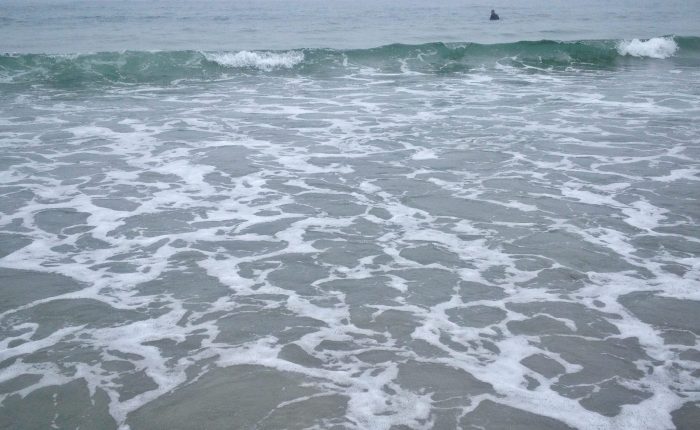
We shoved boards and wetsuits into his SUV and drove the last leg to Higgins. It was still early. A grey light hung over the ocean, clouds unwilling to abandon the morning turned the water dark. Waves barreled toward shore in haphazard fashion, smashing and grinding into each other.

“Oh, this should be fun,” I said. Nick sipped a coffee from Higgins Beach Market .

We parked, suited up and headed for the water. There were a dozen surfers in already. I strapped on my leash and headed in. Nick did the same.

When the first wave hit, a wall of foam and white, it pushed me off my board, spun me and slammed me down. Then another. And another. My board, too big to push under the surface, became a launchpad with each blow. I gasped for breath, regrouped and paddled as best I could, but there was always another wave, and then another.

I watched Nick flip and go under. A wave slammed his overturned board. He popped back up, paddling hard, water churning around him. He got slammed again, but he kept pushing. He was making it out. I was not. Another wave-wall came, pushing me back further. The next one flipped me. I groped for my board, gasping for breath. Then another came. Then another. My arms were left slapping at the water. I was barely moving. They kept coming in fast and from every direction, spilling into each other. I wasn’t making it, the wall had me. So I turned.

It’s a strange thing, giving up. It makes sense sometimes, like when your breath is slowly running dry, but it doesn’t feel good. And if you don’t keep diving into unknown challenges it’s easy to forget what it’s like. In rock climb I don’t often back off a route without at least an honest try. But surfing isn’t rock climbing, and “honest try” means different things in different places. The ocean is something I know far less about. This wasn’t the mountains, wasn’t the dance of movement over stone. So I turned around.

I caught the whitewater of the next wave and rode it in. I was on the beach in seconds, still panting and heaving from the effort. I turned around and watched the surfers in the distance rising and falling, rising and falling. Nick was among them.

Sometimes the waves are just too big. But there is something wonderful in stepping up to the plate at a new challenge, something special in trying while not knowing. When the dance is not endlessly rehearsed there are bound to be failures. I sat on the shore watching the churn.

Then, as I looked out, a pattern emerged. The waves to the right were breaking in chaos, but to the left there was less white, less overlap, not a gap but more quiet. It wouldn’t be enough for an unobstructed paddle, but it offered one with fewer hammer strokes. I kept watching to make sure I wasn’t seeing things. No, it was there. I could get out that way. Or I could at least try.

I waded in up to my waist, still fighting whitewater, popping above it when I could, but watching as I went. I worked my way slowly, waiting for the moment the sea would open for me, the pause that would allow me passage.

Then it came: I saw a gap, pulled my board underneath me and paddled hard. The waves rose but not as high, crested but didn’t break. My arms held, tired but able to pull through the lull. They carried me far enough; I glided past the kill-zone and into the calm. Nick was there, his wetsuit hood pulled around his neck. He waved, then turned back to the ocean. I did the same.

There is something wonderful in movement unrehearsed, in a dance of not knowing. Maybe it makes you give up. Maybe it drowns you. But sometimes it lets you through. Those time are special.


IMG_8046

Free Pens, Fish, and the Effort to Outlast

Free Pens, Fish, and the Effort to Outlast

IMG_7896I love free pens.

As a reporter and someone who writes copiously in my free time, always scribbling in notebooks both for work or for myself, free pens are awesome. They’re like being sponsored—free equipment!

If I had a pen sponsor the company would have to be TD Bank. Their pens are basically my go-to: every time I pop in to deposit a check I grab one, maybe two. Green TD Bank pens are stashed in four different spots in my car, live in my computer bag, hide alongside my notebooks and ride shotgun all day in my front right pants pocket.

In exchange TD Bank gets lots advertisement out of me. The other day I was in line at the post office and a woman was looking around for a pen. I pulled one out of my pocket and handed it to her. “Keep it,” I said, “I get them for free.”

Cashiers and servers are often impressed when you pull your own pen out of your pocket to sign the slip. “TD Bank” — there it is again.

And there’s no feeling more satisfying than using a pen until it’s bled dry. When it scratches its way across a notepad, empty of its usual inky glide, I feel a sense of accomplishment: it’s proof I’ve dedicated a certain measurable amount of time to writing, that I’ve invested in my craft. Years ago I never used to run pens dry; I would lose them well before that was ever a risk. But these days I write enough that it occurs fairly regularly.

Lately, however, I’ve been looking askew at those stacks and stacks of pens. Every one I run dry makes me wince. I toss them in the trash after their last word and I hesitate: isn’t that a lot of waste?

Think about it: when I run a pen dry, it still works. The spring mechanism that clicks the point from retraction into action still operates perfectly. The plastic shell is intact. Even the ink cartridge remains. Everything about the pen is fine, still in perfect working order, it’s just out of ink.

But for my TD pens, this is the point they becomes useless. The only thing left to do is discard them, then swing by the bank to grab two more.

It’s a bit like driving a car until it runs out of gas and deciding to walk away: there’s no problem with the machine, but the liquid that makes it useful is spent. Fill up station? No, there are none of those.

When I just lost pens I never had to think about it—they disappeared without me ever considering their end. But when I’m running them dry, bleeding them to the point they have nothing more to give, I am forced to stare their untimely death in the face. And like I said, as a writer I find myself doing this a lot.

But then I go into my local TD Bank branch, where the bucket of pens is always full. From one perspective there is an endless supply; the cars will keep running out of gas, but there will always be another full one available. And apparently for free.

But really? Are these pens really “free”? I don’t mean in a monetary sense; I mean in the sense of consequences, in the sense of an endless supply. Plastic pens are not apples—they do not grow on trees. They are not the result of some miraculous act of nature that transforms sunlight and rainwater into ballpoint and ink. Pens are plastic, an oil-based technology. They require fossil fuel to make, and when they find their way into the garbage they do not decompose. They are offered up as free gifts, but the are only “free” in the banking sense of the word.

In the global sense, however, plastic is plastic, and it’s not going away. It is turning up everywhere: filling landfills, clogging up the oceans, killing wildlife. A new study found that microplastics—tiny shards of polymers now found throughout the world’s waterways—are stunting the growth of some young fish and killing others.

Some young fish have been found to prefer tiny particles of plastic to their natural food sources, effectively starving them before they can reproduce.

The growing problem of microplastics – tiny particles of polymer-type materials from modern industry – has been thought for several years to be a peril for fish, but the study published on Thursday is the first to prove the damage in trials.

Microplastics are near-indestructible in natural environments. They enter the oceans through litter, when waste such as plastic bags, packaging and other convenience materials are discarded. Vast amounts of these end up in the sea, through inadequate waste disposal systems and sewage outfall.

“Convenience materials.” That sounds like my pens. And my grocery bags (I have two fabric bags, but I don’t always remember them). And my food packaging. It sounds like so much and so many of the everyday things we buy: toothbrush packaging and the toothbrushes itself; sunscreen bottles; electronic accessories; a new windshield ice scraper. Kayaks. Car parts. Tupperware. Printers. Plastics. Plastics everywhere. They are literally everywhere.

IMG_1043What does “disposable” mean? Where does “disposable” go? These are questions we don’t really wrestle with. There is not time to wrestle with them. They are big and unwieldy and quite frankly depressing. They seem too big to tackle, a societal issue that will never get solved.
But it has real implications. In the Pacific Ocean there is a patch of floating garbage roughly the size of Texas. It is called the Pacific Trash Vortex, a place where discarded refuse goes to swim. And as most of it is plastic, it will swim forever.

Add that to climate change, to ocean acidification, to coral bleaching and glaciers melting. There is a Texas of trash out in the ocean. And the Texas estimate is a conservative guess.

But I get free pens. So it’s convenient at least.

This is not someone else’s problem. This is something that is happening because of my doing, my contribution. Like so many of us, I live in a world of convenience. Like so many of us, I recognize I’m contributing to a bleak outcome but have no idea how to approach it differently. How do you change a society? How do we change our reliance on ease, find our way back to an era when what we “threw away” had a shot at actually going away? Even more basic, how do I change myself, my habits that make up a small part of the whole? Can I even do that.

That is ours to wrestle with, and we better wrestle fast: Trash Texas is growing. If our habits remain unchanged it will eventually cover the Earth.

I read a book recently by Italian physicist Carlo Rovelli. In the final chapter he wrote:

I believe that our species will not last long. It does not seem to be made of the stuff that has allowed the turtle, for example, to continue to exist more or less unchanged for hundreds of millions of years, for hundreds of times longer, that is, than we have even been in existence. We belong to a short-lived genus of species. All of our cousins are already extinct.

What’s more, we do damage. The brutal climate and environmental changes that we have triggered are unlikely to spare us. For Earth they may turn out to be a small irrelevant blip, but I do not think that we will outlast them unscathed…

Watching another pen fall into the trash, I can’t help but hear his words echoing in my ears. I too wonder if we can outlast them unscathed.


Note: In researching this I found a place in California that recycles pens! Not enough to solve things, but hey, it’s a start. Also TD Bank recommends removing the internal mechanisms and recycling the plastic shell with other plastics. They were very quick in getting back to me:

IMG_7994

The Road, and Everything Else

The Road, and Everything Else

IMG_7411.JPGThere’s something about the road.

It doesn’t matter how many times people write about it, how many times people say it, the truth of it always resonates: There is something about the road. Maybe it’s the unsteadiness of it, the unpredictability. It cracks people open, leaves them vulnerable, open to spark and tangents. It pulls us in unforeseen directions, leaves us with fresh perceptions. There is something beautiful about it. Something primal.

I was outside just after dusk last night. 100 steps from the house was silent, dark. Then a flash of green, and another. Slowly they multiplied, a sea of beacons blinking around me: fireflies. The first of the season? I couldn’t tell. I hadn’t noticed them before last night, but was that because they weren’t there, or because I’d been distracted? I don’t know. But seeing them was like magic.

How much to we forget to see? How often do we look at the world as mundane because we have grown accustomed? And once we’ve stopped seeing, how do was see again?

That is the gift of the road. It brings us back to our senses, to our sense of wonder. The things that we grow accustomed to at home become new again in our absence. The fireflies regain their spark.

I hit the road in a few days. A week of freediving in the Florida Keys, then out to California for some friends, diving and climbing, then up the Pacific Coast to surf, climb and explore the Pacific Northwest. From there I catch a flight to Belize where I’m working with high school students on a service-learning project for three weeks, then diving for a week. Then it’s back to the PNW, and who knows, maybe more climbing, maybe Canada, maybe drive east.

But as much power as the road has for revealing the richness of our existence, I’m still caught among a mixture or emotions. It’s strange to be preparing to leave again. Today marks two weeks since I got home, barely time to settle after two months of climbing, diving, surfing and friends, adventures that began on one coast and ended on the other. It’s been two weeks of family, friends, oceans, rivers and lakes, cliffs and mountains, coffees and laughter. There are so many things that make life rich, and adventure is but one of them.

Adventure, however, is the one I know well. My heart can throw itself into lost wandering at a moment’s notice, barely a change of clothes in hand. When I was 15 I started carrying a toothbrush, a towel and a fresh pair of underwear with me everywhere I went. I wanted to be ready to wander, always. It’s a habit I’ve only built on over the last two decades.

IMG_0400But there is another version of adventure, a kind that doesn’t require plane tickets and mountains; an emotional kind, a personal kind. It is standing in front of a roomful of people and speaking honestly about something that scares you. It is taking the stage to sing, talking to a friend and admitting you were wrong. Saying “I don’t know” in a roomful of colleagues. It is revealing your heart, your beautiful raw self, with openness and vulnerability, being your true you in a crowd. Those are a different kind of adventure, the kind that build build bonds not just to ourselves or to one another, but to society, to community. They are nature, but not as we normally seek it. They are us in our natural state, us as us.

Those, I find, are rarer on the road. They may be there with one person, or with a few, but to throw ourselves into the depths of our community and be our richest, rawest selves, we need society. We need a critical mass of humanity. We need room to be among the members of our tribe.

That is not the adventure I’m known for. That is the adventure of musicians, artists, dancers, not those we typically call “adventurers.” But it is in the same spirit, lives within the same reckless heart, that someone takes to the stage for the first time to act in a play. To climb a mountain is no more daunting. This is the full spectrum of “adventure.”

My life of late has been full of the mountain kind. It has been full of rope and remote places, plane tickets and passports, oceans and overhangs. Some call it “Living the dream,” but lost along the Pacific Coast Highway is only one kind of adventure, and many versions call. The Dream includes every version of risk.

The Road. That is one thing, and I will soon be back on it. It is a course I can easily take—my bags are still always packed. But the other version of recklessness—the vulnerable human kind—calls too. And to access it takes more than plane tickets, more than wandering. It takes people. It takes community. It takes a crowded room. It takes a willingness to cut through the mundane, to reveal things normally kept hidden. It takes a bold heart, one poised for emotional destruction, not just physical.

And just like wandering the remote enclaves of nature, there is tremendous beauty hidden on these adventures, moments full of richness and light. But they are seen together, shared, not lived alone.

There is something alluring about that. As alluring as the road.