CDS Column Archives: Gun Talk

CDS Column Archives: Gun Talk

d8a5e-s-1070996Sometimes a conversation seems impossible to begin.

Sometimes there is something critically important to talk about, but the words never find their way out.

Sometimes. Like now.

About 10 days ago I walked into a high school cafeteria. It was me and 20 others, surrounded by low ceilings, folding bench tables and fluorescent lights at a school in southern New Hampshire. The class: hunter safety.

It came in two parts: a Friday night, where we learned the basics, then a week off before a Saturday and Sunday of more lessons and a day of field training. That night we went over the seasons for different game, the importance of wildlife conservation, the parts of a gun and the rules of gun safety. We learned about hunting strategies, the importance of approaching landowners before going on their property, basic survival skills and what to do should we become lost. And we learned about guns. We learned about muzzle control, about keeping your finger off the trigger until you are ready to shoot, about treating every gun as if it’s loaded and ensuring your shooting path is clear both up to your target and beyond.

That was Friday. Six days later a 26-year-old Oregon man walked into his college English classroom heavily armed and wearing body armor. He shot more than a dozen people. Nine died. The man then killed himself. It was the 294th mass shooting (more than four people killed or injured) this year.

Two days later I was back in southern New Hampshire, back beneath the glowing fluorescent lights. It was phase two of hunter safety, which, let’s face it, is primarily a course on gun safety.

“Muzzle control, muzzle control, muzzle control,” the instructor, Bob, told us over and over again. “If you learn one thing from this class, I want you to learn muzzle control.”

Learning about guns in the wake of a mass shooting can leave you wondering about your choices. This was, after all, not the first time this had happened to me. In 2012 a friend of mine, a firearms instructor, took me to the pistol range to teach me about handguns. I went back a handful of times and was having fun with it until 20-year-old Adam Lanza walked into a Connecticut elementary school and shot 20 first-graders. He brought with him the same make gun as I’d been shooting. It was the worst elementary or high school shooting in history, and in its wake handguns didn’t seem so “fun” anymore. I have not shot one since.

A taste of that came back this weekend. I took the course because I had this whole ideology behind hunting: I like meat, and I’m more than happy to eat hamburgers, bacon and chicken, but I, like many Americans, have become estranged from what goes into what I eat. My fondness for steak aside, I would struggle to kill a cow if one were put before me.

Or a pig. Or a chicken. I signed up for a hunter safety course because I wanted to acknowledge that disconnect between my appetite and my actions. The act of ordering buffalo wings or pepperoni sets in motion a whole string of market forces that are in fact a complex version of pulling the trigger, and I wanted to acknowledge my part in that killing. Not to call it wrong, but just to recognize my place within it.

But when someone takes that same trigger and turns it on a crowd all of the sudden my interest in guns feels dirty by association.

And the conversation that follows leaves me embarrassed. In the wake of the shooting, as after every shooting these days (there seem to be a lot of them), the sharp claws came out. Snarky memes like “Timothy McVeigh didn’t use a gun, yet you can still buy gasoline, fertilizer, and rent a box truck” line up against charts depicting the number of Americans killed since 2001 by guns (406,496) and terrorism (3,380). The sides are picked—gun-rights or gun control—and the yelling begins. It’s a broken conversation, one we are all caught in and caught by, one almost assuredly better to sit out than to join.

In a way America reminds me of myself eating the chicken without recognizing my part in the killing. Those numbers—406,496 versus 3,380—clearly portray the American disconnect. We fought two wars and instituted sweeping government overhauls to combat terrorism, a risk that takes less than one percent of the lives of gun violence. How are we so blind to 30,000 deaths a year and yet so prepared to fervently fight a shadow? How are we not at least compelled to talk about guns?

It shouldn’t be that complex a discussion; this isn’t the first time something quintessentially American has been killing us an out of control rate. In the 1960s, 1970s and 1980s it was the automobile. Between 1966 and 1974 more than 50,000 people a year died in car wrecks. So the government began requiring automakers to install seatbelts, police began enforcing drunk driving laws and states began requiring passengers to buckle up. The results were dramatic: fatalities dropped even as the number of cars on the road increased. By 2013 there were 32,719 automotive-related deaths, 917 fewer than caused that year by guns.

America did not need to get rid of cars to make its citizens safer. It just had to be smarter, more considered, about its car policy. The same is true of guns: America does not need to get rid of them, but we need to be smarter. The country needs to take a hard look at the disconnect between the rhetoric about protecting American lives and the laissez-faire policies that contribute to 30,000 dead Americans each year.

It shouldn’t be that hard, but it can only begin with a conversation.


This piece appeared in the Conway Daily Sun in October of 2015.
A Collaborative Dance

A Collaborative Dance

Moz-1020781Nothing gets accomplished alone.

We are a country of rugged individualists with celebrity dreams. We dream of making it big, succeeding, pulling ourselves up by our bootstraps, a metaphor that indicates we can create our own salvation.

But nothing happens alone.

I have amazing friends. Some are climbers, adventurers, others photographers, videographers, others writers, teachers, environmentalists, businesspeople. Massage therapists and waitresses. Nurses, engineers and retirees. Together they make my world.

I have big ideas. All the time. Once I came up with writing a book. It died on the vine. Once I tried to fly to Haiti after the earthquake. That didn’t go anywhere either. Another time I came up with another book idea. It ended the same place as the first. All of these were ideas I took on alone.

Once I had an idea to go to Iraq and work as an embedded journalist. This idea I shared with a friend who also happened to be the news director at New Hampshire Public Radio. “Alright,” he said, “let’s make it happen.”

Three months later I was flying into Baghdad, utterly terrified about what I’d gotten myself into.

But I wasn’t alone. That made all the difference. Three weeks later I flew home having done what I set out to do. Nothing else compares to that.

klementovich-20160531-_JCK2368A few weeks ago I came up with an idea. It’s an idea bigger than I am, one that has to do with writing, reporting, adventure, the environment, the future of the Earth and the human race. It’s an idea I don’t want to let go of, one I don’t want to die like so many ideas before it. It’s an idea I need help with. So while it was still fresh, instead of rushing headlong into it I did something simple: I picked up the phone. I called my friends.

My friends can do anything. I watched them climb mountains, write books, build rock gyms, start photography businesses, start nonprofits, reinvent themselves and then reinvent themselves again. I’ve watched them change the world. I’m lucky to have such friends.

But I never understood how they did it. I always looked at my efforts, looked at my ideas, how quickly they withered, and wondered what they knew that I didn’t, what they had that I lacked.

Then one of them asked for my help. She had an idea, a project bigger than herself, something involving climbing and mountains and scientists and conservation and a documentary and college kids, something overwhelming and beautiful. She asked for my help, and then she asked for help from everyone who would listen. And the project grew. It built speed, became something real, took off. There were setbacks, but she kept pushing. It was a beautiful, inspiring dance, one I was honored to have a hand in. It was so big, so complex and powerful and challenging and different, I couldn’t understand how she kept it all going. But then I realized: she asked for help.

Want to do something amazing? Don’t do it alone. Share your idea. Trust it with people who inspire you, with people whose vision matches yours. Let them water it alongside you. Loosen control. Let it see where it takes you. You will not be disappointed.

I am making phone calls now. And my friends, those people capable of doing anything, are answering. It’s almost as inspiring as my idea. Maybe more so.

Turning the Ship and Changing the Tide

Turning the Ship and Changing the Tide

PP-1030179How long does it take to turn a ship? How long does it take to change course, to do something different, to avoid the metaphorical icebergs?

I say “metaphorical icebergs” because the risk of real icebergs is dwindling. It’s a warming world. Things they are melting, and there are real risks hiding behind the warmth: rising sea levels, drought, severe storms. These are the icebergs. Which of the levers do the turning? Does anyone understand the controls?

I spoke to ecologist Gene Likens last week, the scientist who discovered acid rain in North America. It took a generation to get from initial discovery to the passage of legislation aimed at curbing the pollution that caused it, or as Likens puts it, “27 years, three presidents and one pope.”

There are important things to note in that timeline: his first study, for example, came out 9 years after the discovery, meaning 27 years falls to 18 from when the information was publicly available. And it wasn’t until a 1974 study that newspapers picked up the story. That’s when acid rain really became a household issue; now we’re down to 16 years.

16 years is not the generation 27 years nears. It is, however, a long time. Likens said his science faced pushback from industry. Entrenched interests like oil and coal rejected the premise they had any responsibility for acid rain. It took proving that link scientifically to end the argument.

Of course such proof is important—there is no use in regulating an industry innocent of the charges. If it wasn’t oil and coal those laws would have just been more wasted time.

But every day that passed was a lost opportunity. More acid fell from the sky. There is a saying that the only two days that are impossible to change are yesterday and tomorrow. A lot of todays, however, went by in inaction, todays that could have turned the ship.

arctic-death-spiral
Arctic sea ice volume since 1979.

Now we face a different iceberg. Scientifically climate change is undisputed. The argument over human involvement remains, but the planet is getting hotter. And every today gets us closer to whatever comes next. Perhaps it is nothing. Perhaps it is catastrophe.

Likens compared the struggle over acid rain science with what’s happening today with climate change. “The pushback was just like it is now,” he said, again pointing to entrenched interests. Another generation-long fight could be in store.

A decade ago An Inconvenient Truth exploded the conversation about climate change, much like the New York Times coverage of the 1974 acid rain report. So if we benchmark the two, we’re at 10 years. Maybe we can match 16; maybe some course alteration will come down in 2022. That is a long way off, but it’s also almost here.

And what would it mean? What would turning the ship at this moment do? Are we surrounded by icebergs already? Are the coming changes beyond our power to affect? Are we simply too late, caught in a disaster impossible to avoid?

Who knows.That falls to tomorrow, one of those days you can’t change. But we can change today. But to do that we need to have faith in science, something seemingly in short supply with some.

spiral_optimized
An illustration of global temperature change for the last 166 years.

Science is not the conspiracy of one man. It’s multilayered work, an exploration of chance, a process of search more than an answer. And while it can be mistaken (think of early experiments aimed to determine whether light was a particle or a wave—it behaves like both), those missteps are part of the process. The call is always daring to be proven wrong. Scientists strive for that, and yet climate change is not proving wrong.

Industry, meanwhile, as Likens pointed out has a mixed record, much more so than science. Tobacco companies, for example, showed the willingness of big business to subvert science for their own ends. Science’s agenda, meanwhile, has no choice but to bend toward truth. It’s built into the method, the practice of the discipline. It may be hard to put the two on a scale, but if you could the weight of replicable results would trump corporate claims, particularly when huge revenue losses enter the conversation. The skeptic sees industry with strong motivation to deceive; scientists, meanwhile, do not gain by being controversial, or by being wrong. They succeed by being right, precise and verifiable.

And these debates are the fulcrum on which the ship turns. Is there still time to spin the wheel? Even science doesn’t know. But we may all get a chance to find out. Tomorrow.

A Tale of Two Studies

A Tale of Two Studies

9129d-ski-1080245The scientist who uncovered acid rain in North America 50 years ago now sees a parallel struggle waging around climate change and the effects of global warming.
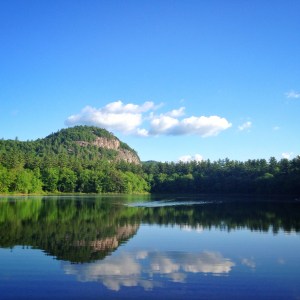
“The pushback was just like it is now,” ecologist Gene Likens said on Tuesday, talking about how his research in the White Mountains was received when it went public in the mid-1970s. Big vested business interests and their allies rejected his findings, he said, until he and his teams could show scientifically where the pollutants causing acid rain were coming from—industrial polluters in the Midwest.

From initial discovery to the enactment of new rules limiting those polluters took nearly a generation. Or, as Likens likes to put it, “27 years, three presidents and one pope.”

Now, he said, he’s watching something similar happen with climate change.

Likens research and his legacy are intimately tied to the White Mountains. It began in 1963 when Likens was a professor at Dartmouth College. He was the lead scientist of a team studying streamwater chemistry in the Hubbard Brook Experimental Forest outside Lincoln, the U.S. Forest Service’s forest-laboratory of the White Mountains. His team wanted to know how the forest worked, to understand the inputs and outputs, what made it tick. They weren’t looking for anything specific, Likens said, but what they they found surprised them: water infused with sulfur dioxide and nitrogen oxides, a concoction capable of leaching aluminum from the soil and depositing it downstream in lakes and rivers, and also capable of killing insects, fish and plants along the way.

What they found was acid rain.

“The very first sample of rain we collected was very acidic,” said Likens, with acidity levels 100 times above normal. “Nobody knew there was a problem,” he said. “It was pure serendipity. So much of science is that way. We didn’t set out to discover acid rain. It was there and we ran with it.”

Their research led to an article in the journal Environment in 1972. Two years later Likens, now a professor at Cornell University, replicated the experiment in the Finger Lakes region of central New York, where again they found sulfur dioxides and nitrogen oxides in the water. He and a colleague published again published their findings, this time in the journal Science.

That’s when their research got noticed.

“It was picked up by the New York Times,” Likens said. “It ran on the front page.”

The year was 1974. Acid rain for the first time was in national headlines. It would be another 16 years before Congress passed revisions to the Clean Air Act to curb the industrial pollution that was the cause.

From acid rain’s discovery in 1963 to Congressional action in 1990, all of it started in the White Mountains, in the Hubbard Brook Experimental Forest, which Likens calls one of the most studied ecosystems on the planet.

“We are much more effective stewards when we have long-term monitoring to guide us,” Likens said, “but the reality is such studies are quite rare.”

Likens research has included collecting decades of stream water chemistry data and associated rainfall information, creating one of the longest such records for any site on Earth. “And I’m still doing it,” he said.

And scientists in other disciplines have been doing similar work, leaving long records that allow researchers to see trends over time.

“So with climate change we can say what happened,” Likens said, “and what is happening.”

Birds in the forest, for example, are arriving earlier. Buds sprout earlier. Mirror Lake, “probably one of the most studied lakes in the world,” he said, is now covered by ice 20 days less each winter than in years past. The planet is definitely warming.

But when it comes to climate change some people push back against the science. And they doubt human involvement. Likens said he seen this before, that it was the same debate over causation that raged with acid rain.

But as a researcher, Likens said, his job is not to get lost in those arguments. A researcher’s job is to continue working, he said, to explore and examine, to collect data and ensure a record exists of what happens in the world.

“I’m not an advocate,” Likens said. “I’m not a politician. I’m a scientist.”


A version of this story ran in Saturday’s Conway Daily Sun.

On Science

On Science

IMG_7944-1Yesterday I woke up to a bear in the yard.
He wasn’t doing anything really, just milling about. I watched him through the window, basked in orange sunlight as he snooped. Then I packed my things to go swimming.

I’m not much of a swimmer. I did a lap across the lake, pausing in the middle to lie on my back, float and stare upwards. I could feel my heartbeat in my ears as I let my wetsuit suspend me, limbs dangling in the water. When I exhaled I sunk. When I inhaled I rose. I watched clouds track overhead, felt the ripples as they brushed my face, then closed my eyes, floating. I stayed like that, motionless, just breathing, for what felt like hours. It may have only been a minute; I lost track of time. Then I turned into the water and aimed for the near shore.

Driving home my phone rang. I didn’t recognize the number, but I answered anyway. “Hi, this is Erik.”

On the other end was Gene Likens, the scientist who 50 years ago discovered acid rain. An ecologist and former Dartmouth College professor, his most recognized work took place at the Hubbard Brook Experimental Forest, a site an hour drive from where I spent my swim. Likens co-wrote a book on the forest, and I thought it might be worthy of a story. We spent 20 minutes talking. He described the surprise of discovering acid rain.

“Nobody knew there was a problem,” he said, but “the very first sample of rain we collected was very acidic,” up to 100 times the normal levels.

What got them to look at rainwater? Curiosity.

“It was purely serendipity,” he said. “So much of science is this way.”

“We didn’t set out to discover acid rain,” he said. “It was there and we ran with it.”

A quote has sat on my desktop for several years:

The beauty of science is not in the answers it provides, but in the act of questioning. And each question leads to more questions. There are no answers, only infinite questions.”

It’s not a quote from some book or from anybody famous. It’s mine, just some musings I scribbled. I jotted it down one day when it popped into my head, something I didn’t want to forget, even though I’ve now forgotten the context it came from.

But yesterday I heard echoes of it in Likens. He was not studying stream water to prove some point. He was there to learn, driven by curiosity. It was a search of wonder, devoid of ego, even though it eventually made a name for Likens.

Science is built on such wonder. It is the act of questioning, of exploration and answers so tenuous they are subject to constant revision. But through the soft passage of time, through the constant brushstrokes of curiosity, a truth emerges. What emerges is the heart, the soul of our world, something foundational. But no part is so sacred it cannot be discarded, slain. Everything is open to more questions. There is something beautiful in that.

I can’t help but wonder if religion is born from the same roots, if at one point humans looked at the majesty of the universe and couldn’t help but exclaim, “Who could have made such a beautiful thing?!” and the answer they came up with was God.

That question is a perfect one. Who could have made such a beautiful thing? What could have led to this, to this world and this life? They echo the question scientists ask today. Look into the heart of the world. Whether your launch point is science or religion it is impossible not to be overcome by wonder, by beauty and grace and the perfect harmony of things larger than ourselves. How does the Earth spin around the Sun? How did life come into being? How did so much order grow out of seemingly infinite chaos?

Those questions were with me too. They were in the bear sitting outside the window yesterday morning, in the beat of my heart in my head, in the caress of the water and the color of the sky. They are questions I asked the lake lying on prone in the water, buoyed up by a force I will never fully understand, asked the sky gazing at clouds dotting a blue so striking it felt like more water. Neither revealed their secrets, but they shared gifts just the same.

Wonder. Beauty. Grace. These are both the heart of science and the heart of religion. Indeed, they are perhaps the heart of everything. The magic of creation is captured in a piece of music, a Van Gogh painting, in Shakespeare and Hemingway. In the movie that speaks to our hearts, in the play that touches our souls, in the book that we come back to and back to. Science, religion, music, art—it is all the same. It is all one thing, different versions of the same dance.

And that dance can take place in the world, with the Earth as your partner: the perfect wave to the surfer, the long winding trail to the runner, the sweep of immaculate stone to the climber. The friend that stands opposite you in dark times. The lover who shares your bed. Creations all. Art, science, religion, beauty all. Questions, infinite questions, too big to ever contain in something so small as an answer, all.

I wrote the piece on Likens today. It will never do justice to his story. But his answers are not the point. He is a scientist; the point is always the questions.

Plastics, the Environment and the Economy

Plastics, the Environment and the Economy

IMG_5458Sometimes the economy and the environment are at odds.

In recent weeks I’ve been reading a lot about plastic, and plastics in the ocean in particular.

It started in April with a stop at the Smithsonian Museum of Natural History. Wandering the exhibits I came across a pair of displays in the Sant Ocean Hall that caught my attention: two piles of trash. One was pulled from the stomach of a seabird, the other from the stomach of a whale. In each pile were hundreds of scraps—pieces of bags, bottle caps and boat parts—almost all of them plastic. Both animals died as a result of their ingestion choices. Plastics look bright and shiny, similar enough to edible tidbits these creatures have eaten for generations to be deadly. So they gobble it up. The result is a belly full of trash.

That was the first thing that got me thinking about plastic. Then I stumbled upon a “say no to straws” campaign highlighting the amount of plastic used each day for the completely arbitrary task of getting our drinks out of our glasses and into our mouths. It seemed absurd: like there isn’t another way to drink a drink? Is that really what we are doing, filling our oceans with garbage in exchange for saving us the trouble of lifting our glasses?

After a bit more research and a few conversations with friends I learned about this initiative:


Apparently the answer is yes, that is exactly what we are doing. Plastic is everywhere. EVERYWHERE. In the ocean, ground up into little bits so small we can’t even see them, rolling among the waves.

That is plastic in the environment.

Then there is plastic in the economy. This morning a news piece from Marketplace.org called “The Next Global Glut: Plastics” popped up on my news feed. The gist is this: with crude oil prices at record lows production of oil-derived goods like plastic are going to increase.

Several new petrochemical plants are being developed, especially around Houston and Louisiana. Vafiadis said the high output from the natural gas industry in the U.S. makes it financially feasible for companies to spend billions of dollars in new plants. 

“There’s enough natural resources available to make the majority of the projects that are being considered today viable,” Vafiadis said. 

As new plants come online, global plastic output will swell. IHS expects that more than 24 million metric tons of new production capacity of polyethylene alone will be added to the market by 2020. About a third of that new capacity will come from the U.S. and will come online within the next few years.

Not mentioned in the story is with increased production comes increased disposal. The giant pile of trash already swirling in ocean will grow.

The environment and the economy—when it comes to plastics there seem to be two distinct conversations: one about growth, the other about impact. Watching these conversations unfold in tandem and without intersection is like watching someone with multiple personality disorder argue with themselves. It’s two halves of the brain unable to connect directly. There are questions of demand, but also of impact. Where is that, the complete conversation, supposed to live?

Tweeting Shrimp

Tweeting Shrimp

IMG_7918-1Last week I wrote a post about chasing snapping shrimp down the Pacific Coast and sent it off into the internet-sphere. The whole piece/story/adventure revolved around a Radiolab podcast on the little crustaceans with the fire of the sun in their palm, so after I wrote it I shot a copy Radiolab’s way just for fun.

AND THEN THEY SHARED IT!!

I love Radiolab. In a world where most science reporting is more about the controversy and who said what about something than on the basic facts and merits of the matter Radiolab brings a sense of wonder to the genre. They tell their stories with nuance and complexity, allowing the pieces of this world that are amazing to stand on their own. (If you want one of the best examples, check out their story The Rhino Hunter, one of the most stunning pieces on the complexity of modern conservation I’ve ever heard.) I wait each week for the next episode to download; their success at telling longform stories in the Twitter Age is remarkable.

So it was nice to see their name tagged next to mine. YEAH!

Enoch Glidden, and the Question “How Can I?”

Enoch Glidden, and the Question “How Can I?”
DSC01212-2 1
Glidden on Washington Column.

What does it take to climb a 3,000-foot cliff?

For Enoch Glidden, a 37-year-old wheelchair-bound climber born with spina bifida, it might sound like a complex challenge built around planning, hundreds of feet of rope, specially designed climbing equipment and more.

But ask him what it takes, and he doesn’t give a complex answer. The Western Maine native keeps it simple: Climbing a 3,000-foot cliff requires friends.

“Nobody does anything without help, disabled or not,” he said.

Next fall Glidden is headed to Yosemite Valley, Calif., the mecca of American rock climbing, with plans to climb El Capitan, the massive granite touchstone for rock climbers worldwide. He’s been there once, last year, and despite his inability to move his legs, he climbed 600 feet up a towering granite rock face.

“It’s possible,” he said. It just comes down to a question he’s asked himself over and over: “How can I?”

That is the theme of the slide show Glidden will be giving Saturday night at International Mountain Equipment in North Conway. “Go Beyond the Fence” discusses his trip last fall and is a step on the road to his next challenge, El Capitan.

“That question has come up my whole life,” Glidden said. “How can I?” He got his first wheelchair when he was 4. Paralyzed from the waist down, he refuses to let that hold him back: He skis (both downhill and cross-country), competes in wheelchair races, plays basketball and is close to getting his pilot’s license. When he sees a challenge he runs at it, and four years ago the new challenge he discovered was climbing.

“It’s just kind of the ultimate challenge,” he said. “It’s all me to get up there.”

He started in New York with Paradox Sports, a Colorado-based nonprofit dedicated to adaptive sports. That led him to ice climbing closer to home — he’s attended Paradox Ice events in North Conway the past three years.

In Yosemite last year, he and a team climbed up Washington Column, a granite tower a few miles north of El Capitan.

But as he said, these kinds of climbs don’t happen alone.

“Pretty much everywhere I go, someone volunteers,” Glidden said. Last fall they had a team of four the night before the planned ascent. By the next morning, their team was up to double digits. People just seem to want to be involved, Glidden said. “I did one presentation, and a whole bunch of people volunteered.”

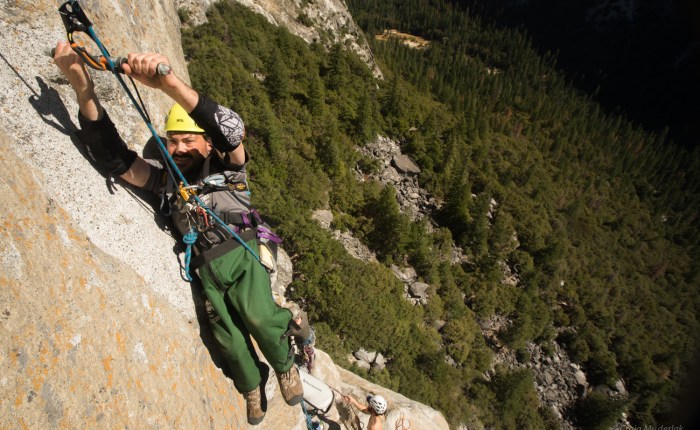
The group hiked to the base of Washington Column, carrying Glidden over broken rock and talus. They climbed 500 feet up, spent the night, then climbed another 100 feet the next day.

“Two climbers go ahead and set the rope,” Glidden said, “and then I do pull-ups on the rope.”

He has a special rope-climbing device rigged with a mini pull-up bar, he said, which he uses to climb the rope.

“The hardest part is living on the wall,” he said. He can’t stand up, so he can’t move around easily. That makes routine tasks like dressing and going to the bathroom difficult. “You can train for pull-ups. You can’t train for the portaledge,” the fabric platform he uses for resting and sleeping, he said.

But he learned a lot on that trip, worked out many of the kinks. Now “I’m pretty much dialed in,” he said. For his trip this year he won’t be scouring around Yosemite for partners. “This time I’m bringing people with me.”

The climb will take five days and nights, and involve sleeping on the side of the cliff. Glidden will again ascend a rope strung up by partners, doing thousands upon thousands of pull-ups over the course of the ascent. This will be by far the biggest climbing challenge he’s attempted.

But in some ways the vertical world is easier than some of the challenges that come before. First, he has to get to the wall. It’s a steep walk over rough terrain to get to the base of Zodiac, his planned route up El Capitan’s right flank.

That’s where the friends come in: helping get him to the climb, not just up it, and then also off the top of El Capitan and down. He’s got 14 people planning to join for some part of the mission, but it’s still up to him to do all those pull-ups. There will be a crew shooting video, plus Glidden blogging, and Paradox Sports and the Spina Bifida Foundation of Greater New England will be broadcasting the climb as well.

But all that is in October. For now, Glidden is still training, still getting ready for the challenge ahead. He’s been taking lessons from Sean O’Neill of Brownfield, Maine, who pioneered many climbing techniques for paraplegics. O’Neill climbed El Capitan by the same route in 2006, also doing thousands of pull-ups.

“He basically taught me everything,” Glidden said.

And along with training, he’s pulling together the funds to get himself out there. He just finished his degree in computer information systems, and he’s planning to intern for the summer in Palo Alto, Calif.

“The day that ends I’m going to Yosemite to go climbing,” he said.

But Saturday night at IME, 2733 White Mountain Highway, North Conway, the Mount Washington Valley will get a taste of his ascent, with video shot from his trip last fall. And Glidden wille discussing that all-important question, “How can I?”

The event will be held upstairs at IME on Main Street in North Conway Village. Doors open at 6:30 p.m. with free beer courtesy of Tuckerman’s Brewery. The film portion will begin at 7 p.m. There is a suggested donation of $10.

This story appeared in today’s Conway Daily Sun.

10,000 Seafloor Clicks

10,000 Seafloor Clicks

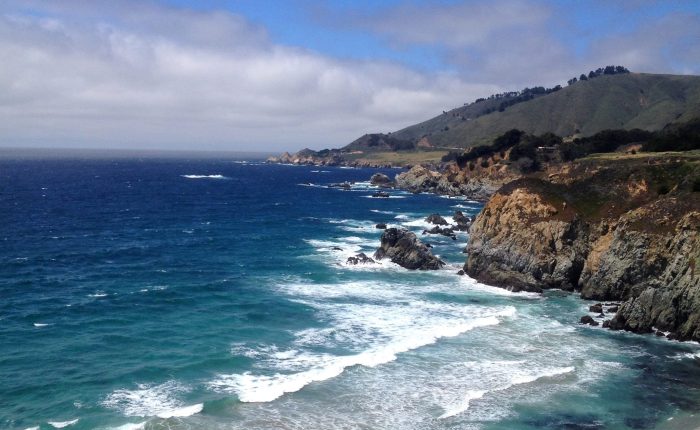
13235224_1490935110932569_1854608173923259447_oIt’s a long drive from Monterey Bay to San Diego, punctuated by towering seacliffs and emptiness. It’s the kind of drive were you find yourself pulling over every five minutes, where the landscape looks sculpted by god. Big Sur. Kerouac’s coast. Every photo looks magnificent, but none are able to capture the spirit of the place.
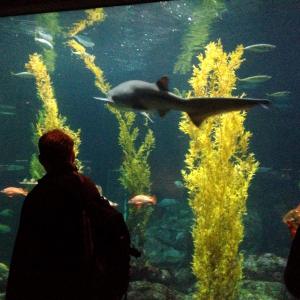
I spent the morning at the Monterey Bay Aquarium, where you can pet a stingray, watch bluefin tuna and hammerhead sharks grow frantic around shimmering clouds of sardines, see hoards of jellyfish from inches away and marvel at octopus species so different one looks like graffiti and another like camouflage. It took hours to wander through the exhibits, past giant bass and sharks and sea anemones.

One small crustacean I barely took notice of was a shrimp. He was a few inches long, with a pair of lobster-like claws, one substantially bigger than the other. His name? The snapping shrimp. I definitely saw one stowed underwater and behind glass, but I barely took notice. It was just another weird little ocean creature, nothing as majestic as the large pelagic predators or as striking as the brightly colored fish. It was just a shrimp.

13235634_1490935080932572_338291320125641097_oThen I started driving. I skirted my way out of Monterey, past Carmel and onto the Pacific Coast Highway. Hours clocked past. The landscape grew into lofty hills above an azure sea. First cell phone coverage faded, then the radio stations. “Next gas 62 miles,” the sign said.

But I come prepared for such terrain: I plugged my iPhone into the auxiliary jack and scrolled through my podcasts. Suddenly one of my favorites caught my eye—Radiolab.

The episode was called “Bigger than Bacon,” and it was about this strange sound emanating out of the ocean: a crackling, like the popping of bubblewrap. What was the culprit? Snapping shrimp!

But more amazing is the power of that sound, as well as the phenomena that accompany it. The snapping is masked by water, muffled, but in reality each snap is roughly 220 decibels, or about as loud as a jet engine. The claw closes at 60 miles an hour, but it occurs in a space so small something amazing happens: at the base of the ocean where no air sits, the snapping shrimp’s claw closes so quickly it forces away all the water, literally vaporizing it, creating a vacuum, an air bubble. Suddenly a void exists where previously there was none, a brief spot of emptiness created by a couple-inch-long organism.

And when the water rushes to fill that space it does it with a vengeance. Molecules slam into one another at such a pace that the space that was once a bubble heats up to 5,000 degrees, the temperature of the surface of the sun. On the seafloor. In the claws of a shrimp.

Seriously. This is no joke. This is real. Scientists even captured it on video:


But here’s the best part: as I listened I drove. And I drove. I drove past the pristine shores of central California, past Santa Barbara and Ventura and the megapolis of Los Angeles, to San Diego, to friends and surf and southern California beaches. I spent a week there, surfing, eating tacos and diving; swimming through Pacific waters in a mask, fins and snorkel, chasing sea lions and Garibaldi fish and leopard sharks.

And the whole time I heard snapping. Every time my ears broke the surface I heard it. I’d never noticed it before, never paid enough attention, but now whenever my head went underwater it was an orchestra. The shrimp were everywhere. I could hear the snapping of their claws at the surface, and when I dove it only got louder. I never saw them, but I could picture the little crustaceans scampering across the seafloor, smashing their claws together like Marvel Comic heroes generating plasma-like heat rays in their palms. The floor of the ocean was on fire, but only the shrimp could see it. And me.

(The full Radiolab is definitely worth a listen. Maybe on a drive?)

https://www.wnyc.org/widgets/ondemand_player/radiolab/#file=%2Faudio%2Fxspf%2F603688%2F

CDS Column: Socialized Soldiers on Quieter Battlefields

CDS Column: Socialized Soldiers on Quieter Battlefields

Iraq-1020772The ceilings hung squat and low, traced by fluorescent lights dotted among recessed tiles. The hallway was dingy, scraped paint along bare walls and floors that wouldn’t shine no matter the scrubbing applied. Worn signs hung on the bathroom doors, faded now after too many handprints, only half the words now visible. Someone redrew the head on the men’s bathroom symbol, but they’d drawn it square. Inside, a black Magic Markered smiley face stared out.

It didn’t look like a hospital. Or it didn’t look like an American hospital, particularly not one in a major city. American hospitals are shiny and well-lit, with glass walls and artwork lining the corridors. They are regal, siblings to university buildings and museums and federal government offices.

But this wasn’t. What came to mind was Cuba — the dark hallways and simple plastic-upholstered seats lining the waiting room walls in the public clinics, the cement stairwells and overcrowding.

But even in Cuba the lines of patients move. People get seen promptly. Not here.

The emergency department was full. Some people stood along the walls. The woman behind the desk said it was a five-hour wait, maybe more.

“Busy day?” my friend asked.

“No,” the woman said looking apologetic. “This isn’t bad.”

We sat down beneath an overhead television. It was 1 p.m. The afternoon soaps were on.

Seven hours later, the evening news was coming to a close. Our wait also was ending.

Welcome to the VA system.

I’ve heard not every Veterans Affairs hospital is the same. Some, I’m told, don’t feel caught in the Soviet era. I don’t know; I’m not a veteran, and I’ve only ever been to one VA hospital. But that one visit was disturbing enough.

My friend and I were in San Diego. Our visits to California overlapped by a few days, so we decided to team up for some surfing, snorkeling and exploring the city.

But on day two she began complaining of lower back pain. An Air Force vet, she Googled the local VA services. There was a hospital on the outskirts of the city, just outside La Jolla Cove where we’d been snorkeling the day before.

She looked at me. “This should be fun,” she said.

Being a veteran, she knew. I did not. But within a few steps of walking in the door I understood viscerally. All the news stories I’d heard in recent years came flooding back, about long wait times and how the head of the VA had resigned and the system was again due an overhaul. It was akin to walking into an inner-city school — one look was enough to know the facility was under-resourced, that the job it was expected to do far exceeded its capacity. Long waits, substandard care, lost files and missed diagnoses seemed to ooze from every exam room. This was less a hospital than a holding pen. Prisons are better equipped.

And sitting there I had ample time to consider the string of ironies I was witnessing. Here I was in a VA hospital, and I kept having flashbacks to Cuba, a country where the population lives on a fraction of the American standard. But despite appearances, Cuban hospitals get better results. Their version of socialized medicine competes favorably with the profit-driven system employed by the United States, and it blows the VA system out of the water. I was looking at America’s finest — the soldiers, airmen, seamen and Marines of the U.S. military — as they were served up the worst of American health care. Some of them may have even served on Cuban shores, may have stood guard on Guantanamo Bay, Cold War warriors who fought the spread of communism.

What did they earn in return for their service? Socialized medicine.

It almost made me laugh: Fight in honor of American values and you earn guaranteed free government-run health care. “Oppose communism to secure your place in socialism.” I doubt that made it onto many recruiting posters.

But there is a tragedy hidden within the comedy: The modern American application of socialized medicine offers veterans few gifts. They give us their best, and we give them our worst. The VA system is known for wait times that sometimes outlast patients, for diagnoses that come too late. “Support our troops” seems to only hold until the fighting is over. After that we leave them to die on quieter battlefields.

The problem, of course, is not socialized medicine. Plenty of countries pull that off at a high standard — most of Europe, Canada, Costa Rica. But the United States has proven incapable at setting up its own system, even for soldiers. That U.S. soldier who was stationed at Guantanamo Bay may have done better to wander off base to see a doctor than visit the hospitals provided by their own government.

So, every day we rob veterans of what they have earned. We underfund and understaff and under-resource to the point of no return, to the point that servicemen and women die as a result.

It’s easy to blame the bureaucracy, to rest at the myth government can’t run anything well and move on. But that is a farce. Government-run health care works worldwide, just not here.

But the VA has to work. Not marginally, not sluggishly, but well. Efficiently. Smoothly, with dynamism and grace. We owe it to every American willing to pledge more than taxes and a vote every four years for his or her country. It may not have been on the recruiting poster, but it is the promise we made.

And we’ve failed. For a generation now we’ve failed. We’ve accepted the myth that government can’t work, that socialized medicine is doomed to fail, and our soldiers have paid the price for it. Sagging buildings and five-hour wait times are not the best we can do. Our veterans are worth more than that.

This piece appeared in today’s edition of the Conway Daily Sun.