A Collaborative Dance

A Collaborative Dance

Moz-1020781Nothing gets accomplished alone.

We are a country of rugged individualists with celebrity dreams. We dream of making it big, succeeding, pulling ourselves up by our bootstraps, a metaphor that indicates we can create our own salvation.

But nothing happens alone.

I have amazing friends. Some are climbers, adventurers, others photographers, videographers, others writers, teachers, environmentalists, businesspeople. Massage therapists and waitresses. Nurses, engineers and retirees. Together they make my world.

I have big ideas. All the time. Once I came up with writing a book. It died on the vine. Once I tried to fly to Haiti after the earthquake. That didn’t go anywhere either. Another time I came up with another book idea. It ended the same place as the first. All of these were ideas I took on alone.

Once I had an idea to go to Iraq and work as an embedded journalist. This idea I shared with a friend who also happened to be the news director at New Hampshire Public Radio. “Alright,” he said, “let’s make it happen.”

Three months later I was flying into Baghdad, utterly terrified about what I’d gotten myself into.

But I wasn’t alone. That made all the difference. Three weeks later I flew home having done what I set out to do. Nothing else compares to that.

klementovich-20160531-_JCK2368A few weeks ago I came up with an idea. It’s an idea bigger than I am, one that has to do with writing, reporting, adventure, the environment, the future of the Earth and the human race. It’s an idea I don’t want to let go of, one I don’t want to die like so many ideas before it. It’s an idea I need help with. So while it was still fresh, instead of rushing headlong into it I did something simple: I picked up the phone. I called my friends.

My friends can do anything. I watched them climb mountains, write books, build rock gyms, start photography businesses, start nonprofits, reinvent themselves and then reinvent themselves again. I’ve watched them change the world. I’m lucky to have such friends.

But I never understood how they did it. I always looked at my efforts, looked at my ideas, how quickly they withered, and wondered what they knew that I didn’t, what they had that I lacked.

Then one of them asked for my help. She had an idea, a project bigger than herself, something involving climbing and mountains and scientists and conservation and a documentary and college kids, something overwhelming and beautiful. She asked for my help, and then she asked for help from everyone who would listen. And the project grew. It built speed, became something real, took off. There were setbacks, but she kept pushing. It was a beautiful, inspiring dance, one I was honored to have a hand in. It was so big, so complex and powerful and challenging and different, I couldn’t understand how she kept it all going. But then I realized: she asked for help.

Want to do something amazing? Don’t do it alone. Share your idea. Trust it with people who inspire you, with people whose vision matches yours. Let them water it alongside you. Loosen control. Let it see where it takes you. You will not be disappointed.

I am making phone calls now. And my friends, those people capable of doing anything, are answering. It’s almost as inspiring as my idea. Maybe more so.

Turning the Ship and Changing the Tide

Turning the Ship and Changing the Tide

PP-1030179How long does it take to turn a ship? How long does it take to change course, to do something different, to avoid the metaphorical icebergs?
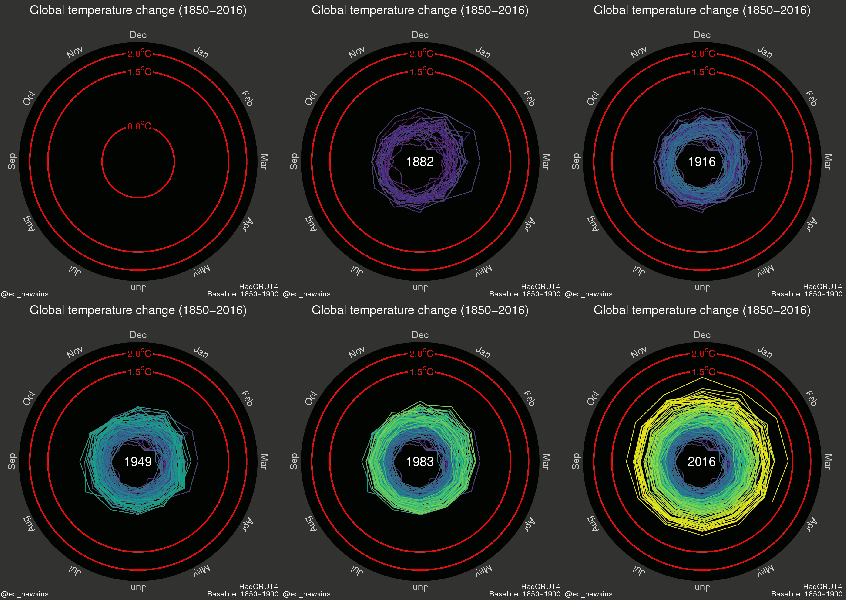
I say “metaphorical icebergs” because the risk of real icebergs is dwindling. It’s a warming world. Things they are melting, and there are real risks hiding behind the warmth: rising sea levels, drought, severe storms. These are the icebergs. Which of the levers do the turning? Does anyone understand the controls?

I spoke to ecologist Gene Likens last week, the scientist who discovered acid rain in North America. It took a generation to get from initial discovery to the passage of legislation aimed at curbing the pollution that caused it, or as Likens puts it, “27 years, three presidents and one pope.”

There are important things to note in that timeline: his first study, for example, came out 9 years after the discovery, meaning 27 years falls to 18 from when the information was publicly available. And it wasn’t until a 1974 study that newspapers picked up the story. That’s when acid rain really became a household issue; now we’re down to 16 years.

16 years is not the generation 27 years nears. It is, however, a long time. Likens said his science faced pushback from industry. Entrenched interests like oil and coal rejected the premise they had any responsibility for acid rain. It took proving that link scientifically to end the argument.

Of course such proof is important—there is no use in regulating an industry innocent of the charges. If it wasn’t oil and coal those laws would have just been more wasted time.

But every day that passed was a lost opportunity. More acid fell from the sky. There is a saying that the only two days that are impossible to change are yesterday and tomorrow. A lot of todays, however, went by in inaction, todays that could have turned the ship.

arctic-death-spiral
Arctic sea ice volume since 1979.

Now we face a different iceberg. Scientifically climate change is undisputed. The argument over human involvement remains, but the planet is getting hotter. And every today gets us closer to whatever comes next. Perhaps it is nothing. Perhaps it is catastrophe.

Likens compared the struggle over acid rain science with what’s happening today with climate change. “The pushback was just like it is now,” he said, again pointing to entrenched interests. Another generation-long fight could be in store.

A decade ago An Inconvenient Truth exploded the conversation about climate change, much like the New York Times coverage of the 1974 acid rain report. So if we benchmark the two, we’re at 10 years. Maybe we can match 16; maybe some course alteration will come down in 2022. That is a long way off, but it’s also almost here.

And what would it mean? What would turning the ship at this moment do? Are we surrounded by icebergs already? Are the coming changes beyond our power to affect? Are we simply too late, caught in a disaster impossible to avoid?

Who knows.That falls to tomorrow, one of those days you can’t change. But we can change today. But to do that we need to have faith in science, something seemingly in short supply with some.

spiral_optimized
An illustration of global temperature change for the last 166 years.

Science is not the conspiracy of one man. It’s multilayered work, an exploration of chance, a process of search more than an answer. And while it can be mistaken (think of early experiments aimed to determine whether light was a particle or a wave—it behaves like both), those missteps are part of the process. The call is always daring to be proven wrong. Scientists strive for that, and yet climate change is not proving wrong.

Industry, meanwhile, as Likens pointed out has a mixed record, much more so than science. Tobacco companies, for example, showed the willingness of big business to subvert science for their own ends. Science’s agenda, meanwhile, has no choice but to bend toward truth. It’s built into the method, the practice of the discipline. It may be hard to put the two on a scale, but if you could the weight of replicable results would trump corporate claims, particularly when huge revenue losses enter the conversation. The skeptic sees industry with strong motivation to deceive; scientists, meanwhile, do not gain by being controversial, or by being wrong. They succeed by being right, precise and verifiable.

And these debates are the fulcrum on which the ship turns. Is there still time to spin the wheel? Even science doesn’t know. But we may all get a chance to find out. Tomorrow.

A Tale of Two Studies

A Tale of Two Studies

9129d-ski-1080245The scientist who uncovered acid rain in North America 50 years ago now sees a parallel struggle waging around climate change and the effects of global warming.
“The pushback was just like it is now,” ecologist Gene Likens said on Tuesday, talking about how his research in the White Mountains was received when it went public in the mid-1970s. Big vested business interests and their allies rejected his findings, he said, until he and his teams could show scientifically where the pollutants causing acid rain were coming from—industrial polluters in the Midwest.

From initial discovery to the enactment of new rules limiting those polluters took nearly a generation. Or, as Likens likes to put it, “27 years, three presidents and one pope.”

Now, he said, he’s watching something similar happen with climate change.

Likens research and his legacy are intimately tied to the White Mountains. It began in 1963 when Likens was a professor at Dartmouth College. He was the lead scientist of a team studying streamwater chemistry in the Hubbard Brook Experimental Forest outside Lincoln, the U.S. Forest Service’s forest-laboratory of the White Mountains. His team wanted to know how the forest worked, to understand the inputs and outputs, what made it tick. They weren’t looking for anything specific, Likens said, but what they they found surprised them: water infused with sulfur dioxide and nitrogen oxides, a concoction capable of leaching aluminum from the soil and depositing it downstream in lakes and rivers, and also capable of killing insects, fish and plants along the way.

What they found was acid rain.

“The very first sample of rain we collected was very acidic,” said Likens, with acidity levels 100 times above normal. “Nobody knew there was a problem,” he said. “It was pure serendipity. So much of science is that way. We didn’t set out to discover acid rain. It was there and we ran with it.”

Their research led to an article in the journal Environment in 1972. Two years later Likens, now a professor at Cornell University, replicated the experiment in the Finger Lakes region of central New York, where again they found sulfur dioxides and nitrogen oxides in the water. He and a colleague published again published their findings, this time in the journal Science.

That’s when their research got noticed.

“It was picked up by the New York Times,” Likens said. “It ran on the front page.”

The year was 1974. Acid rain for the first time was in national headlines. It would be another 16 years before Congress passed revisions to the Clean Air Act to curb the industrial pollution that was the cause.

From acid rain’s discovery in 1963 to Congressional action in 1990, all of it started in the White Mountains, in the Hubbard Brook Experimental Forest, which Likens calls one of the most studied ecosystems on the planet.

“We are much more effective stewards when we have long-term monitoring to guide us,” Likens said, “but the reality is such studies are quite rare.”

Likens research has included collecting decades of stream water chemistry data and associated rainfall information, creating one of the longest such records for any site on Earth. “And I’m still doing it,” he said.

And scientists in other disciplines have been doing similar work, leaving long records that allow researchers to see trends over time.

“So with climate change we can say what happened,” Likens said, “and what is happening.”

Birds in the forest, for example, are arriving earlier. Buds sprout earlier. Mirror Lake, “probably one of the most studied lakes in the world,” he said, is now covered by ice 20 days less each winter than in years past. The planet is definitely warming.

But when it comes to climate change some people push back against the science. And they doubt human involvement. Likens said he seen this before, that it was the same debate over causation that raged with acid rain.

But as a researcher, Likens said, his job is not to get lost in those arguments. A researcher’s job is to continue working, he said, to explore and examine, to collect data and ensure a record exists of what happens in the world.

“I’m not an advocate,” Likens said. “I’m not a politician. I’m a scientist.”


A version of this story ran in Saturday’s Conway Daily Sun.

Plastics, the Environment and the Economy

Plastics, the Environment and the Economy

IMG_5458Sometimes the economy and the environment are at odds.

In recent weeks I’ve been reading a lot about plastic, and plastics in the ocean in particular.

It started in April with a stop at the Smithsonian Museum of Natural History. Wandering the exhibits I came across a pair of displays in the Sant Ocean Hall that caught my attention: two piles of trash. One was pulled from the stomach of a seabird, the other from the stomach of a whale. In each pile were hundreds of scraps—pieces of bags, bottle caps and boat parts—almost all of them plastic. Both animals died as a result of their ingestion choices. Plastics look bright and shiny, similar enough to edible tidbits these creatures have eaten for generations to be deadly. So they gobble it up. The result is a belly full of trash.

That was the first thing that got me thinking about plastic. Then I stumbled upon a “say no to straws” campaign highlighting the amount of plastic used each day for the completely arbitrary task of getting our drinks out of our glasses and into our mouths. It seemed absurd: like there isn’t another way to drink a drink? Is that really what we are doing, filling our oceans with garbage in exchange for saving us the trouble of lifting our glasses?

After a bit more research and a few conversations with friends I learned about this initiative:


Apparently the answer is yes, that is exactly what we are doing. Plastic is everywhere. EVERYWHERE. In the ocean, ground up into little bits so small we can’t even see them, rolling among the waves.

That is plastic in the environment.

Then there is plastic in the economy. This morning a news piece from Marketplace.org called “The Next Global Glut: Plastics” popped up on my news feed. The gist is this: with crude oil prices at record lows production of oil-derived goods like plastic are going to increase.

Several new petrochemical plants are being developed, especially around Houston and Louisiana. Vafiadis said the high output from the natural gas industry in the U.S. makes it financially feasible for companies to spend billions of dollars in new plants. 

“There’s enough natural resources available to make the majority of the projects that are being considered today viable,” Vafiadis said. 

As new plants come online, global plastic output will swell. IHS expects that more than 24 million metric tons of new production capacity of polyethylene alone will be added to the market by 2020. About a third of that new capacity will come from the U.S. and will come online within the next few years.

Not mentioned in the story is with increased production comes increased disposal. The giant pile of trash already swirling in ocean will grow.

The environment and the economy—when it comes to plastics there seem to be two distinct conversations: one about growth, the other about impact. Watching these conversations unfold in tandem and without intersection is like watching someone with multiple personality disorder argue with themselves. It’s two halves of the brain unable to connect directly. There are questions of demand, but also of impact. Where is that, the complete conversation, supposed to live?

CDS Column: Cuba, A One-Hour Visit

CDS Column: Cuba, A One-Hour Visit

IMG_8150How do you explain a country?

It’s a presumptuous task. I’ve taken six trips to Cuba in the last year, spent a little over two months there, visited a handful of towns, climbed in the western mountains, swam in the clear blue Caribbean, danced in Salsa wherever I could and wandered the Malecon. I’ve also listened to multiple professors discuss topics from trade to transgender rights, studied their history and talked politics with the people.

But still. The Cuban/American relationship is so embattled, so complex, how do you boil it down to an hour talk?

GEMM9041
Jamie Gemmiti photo

That was Thursday night. The North Conway Public Library asked me about giving a slideshow on Cuba, about what it’s like to go there. I agreed—I fell in love with the country, and after a handful of visits it was clear the island was vastly misunderstood at home.

How? Communism, for example: Cuba is a country of small-scale entrepreneurs running restaurants and rooming houses out of their homes. There is a hustle to these new businesses, a creative energy akin to the growing food truck culture of the United States.

These enterprises exist against a backdrop of state-run restaurants and hotels that Cubans themselves will tell you are bad, not worth visiting. The state-run enterprises get government funding, but they also suffer from the endemic sluggishness of businesses allowed to bloom without fear of competition. Communism exists in Cuba, but it is no longer ubiquitous. It is the dead skin the country is still working to slough off.

And history. Explaining the longstanding Cuban desire for an independent state to Americans is an upstream paddle. We remember the Bay of Pigs and the Cuban Missile crisis but have forgotten the Spanish-American War. Cubans remember both. And their version of those stories are different from ours.

Cuba was a Spanish slave colony for hundreds of years, a satellite possession rich in sugar. But that wealth was siphoned off. The island was populated by serfs and a few wealthy masters who minded the plantations.

But in the mid-1800s a handful of those masters grew distasteful of the inequality surrounding them. Like American patriots 100 years before, they began writing and speaking about a freedom and building a national consciousness where previously there had been none.

Then in the 1890s they went to war with Spain, and the United States joined the fight. Cubans reasoned American assistance was offered in solidarity—America too had once been a colonial possession. But when the war was over and Cuba “liberated” freedom proved to be in name only: the country traded one overlord for another. Their protector became their new master.

That is not history most Americans remember, or how most Americans remember that history. But island stayed as it was: a land of serfs ruled by far off masters. Their dreams of freedom were deferred.

Enter the revolution. In American eyes it was the insidious growth of communism. But to Cubans it was the realization of a long held dream, one of national self-determination and governance. Nearly 200 years after Americans threw off the yoke of colonialism by kicking out the British Cubans got to do the same, but the oppressor they had to expel wore the Stars and Stripes.

Again, not a story Americans are used to hearing. But walk around downtown Havana and you’ll see indications of just how much influence the American Revolution had on Cuban thinking. Statues and depictions of U.S. presidents dot the city. Their words are inscribed on Cuban monuments. Cubans feel a brotherhood with anyone striving for freedom, regardless of past (or current) animosity. It is a refreshing view of the world.

And that’s how the people are too: not once in six trips did I have a Cuban cuss me out for being American. Indeed, what I experienced was the opposite—excitement that I was visiting their homeland, that I was interested in their country. Tell a Cuban you’re from America and they’ll smile wide. They’ll grab your hand and shake it vigorously. They clap you on the shoulder and tell you “Welcome!” This is not the response of an enemy; it is the reaction of a long-missed friend.

And that’s what’s so hard to explain. To Americans Cuba’s isolation and glaring absence from the standard diplomatic worldview has gone largely unnoticed. And when it pops up it is something askew, a decision that is their fault, the result of their bad behavior. That is our reading our history.

But for Cubans the country they feel most akin to walked out on them. Their cultural touchstone, indeed their inspiration for independence, shut the door on them. That it is now cracking back open is a joyous thing.

I gave a slideshow on Thursday about Cuba. It was mostly words and pictures, sunsets and sand beaches. Those things are beautiful, and Cuba is rich with them.

But it’s much harder to capture the island’s palpable emotion, the joy that rekindled relations has brought the Cuban people. It’s a warmth of welcome Americans struggle with—our enemies of 60 years are often deeply demonized, universally denounced as “evil.” Few people say of Iraqis and Afghans, Iranians, North Koreans or Cubans “but the people, they are our kin.” They are more often viewed as hostile collaborators, willing supporters, people to be feared. The governments and the governed are viewed through one lens.

That is where Cubans are most refreshing: 60 years of exclusion and they still haven’t lost their sense of nuance. The American people are not the embargo, nor are they the travel ban. They are people, just like their Cuban counterparts, and people are meant to be welcomed, embraced, warmly greeted, regardless of politics or history. Cubans know that.

Amid the pictures of Afro-Cuban street musicians and colonial cityscapes I would have done well to mention that more.


This piece appeared in today’s Conway Daily Sun.

Tweeting Shrimp

Tweeting Shrimp

IMG_7918-1Last week I wrote a post about chasing snapping shrimp down the Pacific Coast and sent it off into the internet-sphere. The whole piece/story/adventure revolved around a Radiolab podcast on the little crustaceans with the fire of the sun in their palm, so after I wrote it I shot a copy Radiolab’s way just for fun.

AND THEN THEY SHARED IT!!

I love Radiolab. In a world where most science reporting is more about the controversy and who said what about something than on the basic facts and merits of the matter Radiolab brings a sense of wonder to the genre. They tell their stories with nuance and complexity, allowing the pieces of this world that are amazing to stand on their own. (If you want one of the best examples, check out their story The Rhino Hunter, one of the most stunning pieces on the complexity of modern conservation I’ve ever heard.) I wait each week for the next episode to download; their success at telling longform stories in the Twitter Age is remarkable.

So it was nice to see their name tagged next to mine. YEAH!

Fire

Fire

pic-0007The two lanes wound through the city, cars streaming like a river towards the downtown. Colin banked right then left, steering from memory, pressing the gas pedal as the road began to climb. The leaves, fresh and green, rustled in the breeze. Colin pulled to a stop at a traffic light and felt the wind dance in his open window. It was cool and fresh. The light turned green. He pressed the gas.

As the car climbed, Colin saw smoke. It was billowing skyward from something over the crest of the hill. With every turn of the tires the horizon sank, revealing more smoke whirling in the breeze, dark against the blue sky.
The wheels turned, the car climbed, and Colin looked. The horizon dropped. What was burning? He couldn’t see.

Then the flames were there, dancing over the pavement skyline, red and yellow among the bricks. The fire strained for the sky, leaping and jumping. One more revolution and Colin would see what was burning. The car crested the hill at a stoplight—red—and Colin pushed the brake pedal. Across the street, standing on the sidewalk next to the intersection, stood a man engulfed in flames, burning.

His eyes were closed, Colin could see that. And his face was taut. His teeth glistened through a grimace. He held his arms out from his sides at an angle, both hands balled into fists. He seemed to be dancing, hopping from one foot to the other, red flames licking their way up his body.

His clothes were not yet burned away. They seemed to breathe fire all around him, drawing it down his shoulders, along his legs, up into his hair. A soft breeze fanned the flames like a flag and left the leaves shuddering in the trees behind him.

Colin sat at the light, both hands on the wheel. A woman in the next lane was also staring. A man and a woman were walking together on the sidewalk, laughing, unaware of the man and his flames.

Colin’s gaze returned to the man, still caught doing his strange shuffle. His clothes were melting, fusing into his skin. His lips were burning away from his teeth. The man opened his eyes—Colin couldn’t tell their color beneath the flames—and scanned around him through a veil of fire.

And then he stopped, his eyes on Colin. Through the intersection, the windshield, the glare of the traffic light, the red of the flames, the man’s eyes locked on Colin’s, even as the fire ate his eyelids.

And Colin stared back. They were transfixed—the burning man shuffling from foot to foot, Colin with his hands on the steering wheel, eyes locked across the divide. Colin could feel the sweat on his back, beaded and cool, something the man would never feel again. He held the man’s gaze and watched as the tissues around his eyes charred and turned black. He was unable to look away.

The light turned. Green. Colin rolled forward, still transfixed, still unable to turn. The burning man followed him as he passed.

Colin crossed the intersection, pulling the wheel to the left and glided into an open space. He leapt out of the drivers seat. The burning man had lost control of his muscles and fallen to the ground. From either side people ran towards the charred body. One was carrying a fire extinguisher, bright and red.