Storms, Rays and Cyclones

Storms, Rays and Cyclones

IMG_7875The ocean hides amazing things.

I grew up on the ocean. As a kid I spent my summers playing among schist outcroppings and granite boulders on the coast of Maine, hopping from rock to rock and splashing in tidepools.

In middle school, however, my relationship with the ocean changed: I got my lobster license, a dingy and a handful of traps. A 10-year-old kid, my working days began early, often before sunrise. I would row around, hand-hauling traps off the stern, collecting lobsters, rebaiting as I went.

It sounds idyllic—summer sunrises over a glass-calm ocean—but to middle-school-me it was not. It was hard work, and I didn’t really know what I was doing. I remember finding out I’d brought in several lobsters that were just under the legal limit; I didn’t understand at 10 that “close” didn’t count in measuring shellfish. No one had gone over it with me step by step. I had a boat. I had traps. But when it came to the details, I was on my own.

Everybody has to muddle their way through youth somewhere. Much of mine was done on a lobster boat. The fish oil would permeate my skin, causing my hands to swell then the skin to die, peeling off in long strips. Back at school each fall I would have to explain why my hands were shedding. I spent off days working sternman (think “lobsterman assistant”) for a friend of my stepfather’s. His name was Earl. He was older, groaned every time he had to sit or stand, but he was kind, loved to tell jokes.

He also loved cheap cigars. And his black lab came fishing every day. I spent 1o hours a day filling baitbags with dead fish, breathing a combination of them, diesel fumes and cigar smoke. It was enough to put me off the ocean.

That was when I was 15. Almost 20 years later, after two decades spent among mountains, the call of waves came back to me. The space I needed from water was over.

Then last week I came across this:


I spent my youth at the ocean’s edge, whether that was at the shore or the surface. But of late I’ve been looking below. Or more accurately, within.

Today I fly south to spend more time within: the Florida Keys. I’m headed there for four days on the water, in the water, within the water. My blown eardrum is hopefully healed, and the third named storm of the Atlantic hurricane season is hopefully going to blow out to sea, leaving the water calm enough to enter. We’ll see.

But a dream of mine is a cyclone of another kind: the one of manta rays pictured in Peschak’s talk. That is a rekindling of the oceans draw that might leave me spinning, but this time I wouldn’t object.

Next trip. Or soon at least.

5 a.m.

5 a.m.

13403970_1509050489121031_6107610005133950721_o5 a.m. The wind and rain from the night before had died. Low tide would hit in an hour and a half, the same amount of time it would take to drive to Higgins Beach.

“The waves look better tomorrow,” Nick told me as we pulled off our wetsuits. “Want to come back?”

I did. We’d spent an hour in the Maine water, riding small waves and slicing across foam. It was the kind of day that leaves you smiling after weeks away, but also the kind that leaves you wanting more.

But the ocean heard our call: the remains of Tropical Storm Bonnie, the second named storm of the season, were still churning the North Atlantic, throwing waves due to hit Northern New England the next day.

So this morning, at 5 a.m., I woke up. I rolled out of bed, pulled clothes on (no need to shower when the first appoint of the day is an ocean), grabbed a biscuit and orange juice carton and started driving.

“Morning,” Nick said, still in need of coffee. “I looked at the webcam. It’s a bit mushy.”

“The tide just switched,” I said. “Maybe it’ll be fine.”

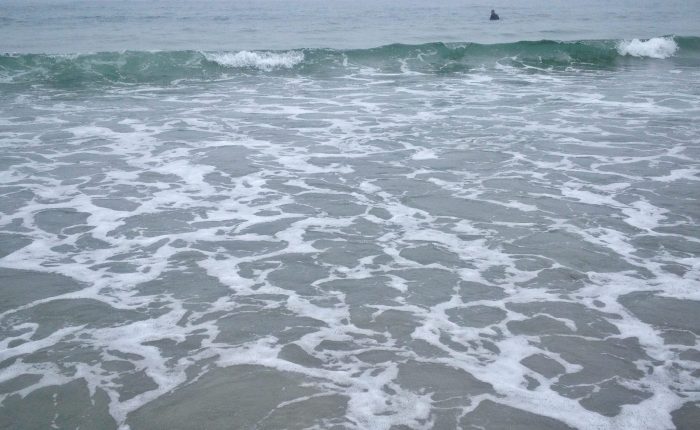
We shoved boards and wetsuits into his SUV and drove the last leg to Higgins. It was still early. A grey light hung over the ocean, clouds unwilling to abandon the morning turned the water dark. Waves barreled toward shore in haphazard fashion, smashing and grinding into each other.

“Oh, this should be fun,” I said. Nick sipped a coffee from Higgins Beach Market .

We parked, suited up and headed for the water. There were a dozen surfers in already. I strapped on my leash and headed in. Nick did the same.

When the first wave hit, a wall of foam and white, it pushed me off my board, spun me and slammed me down. Then another. And another. My board, too big to push under the surface, became a launchpad with each blow. I gasped for breath, regrouped and paddled as best I could, but there was always another wave, and then another.

I watched Nick flip and go under. A wave slammed his overturned board. He popped back up, paddling hard, water churning around him. He got slammed again, but he kept pushing. He was making it out. I was not. Another wave-wall came, pushing me back further. The next one flipped me. I groped for my board, gasping for breath. Then another came. Then another. My arms were left slapping at the water. I was barely moving. They kept coming in fast and from every direction, spilling into each other. I wasn’t making it, the wall had me. So I turned.

It’s a strange thing, giving up. It makes sense sometimes, like when your breath is slowly running dry, but it doesn’t feel good. And if you don’t keep diving into unknown challenges it’s easy to forget what it’s like. In rock climb I don’t often back off a route without at least an honest try. But surfing isn’t rock climbing, and “honest try” means different things in different places. The ocean is something I know far less about. This wasn’t the mountains, wasn’t the dance of movement over stone. So I turned around.

I caught the whitewater of the next wave and rode it in. I was on the beach in seconds, still panting and heaving from the effort. I turned around and watched the surfers in the distance rising and falling, rising and falling. Nick was among them.

Sometimes the waves are just too big. But there is something wonderful in stepping up to the plate at a new challenge, something special in trying while not knowing. When the dance is not endlessly rehearsed there are bound to be failures. I sat on the shore watching the churn.

Then, as I looked out, a pattern emerged. The waves to the right were breaking in chaos, but to the left there was less white, less overlap, not a gap but more quiet. It wouldn’t be enough for an unobstructed paddle, but it offered one with fewer hammer strokes. I kept watching to make sure I wasn’t seeing things. No, it was there. I could get out that way. Or I could at least try.

I waded in up to my waist, still fighting whitewater, popping above it when I could, but watching as I went. I worked my way slowly, waiting for the moment the sea would open for me, the pause that would allow me passage.

Then it came: I saw a gap, pulled my board underneath me and paddled hard. The waves rose but not as high, crested but didn’t break. My arms held, tired but able to pull through the lull. They carried me far enough; I glided past the kill-zone and into the calm. Nick was there, his wetsuit hood pulled around his neck. He waved, then turned back to the ocean. I did the same.

There is something wonderful in movement unrehearsed, in a dance of not knowing. Maybe it makes you give up. Maybe it drowns you. But sometimes it lets you through. Those time are special.


IMG_8046

The Road, and Everything Else

The Road, and Everything Else

IMG_7411.JPGThere’s something about the road.

It doesn’t matter how many times people write about it, how many times people say it, the truth of it always resonates: There is something about the road. Maybe it’s the unsteadiness of it, the unpredictability. It cracks people open, leaves them vulnerable, open to spark and tangents. It pulls us in unforeseen directions, leaves us with fresh perceptions. There is something beautiful about it. Something primal.

I was outside just after dusk last night. 100 steps from the house was silent, dark. Then a flash of green, and another. Slowly they multiplied, a sea of beacons blinking around me: fireflies. The first of the season? I couldn’t tell. I hadn’t noticed them before last night, but was that because they weren’t there, or because I’d been distracted? I don’t know. But seeing them was like magic.

How much to we forget to see? How often do we look at the world as mundane because we have grown accustomed? And once we’ve stopped seeing, how do was see again?

That is the gift of the road. It brings us back to our senses, to our sense of wonder. The things that we grow accustomed to at home become new again in our absence. The fireflies regain their spark.

I hit the road in a few days. A week of freediving in the Florida Keys, then out to California for some friends, diving and climbing, then up the Pacific Coast to surf, climb and explore the Pacific Northwest. From there I catch a flight to Belize where I’m working with high school students on a service-learning project for three weeks, then diving for a week. Then it’s back to the PNW, and who knows, maybe more climbing, maybe Canada, maybe drive east.

But as much power as the road has for revealing the richness of our existence, I’m still caught among a mixture or emotions. It’s strange to be preparing to leave again. Today marks two weeks since I got home, barely time to settle after two months of climbing, diving, surfing and friends, adventures that began on one coast and ended on the other. It’s been two weeks of family, friends, oceans, rivers and lakes, cliffs and mountains, coffees and laughter. There are so many things that make life rich, and adventure is but one of them.

Adventure, however, is the one I know well. My heart can throw itself into lost wandering at a moment’s notice, barely a change of clothes in hand. When I was 15 I started carrying a toothbrush, a towel and a fresh pair of underwear with me everywhere I went. I wanted to be ready to wander, always. It’s a habit I’ve only built on over the last two decades.

IMG_0400But there is another version of adventure, a kind that doesn’t require plane tickets and mountains; an emotional kind, a personal kind. It is standing in front of a roomful of people and speaking honestly about something that scares you. It is taking the stage to sing, talking to a friend and admitting you were wrong. Saying “I don’t know” in a roomful of colleagues. It is revealing your heart, your beautiful raw self, with openness and vulnerability, being your true you in a crowd. Those are a different kind of adventure, the kind that build build bonds not just to ourselves or to one another, but to society, to community. They are nature, but not as we normally seek it. They are us in our natural state, us as us.

Those, I find, are rarer on the road. They may be there with one person, or with a few, but to throw ourselves into the depths of our community and be our richest, rawest selves, we need society. We need a critical mass of humanity. We need room to be among the members of our tribe.

That is not the adventure I’m known for. That is the adventure of musicians, artists, dancers, not those we typically call “adventurers.” But it is in the same spirit, lives within the same reckless heart, that someone takes to the stage for the first time to act in a play. To climb a mountain is no more daunting. This is the full spectrum of “adventure.”

My life of late has been full of the mountain kind. It has been full of rope and remote places, plane tickets and passports, oceans and overhangs. Some call it “Living the dream,” but lost along the Pacific Coast Highway is only one kind of adventure, and many versions call. The Dream includes every version of risk.

The Road. That is one thing, and I will soon be back on it. It is a course I can easily take—my bags are still always packed. But the other version of recklessness—the vulnerable human kind—calls too. And to access it takes more than plane tickets, more than wandering. It takes people. It takes community. It takes a crowded room. It takes a willingness to cut through the mundane, to reveal things normally kept hidden. It takes a bold heart, one poised for emotional destruction, not just physical.

And just like wandering the remote enclaves of nature, there is tremendous beauty hidden on these adventures, moments full of richness and light. But they are seen together, shared, not lived alone.

There is something alluring about that. As alluring as the road.

10,000 Seafloor Clicks

10,000 Seafloor Clicks

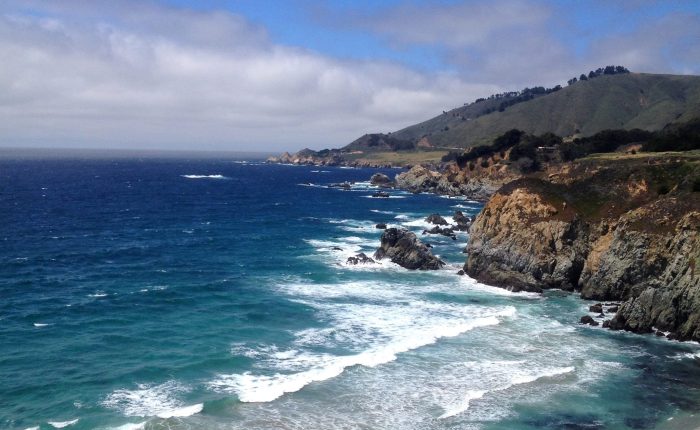
13235224_1490935110932569_1854608173923259447_oIt’s a long drive from Monterey Bay to San Diego, punctuated by towering seacliffs and emptiness. It’s the kind of drive were you find yourself pulling over every five minutes, where the landscape looks sculpted by god. Big Sur. Kerouac’s coast. Every photo looks magnificent, but none are able to capture the spirit of the place.

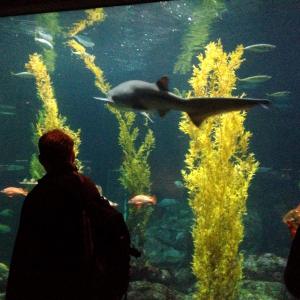
I spent the morning at the Monterey Bay Aquarium, where you can pet a stingray, watch bluefin tuna and hammerhead sharks grow frantic around shimmering clouds of sardines, see hoards of jellyfish from inches away and marvel at octopus species so different one looks like graffiti and another like camouflage. It took hours to wander through the exhibits, past giant bass and sharks and sea anemones.

One small crustacean I barely took notice of was a shrimp. He was a few inches long, with a pair of lobster-like claws, one substantially bigger than the other. His name? The snapping shrimp. I definitely saw one stowed underwater and behind glass, but I barely took notice. It was just another weird little ocean creature, nothing as majestic as the large pelagic predators or as striking as the brightly colored fish. It was just a shrimp.

13235634_1490935080932572_338291320125641097_oThen I started driving. I skirted my way out of Monterey, past Carmel and onto the Pacific Coast Highway. Hours clocked past. The landscape grew into lofty hills above an azure sea. First cell phone coverage faded, then the radio stations. “Next gas 62 miles,” the sign said.

But I come prepared for such terrain: I plugged my iPhone into the auxiliary jack and scrolled through my podcasts. Suddenly one of my favorites caught my eye—Radiolab.

The episode was called “Bigger than Bacon,” and it was about this strange sound emanating out of the ocean: a crackling, like the popping of bubblewrap. What was the culprit? Snapping shrimp!

But more amazing is the power of that sound, as well as the phenomena that accompany it. The snapping is masked by water, muffled, but in reality each snap is roughly 220 decibels, or about as loud as a jet engine. The claw closes at 60 miles an hour, but it occurs in a space so small something amazing happens: at the base of the ocean where no air sits, the snapping shrimp’s claw closes so quickly it forces away all the water, literally vaporizing it, creating a vacuum, an air bubble. Suddenly a void exists where previously there was none, a brief spot of emptiness created by a couple-inch-long organism.

And when the water rushes to fill that space it does it with a vengeance. Molecules slam into one another at such a pace that the space that was once a bubble heats up to 5,000 degrees, the temperature of the surface of the sun. On the seafloor. In the claws of a shrimp.

Seriously. This is no joke. This is real. Scientists even captured it on video:


But here’s the best part: as I listened I drove. And I drove. I drove past the pristine shores of central California, past Santa Barbara and Ventura and the megapolis of Los Angeles, to San Diego, to friends and surf and southern California beaches. I spent a week there, surfing, eating tacos and diving; swimming through Pacific waters in a mask, fins and snorkel, chasing sea lions and Garibaldi fish and leopard sharks.

And the whole time I heard snapping. Every time my ears broke the surface I heard it. I’d never noticed it before, never paid enough attention, but now whenever my head went underwater it was an orchestra. The shrimp were everywhere. I could hear the snapping of their claws at the surface, and when I dove it only got louder. I never saw them, but I could picture the little crustaceans scampering across the seafloor, smashing their claws together like Marvel Comic heroes generating plasma-like heat rays in their palms. The floor of the ocean was on fire, but only the shrimp could see it. And me.

(The full Radiolab is definitely worth a listen. Maybe on a drive?)

https://www.wnyc.org/widgets/ondemand_player/radiolab/#file=%2Faudio%2Fxspf%2F603688%2F

Saving Caucasian Snow

Saving Caucasian Snow
11935159_10206619945471708_9033694213573887170_o
Part of our team on the north summit of Aragats. Tim Terpstra photo

Last September I took a flight from Boston to Yerevan, the capital of Armenia, a country I had barely heard of and knew even less about. Tucked in between Turkey, Iran and a handful of former Soviet republics, it is an arid plain with a history of invasion and cross-invasion.

It is also home to the Lesser Caucus Mountains, part of the mountain range that divides Europe from Asia. I was there on an American Alpine Club climber exchange, teamed up with Americans, Armenians and Iranians climbing our way across Armenia and Georgia, everything from single-pitch sport and trad routes to alpine snow and ice up 5,000 meter peaks. It was a tremendous three weeks, one full of new friends and meaningful connections.

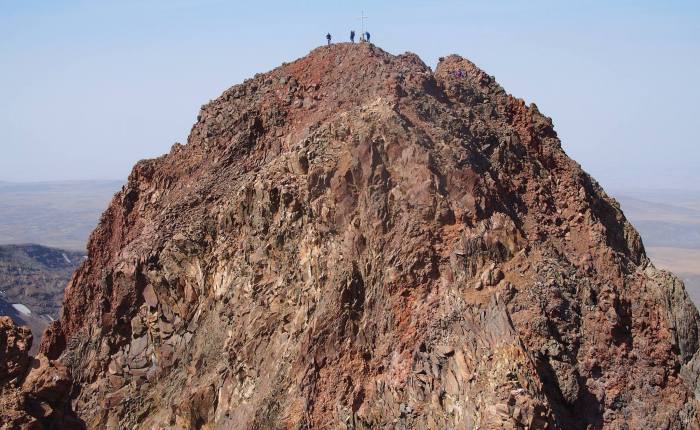
One of the mountains we climbed along the way was Mount Aragats, the tallest peak in Armenia. (Historically Mount Ararat was the tallest peak in Armenia, but it’s now part of Turkey, and the border is closed. This is a painful fact for Armenians.) Aragats has four distinct summits, the north being the tallest at 13,420 feet. Climbing it means clambering over loose shale and boulders to windswept ridges. Most of the mountain feels unstable, like stacked blocks barely held together. There was one small patch of snow tucked beneath the southern and western summits, but otherwise it was dusty, dry and hot.

Historically, however, the snows of Aragats have held through the summers. They have kept creeks flowing in hotter months. Prior to escalating global temperatures, Aragatan snowfields would last through the year and provide a stable source of water through dry times.

Today, however, high temperatures melt things quickly, leaving the valleys flooded in the spring and parched by fall.

This short documentary by Armenian filmmaker Vardan Hovhannisyan lays out what is happening, and what local scientists are trying to do about it:


Yep. Thermal blankets. Several of us noticed them on our descent—white mounds squirreled away beneath the south summit. We didn’t realize what they were, that they were an attempt to save Aragats’ last few patches of snow. I remember discussing them when we got back to camp, but no one could tell exactly what they were. Now we know.

Blankets. Is that the solution to global warming? For now, the answer in Armenia seems to be yes. But it’s a lot of pressure for a few swath of fabric. What if the blankets insulate too well? Or not well enough? How many do they need to makes sure there is enough water? Do they have to cover the mountain? What happens if things don’t last through the summer?

These are complex questions, ones previously left to nature to ponder. But lately her answers have left Armenians parched. Now it’s up to Armenian scientists to see if they can do better.

When we were there in September our team didn’t know the difference. We didn’t realize we were walking over fields usually covered with snow. We scrambled the bare rocks unaware they normally would be entombed by snow.

To us Armenia was just dry. Now we know why.

Rhinos, Horns, and Compounding Complications

Rhinos, Horns, and Compounding Complications

Moz-1020958I was working this morning when a story about the legalization of the rhino horn trade in South Africa drifted across my computer screen. The South African Supreme Court yesterday struck down a ban on domestic sales of rhinoceros horns. International trade is still illegal, but the verdict makes it possible to now sell horns inside the country.

Harvesting horns can be done without killing the rhinoceros. If the horn is cut off above the root it will grow back. One rhino rancher in the story said he had stockpiled five tons of horns since the domestic ban was implemented in 2009.

But the lifting of the ban opens the door for the sale of illegally harvested horns too. And considering the value of rhino horn, the market demand in Asia and the corruption prevalent in South Africa, it seems destined to bolster the illicit trade.

Two years ago I was in South Africa. I was there for work, but I had time to tour Kruger National Park, one of the largest game reserves in Africa and home to many rhinos. I drove through after a week in Mozambique alongside Majka Burhardt working on a development project in the newly-born Limpopo National Park. The project was short-lived, but it gave me a chance to see Kruger, and Limpopo.

It also gave me a chance to see just how complicated effective conservation can be, even when what is at stake is something as endangered and iconic as rhinoceros.

Limpopo abuts Kruger National Park, sitting just over the Mozambican border. It’s about half the size of Kruger, running roughly half its length. On paper the two are similar—massive game reserves that together form a transnational park—but where Kruger has a 100+ year tradition of conservation Limpopo is brand new. The roads are rough, the facilities primitive, the infrastructure nonexistent. Mozambique is nowhere close to South Africa in its development or its ability to provide effective governance. One South African telling us, “This is real Africa,” like his country was Africa-light.

And it seemed true: South Africa is far more developed than its neighbors. The Mozambican government had hired a team of white South Africans to help implement the new national park and teach Mozambique the techniques that had made Kruger successful. And those South Africans collectively shook their heads at the challenges in Limpopo.

The largest challenge? Poaching. Specifically, rhino poaching. But not in Limpopo; in Kruger. Poachers were using Limpopo as a launching point for excursions into Kruger, where stocks of rhinos were plentiful, and as a refuge for once they had possession of a horn.

Limpopo is a new park, new enough that it still contains villages. As we passed over its rough dirt roads small outposts of huts sprang up. Inhabitants numbering in the dozens, perhaps up to 50. Those villages, according to park officials, are where the poachers live.

But Limpopo lacks animals. In two days there we saw one Cape buffalo. In Kruger we saw whole herds. We saw zero lions, zero elephants, zero hippopotamus. Compared to Kruger Limpopo was desolate, empty of the game that make African parks famous. A hunting concession in its former life, Limpopo was barren. So while the 20th century offered Kruger’s animal populations protection, Limpopo’s fauna faced getting shot. Today anything within its borders is protected, but in reality there isn’t much left to protect.

And according to park officials, the villagers in Limpopo include teams of poachers who sneak across the border to shoot rhinos, hack off the horns with axes and then return home.

As we drove through the villages an official pointed to one of the huts. A pickup truck sat parked out front. “That’s a poacher,” he said. They don’t hide it. They don’t have to.

On the Kruger side, however, they do. In the field it’s often the sound of the ax that gives them away. The chopping—you can hear it for miles. But still, it’s hard to catch them in the act. Often times patrols find the bloody carcass with a snout in tatters.

It would be tempting to just move the villagers, to declare Limpopo a park and demand they find somewhere else to live, but this isn’t 1898. Native people have rights, and like the rhino, they also are in need of protection. Limpopo officials would love to pick up the villages and relocate the inhabitants outside the park, instantly cutting the poachers’ easy access to the rhinos, but in the modern era relocating native people is no simple task. What is the government to do, put them on “reservations” somewhere nearby? The world has a long history of such maneuvers, of taking people pulled from their native soil and forcibly settled on some new plot of land. Few of these tales have happy outcomes.

So in Limpopo the rights of villagers to clash with those of the rhinoceros. Protect the rights of one or the other, but not both. Who should officials prioritize? In hindsight either choice will likely wind up seeming crass and misguided.

But perhaps that is modern conservation: the easy problems have been solved. What’s left are difficult, intractable ones. It might be that way everywhere, not just in Limpopo.

And now South Africa has cracked the door to the rhino horn market. The problem doesn’t grow any simpler.

Sea Lions and Blown Eardrums

Sea Lions and Blown Eardrums

13221217_1494289507263796_1857274098760016918_oIn freediving they teach you to protect your ears. Don’t go down if you feel any pressure, they tell you. Equalize constantly using the Frenzel Maneuver as opposed to the more air-intensive Valsalva Method. If your wetsuit is hooded poke holes at the ears to ensure no unintended barriers disrupt clearing.

But you can’t plan for everything. Like sea lions—nobody warned me about those.

La Jolla is on the north side of San Diego. It’s a marine sanctuary on the edge of the city, the kind of place tourists and locals alike flock. The water is cool but clear, and it’s lined by beaches, caves and one well-known cove: La Jolla Cove, where the sea lions are.

We’d already seen one sea lion two days before snorkeling from the beach to the caves. It was evening, growing dark soon, but Reza suggested we could get to the caves, which offer exploration opportunities. Along the way we’d pass troves of leopard sharks. So we suited up, waded into the breakers and swam.

The waves were bigger than we expected. They slammed the nearby seawall, throwing spray into the sky. The sand floor churned. There were no leopard sharks. “It must be too rough for them,” Reza said, “but not for stingrays. Watch out for them.”

One slid past, its wings beating in unison, its body gliding over the sand. I swam after it, watching its path arc and bend. But it didn’t take long to lose me. Soon I was aimed for the caves.

The swell that scattered the leopard sharks was disturbing the caves too—each wave flooded the hollows, pounding the insides. I went in briefly, flushed by the surge, but it wasn’t a place to stay. We swam out a safe distance and watched the pounding, opting for a perch among the seagrass as it streamed back and forth in the depths. A few leopard sharks poked around, and fleets of striking orange Garibaldi fish, the state fish of California. But dark approached, and soon we were heading back towards the beach.

That’s when it happened: A seal popped up. Or a sea lion. He was just a few feet away, his nose pushed up out of the breakers. He was playing in the waves, snaking between us. He knew we were there, and he didn’t care.

“That was SO COOL!” Katelyn shouted, shivering. She was right.

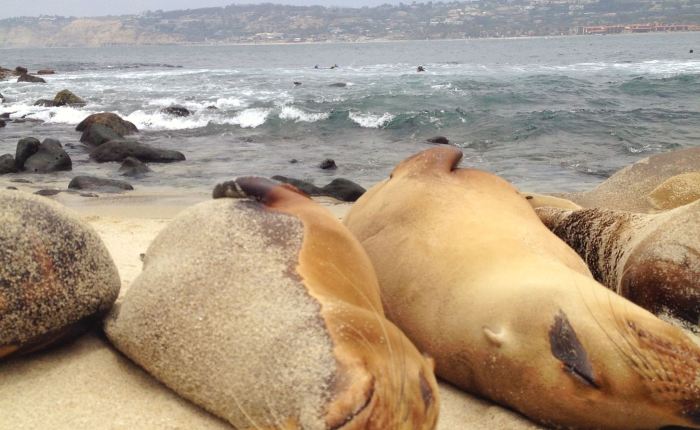
Two days later we were back, but instead of the beach we went to the cove, the hangout for sea lions. It’s a public park, but it’s unclear who it’s intended for, humans or wildlife. The left side of the small beach is covered with 400-pound sea lions and their pups, joined by people snapping selfies. It’s chaotic, with the occasional sea lion charge. But on land they waddle more than run, and the crowds were able to get out of the way. Sometimes, though, there was lots of shrieking. (There was a This American Life story about this sea lion/human dynamic. It’s worth a listen.)

The right side of the beach, meanwhile, is the domain of swimmers and snorkelers, humans looking to explore the wetter part of the cove. That’s were we set up, pulling on wetsuits, donning masks and fins. I wadded in, trading the noise of the beach for lapping waves.

In the water the sea lions were everywhere: snaking through the depths, turning and barrel-rolling in the waves. They were dancing, playing in teams of two and four. I dove with them, trying to hold my breath and keep up as they rocketed past rocks and reed beds. The were so fast, underwater torpedo-shaped bears. We dove and dove and dove together; they weren’t scared of me. They swam around and investigated me, peered at my wetsuit, fins and snorkel, but never too close. They were like underwater mirrors mimicking my dives, always partway across the room. I’d come up breathless, but then another would swim by and I’d follow. They never ran away; they swam unconcerned.

“That was AMAZING!” I said when I came out for a break, panting. “I could do that forever.”

And soon I was back in the water, again surrounded by sea lions. Four of them sliced through the swells around me, sleek as sharks. I watched them spin as they rocketed below the surface. I dove and joined them, imitating their twisting and corkscrewing.

That’s when I felt it—as I spun a little pocket of air in my ear canal bubbled out and danced toward the surface. Seawater rushed into the void. I felt it slam cold against my eardrum. There was a brief, sharp pain, and then I felt woozy. I was less than two feet below the surface, but I needed air. I pulled up my head and tore off my mask, tried to catch my breath, but the ocean, the waves around me, even the beach seemed to be swaying. I cleared my ears, but something wasn’t right. I tried again, but no. My four copilots were gone, swum off. I was bobbing alone in the waves, barely able to hold upright.

I cleared my snorkel, pulled my mask back on and slowly turned towards shore. I paddled gently, without thinking or pushing, sure I’d blown my eardrum. Not great. I reached the sand and pulled my fins off, letting the water hold me up. Walking out felt like climbing into a tunnel—the noise of the crowds and the sea lions faded to the periphery. There was blackness at the edges. I sat on a rock and again tried to clear my ears, but nope. I’d definitely done something real.

They don’t teach “Never barrel-roll with sea lions in the Pacific” in freedive class. Maybe that would be too specific a lesson. But now I know. And a little Googling has taught me a perforated eardrum needs six to eight weeks to heal. I’m headed to the Florida Keys in three—I’m hoping for the accelerated program.

And it was only afterward, after more Googling, that I understood the difference between seals and sea lions. Sea lions are much bigger, and they have a habit of being occasionally aggressive around humans. The explanation I read was seals are aquatic weasels and sea lions descended from bears. I’m glad I didn’t know that as I stared face-to-face with them. They were bigger than me, much better swimmers. But they were also amazing. I’d do it again in a second. Eardrum and all.

On the Road

On the Road

13071776_1474279299264817_5955152375711111058_oI stood by the side of U.S. 191 waving my arms. Another car slid past. Then another. And another.

“Damn it!” I shouted after the fifth went by without slowing. “Stupid!”

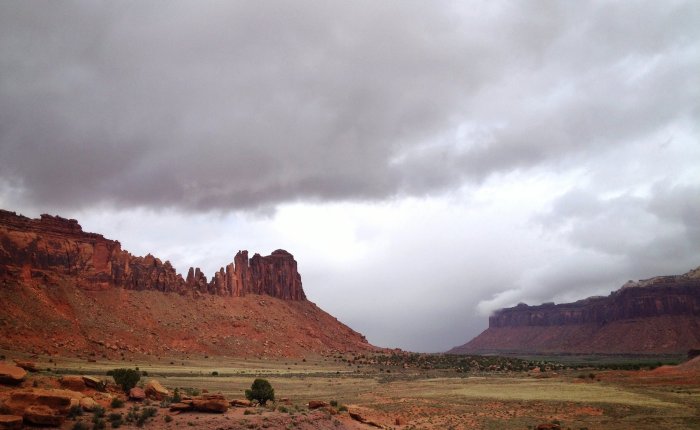
Rain was beginning to fall, and the wind had picked up. The clouds hung low over the mesa. The La Sals were covered in snow.

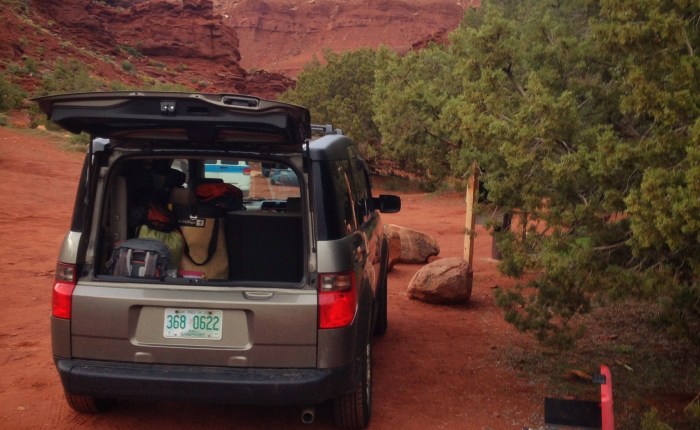
I was 25 miles from Indian Creek, 40 from Moab, and the battery in my Honda Element was down to Empty.

I’m such an idiot sometimes.

The plan was for a rest day. After three days of sandstone splitters my fingers were shot, my hands were raw and my arms were spent. I needed a shower, a refill on water, some internet and a grocery store. But instead I was on the side of the road miles from anywhere hoping against reason to flag down a pair of jumper cables.

Sometimes the adventure on climbing trips has nothing to do with the climbing.

Everything began in April. First stop: Washington D.C., the climbing Mecca. Andre, my scheduled Red Rocks and Yosemite partner, offered a session at Earth Treks and to let me crash in his spare room. After a New England winter of ice and snow it felt great to pull plastic. Humbling, but fun.
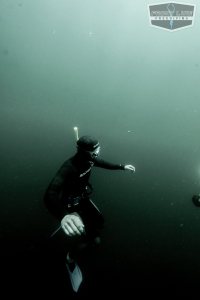
12961430_1458805094145571_3194725830949882464_oFrom there I drove on to Wilmington, North Carolina, for a weekend of freediving, descending like a SCUBA diver but without a tank, holding my breath as the light faded through the meters of oceanwater. Stealth-camping in my Element, eating meals out of Wholefoods, it felt like any climbing weekend, except that the worst advice you can give is “BREATHE!”

From there I drove west, the favored direction for the next six weeks. The first real climbing stop was Eastern Tennessee and two days at a secret cliff a friend was developing. “It’s a mix of the Red and the New,” he told me, “more technical than the Red but fewer stopper cruxes than the New.” An oath of secrecy later I found myself below a 40-meter high cliffband stretching from hollow to hollow, perfect orange rock towering above.

13002451_1459754597383954_5867903751223971741_o“This route is five stars,” my friend told me again and again. He was right. Beautiful sandstone, and to ourselves. We put up a new 5.12 with a fun bouldery crux near the ground and bolt after bolt of devious climbing above, 16 bolts of perfection. The Southeast is still full of hidden gems.

But I had friends to meet in the Red, as well as a project to attend to.

For Northeasterners the RRG is a transition ground, the place to switch from pulling on ice tools to grabbing rock holds. It’s a spring pilgrimage, one seldom observed fit for rock climbing.

A few years ago I caught a glimpse of Cell Block Six, a soaring line on the Midnight Surf wall. It called to me, a perfect transition route—big holds, big moves, lots of airtime—it seemed to shout “Welcome to sport climbing season!” I wanted on.

So day one: Warm up slow on 5.10, then head to where the cliff arches at angles that block the sun. Get on the project. Fall all over the project.

Day two: Recover from Day one.

It took two days of gravity testing, pizza dinners and sandstone buckets to clip the chains, but a pair of handjams after the crux unlocked the route. Desperate through the crux, I recovered enough in those jams to feel like the chains came too soon. The transition to rock season was on!

With the project in my pocket I turned west again, to Indian Creek. It’d been 13 years since I’d climbed in the Creek, I was due a visit. And after a few years mostly sport climbing the idea of splitters beckoned. Last fall I was part of an AAC exchange to the Caucus Mountains, climbing rock routes and alpine peaks in Armenia and Georgia. Our host was a strong and energetic Armenian named Mkhitar, and after the trip our group wanted to return the hosting favor. Mkhitar accepted an invitation from exchange member and famous alpinist Jim Donini to take a month-long tour of American rock, from the Creek to Red Rocks to Yosemite to the Black Canyon. Anyone who wanted to join was welcome to tag along.
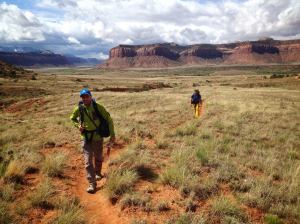
13123396_1475909295768484_6295289621947350976_oThat’s how I landed on the side of the U.S. 191 waving in vain at passing cars.

The Creek is buried in technological darkness. Indeed, that is part of its appeal—no services, no cell coverage, just coyotes and varnished sandstone. The camping is primitive, the climbing superb. After the noise of Miguel’s and 1,000 miles of highway I sunk into that darkness with relish.

Jim, Mkhitar and a small crew had already staked out a camp and were on the rocks when I arrived. I spilled out of my Element and roped up, barely 7 hours out of Denver. Mkhitar’s face was stretched thin in a smile as he looked at the walls surrounding him. It was going to be a good trip.

But two days later after pitch after pitch of steep sandstone I needed a break. I tumbled back into my car and headed north. Rain spat as I climbed out of the canyon to the plateau, occasionally unleashing in waves, then quiet. I turned on my wipers, then my headlights. Red mud rinsed the land around me.

The first cell signal popped up a short distance from where the road to Indian Creek intersects the highway. My phone buzzed to life; emails downloading, text messages vibrating. I pulled over and switched off the car, leaving the key turned one click to listen to the radio. Three days away and a lot had happened; I started sorting through the layers.

Half-an-hour later, still sitting by the side of the road replying to a Facebook messages, the radio went silent. My phone battery indicator went from green to white.

“NO!” I shouted, suddenly realizing I’d left my headlights on. “NO! You idiot! What are you doing?!”

Half-an-hour—roughly the time it would have taken to get to Moab, where I could have done all of this internetting in the library, surrounded by central air, electric outlets and comfy seats. Instead I was now the proud owner of a dead Honda, parked in a patch of mud along the highway, rain moving in.

I tried the key: Nothing but clicks. I tried waiting a few minutes, hoping maybe the battery would recover enough residual charge, but I was too panicked to let it sit more than 90 seconds. More clicks. Finally I accepted what I had done, what I would have to do. I pulled on a fleece and stepped out into the spitting drops.

The first dozen cars didn’t even slow. Then came the fleet of rentals. “No,” the driver’s would say, one after another, “I don’t have cables. This is a rental car.” One guy offered to send help when he got to Monticello, but that sounded complex and expensive. “At least let me call you when I get there,” he said. “If you are still here I can send someone.”

I relented and gave him my phone number.

Drivers would see other cars pulled over and would pull over themselves, but they too had nothing to jump a battery with. (I, of course, was in no position to throw stones—where were my jumper cables?) I started to grow worried this could get expensive. I had cell coverage. I could call a towing service for a jump. But that felt like expedition tactics, resorting to aid climbing when I had set out for a free ascent.

I have learned that sometimes you can tell a car that has jumper cables. Sometimes the giveaway is the vehicle, other times it’s the driver. This time it was both. Truck. White. Extracab. With a diamond plate toolbox in the bed. A Utahn in his 40s with sandy hair, a mustache and well-worn Levi’s.

He was coming from the other direction. He slowed down and made a u-turn, pulled over all the way to the dirt embankment, letting his truck handle the terrain. He drove towards me, standing small against the desert, but stopped a few yards away. He was on his phone, and he just kept talking. He held up a finger. “One minute,” he seemed to be saying, “I’ll take care of this in one minute.”

Other cars were streaming past. I could be out there flagging them down, I thought. But I had a feeling.

He hung up the phone and rolled down his window.

“Do you have jumper cables?” I asked. The feeling was growing.

He paused, answered slow.

“Yep.”

The feeling was hope. “Can you give me a jump?”

Another pause.

“Yep.”

Another handjam rest. Maybe this crux would go too.


This piece originally appeared on the Trango website.

Cuba: Island found, or lost?

Cuba: Island found, or lost?

Cuba-2570“How do you get there?” It’s always the first question whenever I tell someone I guide trips to Cuba. Maybe they’ve heard of Americans slipping in illegally through Canada or Mexico. Maybe they figure I’m doing the same.
“Miami,” I reply. “By charter. It’s less than an hour flight.”

The next line is also scripted: “Well, now’s the time to visit. Before the Americans get there and screw it up.”

To be clear, these aren’t Europeans, Canadians, or Mexicans I’m talking to, they are Americans. Most of them haven’t visited, but they know Cuba is opening, and they know when it does Americans are going to ruin it.

The Cubans I talk to aren’t so sure. When they hear “American,” they smile and reach with both hands. “It’s about time,” they say, eager to shake.

View Story
Cuba: An island seeks to connect
I hate to be the one to do this, but I’m here to tell you that the frozen-in-time utopia is not a realistic picture of present-day Cuba.

My job as guide to Cuba is a new one. Before last December, before President Obama announced reestablishing US-Cuban relations and loosening travel restrictions, just visiting could have landed me in jail. Even now the US government forbids tourists from going; our groups are classified as “people-to-people” exchange trips, and they require US Treasury approval.

There are no beach visits or snorkeling trips on our tours. We go to meet Cubans, experience the culture, and explore a country hidden behind 60 years of embargo.

That’s why participants go. I go to watch history unfold. If those Americans are right and we are going to ruin Cuba, then I am the leading edge of the invasion force. The destruction — the Starbucks, McDonald’s, and Marriotts — will come in my wake.

But despite the risk, Cuba’s excitement for what comes next is palpable. On our April trip, every time someone learned our group was American, they got excited.

“Do you think it will happen?” they said. “Will the blockade end?”

Then President Obama shook hands with Cuban President Raul Castro, and overnight we became celebrities. Whenever we were in the street and people learned we were American, they’d grab us.

“You’re Obama,” they’d say, grabbing our hands, “I’m Castro.” Then they’d shake vigorously, smiling. This didn’t happen once or twice. This happened a lot. Our group was there to meet Cubans, and the Cubans used the opportunity to re-create an emblematic moment of their expanding future.

It’s a moment that keeps moving forward: My last trip coincided with the US announcement it would reopen its embassy in Havana. Next time I visit, the embassy will be open. Things are changing fast.

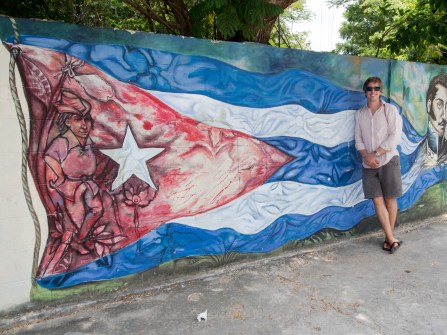
But not everything. The streets are still flooded with 1950s Fords and Chevys, and the faces of Fidel, Che Guevara, and Hugo Chavez still loom large on countless murals and billboards. Soviet-style architecture still dots the Havana skyline, and when the sun goes down, crowds still swarm the Malecon, Havana’s iconic 8-kilometer seawall.

Cuba seems caught somewhere between the developing and developed world: Everyone has health care and a university degree, but buildings are falling down and basic goods can be scarce. But it’s that juxtaposition that makes Cuba remarkable. There are few places in the world where I would encourage people to go out after dark to wander the streets and look to strike up conversations, but social hour in Havana doesn’t begin until 9 p.m. and crime is rare. If “people-to-people” interaction means meeting Cubans where they are, then it begins at dusk on the Malecon.

Other parts of the Cuba experience, meanwhile, seem cribbed from old jokes about the ills of central planning: the three elevators in the upscale Habana Libre hotel that have been down for months; the stores that just keep running out of bottled water.

Then there’s the undercurrent of hard currency that lubricates every interaction; nothing happens without a few dollars exchanged in the palm of a handshake. There are two sides to this game: One is that the government pays so little, everyone must supplement their income with “tips,” the other is that without a contribution, you might be turned away next time. The restaurant might be closed. The tour could be cut short. It’s part of how Cubans get by, and after 60 years in the shadow of the embargo, Cubans know how to survive.

And that’s the truth I come back to each time an American tells me we’re going to ruin it. A half-century of sanctions, spies, and submarines didn’t succeed. Instead, that time taught Cubans to think on their feet, to adapt and endure. As the country opens, Americans will come — for both vacations and business ventures — and Cuba will greet them openly, with a handshake and a smile.

But I’m willing to bet it will still be Cuban palms that wind up filled with folded bills, and again without losing their island.

I’ll tell you for sure after my next trip. Or the next.


This story appeared in the Boston Globe in August of 2015.

Quitting

Quitting

Yesterday I quit climbing.

It was 5:30 p.m. and growing dark. I was standing in my living room, naked from the waist up, a pile of outdoor clothes draped on the arm of the couch beside me. I had been waiting for this moment all day, for work to end so I could go climbing in Crawford Notch, but now that the moment had arrived I was faltering. “Should I go?” I thought, wearing nothing but blue Capilene tights. “Do I really want to? Or am I just going climbing because climbing is what I do?” Would my plan leave me smiling and satisfied, or would I just wind up wishing I was back at home? I didn’t know, so I just stood there in my long underwear watching the sky grow darker.

I tied into a rope for the first time at 17, and ever since I’ve poured myself into my passion. I’ve spent weekends, vacations and thousands of dollar on climbing. Now I can just describe it as what I do. It’s intricately linked to my closest relationships, my work and where I choose to live. It’s how I meet people, what I talk about with friends, how I relax, what social occasions are centered around, the focus of the organizations I donate to and how I volunteer my time. It has become more than a passion — it has become life.

And yet I quit.

I stood in my living room yesterday, lost in my head, naked, exposed, and I didn’t want to go climbing. “No,” I thought, pulling off my Capilene, “I’m not going. It isn’t me, not today. I’m not a climber. I’m just not.”

It wasn’t the first time I’d quit. I quit the day before too. I had plans to go to Tohko on Sunday with Scott, but after two days out at Ice Fest I was tired. I got home and didn’t feel it. “Not today,” I thought as I sat down to read. “I’m not climbing. Not now. Not today.”

It feels good to quit, to reject the passion that in many ways has come to define me. It feels good to put it down, to let it rest, to let the pressures and expectations that built up around it dissolve. Will I send my project? Who knows. Probably not, because I quit. And that’s OK. After weeks and months of doing nothing but climbing, I just walked out the door.

It doesn’t take long to fall into habits, and climbing is an easy one to fall into. When you climb every weekend, every vacation and every free moment it can be difficult to determine whether you are climbing today out of passion or simply because you climb. For me at some point the climbing flips from being a passion to being work. “It is the weekend again. Where are we climbing?” The desire to tick the next project, to push to through the next grade, takes over, and when it does the passion is gone. But I keep climbing because I know nothing else. What meaning does it bring at that point? What value? None. The feelings climbing can elicit are gone, and yet I stick to it. It’s become a habit, just what I do.

When that happens, I quit. I walk away. I put down my gear, fuck it, and do something else. I did it yesterday. I pulled of my Capeline, did some Googling, and instead went to a yoga class. It felt fantastic. I spent an hour and a half trying not to fall over. Every pose was taxing. I embraced sucking at something, free from any self-imposed pressure to perform. It felt the way climbing felt that first day. It felt the way it felt when I quit this summer — instead of tying in I went surfing, and I spent hours just trying to stand up. Ego stayed home during those sessions — I couldn’t afford its critique.

Quitting is liberating. It is freeing. It takes the thing that you allow to define you and puts it back in its place. Climbing isn’t life, it is an activity. It is a way to spend time, no more, no less. It can be fun or it can be miserable, depending on the day, but it is neither good nor bad. And when it starts to feel overwhelming, like it has become a job rather than a passion, the best thing I can do is quit.

And so yesterday I did just that. I quit. I walked away. I said fuck it, and in rejecting climbing I found freedom. It was in every yoga pose — the same feeling discovered 14 years ago, that first day I tied into a rope — the wonder of movement, the high of self-awareness, the intense connection between mind, body and breath. Instead of searching for that feeling in climbing like a heroin addict seeking another fix I looked somewhere else. And there it was. I found it. All that because I quit.

I’ve quit so many times before. I spent a year barely climbing once, and three years off the ice. I went on sailing and bicycling trips, spent weekends camping and watching movies, blew money on cameras, concerts and plays. I’ve quit countless times since too, and each time I discover how much I truly love my other passions. Quitting has allowed me to I train and compete in a triathlon, and it afforded me a stint in Iraq and Kuwait reporting for public radio. Quitting has given me much more than it ever took away.

Quitting has also let me discover, once I finally tie back in, how much I love climbing. The quitting helps me see my passion within a proper context, as one passion among many, all of which are rewarding and expand my perspective. Embracing the quit and the subsequent resurrection refills my passion. It allows the beauty of what climbing offers wash over me. It helps me grow.

Passion are meant to support us, to engage us and push us to new heights and levels of understand about ourselves, but if they come to define us they do the opposite — they make us contract. They can help us seek our own self-imposed boundaries, or they can form the foundation for those same walls. Climbing runs that risk for me. It is in so much of my life it can easily box me in if I sit back and let it. But in quitting I reject that mold and embrace the growth. Quitting allows me to look around with clear eyes and see all the other things I am missing.

It also gives me a chance to recommit. Every time I quit I get to rediscover the wonder climbing brought me that first day. Quitting reinvigorates my passion. Yesterday I decided I would not climbing. I quit, and rejecting climbing as a definition. I won’t go again, I told myself, until the drive comes from a place of passion, a place of love, a place of growth and willingness to accept the unknown. If the thought of climbing provokes a question about to whether I want to be there, whether or not I was making the right decision, I wasn’t going. Climbing should provoke feelings of elation, I reasoned, not exhaustion, so I quit. I just walked away.

Then today I got up and packed my bag for the rock gym. I’ll be there tonight, back on the wall, back among friends. My quit has run its course. My willingness to walk was the ingredient necessary to see my passion with fresh eyes again. After years of pitched battles (within myself always), it now takes just days to be ready again (except for those times it takes weeks or months). Today I’m back to climbing out of love rather than obligation. Quitting kicked the habit, and it no longer rules me. I cannot deny I my passion, but through quitting I let it re-bloom into a passion, a love, of my choosing. If it were any other way I’d have to quit.