Taxes, Improvements, Politicians and Papers

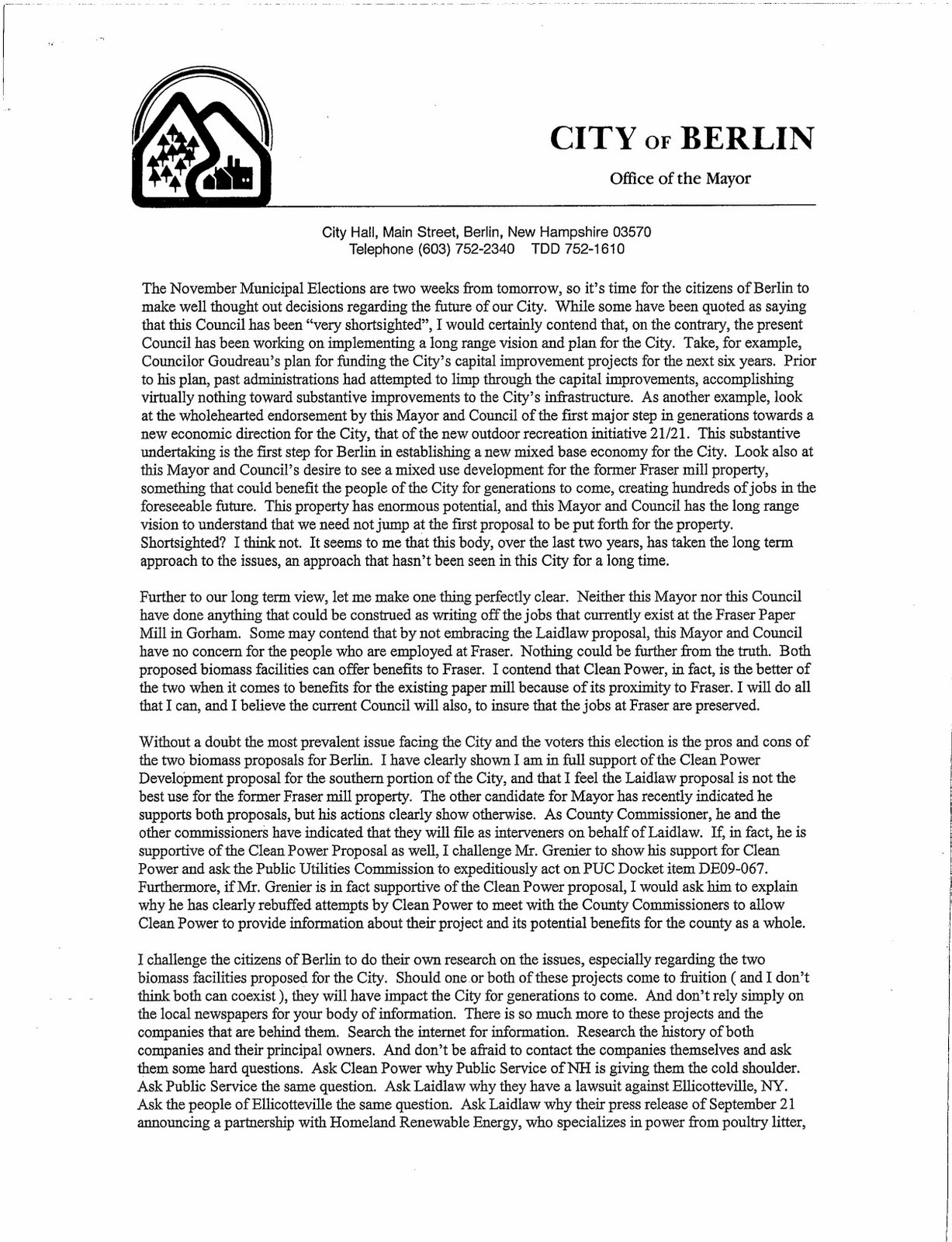
I am supposed to meet with Ron Goudreau and Paul Grenier (separately) to talk capital improvements and taxes. Mr. Grenier said the bond will result in at least a $1.67 increase in the tax rate, which currently is $29.82. Mr. Goudreau said the $29.82 includes the first year’s repayment on the bond. There won’t be a tax increase, he said, because the bond payments are already figured into the tax rate.
I minored in economics, so hopefully I have enough financial understanding to sort this out for the voters. I don’t think it’s enough for a reporter to write down what people are saying; they have to dig into the numbers and analyze what’s really there. There were sharp words at Monday’s meeting, and I reported them as well as I could. Now it’s time for me to look into the numbers behind the numbers.
So expect that in next week’s Berlin Reporter. I’m glad there are still people out there willing to pay the 50 cents. It keeps me in a job, doing what I love.

Side notes:

  • Mayoral debate at the Berlin city hall auditorium, Wednesday, October 28, at 6:30 p.m. Come see who you’re voting for and learn their positions.
  • It is constructive remarks like those LPJ has received recently that convince me to allow anonymous comments. Glad to see the discussion stay clean. I appreciate people posting, no matter the viewpoint, as long as their goal is to build a better Berlin. So thanks.
  • I bought the domain lastprintjournalist.com. I just put in a placeholder because I haven’t built the site yet, but I feel like I’ve got a fairly consistent thing going here, and I’d like to build it out. Journalists have to have websites these days, and I’m no exception. I’m not looking to move on from the Reporter, but I’m always looking for freelance opportunities, and if I’ve got a website to direct people to so they can see some of my work, it helps. Eventually I hope to have the the blog there, to house everything in one place, but for now I’m just saving my spot.
  • There’s a public hearing next Tuesday about the ATV trail.
  • It’s time to donate to NHPR. I freelance for them occasionally, and I’ll be reporting on Berlin’s ATV trail sometime in the next few weeks. They need money to pay me, so please, help me out by helping them.

I reread my story about Laidlaw investors saying they intend to send Mr. Grenier campaign contributions. It’s funny, but by the time stories come out I haven’t looked at them in a week. When I received calls and criticism about it, I hadn’t looked at it in a while. But after reading the story today I realize how off base those comments are. I thought maybe I’d screwed something up and been unfair to Mr. Grenier. But no, I was right on, and if I had to do it again I’d write the same story. I represented Mr. Borowski fairly, including his ties to the area and his good reasons for wanting to see Laidlaw succeed. I represented Mr. Grenier fairly as well, including his hesitation before he said he would reject any money from outside the city.
I thought maybe I’d left those things out. I thought maybe I’d been too worried about length and edited the story down. But no, I didn’t, I represented the various parties fairly and accurately. And in the end, no one in the story looks all that bad.

Sometimes accurate reporting makes people look like crap. That sucks, but that’s what I’m there for. Maybe there is some meeting going on in Berlin that, if made public, would make everyone look like jerks. I hope to be there. A few phone calls and complaints aren’t going to scare me off. My goal isn’t to make anyone look bad. In fact, no one has to answer to me. They are answering to the residents of Berlin. And of Gorham. And Milan, Dummer, Randolph and Shelburne. I’m asking questions for those people, because they don’t have the time to. It takes more than calling a fair story biased to make me stop. Or a page full of numbers.

P.S. Ryan — You don’t want to buy the paper if you stay in city government, because I won’t be able to curb my reporting for your sake. Sometime you’ll make an asinine comment that I’ll put in the paper, and you’ll want to fire me, and I’ll only have been doing my job, and it’ll be a great big mess. I agree, I’d like to see more people reading the Reporter. But the paper doesn’t come with the printing press. The daily owns their press. It’s in Conway and it prints three other daily papers; that makes their business viable. The Reporter is owned by Salmon Press, which owns 10 other weeklies around the state, which makes their business viable. Buy a press to print one paper and you’ll lose money at the speed of sound. Launching an online paper cuts that cost, but the advertising revenue online is negligible, not enough to pay for quality reporting. Berlin is struggling with the same challenges the rest of journalism is: how do you support quality reporting in the Internet age? Luckily community papers are successful enough to continue surviving. As far as I know, our market isn’t growing yet. I hope my reporting will change that, but in a world where people live more and more online that may not be realistic. There are blogs, yes, but few places online for high quality local news. Residents don’t need to read people’s opinions about what is going on in Berlin—they need the facts about what is going on in Berlin. There is not, at this time, a good model for how to provide that. I’m trying to resurrect a dinosaur here, singlehandedly. Berlin has a shot at rebirth, and it’s much greater than that of newspapers.
And Jon, thank you for the compliment on LPJ as a news destination. I’m glad people come here for news and to share their opinions, but there is 10 times as much news in every Reporter than goes on here and more in depth analysis. My story about shareholders didn’t break here, remember, it broke in the Reporter. We all come here talk about it, and people add value to my work by commenting here, but the fact is this is a side project that doesn’t pay for groceries or pay my rent. The real news is in the paper; this is just the 21st century water cooler.

I wish I had an answer for newspapers. They are so valuable. I love my work, and I think it is integral to maintaining democracy. I’m lucky to have a community and an employer that supports me. What the future holds I don’t know. Will Berlin support two papers when everyone gets high-speed Internet and starts posting their ads on Craigslist? I doubt it. Which paper will fold, or will both? I don’t know. But right now, at a time where Berlin needs quality reporting so residents can make important decisions about their future, the two papers are still there. Hopefully a new model will be created before the old one dies. Otherwise there won’t be anyone out there to find out who is giving money to what causes or who’s numbers about the tax rate are accurate.

So buy a paper. Maybe a subscription for your mom for her birthday? I don’t know, but I hope everyone reading this realizes the value of quality journalism. We need it, and the fact is, it isn’t free.
Anonymous Posters

I’ve had several people tell me I should restrict comments from anonymous people. I don’t want to do that, because I don’t like imposing restrictions on ideas. during tense debates, however, like are occurring this election season, commenters call people liars and thieves without signing their name. That is a sad. Everything I write has my name on it. Matt Borowski and Jon Edwards stridently disagree on politics in Berlin, but both men have the decency to sign their posts. The Internet has given people anonymity, which doesn’t help improve the discourse. Don’t be a coward and post without signing; stand behind your convictions and let us know who you are. Mr. Borowski has, and so has Mr. Edwards. Mr. Grenier has, and so has Mr. Bertrand. These people are willing to attach a name to their comments, whether they are online or in city hall. Before you jump to criticize their beliefs ask whether you’d be willing to do it publicly. If not, don’t do it, either out in the world or online.

I feel like a middle school teacher who has to occasionally quiet the class. There are great debates going on in Berlin. I’d like to have them go on here too, without the dead weight brought by a few individuals.

To everyone engaging in the great discussions: thank you.

Election Season

Last night’s city council meeting could have filled a paper. There were more public comments and back and forth than I’ve ever seen there. I had 600 words to capture the entire meeting. That sucks. 600 words is enough to cover one issue in depth, or two issues briefly. I chose one issue in depth, which of course meant I left a lot out.
The city needs to start videotaping the meetings. I, and no other print reporter, could capture the energy of last night effectively. But I could make residents aware something worth noting happened, and then they could watch for themselves to see what really went on.
To me, last night’s meeting was almost entirely political. Both sides made their stand, their appeal to the voters. Paul Grenier, Bob Danderson and Mike Rozak could be accused of provoking the politicization of the evening, but Mayor David Bertrand’s written mayor’s report was not a reaction to their comments. Both sides were taking advantage of the opportunity.
But there were some really interesting developments. Councilor Ron Goudreau’s challenge of Mr. Grenier’s numbers was great, if for nothing else than to clearly portray the differences in the two camps. Councilor Ryan Landry passionately urged Berlin to reject Mr. Grenier’s and Mr. Danderson’s ideas. His comments were emotional, clearly rejecting the return to the past these two men represent. They would resonate with some residents, but whether they represent the views of the majority of voters is unclear.
I couldn’t imaging a more interesting meeting. The entire city should have been there to watch. The next two meetings should have even more fireworks, particularly the one the night before the election, on November 2. That will be the public hearing for the capital improvement plan resolution, which, despite the candidates’ comments, the council moved forward. I can’t wait for that one.

But I didn’t even have room for the resolution the city did pass, to allow the police department to get a $10,000 grant. And I didn’t have room to talk about how the city decided to file for interveener status with the PUC in the Clean Power/PSNH affair. I didn’t get to talk about Jon Edwards’ comments, or Barry Kelly’s comments, because I was so pressed for space.

The newspaper is a tool, but it is no substitute for civic engagement. For the next few weeks, I hope people put down the paper, shut down the computer, and come to the meetings. See what these people are really saying. Try to understand it better. The Berlin Reporter or the daily paper are a horrible filter for what happened last night. So is the opinion of almost anyone who was there, because it’s nearly impossible not to have an opinion on these issues. But if you are there you can make up your mind, without having to rely on anyone else.
I am going to meet with Mr. Grenier to try to better understand his numbers to see if what he said last night was true. I am also going to meet with representatives from the council to see if their numbers for the capital improvement plan make sense. That is the job of a paper—to try to find the truth, not just print what people say. But the two different groups have such different visions for the city, it almost doesn’t matter what they say. Their views for Berlin are worlds apart, it seems, and Laidlaw is only part of it. The community needs to make an informed decision, and it needs to make sure its city council reflects their vision of the city’s future. What does that mean? Citizens need to show up. They need to learn what these people stand for. They have to hear the arguments for themselves. No amount of mediation from the media will do it justice. Their words are more powerful than mine, and I implore Berlin to come out and hear them.

It’s a Dirty Job…

…but somebody’s got to do it.
Several members of the city council said they wanted to step aside before the election, that they didn’t intend to run again. I’ve had conversations with almost all the incumbents, and several told me they decided to run the evening the registration period expired. One councilor even said he was torn as to whether he wanted to win or lose because of the four-year commitment a victory would mean.
I have no doubt about the motivation of every person running for council: there isn’t a person there that doesn’t want to see Berlin improve. Paul Grenier might think Laidlaw is the way to do that, and David Bertrand may have a different vision, but both are fighting for what they think is right.
What I wonder though, is how do you make committed public servants and keep them interested in serving? At some point it isn’t about an issue; it’s about how you foster civic engagement.
Tim Cayer is running unopposed for the four year seat in ward four. That’s a shame, simply for the fact that people ought to have choices. If no one is willing to challenge a candidate, the result is weak democracy. Does ward four support councilor Cayer’s stances on the issues, or do they simply have no one else to vote for? In this election, we won’t know.
Councilor Ron Goudreau is running for ward three specifically because he wanted there to be a choice. His positions contrast Mike Rozek’s sharply, and so he ran to make it a race. He didn’t want to see in ward three what is going on in ward four, so he stepped up to the plate.
In a community that is a shell of its former self like Berlin, it is understandable there might be trouble finding candidates, but at the same time the passion of the people here makes me think there must be hundreds willing to sacrifice their 300+ hours.
I know council is a big commitment, but Berlin’s work ethic is legendary. I find it hard to believe the residents of this city, who prove time and time again they will not lay down and die, are unwilling to take on a part-time job for their city.

As I understand it, it’s better now than it was. At one time there were vacant seats on the council, I’ve been told. I haven’t verified the truth of those claims, but it seems Berlin is in too exciting a time to have people sitting on the sidelines. Laidlaw or no, there is a federal prison, ATV trail inter-connectivity, new businesses and new people coming to town. Millions of dollars is being spent to remove old houses. The burned out buildings on Main Street are about to come down. The Notre Dame school will soon be changing hands. There are signs all around pointing forward, upward, and there is no better time to be involved.
I get paid to sit through those meetings every Monday night, so I can’t claim to know how it feels. But I also don’t the investment in this community the residents do. I meet people every day who have lived in Berlin all their lives and would never consider moving away. They care about this city. How do you enlist them to start acting in one more way? How do you convince them to throw their hat in the ring?

David Bertrand’s candidacy is of the utmost importance to this city. So is Paul Grenier’s. With only one of these men, democracy would fail in Berlin. It takes both of these men to offer residents a choice. Having a challenger in a race may be a bad thing depending on which side of the issue you stand on, but in terms of the health of democracy in the city and the right of residents to have their voices represented it’s invaluable. If it takes an issue like Laidlaw to get people fired up and engaged in the discussion, I hope the fight goes on for a long time. It’s better than empty seats at city hall.

Update: What a city council meeting! Can you imagine they don’t videotape those? Real life drama for political science nerds; better than Lifetime. I’ll try to put something up tomorrow, but my writing is no match for being there. If you weren’t there, you missed one heck of a show.

Hole in the ground…

I wonder if communities really want to know what is going on. Do they have a real interest in journalism that looks past the bake sales and the town events to what is going on behind the scenes?
I am working to raise people’s awareness, or at least access, to what is going on in Berlin. I intend to incorporate video, audio and written reporting on the city, because every bit of openness is more information for people to make decisions from.
People like the idea of openness, just not when they are under the microscope. But it takes an informed citizenry for democracy to work.
I didn’t pick sides, but stories quickly become partisan issues. Last week I spoke to Paul Grenier about receiving money from out of town donations, and I wrote a story that quoted him as saying he would not accept such money. I also called Mayor David Bertrand to ask him the same questions, and I investigated reports he had accepted out of town money in the past. I challenged both candidates because that is what I am supposed to do as a reporter. Both stories appeared in Wednesday’s Reporter.
People didn’t like it. I received complaints and accusations that the stories were sensationalization. It makes me wonder what people would like from their paper. Do they want to become an informed citizenry, or do they want to have their views reinforced?

The big news, to me, was what Laidlaw investors were trying to do. NOT what Laidlaw was trying to do, because they weren’t trying to do anything, and NOT what Mr. Grenier was doing, because he was doing exactly what he should: he said he wouldn’t accept those contributions. So I started the article with what those investors were trying to do, and I included Mr. Grenier’s response that the mayors seat couldn’t be bought.

And yet someone posted on LPJ that Mr. Grenier was basically running for financial gain, while people who side with Mr. Grenier said I’d thrown him under the bus.
Maybe no one reads papers anymore. Maybe they get through the first paragraph and then make up the rest of the story themselves. Maybe they just read the headlines. The story I wrote quoted Mr. Grenier as saying he wouldn’t take money, and it quoted Lou Bravakis as saying Laidlaw hadn’t tried to give money to any candidate. It laid out the facts in a pretty clear way, which may not have made the investors look great, but it pretty clearly absolved Mr. Grenier and Laidlaw from blame.
And there was a story about Mr. Bertrand. No one cared that Mel Liston of Clean Power offered Mayor Bertrand money, which he turned down. Interesting.
I don’t get it. Maybe I need tweak my writing to better focus people’s attention on who they should get mad at. I don’t believe that’s the case, however: if you’re reading a newspaper, you are intelligent enough to make up your own mind. It’s my job to lay out the facts, not to interpret them.
Was it easy to assume Mr. Grenier was at fault for investors’ actions while excusing Mayor Bertrand for Mr. Liston’s offer? Maybe he inspires stronger feelings, and therefore stronger reactions? I don’t know. Did no anyone even make it down the page to the story about Mr. Bertrand?
How about both men acted admirably in the face of attempts by out-of-town groups to influence the election? That’s what I thought the stories said, while highlighting the flagrancy of the Laidlaw investors’ actions, but that’s not what people read. I must be making a mistake in my writing, or I’ve got too high expectations for readers.

I guess it all does come down to Laidlaw. A former reporter said they stayed away from of the issue because people lost all capacity for reason whenever it came up. I learned what that reporter meant for the first time this week. That doesn’t mean I will be anymore delicate about how I report, because I don’t see any other way to get the facts out, but I will be more prepared for criticism and biased comments from both sided.

What are the community’s expectations for openness? How much of this stuff do they want to know? Are they able to make decisions if the facts are before them, or do they need to be spoon-fed their opinions? Judging by the number of people who attend city council each week, people have other concerns than how the city officials are running things. I am not trying to disappoint them by reporting on more than the latest flowerbed renovation. I see in depth coverage as what I’m supposed to do, but maybe I’m disturbing people who just want to be left alone to think the way they want to think. People want to be mad at Mr. Grenier and excuse Mayor Bertrand, without ever making it far enough into the story to see that both men are rare examples of people in Berlin who actually care. Or they want to be mad at me for exposing investors’ actions, without reading far enough to see I never accused either candidate of wrongdoing.
Both men want to do what is best for the city, but they have different views of how to get there. I do not support of oppose either one; I am a referee working to ensure a clean fight. But what people want is to have their opinions supported and a hole in the ground to stick their heads in.

Conversation with Mayor Bertrand

I talked to Mayor David Bertrand about his bid for reelection and his stances on the issues in contrast to Paul Grenier’s. A story about it will be in an upcoming paper, but I shot video of the conversation I thought might be worth posting here. It is incomplete and unedited, but it gives voters an idea of his stance on the issues. I’m shooting with a Panasonic Lumix LX3, which only shoots in 10 minute segments, so that’s why there appear to be two edits in the middle of the video. And I didn’t want to stop the conversation after I ran out of space on the card, so I only got the first 1/2 hour of our talk. I don’t know many people who would want to watch more than that anyway. The quality is also pretty low—I have a better version, but blogger won’t allow the large file. Enjoy.

Because I interviewed Mr. Grenier over the telephone I do not have video of our conversation. I will see if I can talk to him again and capture it, because he should be afforded an equal opportunity to voice his views. The more information I can get up here the better; informed voters are in the best interest of the city.

Along the same lines, on October 28 the Reporter will be hosting a mayoral debate in conjunction with the Berlin Daily Sun. It will be in the city hall auditorium at 6:30 p.m. It will be a chance for voters to come hear, meet and talk to the people hoping to represent them over the next two or four years. The main attraction will be Mr. Bertrand and Mr. Grenier answering questions about their views on the future of the city, but there will also be a chance for people running for council to speak. Hopefully lots of people will come to learn the positions of some of the less well known candidates. So please come out and get to know who you’re voting for. It’s likely to be a very close, very important election.

Gorham vs. Berlin vs. Randolph

I skipped the Berlin city council this evening to attend a public hearing in Gorham about expanding ATV trail usage to include some of the rails to trails land in Gorham, creating a corridor to Success. The conversation got heated at times as Randolph residents and several Gorham residents voiced their opposition to ATVs sharing the multi-use trails.
I couldn’t help but laugh watching the two camps, with divisions that go far beyond their preferred method of motorized or non-motorized recreation. It was a civics lesson but also an economics lesson. It was also a discussion Berlin should be watching.
Advocates for the plan want Jericho to connect to Success via Gorham, because they see potential for economic benefit in Gorham. They are betting a direct trail from Gorham will keep the ATVers sleeping and eating in Gorham, even if the Berlin allows ATVs on city streets.
If the infrastructure is already in Gorham and that trail opens, what will be the incentive to open a hotel or restaurant in Berlin? What will be the incentive to stay or eat in Berlin? Maybe there will be so many ATVers that the region will have to build excess capacity, but if not Gorham certainly has less to do to make itself the next ATV destination: it merely has to open a trail. Berlin has to build a tourist infrastructure, and that could take years instead of days.
But then there are the Randolph residents. I didn’t see one under 40, and they were not ATV riders. They talked about hiking and biking and snowshoeing and skiing, about how wonderful it is to hear the snow melt off trees on a winter’s day, and about how much they detest ATVs and snowmobiles noise. They were worried the trail might one day continue west from Gorham along the rail to trail property on U.S. Route 2, and they have been circulating emails for more than a week discussing how they can protect against such development. They have contacted representatives and senators and the executive council, and they have been amassing supporting organizations to their corner.
They were a different people talking a different language.
It goes back to the conversation I was having before, about seeing the other person’s perspective. The ATVers in the room didn’t have any appreciation for the fact that ATVs are annoying to people who don’t ride ATVs, and the non-ATVers didn’t have any appreciation for the fact that ATVers have a right to ride. Everyone just complained about the other side, while I tried not to laugh. (I feel comfortable laughing in Berlin council meetings—I know everyone there pretty well now—but this was Gorham, where I don’t know anyone.)

Berlin has something unique on this front: a lack of naysayers. In the months I’ve been covering the ATV issue I’ve heard one person speak out against it. In Gorham tonight there were 25 people that spoke against it, and 50 people came to the meeting. The room only had seats for 40, so people were standing against the walls and crammed in the doorway. It is a different issue in Gorham than it is in Berlin—the contingent of hikers and cyclists is larger there, and their perspective might make this a fight. One woman put it well, saying ATVing and other sports don’t go together well. They don’t have to be separated, she said, but it helps. In Berlin, it isn’t much work to separate the two, because there aren’t people doing other things. In Gorham, it’s much more an issue, and something that will likely inspire more debate. Randolph is like Berlin, but only the other side of the issue, so again there isn’t really a fight.

Berlin and Gorham may soon be competing for the ATV dollars, and Gorham has a head start. The ATV park may be in Berlin, but there aren’t lots of places there to spend your money if you come up for the weekend, and that will take time to change. In the meantime Gorham might take the thunder out of Berlin’s efforts to become the ATV capital of the state, simply by opening a trail.

One final thought: some people (including Chris Gamache from the Bureau of Trails) spoke of regionalization. I’ve heard that term a lot lately, from talking about schools to local government to economic development. But then, back at each town hall and city council chambers, I hear councilors and selectmen talking about how they want the businesses in their town to benefit, that they don’t care about the community down the road. The Grand Hotels, Grand Adventures initiative argues the region doesn’t have a critical mass to draw people in any one town, but as a region they do. But the region isn’t a region; it’s like Afghanistan or Africa—carved out of a map by people disconnected from its past, its future, its economy and its people. Gorham doesn’t like to be associated with Berlin, and Berlin resents Gorham’s success. No one there talks to Lancaster or Errol, and Colebrook is off by itself. Grand Hotels, Grand Adventures is an effort to make this appear a cohesive unit outside Coös County, but there is no effort to make it a cohesive unit within Coös County. It would be a shame if Gorham scoops the ATVers away from Berlin, if for no other reason than it will heighten the animosity between the two. The two communities will continue fighting each other, instead of cooperating to make each other stronger.
Mayor David Bertrand said in an interview today the current council thinks outside the box, something past Berlin city councils haven’t done. But when it comes to regionalism, this council is in step with past councils. Provincialism runs deep, and it seems to be a box the region can’t find its way out of. In a city and a region searching for useful answers to complex questions, it’s a shame to see so much animosity directed at people stuck in the same boat.

Quebec

I went for a short visit to Quebec City this weekend. My wife and I stayed at the Chateau Frontenac (we had coupons left over from our honeymoon), took in the sights and bought a lot of wine. While there we had a number of discussions about why rural Canada seems to be doing better than rural America. On Canadian television some Canadian politician was talking about how the Canadian economy is no longer in decline. All around Quebec factories were chugging away. It was strange to drive north from northern New Hampshire to find a thriving economy, because I’ve always looked at the region’s northern location as the big hurdle to success.

What are ingredients for a robust economy? We drove through Sherbrooke and Coaticook yesterday, one with its thriving industry and a bustling economy, the other with its pastoral surroundings and cute downtown. What have they got that Berlin is missing? I know the traditional answer of a highway appeals to some people, but that doesn’t strike me as enough. Berlin was an export town for a century—the roads didn’t all the sudden disappear.

And Coaticook, with its one hotel, made me worried for Berlin. I’d been there before on a bicycle tour, so I knew it was a cute little town next to a beautiful gorge. We could break up the drive between Quebec City and home, I thought, and visit another side of Quebec. But pastoral countryside and a stunning gorge haven’t resulted in tourist infrastructure. The only hotel was a run-down place next to a grocery store; instead of paying $75 for the night, we opted to drive home.
If that place hasn’t built the infrastructure to accommodate tourism, I have to question whether Berlin can. Again, like the Sherbrooke example, the mix of factors that led to the current state of the town aren’t clear to me, but it throws up big flags as to what the viability is for this model.

But I do have to say we drove through Berlin at about 8:30 last night, and the Budget Inn was packed. I was amazed, and my wife asked if maybe some of the people lived there. I didn’t know, but it seemed a good sign that people might look at Berlin as a place to spend their vacation. Again, I don’t know the truth there, but the mix looks like its getting better, which hopefully means good things for Berlin.