New Sheriff In Town

…well, mayor.
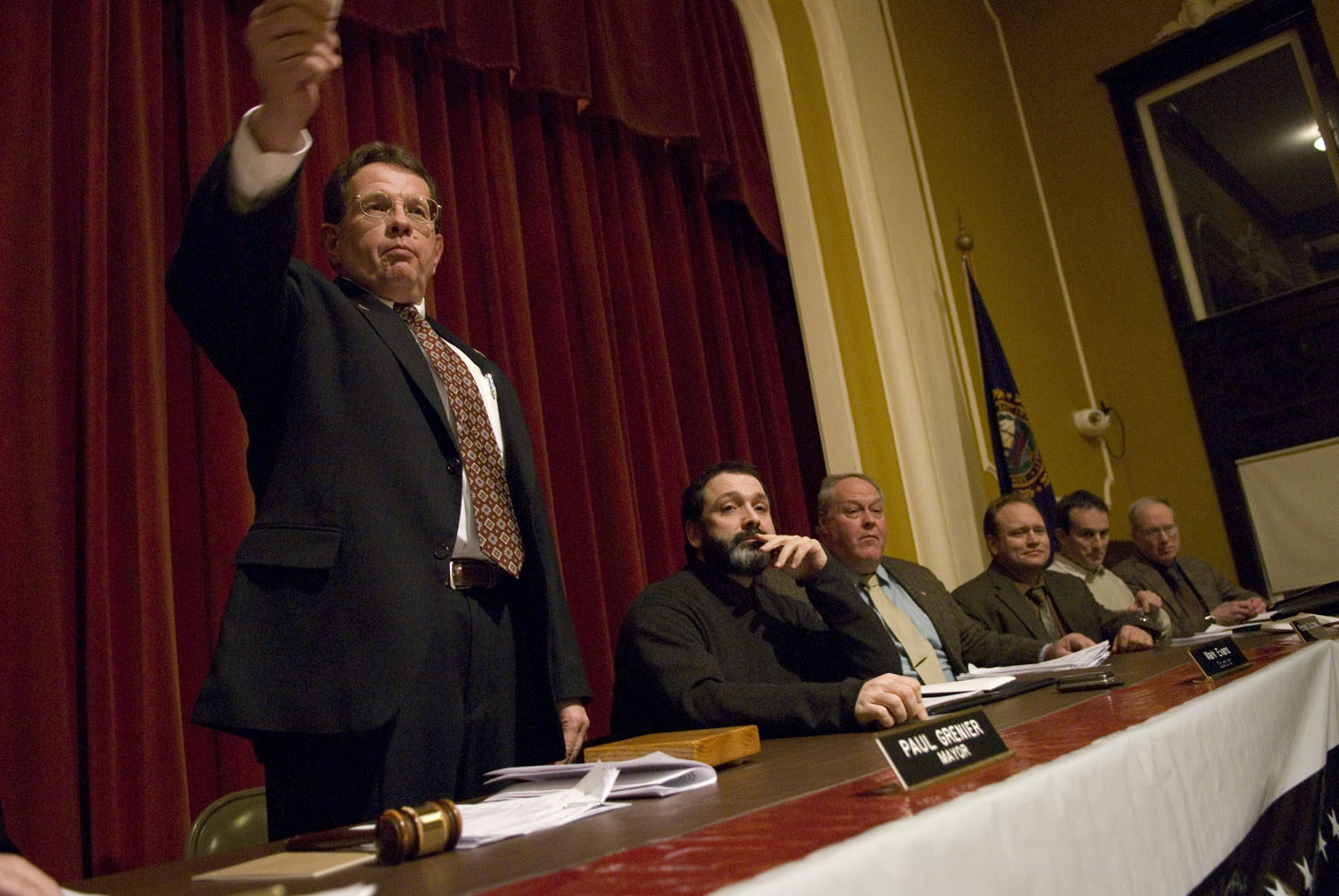
Mayor Grenier made good on his promise to create closer ties with Laidlaw—a number of representatives from the company were at the meeting tonight, as Mayor Grenier, Councilor Robert Danderson and Councilor Michael Rozak were sworn in. It will be an interesting new chapter in the book of Berlin.
I’m interested to see how the new council interacts. The staunch Laidlaw opponents ranks are pretty close to the staunch Laidlaw supporters, and it could result in some tough battles if the council does not resolve to put those differences aside.
Mayor Grenier did call for support of both the Laidlaw and the CPD project, and I noticed Robert Danderson’s name on one of the petitions requesting CPD be subject to SEC review. It will be interesting to see if these two recent allies butt heads on this issue and if Mayor Grenier is going to go to bat for CPD with the same vigor he has gone to bat for Laidlaw.

On Wednesday WREN comes to a BIDPA meeting, which should offer another conversation worth following. WREN could bring a creative spirit to Berlin many people say was extinguished by years of mill life, but it will require the city taking a chance on them, a chance they can barely afford. If they are able to foster a partnership, however, it could be a rich partnership for both parties.

I’m getting back into the swing of Berlin, and I’m realizing how much I missed it. Work is always nice to get away from for a while, but when work is in Berlin it’s even nice to get back to. I took a ride with the police chief and Commissioner Steve Griffin today, along with a reporter from the daily. Chief Morency and Commissioner Griffin were presenting a Berlin woman with a plaque commemorating her 38 years of service as a crossing guard. We arrived, and she, her daughter, and a close friends plied us with cupcakes, coffee, soda, crackers, cheese, mini-cupcakes, donuts and juice. I don’t even drink coffee but I took a cup just to make these wonderful women happy. I also grabbed some grapes at the insistence of my hostesses. I’m not part of the French culture that dominates Berlin, but when we left Chief Morency and Commissioner Griffin reminisced how the was exactly like every visit to their grandmothers’ house as a child. I couldn’t help but smile. I’ve been allowed into a community that has more heart than most people would know how to cope with. After a few weeks away, it is certainly nice to be back.

Council Cracks

Tonight’s city council meeting was awesome. Great. Phenomenal.
Councilor Dick Lafleur made it clear he was unhappy with the other councilors for not making the meeting last Monday.
“The greatest responsibility of every public official is to be here,” he said.
Councilor Lafleur was appointed to fill the mayor’s role for that meeting, but only Councilors Ron Goudreau, Tom McCue and Mark Evans joined him for that meeting. Councilor Lucie Remillard called in sick and Mayor David Bertrand was on vacation, but the other councilors were unaccounted for.
I’m not sure what protocol is in that situation, but Councilor Lafleur was clearly not happy with the outcome. He said he was angry then and now, and that he was embarrassed by the situation councilors put him in.
Mayor Bertrand tried to reel him, asking what the remarks had to do with the budget, but Councilor Lafleur said the budget was of utmost importance and councilors had neglected their responsibility to it last week. He then continued with his comments.
Councilor David Poulin asked the mayor if he was going to bang the gavel or if he should hit Councilor Lafleur with it. He said he was not going to be lectured to about his decisions, that he had good reasons for missing the meeting, and that it was disrespectful for Councilor Lafleur to speak to his fellow councilors that way.

I pulled out my camera right at the end and missed getting it on tape. As someone who enjoys political theater, this was rich stuff. I’m sorry I don’t have a visual record of it to share. I might know someone who has audio of it, however, and I’ll see if I can’t get it up here. This was the second YouTube worthy display by Councilor Poulin—I’m going to have to keep my camera ready when he’s around.

This group has worked well together in the time I’ve been covering them. Councilors Lafleur and Poulin seem to taunt each other every once in a while, but this was the most hostile tone I’ve seen between sitting councilors. Up until now they saved it for opposition candidates.

The atmosphere of city council seemed to change about the time the election got heated, and I’m not sure it has settled since. I’m also not sure it will settle any time soon. Councilor Poulin ended the meeting by saying he wanted to buy all the stationary featuring the stack in the seal to get rid of it as soon as possible. Since Mayor-elect Paul Grenier has made it clear he wants to reinstate the old seal it is hard not to see this as a slight to the incoming administration.

After such a hard-fought election, where both sides clung to visions of Berlin’s future that are in many ways irreconcilable, it will be interesting to see how things move forward. Mr. Grenier told me he expects everything will smooth over rather quickly; I’m not so sure. If Councilor Poulin’s statement about the paper is any indication, some of the remaining councilors are preparing for a fight.

It’s Just An Election…

A lot of people looking for a progressive Berlin are upset about the outcome of the election. I have to ask: Why?
Perhaps the candidate you wanted to win didn’t, but does that really matter? The city still has $4.3 million to take down or fix up dilapidated properties. It still has funky new stores opening on Main Street. It still has a brand new ATV trail, which people for years have been fighting for. The roof is still going up on Fagin’s Pub, and Tony’s Pizza is still newly opened. There is more good than bad going on in Berlin, and protesting effective democracy doesn’t seem to behoove people calling themselves “forward thinking.”
People came out to vote on the seventh: 40 percent of registered voters cast ballots. Paul Grenier’s message about jobs connected; many people have struggled in the last two years, more for reasons affecting the nation than what is going on in Berlin. I’ve heard numerous people say Berlin is turning around, and I don’t think changing a few councilors matters.
Honestly, I’m excited to see some of the faces that got elected to council get to work. Both Ryan Landry and Tim Cayer were appointed to their seats, and now they have the people’s support to back up their positions. Mr. Landry has a passion for Berlin, and I agree with Paul Grenier’s comment that he is a “rising star.” It was several months ago Mr. Landry was talking about being proactive with the property BIDPA acquired on Main Street, and here it is November and BIDPA is considering similar steps.
David Poulin is another person who I’m interested to see get to work. His speech at the debate was fiery and sharp, and he may come into city hall looking to push the progressive policies he espoused.
These people will be fighting for a progressive Berlin, and it’s likely it will continue to improve.

The council will be an interesting mix this session. Councilor Tom McCue will join the three councilors listed above to make a pretty united front. Councilors Lucie Remillard and Mark Evans will be swing voters on some issues, but the fact is I don’t know that Councilors-elect Bob Danderson and Mike Rozak are going to create a united front with Mayor-elect Grenier. On Laidlaw they have a consensus, but the fact is the city does not have much to do with that process for the foreseeable future. As everyone says, the ball is in Laidlaw’s court. The big issue before the council is keeping taxes down, which, quite frankly, every councilor seems committed to do. There are differences on how infrastructure spending will proceed, but in some ways the $4.5 million will already be spent by January. Capital improvements are going to move forward. If the $7 million TIGER grant comes through it will be even more sweeping improvements than residents imagine.

The election was a wake up call to progressively minded people. Berlin cannot afford to leave the laid-off mill worker behind. It can’t even afford to give the impression it is leaving the mill worker behind. “Vote Jobs” may be a hard promise to deliver, but over a two week campaign season it’s enticing rhetoric that finds support among people without jobs.
Mr. Grenier is in favor of both biomass projects, though he is more enthusiastic about Laidlaw than CPD. But neither plant will be operational before November 2011, when he will be up for reelection. The federal prison will open next fall and do good things for the economy, but many of the jobs won’t be for Berlin residents.
There is no easy answer. The long range view or the short range view—neither helps an unemployed worker tomorrow. But people and organizations within the city are taking steps to do something about the challenges Berlin faces, and they aren’t affected by council.
The Roger Brooks initiative, the Neighborhood Revitalization Program, the Neighborhood Stabilization Program, the RSA 155-B process, the new role BIDPA is developing for itself, the district heating plans, the 21/21 project—all of these are moving forward regardless of the electorate’s choices. Many of these have been supported by several councils, and they will continue to be supported in the future.
It is important for people who feel under-represented on the council to have a voice. Paul Grenier connected with people who are looking for short term gain. If he is able to deliver a substantial number of jobs by 2011 he will deserve reelection. If he can’t he will leave out-of-work voters feeling alienated, but that’s better than disregarding their votes today. Mr. Grenier clings to the city’s heritage, and he used it to rally support. And no one can deny on some topics he is right: the city can’t afford any more laid-off high school educated 50 year olds. What would they do for work next?
The current council didn’t disregard these voters, but they were unable to make them understand how the council’s long range plans benefited them.
David Bertrand had a hard time connecting with those voters, with his Ivy League education and his good job. I don’t know the demographics of Berlin, but it is likely there are more people who share Mr. Grenier’s background than Mr. Bertrand’s. Mr. Bertrand has great ideas for the city, but he needed to make better connections with the people he is trying to help to win. In the meantime, Mr. Grenier’s experience and rhetoric may have propelled him through this election, but his ability to deliver will likely make it a challenge to replicate his success in 2011.

Or, if things change fast enough in Berlin, he may be fine. The economy was bad in 2007, when Mr. Bertrand defeated Mr. Danderson resoundingly. It was still bad in 2009 when Mr. Grenier defeated Mr. Bertrand with similar numbers. If the economy rebounds before the next election Mr. Grenier will likely keep the seat. If not, the urge to toss the bastards out will probably sweep him aside, assuming someone decides to run against him. Regardless, however, Berlin’s fortune is changing.
Councilor Ron Goudreau said at Monday’s council meeting he’d like the city to have authority to fine property owners who don’t clean up after a fire. It would give them added incentive to get to work sooner, he said, and stop the problem so clearly illustrated on lower Main Street.
But fines don’t work, City Manager Pat MacQueen and Councilor McCue said, because all to often they are levied upon people who can’t pay. The city, in effect, is powerless in this case.
But at the same time it isn’t. When that $4.3 million makes its way through the city in the next two years it will change the face of Berlin. It will remove many of the buildings that stain city streets. It will push up the property values and make the city more inviting.
All the sudden, when a building burns down, the plot of land it used to sit on will be worth more than the cleanup. Land owners will have incentive to clean the property up, even if just to sell it. It won’t be worth it to walk away anymore, and the cleanups will take weeks or months instead of years.
And all this is because of the city, regardless of the council. Berlin is changing, no matter who wins office. Don’t worry about the direction of city because it’s already moving, and there is nothing that can get in its way.

The Next Administration

At the mayoral debate there was one question I thought was better than the others, and I didn’t asked it. Barbara Tetreault asked the candidates how they were going to unify the city, which has been polarized for years over the Laidlaw issue. Now Paul Grenier is going to be taking the reins of an administration as divided as the city. Even the alliances he formed to win this election are ones that may not play out well once they are in council chambers: Mike Rozak said at the debate he doesn’t agree with Mr. Grenier on much, but he agrees with him on the Laidlaw issue.
The council will have to get over the rough campaign. As I’ve said several times, I didn’t expect it to get this contentious, but from what people have told me this is mild by Berlin standards. But Councilor Ryan Landry had harsh word for Mr. Grenier at the council meeting several weeks ago. Soon the two men will sit together every Monday night. Councilor David Poulin was outspoken in his support of the incumbent council at the debate; now he will be joined by three of the people he criticized. Mr. Grenier, Mr. Rozak and Mr. Danderson blasted the current council pretty hard over the campaign. The three will soon join the six incumbents—somehow they’ll have to move forward.
Someone said as the election results came in that the old was going to have to learn to work with the new, and the city would get the best of both. Let’s hope that’s the case. What is so interesting is the traditional alliances have been shattered by one issue, and people who would normally support one another are on opposite sides.
I’m interested to see how Mr. Rozak and Councilor Mark Evans work together. Both are fiscal conservatives, but Mr. Evans backed Mr. Goudreau in the election. I’m also interested to see how Mr. Grenier and Mr. Rozak interact. I don’t know much of either man’s history, but as I understand it they don’t really come from the same side of most issues.
And then there is this new group of Mr. Poulin, Mr. Landry and Mr. Cayer. These councilors are trying to make the city think and act in new ways, ways the newly elected mayor and councilors do not agree with. They will have to work with the old guard to get anything done.
It will definitely be an interesting time in Berlin. It isn’t clear what the council can do to aid the Laidlaw project’s progress, or how the new councilors will fulfill their Vote Jobs promise before the next election, seeing as no biomass plant is likely to be operational before 2011.
In all, there was definitely a shift in the leadership, but not enough of a shift to make a 180 degree turn. It may be a contentious two years at city hall.
Or, as Ms. Tetreault suggested, the mayor might find a way to unite the city in order to move forward. Berlin can only hope.

Results

Right now, wards one and two are in.

Ryan Landry won ward one.

Bob Danderson won ward two.

Paul Grenier won both wards. Still waiting on wards three and four.

Update: Ward four goes to David Poulin and Tim Cayer. Paul Grenier won this ward as well.

Update: Ward three goes to Mike Rozak. Paul Grenier won this ward as well. Berlin has a new mayor.

Election Night

The election results should be announced by 8:30 p.m. tonight. LPJ will post the numbers immediately, and the Berlin Reporter will have a wrap-up tomorrow on their website. Again, because of the day of the week it won’t be in the print edition, but we’ll have the story the same time as the daily. In fact, if all you want are the numbers, LPJ will have them up by 9 p.m.

Sometimes makes you wonder how paper papers can last, with instant reporting capabilities.

In that vein, I’ll also put the results out on Twitter. Twitter is a great source for realtime news. Like right now, there is yet another old building coming down in the city. You can check out photos here. Right on Mason Street, one I wasn’t aware was coming down. I’m looking to find out some info, but without a doubt it adds one more positive sign to all those stirring around Berlin lately.

Update: The roof collapsed in the night and had to be torn down.

Debate Video

Last night’s debate, in six clips. I left out the audience questions; if anyone misses them let me know and I’ll post them too. It was a great discussion, and I hope people will use this as a resource to further educate themselves about the candidates. If you want a full quality version give me a shout and I’d be happy to provide you with it. (Not that I expect anyone to take me up on that, but if you want it…)

Opening Statements

Questions One and Two

Questions Three and Four

Questions Five, Six and Seven

Questions Eight, Nine and Ten

Closing Statements

Debate Night

Tonight’s debate was great. Awesome. Perfect.

I’d like to thank all the councilors and candidates who made the debate happen, and everyone who came out to watch and to learn. I hope it helped make up some voters’ minds. (I also admit, I’m not event organizer, so that it didn’t have more hiccups than it did was surprising.)

I recorded the entire mayoral portion and will post it on here as soon as I can. I didn’t record the council comments because I ran out of space on my card, and unfortunately I missed one of the most interesting speakers of the evening, Councilor David Poulin.
Councilor Poulin made rapid-fire comments on almost every issue the city faces, supporting the current council and dismissing the challengers. It was funny, pointed and well-delivered. Because I won’t be writing about it for next week’s paper (which won’t come out until after the election) I wasn’t taking notes and therefore don’t feel I can adequately report it. But suffice to say, it was quite a speech. Someone commented city meetings might be too boring for people to attend. Moments like that, however, are why they’re worth attending. His speech, as much as the mayoral debate, made the event worth attending. I just feel bad for those people who left before they could watch it. And I feel bad I didn’t bring a second memory card.

Update: I didn’t comment on this much last night, because I was tired and had a long day planned for today. But I just wanted to say both Mr. Grenier and Mr. Bertrand did an excellent job answering the questions. I think they both came off very well and made persuasive arguments for their positions.
I know many people I’ve talked to are frustrated with Mr. Grenier, usually for two reasons: the ad in the paper featuring the burned Main Street building, and his aligning himself with Mr. Rozak and Mr. Danderson. I spoke to several people today who decided not to vote for him specifically because of one or the other of these issues. Last night, however, he made strong arguments why voters should consider him, even if they aren’t willing to vote straight ticket.
I asked Mr. Bertrand a week ago if he had the fight in him to run in a hotly contested election. Last night he proved he does. Councilor Mark Evans said he didn’t think his performance played well. He said he thought Mr. Bertrand came off as frustrated. Someone else told me today they were pleased to see him show some passion and emotion. I lean to the latter, but I can understand the former.
After the debate, I’m impressed with the caliber of both candidates. Honestly, I don’t agree with Mr. Grenier’s strong support of the Laidlaw project, but I also don’t agree with Mr. Bertrand’s outright rejection of it. I agree with the forward image this council has pursued, but I understand Mr. Grenier’s steadfast defense of the city’s roots. I don’t think people can be argued into trying to change the city’s image—they have to be persuaded to come along. This council has been moving forward with great strides, and they may have lost touch with some of the people not so ready to run towards the future. The council has noble goals, and they have to make sure to include those people without such progressive views in order to maintain their support.
Mr. Grenier’s experience of being laid off from the mill at 41 is not one to be taken lightly. He is right, the Fraser mill is employing people who do not fit in the 21st century economy. It is important the city preserve those jobs. The council has been doing that, but without the emphasis Mr. Grenier deems appropriate. That is a very important point.
There are the jobs for people in Berlin now, and the jobs for people in Berlin in the future. I don’t know how to supply either or both, but that’s the task for whichever man should become mayor.

I didn’t know Mr. Grenier before this election, and our first interactions included some friction. I have spent a lot of time with this council, covering every Monday night meeting, and I am friendly with all of them. That has affected my opinion, but it has not affected my reporting. It is a good lesson, though, that people shouldn’t criticize people at meetings they weren’t at. I sit in all the council meetings, so I know how hard this council worked. I don’t consider people who say the council hasn’t been doing anything to be very well informed because I watch them work diligently every week.
The flip-side is also true, however. The reporter from the daily covered council when Mr. Grenier and Mr. Danderson were their, and she likely dismisses the current council’s claims that nothing happened under that administration.
These are all good people, doing a job to the best of their abilities. Either Mr. Grenier or Mr. Bertrand would represent the city of Berlin well.
I’m interested to see how democracy plays out for the city, and how that in turn plays out in the future. I’ll be prepared in the future to dismiss criticism of the current council’s term in office, because I sat in every meeting. Hopefully this will teach me to look at all such criticism with skepticism, and I’ll continue to keep of my opinions to myself. The people of Berlin should decide this election; my job is to let them know where the candidates stand. It will be interesting to see what they decide on Tuesday, and which of these men is left standing.

Where is everybody?

I went to the public information meeting about ATVs last night. Where there were no more than 20 people, and most of them were AVATV club members who already are familiar with the rules. It reminded me about the fire information meeting earlier this year, where again almost no one showed up. At city council often it’s just the daily paper’s reporter and me, and everyone else is at home.
Was it always this way, or did more people come out to these things at one time? I looked at the turnout statistics for municipal elections, and in 2005 it was about 15 percent. That isn’t a lot of involvement in community government.
Some people are obviously frustrated by that level of investment, though I wonder if that is significantly lower than other cities around the state.
City government allows people to vote in representatives, essentially so they don’t have to show up to meetings. Granted that might work if everyone read the newspaper or if the meetings were televised, but currently there are lots of people that are uninformed. I’m not sure what anyone can do about that.

I’ve covered the burned out buildings on Main Street pretty extensively, with several in depth stories. I saw the Vote Jobs ad in the daily that caused such a stir, and I’m not sure exactly what to get out of it. The process is one dictated by state law, and there isn’t anything any councilor could have done different about it. But if people aren’t informed and didn’t read my other articles about RSA 155B than its unlikely they’ll read the next one.
There will be lots of unanswered questions in this election. Councilor Landry pointed out a great question about Mr. Grenier’s stance on Clean Power. Mr. Grenier pointed out a great question on municipal finance, whether the budget should be balanced with a bond. Both of these issues came up to me Monday night, when the paper is essentially done and headed to the printer for Wednesday, and the next paper comes out the day after the election. Would I like to see these questions answered? Yes. Will I be able to do it before the election? No.

I’d like to say the Reporter has the tools to filter through all the election rhetoric to provide a clear view to residents, but it doesn’t. Four editions of my paper come out after the closing period before the election, and with the closing period being a Monday night that essentially rules out any good reporting for that Wednesday’s paper.
So I’ve got three papers to paint a clear picture, while not ignoring other news, like ATV trails and new businesses opening and PUC hearings. I do what I can, but it won’t ever be complete.

Couple that with low newspaper readership and it seems likely the paper has little influence in the discussion. I spend my days going around Berlin and talking to people, and what I find is many don’t understand the issues. People are mad about the buildings on Main Street, and they blame the council for taking them using immanent domain laws. Not possible, but they’re mad anyway. They blame the council for Laidlaw not moving into town. According to Councilor Mark Evans, who is not opposed to the project, the council hasn’t slowed Laidlaw down at all. But the council receives the criticism.
The same will be true of any future council, whether the incumbents stay in office or the challengers win. The council will get blamed for the city’s flaws, regardless of their ability to fix them. In many ways its remarkable people are ever reelected, considering how easy a target the council is.

If more people showed up I think they would have a different view. The council, the police department, the fire department, the city departments all work diligently to preserve, protect and improve the city. It’s not hard to realize that when you’re there every day. There are people who work primarily for their own interests in the community, but mostly its selfless sacrifice. If people showed up they’d see it. What I put in a paper only a small minority of the city reads doesn’t matter; how involved in the community people are does.

I get frustrated by this. I started this blog, and I’ve worked hard for the Reporter, because I want to see Berlin flourish. But these things don’t decline overnight, and it won’t return quickly either. There is hope for Berlin. The frustrating has been fading into the past, and it will continue to do so. The signs of new blood that I’ve been trying to point out in the Reporter haven’t disappeared just because it’s election season—they have increased. The ATV trail will be open in another week, and there are several new stores opening on Main Street. The pizza place that was closed for so long is opening again, and the southern burned out building is scheduled to be cleaned up in the next few weeks. In all, it’s a progressive, creative, revitalizing time for Berlin.

The fact is, no candidate is going to turn around Berlin’s job market in two years. That’s a hard truth campaign signs can’t fix. Because of that the next election is likely to be as fraught as this one.

I have had hold back flashes of despair for Berlin when the world seems aligned against it. I’m no more immune than anyone else to those feelings. It isn’t my city, but in covering it I’ve come to care about its future and its people. It deserves more than to be the butt of statewide jokes.
And I see dedicated people working to improve it, quite skillfully, without the support of residents. Many have lost the drive to pay attention to what goes on at city hall, but that can’t affect the people working there. The city needs those people, with passion and ideas and new ways at looking at things, to move projects forward and helping the city evolve. A few empty seats, I pray, won’t be enough to dissuade people who care.

Update: There was a good turnout tonight to the debate between candidates Mr. Grenier and Mr. Bertrand. It was a worthwhile exercise, and it did more to inform the public than a dozen newspaper articles. It speaks to the value of showing up. A fair portion of the city did tonight, and I hope many more do so again on Tuesday.